I started reading ghost stories as a child and enjoyed the chill that the best of them sent up my spine. I began writing ghost stories, with a sci-fi and mystery twist, almost ten years ago when I wrote my first Bad Vibes Removal Services story. The series features Lea, a young history graduate student, working in a new service industry. She sanitizes and neutralizes the lingering emotional history from buildings and homes using newly invented equipment. She was drawn to the job because she’s always been sensitive to emotional atmosphere in rooms and has always been able to see ghosts.
The technology she uses in her job was created by a private detective named Montgomery in his quest to create a device to read the subatomic changes in soft materials caused when sound waves pass through them. Montgomery wanted to be able to read the recordings of conversations held in rooms in order to solve crimes. He ended up being able to track the emotional energy left in walls along with the sounds. In order to put his new technology in the public eye, he started Bad Vibes Removal Services to serve as a sister company to his own Montgomery Investigations business.
Lea, with her team of coworkers, soon discovers that she can’t neutralize the lingering emotions in a house if the source, a ghost in distress, is still present. Many of the ghosts she encounters died under questionable circumstances, leading to murder investigations.
The series started with one story. But I liked the characters so much that I wrote more stories, which led me to write a novel, The Walls Can Talk, then more stories, and another novel, Degrees of Deceit, then, more stories. The series currently has 15 or so published short stories and two novels. The latest story in the series, called “Wedding Vibes,” was published in Black Cat Weekly #145 courtesy of editor Michael Bracken. The story features Lea’s wedding reception being crashed by both a ghost and thieves trying to steal gifts. Luckily, her boss, Montgomery, her coworker and Maid of Honor, Kamika, and the rest of her friends are on the case. The thieves chose the wrong reception to crash.
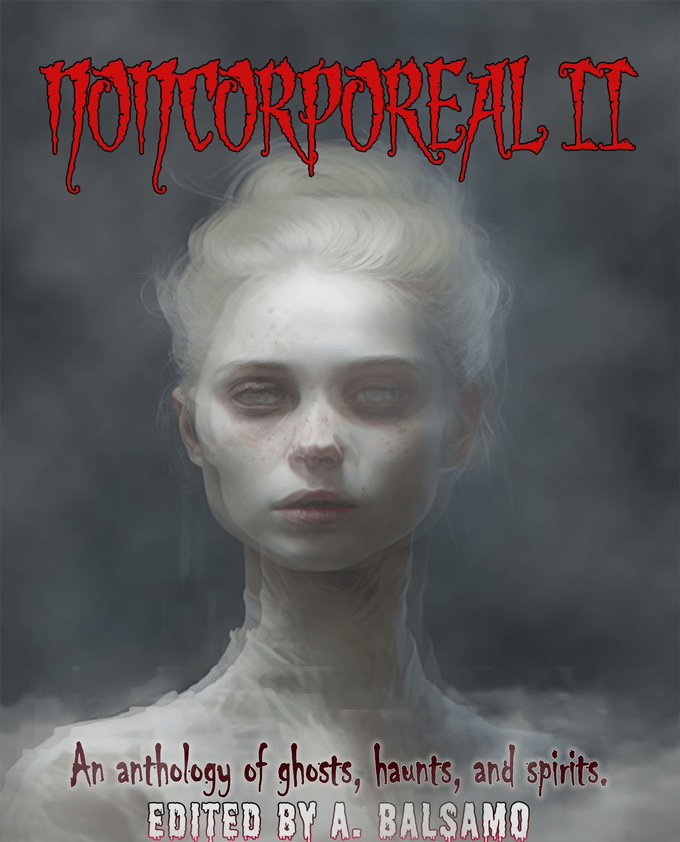
Another one of my ghost stories is rolling out right now, too. “A Lonely Death” is coming out in an anthology of spooky stories from Inkd Publishing called Noncorporeal II. Those who ordered the anthology from the Kickstarter should be receiving their copies shortly, and it will go on sale to the general public soon. The story begins with a cowboy digging a grave in the “middle of nowhere Texas” in the mid 1800s. Soon there after, a little boy whose home was built in what once was the “middle of nowhere Texas” meets a ghost. This story is told from the point of view of the ghost and from the point of view of the people in whose home the ghost appears.
This story was inspired by a three-year-old who was seen in his home talking to and looking up at an adult who the child’s mother couldn’t see. The family had several guests report either seeing a man who vanished or feeling “creeped out” in their guest room. The house was brand new, built on what had been farmland in Central Texas. My story answers the question of why a brand new house might have a ghost.
****
N. M. Cedeño is a short story writer and novelist living in Texas. She is active in Sisters in Crime- Heart of Texas Chapter and is a member of the Short Mystery Fiction Society. Find out more at nmcedeno.com
This week I read with great interest a recent essay by Isabella Cho, Harvard undergrad studying poetry, titled “The Case for Indeterminacy.” Harvard Magazine, June 2024. Cho says that, with students anxiously piling into “useful” majors (computer science, engineering), the dismissive attitudes she sees toward humanities reflect an effort to appear to be “in the vanguard of innovation.” She constantly hears the refrain “What are you going to do with that?”
What is the importance of good writing? In publications that may not always occur to you? Don’t we need accurate truthful writing for all disciplines, all activities? Math, physics, biology, biochemistry, medicine, business strategy? And, of course, cooking!
I recently embarked on a personal campaign to resurrect a favorite taste from childhood: salt-rising bread. But after rereading the recipe for potato salt-rising bread several times in my iconic and hitherto unimpeachable cookbook, I had to conclude I could not tell whether the starter had to stay warm for 15 hours–or not. Did I have to rig up the heating pad and my thermometer? –or not? I have finally concluded I must chuck the resulting loaf off the back deck into the bushes. In this case, “indeterminacy” was unhelpful.
The loaf I’m gonna fling…
But as Isabella Cho points out, it’s worth wrestling with indeterminacy as well. And an indeterminate answer can also “do” something !
For example, what about poetry? “What can we do with that?”
Poetry can “do” on several levels. For example, take the tail end of Frost’s “The Road Not Taken”: “Two roads diverged in a wood, and I–I took the one less traveled by, And that has made all the difference.”
We can ask, “What did those words do?” And then we realize the poem did indeed do something. Made us think, made us wonder, made us speculate. Maybe even made us consider own our lives, our own choices. Frost’s words didn’t specify what “difference” the road choice made to the narrator of the poem. (Some “indeterminacy” there.) Instead, you and I may find ourselves wondering, thinking –about what difference a choice made–for ourselves.
Poetry can also present a description that is so stunningly accurate that we may think it could never be put any better. Emily Dickinson, with her 1800 or so poems, gave us unforgettable lines. “A narrow Fellow in the grass”–you’re already remembering that she “…never met this Fellow/Attended or alone/Without a tighter Breathing/and Zero at the Bone.” “Zero at the Bone!”
Yes, zero at the bone even with no rattles on its tail. And what about “I heard a fly buzz – when I died”? Yikes! We can hear that fly, we’re there in the room… Or “‘Hope’ is the thing with feathers”…
The impact of such lines goes beyond mere description. Poetic writing can also simply smack us upside the head. We can’t forget Shakespeare’s terse description in Julius Caesar, in iambic pentameter, when Caesar comments to Antony that “Yon Cassius has a lean and hungry look,/ He thinks too much; such men are dangerous.”
“A lean and hungry look.” Five little words! –and Shakespeare has told us all we need to know about this character. Cassius is not satisfied, is too hungry ever to be satisfied. The moment we heard those two lines in 10th grade English (or whenever), we knew precisely what Shakespeare meant. The words did something. They showed us what to watch for, when Cassius next walked onstage.
Prose can also “do.” It can make a character (mere words on a page) spring to life. In This Tender Land William Kent Krueger works this magic for Mose, the mute Sioux boy at the “Indian school” where two white boys, Albert and Odie, wound up during the Depression. Since Odie’s mother was deaf, Odie tells us, “even before I could speak, I could sign.” Now Mose has learned sign language as well, and when Odie plays a song like “Shenandoah” on his harmonica, here’s what happens:
“There was something poetic in Mose’s soul. When I played and he signed, his hands danced gracefully in the air and those unspoken words took on a delicate weight and a kind of beauty that I thought no voice could possibly have given them.”
I was instantly drawn to Mose. What a lyrical description not merely of the unsung words Mose puts to music, with his hands, but of the gracefulness of Odie’s duet with a boy who can’t utter a word.
Richard Osman’s fourth Thursday Murder Club novel, The Last Devil To Die, uses dialogue to depict the tender relationship between two characters at the retirement home, Elizabeth the spy, and her husband Stephen, now suffering from dementia. Stephen lies with his head in Elizabeth’s lap:
“I understand this,” says Elizabeth. “For all the words in the world, when I go to sleep tonight, my hand won’t be in yours. That’s all I understand.” “You have me there,” says Stephen. “I have no answer for that.”
But no spoilers here.
Words on the page. So specific that from crisp black and white print, pictures swirl into our minds. Or make us think, make us wonder, raise questions to ponder. Specificity…and indeterminacy…
Rooting around in Emily Dickinson’s poems I saw one I’d never read: “The Brain Is Wider than the Sky.” It explains the values of specificity and indeterminacy in just a few astounding lines. Here’s the first stanza:
The brain is wider than the sky, /For, put them side by side, /The one the other will include/ With ease, and you beside.
There it is. We humans must have both.
Finally–News! Ghost Bones, Book 9 in my Alice MacDonald Greer Mystery Series, set in the Texas Hill Country, will be out this month!
Helen Currie Foster lives and writes north of Dripping Springs, Texas, loosely supervised by three burros. She’s drawn to the compelling landscape and quirky characters of the Texas Hill Country. She’s also deeply curious about our human history and how, uninvited, the past keeps crashing the party. Follow her at http://www.helencurriefoster.com.
A 2010 study published in The American Journal of Psychology found that “memories associated with smells were not necessarily more accurate, but tended to be emotionally more evocative.” How true!
From my office window in Austin, Texas, I look at the magnolia blossoms on the tree in front of my house. Pretty and pink, the blossoms are at the top of the tree. Too high up for me to reach and cut, I still enjoy their lovely fragrance when they fall to the ground. And that scent transports me 1,500 miles northeast and more than half a century past, with images of my grandfather’s cherry tree—a key to the portal unlocking memories of my life in an immigrant community.
My grandfather’s cherry tree didn’t grow, surrounded by green hills and grass. It grew in a crowded Italian ghetto: a city within a city. Corona, New York. Here, cement sidewalks and concrete streets only allowed for narrow curb strips of weeds in front of houses, separated by narrow alleys. Few residences had any space to speak of; my grandfather’s house was one.
Now, when I remember and look at pictures, I wonder how he dealt with the adjustment going from the grinding poverty of Sassano, Italy, surrounded by gently rolling hills, farms, trees, and greenery, to a somewhat better existence but encased in hard, cold, and grey surfaces. It’s a question I never did ask. I suppose his poverty-stricken but agrarian roots wouldn’t allow his small piece of the stark, utilitarian landscape to remain solid pavements of grey without a trace of nature. But back to the Cherry Tree.
Planted in a small patch of dirt in his yard, surrounded by cement, my grandfather’s cherry tree grew straight and tall. Its round trunk was encased in bark that looked so dark it could have been black. It gave off a sweet fragrance in early June, only perceptible in the early mornings before the smells of car exhaust, trash, vent fumes, and the brick, mortar, and wood from the close-together homes crowded it out. Once spring arrived, windows were kept open, and the aroma of cooking wafted out, joining the profusion of smells that swept the neighborhood. As sweet as the tree’s fragrance was, its fruit was mainly sour and enjoyed by the birds more than the family.
According to the charts, cherry trees in the northeast had and still have edible fruits by the third week of June, and I recall birds pecking at them and dropping some of the ripened cherries into the cement yard. My grandmother would sweep them up fast, lest they get under our shoes and dirty her faded but clean linoleum floor. However, the cherry tree’s memories do not stop there. Like tendrils on a vine, places, events, and smells latch on to the Prunus Serotina.
In New York City, public schools in the 1950s were let out by the middle of June. That meant I could help my grandfather tend his little farm two blocks from the house, nestled between dilapidated houses on either side of the property and protected by an eight-foot tall chain link fence that ran the perimeter of the entire lot. The land in his little enclosure always smelled earthy. He’d fertilized it before the planting began. There were rows of corn, cabbage, zucchini, and Swiss Chard. There was an area dedicated to lettuce. The corn always had a slightly sweet and earthy odor. I have no recollection of smelling the growing cabbages or zucchini. Still, when I sauté garlic, I often recall Grandmother doing the same, then frying thick slices of zucchini and smothering them in a rich marinara sauce to finish cooking.
Perhaps my favorite olfactory memory is the fragrances from the herb garden. The lemony aroma of thyme is still one of my favorites, as are the peppery scent of oregano and the sweet, refreshing smell of basil. My grandfather would smile when he handed me a full bouquet of basil. Maybe he already knew the beneficial effects of basil when I’d bury my nose in it and breathe deep before walking back the three crowded city streets to the house with the cherry tree.
As a child raised in this hybrid environment, half city life, half farm life, I took these scents for granted. Didn’t everyone have them?
I’m amazed about how much smell has gained scientific support for its impact on different areas of life, besides memories of days gone by. Scientists at Brown University looked at 18 studies about aromachology. They found that smelling lavender can indeed relax you, make you less stressed, and even help you awaken more rested. Researchers examined studies about other scents like rosemary, peppermint, and orange. They propose that rosemary may help you sleep better, improve memory, and help with hair growth. Peppermint might boost physical performance, and the smell of oranges can reduce anxiety and help you feel more content or happier. Of course, more research is needed, If nothing else, taking the time to enjoy the fragrances is already a step in slowing down and smelling the roses – in this case the aromatic plants.
When discussing memory stimulants and other benefits of scents, coffee, while not an herb, cannot be left out of the conversation. Scientists would have us smell the coffee to wake up, reporting that the aroma alone of my preferred caffeine brew would awaken us. That can work, but I’ll continue drinking the coffee after its perfume fills my kitchen. Then I’ll smell everything else.
So you start writing your post about the incomparable Josephine Tey’s mystery novels two weeks before it’s due but don’t finish, and then you forget, and a colleague reminds you, but the piece refuses to come together, and the day it’s due, it’s still an embarrassment, and the next day it’s not much better, and you decide, Oh heck, at this point what’s one more day? and you go to bed,
and in the middle of the night you wake to find twenty pounds of cat using you as a mattress, and you know you might as well surrender, because getting him off is like moving Jello with your bare hands,
so you lie there staring at what would be the ceiling if you could see it, and you think, Macbeth doth murder sleep…. Macbeth shall sleep no more,
and then you think about Louisa May Alcott writing, She is too fond of books, and it has turned her brain,
and you realize your own brain has not only turned, but has possibly come completely unhinged.
And you can’t get back to sleep, so you lie there thinking, Books, books, books. Strings and strings of words, words, words. Why do we write them, why do we read them?What are they all for?
And you remember when you were two years old, and you parroted, from memory, because you’d heard it so many times,
The owl and the pussycat went to sea in a beautiful pea green boat,
because happiness was rhythm and rime.
And when you were five and your playmate didn’t want to hear you read “Angus and the Cat,” and you made her sit still and listen anyway.
And when you were sixteen and so happy all you could think was, O world, I cannot hold thee close enough!, and you didn’t know who wrote it but you remembered the line from a Kathy Martin book you got for Christmas when you were ten.
And when you were tramping along down by the river and a narrow fellow in the grass slithered by too close, and you felt a tighter breathing, and zero at the bone.
And when you woke early to a rosy-fingered dawn and thought
By Dana Ross Martin, (CC BY-NC-ND 2.0)
I’ll tell you how the sun rose, A ribbon at a time, The steeples swam in Amethyst The news, like Squirrels, ran – The Hills untied their Bonnets –
And when you saw cruelty and injustice, and you remembered, Perfect love casts out fear, and knew fear rather than hate is the source of inhumanity, and love, the cure.
And when your father died unexpectedly, and you foresaw new responsibilities, and you remembered,
We never know how high we are Till we are called to rise.
And when your mother died, and you thought,
Oh, if instead she’d left to me The thing she took into the grave!- That courage like a rock, which she Has no more need of, and I have.
And at church the day after your father’s funeral, when your cousins, who were officially middle-aged and should have known how to behave, sat on the front row and dropped a hymnbook, and something stuck you in the side and you realized that when you mended a seam in your dress that morning you left the needle just hanging there and you were in danger of being punctured at every move, and somehow everything the minister said struck you as funny, and the whole family chose to displace stress by laughing throughout the service, and you were grateful for Mark Twain’s observations that
Laughter which cannot be suppressed is catching. Sooner or later it washes away our defences, and undermines our dignity, and we join in it … we have to join in, there is no help for it,
and that,
Against the assault of Laughter nothing can stand.
And when you fell in love and married and said with the poet, My beloved is mine and I am his.
And when, before you walked down the aisle, you handed a bridesmaid a slip of paper on which you’d written, Fourscooooorrrrrrre…, so that while you said, “I do,” she would be thinking of Mayor Shinn’s repeated attempts to recite the Gettysburg Address at River City’s July 4th celebration, and would be trying so hard not to laugh that she would forget to cry.
And when your friend died before you were ready and left an unimaginable void, and life was unfair, and you remembered that nine-year-old Leslie fell and died trying to reach the imaginary kingdom of Terabithia, and left Jess to grieve but also to pass on the love she’d shown him.
And when the doctor said you have an illness and the outlook isn’t good, and you thought of Dr. Bernie Siegal’s writing, Do not accept that you must die in three weeks or six months because someone’s statistics say you will… Individuals are not statistics, but you also remembered what Hamlet says to Horatio just before his duel with Laertes,
There’s a special providence in the fall of a sparrow. If it be now, ’tis not to come. If it be not to come, it will be now. If it be not now, yet it will come—the readiness is all.
And by the time you’ve thought all that, you’ve come back to what you knew all along, that books exist for pleasure, for joy, for consolation and comfort, for courage, for showing us that others have been here before, have seen what we see, felt what we feel, shared needs and wants and dreams we think belong only to us, that
Photograph of Helen Keller at age 8 with her tutor Anne Sullivan on vacation in Brewster, Cape Cod, Massachusetts (Photo credit: Wikipedia)
everything the earth is full of… everything on it that’s ours for a wink and it’s gone, and what we are on it, the—light we bring to it and leave behind in—words, why, you can see five thousand years back in a light of words, everything we feel, think, know—and share, in words, so not a soul is in darkness, or done with, even in the grave.
And about the time you have settled the question to your satisfaction, the twenty pounds of Jello slides off, and you turn over, and he stretches out and leans so firmly against your back that you end up wedged between him and your husband, who is now clinging to the edge of the bed, as sound asleep as the Jello is, and as you’re considering your options, you think,
The Owl and the Pussy-cat went to sea In a beautiful pea-green boat, They took some honey, and plenty of money, Wrapped up in a five-pound note. The Owl looked up to the stars above, And sang to a small guitar…
and by the time the Pussycat and the Elegant Fowl have been married by the Turkey who lives on the hill, and have eaten their wedding breakfast with a runcible spoon, and are dancing by the light of the moon, the moon, you’ve decided that a turned brain has its advantages, and that re-hinging will never be an option.
“A Mind Unhinged” appeared on Austin Mystery Writers on February 25, 2016.
***
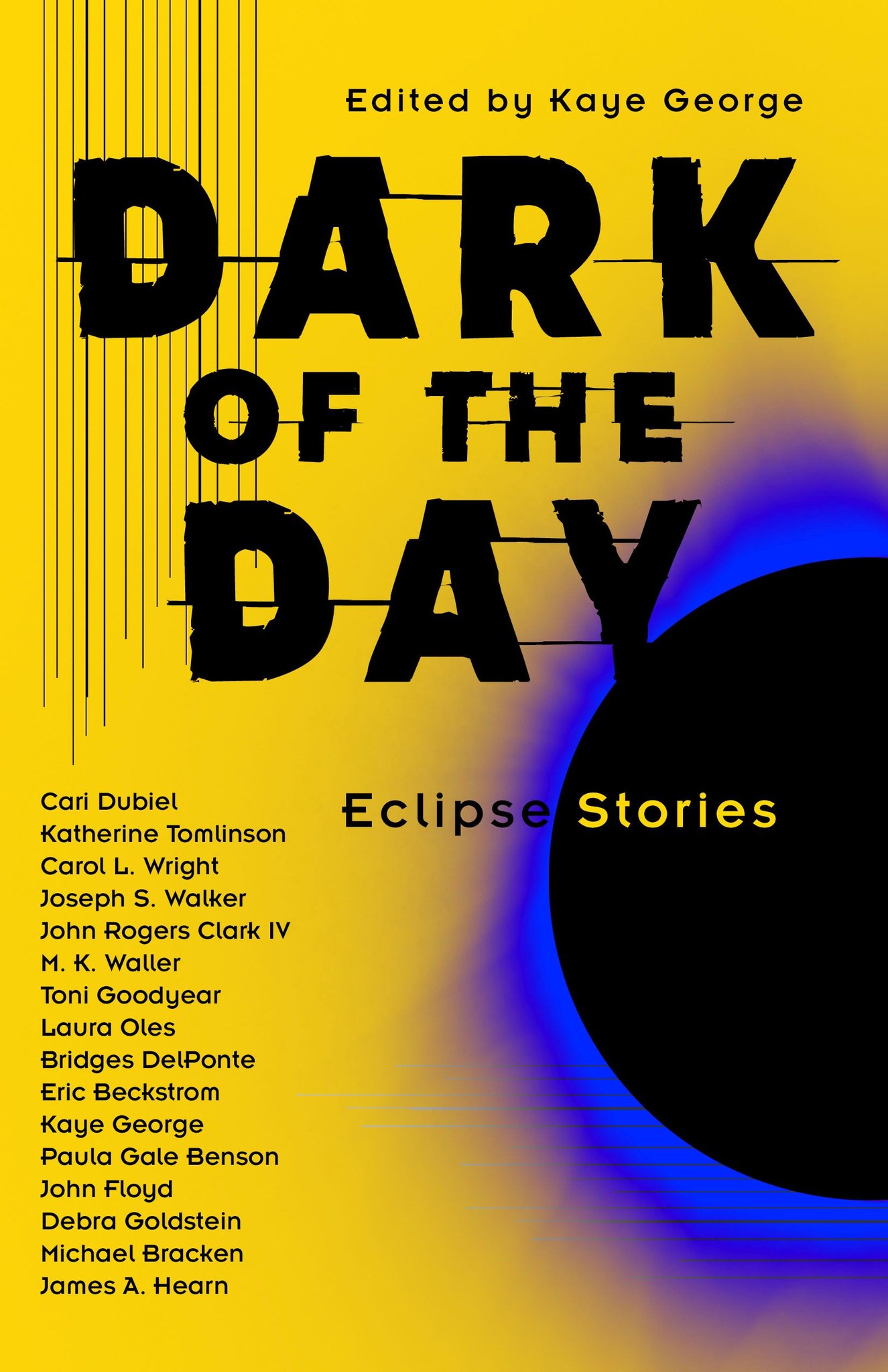
Kathy Waller [M. K. Waller] writes crime fiction, literary fiction, humor, memoir, and whatever else comes to mind. Her latest story, “Mine Eyes Dazzle,” which appears in Dark of the Day, was mentioned by Robert Lopresti as “The best mystery story I read this week” (Little Big Crimes, May 12, 2024).
Other short stories appear in other anthologies: the Silver Falchion Award winner Murder on Wheels, Lone Star Lawless, and Day of the Dark, as well as online. She is co-author, with Manning Wolfe, of the novella STABBED,
Memories of growing up in a small town on the San Marcos River in Central Texas, and life in a large extended family, inspire much of her work. She now lives in Austin.
The 1970s! Disco! Abba! The Eagles! Richard Nixon. The end of the Vietnam War. Women’s Rights. And, umm, yeah, other stuff. I was born mid-decade and have no real memories of the 1970s. Writing about the 1970s, for me, isn’t a matter of “write what you know,” but rather one of “research what you need to know.”
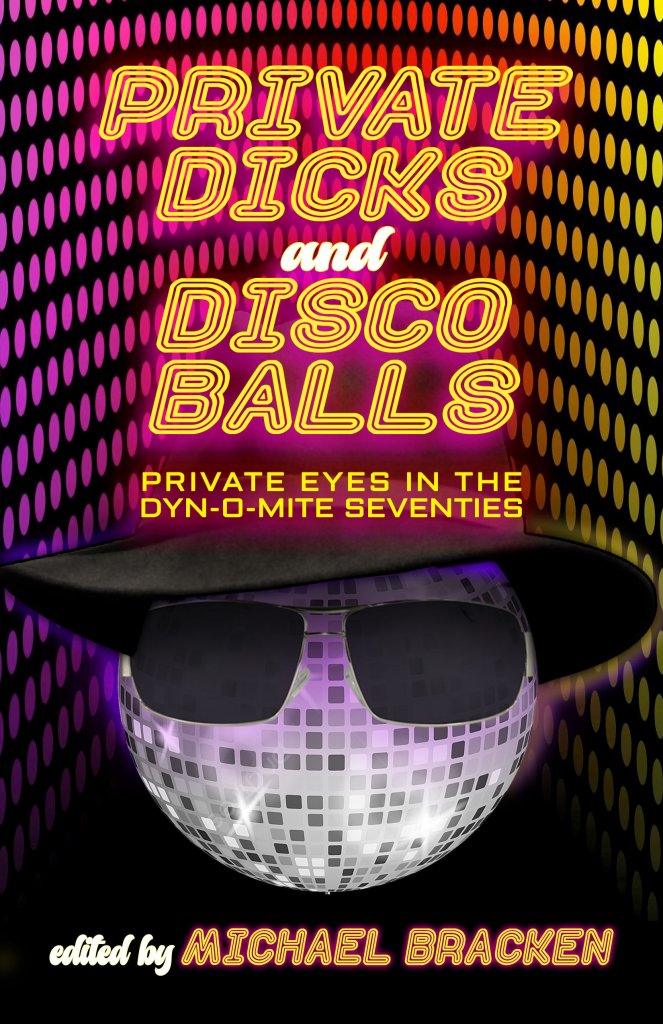
When editor Michael Bracken asked me to submit a story for the Private Dicks and Disco Balls: Private Eyes in the Dyn-O-Mite Seventies (Down & Out Books, May 2024) I read the requirements, which specified including some historical event from the 1970s, and knew I would have to dive into research.
I began searching for events of the 1970s with the help of the internet and my local library card. Logging into my local library online gave me access a plethora of research material, including the archives for Time Magazine (1923-2000), Life Magazine (1936-2000), one hundred years of The Austin American Statesman (1871-1980), and access to Newspapers.com for free. I skimmed or read news articles from major newspapers covering crime, disasters, and political issues of the 1970s. Women’s rights issues, including Title IX, employment protections, and the attempts to pass the Equal Rights Amendment, recurred in my search, leading me to the event I needed for the story: the Battle of the Sexes tennis match between Billie Jean King and Bobby Riggs. The Battle of the Sexes took place in Houston in September 1973.
I even found video from the era, including video from the tennis match itself. Archived videos are fabulous research resources. I discovered news broadcasts from Houston during the 1970s and watched several segments. The benefit of video in research for writing can’t be overstated. Watching news broadcasts provided glimpses of linguistic quirks, clothing styles, hair styles, technology, and automobiles of the 1970s. The insane way (by today’s standards) in which reporters wandered into crime scenes, shoved microphones into the face of working doctors in hospitals, and even sickened themselves while reporting on chemical disasters fed into my understanding of the decade. If a reporter could get away with that much, a private investigator could do that and more.
My research uncovered regulations on who could and couldn’t be a police officer, leading me to articles explaining how, for decades, the height requirement for the Houston Police Department eliminated all the Hispanics who applied for the police academy. The height requirement was changed in the early 1970s to allow for greater diversity in the department. I learned how women’s roles in police departments were limited and about efforts to remove those limits. This research helped in the creation of one of my secondary characters for the story: a petite, Hispanic woman with quashed aspirations for law enforcement.
In researching fires and industrial accidents, I found articles on hazardous materials being routed through Houston and the dangers they posed. I read calls for the creation of hazardous material routes around big cities. Then I reached out to an expert with knowledge of industrial explosives from the 1970s to 2000s. My father worked as an insurance underwriter for a special risk program that included insuring businesses that manufactured, distributed, or used things that go “BOOM.” He had to learn a lot about explosives. He was, and is, a fount of information.
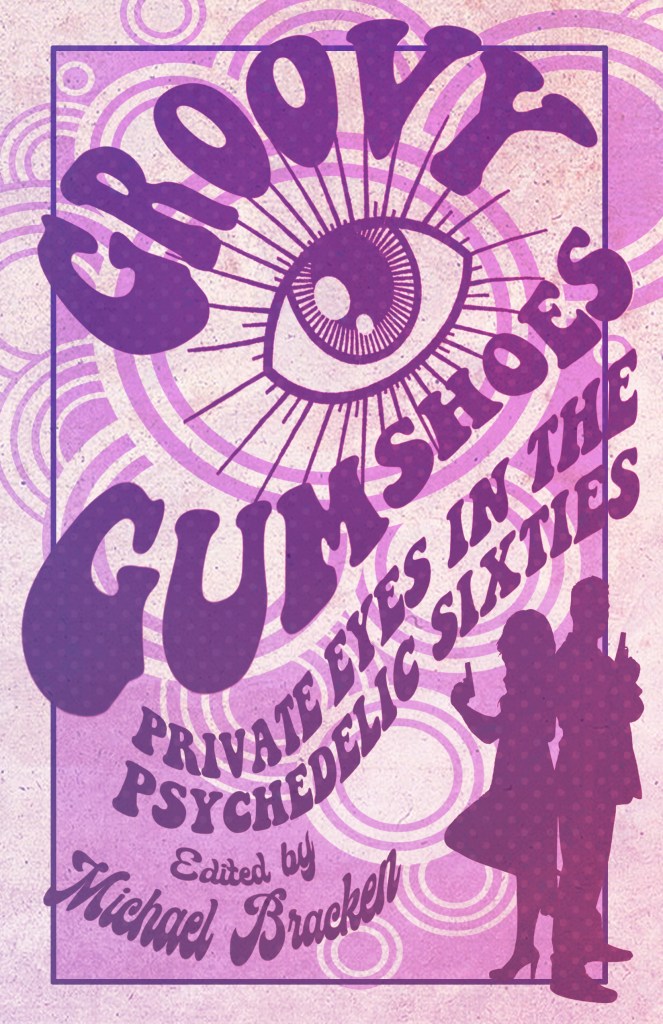
As I worked, I learned more than I needed for my story, and the research began to coalesce into a plot involving my detective, Jerry Milam, in an arson investigation that led him from Austin to Houston during the week of the Battle of the Sexes tennis match. Jerry Milam previously appeared in Groovy Gumshoes: Private Eyes of the Psychedelic Sixties, (Down & Out Books, 2022, edited by Michael Bracken) in a story entitled “Nice Girls Don’t.”
They say “write what you know,” but the caveat to that is “learn what you need to know.” I researched what I didn’t know and I melded it with what I already knew. I was already familiar with my setting in Houston, although I did consult a few maps. Describing Houston is easy for someone who was born there and visits the city regularly. Also, tucked into the story are details that I know because I have an affinity for trivia, including details that my PI would have known: like who was Red Adair (hint: John Wayne played a version of him in The Hellfighters) and what happened in Texas City in 1947 (hint: worst industrial accident in US History).
My local library online research resources are phenomenal and are my favorite place to browse when I need very specific historical information. Reaching out to experts is also beneficial for getting the nitty-gritty details right. Do you have favorite research sites? Where do you look when you need accurate information quickly?
****
N. M. Cedeño is a short story writer and novelist living in Texas. She is active in Sisters in Crime- Heart of Texas Chapter and is a member of the Short Mystery Fiction Society. Find out more at nmcedeno.com
When you read a passage and experience words that strikes home forcefully–so forcefully that you almost gasp–what did the writer do that moved you so?
I’m collecting examples. For my husband it’s John Steinbeck’s tide pool in Cannery Row:
“…When the tide goes out the little water world becomes quiet and lovely. The sea is very clear and the bottom becomes fantastic with hurrying, fighting, feeding, breeding animals…Starfish squat over mussels and limpets, attach their million little suckers and then slowly lift with incredible power until the prey is broken from the rock…”
I’ve never seen a Monterey tide pool. Yet Steinbeck made me feel I have. I want to sit at the edge of the tide pool, hear “the snapping shrimps with their trigger claws pop loudly” and see the “black eels poke their heads out of crevices and wait for prey.”
Why? Steinbeck’s description is so closely observed…it’s as if my own eyes and ears saw and heard.
What about food? Proust’s memory of a madeleine crumb dipped in his aunt’s tea didn’t initially resonate with me (a madeleine seemed too bland; I would’ve preferred a buttery, crunchy, tender croissant!)–until I read his analysis.
When Proust discovered that his second and third bites of the madeleine lacked the same impact–“the potion is losing its magic”–he stretched his mind further. He writes that the source of memory was not his sense of sight (though his description of the scalloped pastry is charming). Instead, his memory came from taste and smell: “But when from a long-distant past nothing subsists, after the people are dead, after the things are broken and scattered, still, alone, more fragile, but with more vitality, more unsubstantial, more persistent, more faithful, the smell and taste of things remain poised a long time, like souls, ready to remind us, waiting and hoping for their moment,…and bear unfaltering…the vast structure of recollection.”
No French bakery in my grandmother’s small Texas town, Itasca. But the memory of her kitchen still comes back when I smell lavender, or yeast–my grandfather’s lavender talc, my grandmother’s ineffably delicious yeast rolls.
Here’s another powerful example from The Orphan Keeper by Camron Wright, about a young man, kidnapped from his home in India, then sent to a dishonest orphanage which places him for adoption in America where he rejects any Indian heritage and suppresses all his memories that aren’t “American.”
As a student in England he’s taken to an Indian restaurant where–reluctantly–he smells, then tastes, what’s offered:
“The scent that swirled around his neck had started rubbing his shoulder, reminding him softly that once, a very long time ago, they had met….[He] took his first bite. The spices in his mouth grabbed hands and began dancing in rhythm across his tongue–cumin, garlic, peppers, ginger, tamarind, cinnamon, and more. They weren’t just dancing–they were cheering, clapping, celebrating, singing, reminiscing. They were pulling out wallets and showing each other pictures of their kids….The mingling spices, the familiar taste, it felt like a whisper arriving with the wind, more message than memory.”
Curry, of course. Just reading this made me long for mango chutney! And I thought it a powerful description, because closely observed, and particularly because until this moment we know the protagonist has been stubbornly resistant to anything Indian.
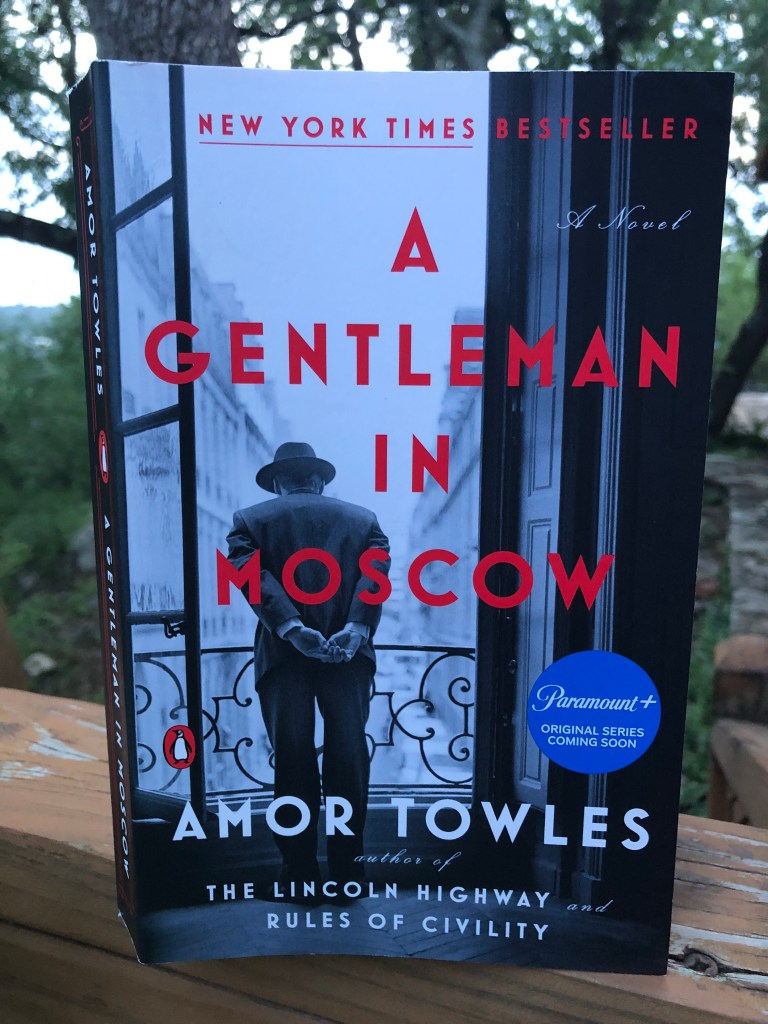
In A Gentleman in Moscow, by Amor Towles, do you recall the bouillabaisse scene? The three conspirators have carefully gathered the ingredients–hard to come by in Moscow; have picked up their spoons; and have taken their first taste. Count Rostov closes his eyes “to attend more closely to his impressions”:
“One first tastes the broth–that simmered distillation of fish bones, fennel, and tomatoes, with their hearty suggestions of Provence…One marvels at the boldness of the oranges arriving from Spain and the absinthe poured in the taverns. And all of these various impressions are somehow collected, composed, and brightened by the saffron–that essence of summer sun…[W]ith the very first teaspoonful one finds oneself transported to the port of Marseille–where the streets teem with sailors, thieves, and madonnas, with sunlight and summer, with languages and life.”
Bouillabaisse! Your memories may differ. Were you reading Julia Child and launching a kitchen experiment? Were you visiting Marseille, and were there still sailors, thieves and madonnas?
The Count has shared his memories, aroused by fish bones, fennel, tomatoes, shellfish and saffron. But your memories are your own. Also, the scene is powerful not just because it is closely observed, but also because it reminds the reader forcefully that at this point the Count has only his memories–he can’t leave the Moscow hotel, much less travel to Marseille.
I’m puzzled not to find food more “closely observed” in novels. A favorite moment: Virginia Woolf famously describes the boeuf en daube at the dinner party which is a central feature of the first half of To the Lighthouse. Mrs. Ramsay is thinking the cook “had spent three days over that dish,” as she prepares to serve it to her guests:
“…An exquisite scent of olives and oil and juice rose from the great brown dish as Marthe, with a little flourish, took the cover off. …[Mrs. Ramsay] peered into the dish, with its shiny walls and the confusion of savoury brown and yellow meats, and its bay leaves and wine, and thought, This will celebrate the occasion…”
Cookbooks, of course, intend to awaken our senses as we peruse the recipes. But the description of boeuf en daube in To the Lighthouse, with the mouthwatering anticipation it creates, has a different impact. It places us in the scene. It almost makes us, as readers, feel like guests sitting at Mrs. Ramsay’s table, alongside the odd characters Woolf has already introduced. Or possibly we also feel a bit like Mrs. Ramsay, the hostess, hoping to delight and reassure her houseguests, who are a difficult lot.
I’d love to hear other examples from readers. A “closely observed” passage can make us do just what the author wants: turn the page and keep reading! Right now I’m engrossed in Someone Always Nearby, Susan Wittig Albert’s fascinating novel about two real people, Georgia O’Keefe and Maria Chabot. I’m finding this a daring literary adventure about two daring and adventurous women, the artist you know and the woman who wanted to be indispensable to her.
It’s May–bluebonnets are gone, summer approaches. What tastes and smells bring back your summer memories? Grape popsicles, melting on the tongue? The clean bluegreen smell of Austin’s Barton Springs, mixing creek water and artesian spring water? The faint smell of chlorine from a pool crowded with splashing children? A mountain trail in the Rockies, with the cool green odor of aspen groves rising up from a creek? Dust blowing at the ball park, freshly mowed lawns, the faint rubbery smell of a sprinkler on a hot day? The smell of a roasting marshmallow just before it bursts into flame?
Good news from where I write: Ghost Bones, Book 9 in my Alice MacDonald Greer Mystery series set in the small town of Coffee Creek, Texas, will soon be out! With mystery, legal drama, and matters of the heart.
Helen Currie Foster lives and writes north of Dripping Springs, Texas, loosely supervised by three burros. She’s drawn to the compelling landscape and quirky characters of the Texas Hill Country. She’s also deeply curious about our human history and prehistory, and how, uninvited, the past keeps crashing the party. Ghost Daughter, Book 7 in The Alice MacDonald Greer Mystery series, was named Finalist in the 2022 Eric Hoffer Book Award Grand Prize Short List. Follow her:
Readers, what’s your pleasure? Do you prefer romance, adventure, family sagas, historical fiction, or fantasy? The list goes on and on, but in most cases, the mystery of not knowing what will happen is a strong underlying driver of any story.
Even simple, everyday decisions contain elements of the unknown. Before we contemplate the mysteries of the universe, or at least of the day, we wonder what should we eat for breakfast? What outfits should we wear? And even those close-in unknowns can sometimes create a sense of wonder when we decide. A new recipe that tastes surprisingly good. An outfit that is more flattering than expected. We can wonder if something out of the ordinary will happen to us today? Will we meet someone new? What new experiences will we encounter? Will we learn anything new and valuable before we lay our heads down at the end of this day?
Each of us has our own never-ending list of conscious and unconscious questions. And our wonderment is not limited to the higher questions of life. A little gossip goes a long way. We often enjoy the delicious anticipation of learning the answers to other people’s secrets. That’s why exposés of celebrity lives are so popular. And that’s the stuff novels are made of.
Bestselling author Nikki Erlick takes a unique approach to creating suspense in her book, The Measure, which is not a mystery. She presents the lives of eight individuals in a world of 7.9 billion people. Their days begin like any other, except that all over the world, everyone over the age of twenty-two wakes one morning to find a mysterious, little wooden box at their front doors, addressed and waiting for them whether they live in a tent, an apartment, or a house. Inside these boxes are strings of varied lengths, representing the time left for each recipient to live. The first response is, is this a joke? Once it’s established that it’s not some universal joke, shock and disbelief come. And then the questions. Where did these boxes come from? Who sent them?
When it’s learned that the strings accurately correspond to the length of life, how many will choose not to look inside the boxes? How do those who chose to look and find short strings cope with impending death? What impact does this knowledge have on societies worldwide, and specifically on these eight lives?
The publisher’s synopsis calls The Measure an “ambitious and invigorating story about family, friendship, hope, and destiny.” Such tales can be found in many other books and in more depth. It wasn’t the philosophical questions these characters faced that held me. It was the enigmatic circumstances created by Ms. Erlick.
If you haven’t read the book, by now you’ve developed your own questions about where the boxes came from, what it all meant, and the mystery of the denouement. The questions of life are intriguing and found everywhere in fiction, regardless of genre. I love to read stories that may not be mysteries in the traditional sense,because there will always be elements of the unknown and questions to be answered. Will you read this one? That’s the new unknown for me.
In my Housekeeper Mystery Series, the characters must face all the usual questions and problems of life, including health issues and the loss of friends and family. Still, they must find answers to the who, what, where, when, how of criminal situations. Any the why – which means delving into the darker side of human nature.
In book one of the Housekeeper Mystery Series, I’m Going to Kill that Cat, protagonists Father Melvyn and Mrs. B. are drawn into solving the murder of a parishioner and finding her missing cat. Their discoveries threaten to unleash a major scandal for the parish, and they find their own lives on the line.
In book two, Catwalk Dead, Murder in the Rue de L’Histoire Theatre, Father Melvyn and Mrs. B. must use all their powers of logical deduction to unravel the case and prove it’s not the Macbeth theater curse at work before anyone else dies and her son’s ballet company is destroyed.
The Church Murders and the Cat’s Prey is book three. It begins on Easter Sunday when a sinister and deadly plot to destroy Austin’s religious communities begins with Father Melvyn being shot as he celebrates Mass. Panic grips the city. Will evil prevail, and will Mrs. B. and Father Melvyn help find the answers? Will they survive?
The following post appeared on my personal blog, Telling the Truth, Mainly, in April 2022. But the story of my writing process is always worth a retelling. Please read on.
*************
Sometime back in the 1930s, my grandmother picked up the telephone receiver just in time to hear the Methodist minister’s wife, on the party line, drawl, “I am just wo-ahn out. I’ve been waterin’ the yahd.”
To those not in the know, the statement might not seem funny, but my family has its own criteria for funny. And so those two sentences entered our vernacular.
They were used under a variety of circumstances: after stretching barbed wire, frying chicken, mowing the lawn, doing nothing in particular.
My father would fold the newspaper, set it on the table, and announce, “I am just wo-ahn out. I’ve been waterin’ the yahd.”
I am wo-ahn out now but not from waterin’ the yahd.
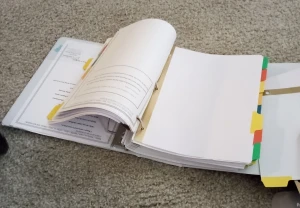
Putative novel 2022
Last night David, the family’s official printer, printed the manuscript of what I’ve been calling my putative novel. It runs to over two hundred pages, 51,000 words. It isn’t finished—far from it. There’s more to write, scenes to put in order, clues and red herrings to insert, darlings to kill. All that stuff. And more.
However, for the first time it feels like I can stop calling it putative. No longer supposed, alleged, or hypothetical. It’s looking more like a potential novel. Possible, Even probable.
Now, about being wo-ahn out.
Last night I started putting the manuscript, scene by scene, into a three-ring binder. That required using a three-hole punch.
I hate using three-hole punches. I hate fitting the holes in the paper onto the binder rings. They never fit properly. Getting them on the rings requires effort. It’s tiring.
When I went to bed, I was all the way up to page 37.
Then I woke at 5:30 this morning. Instead of turning over and going back to sleep, I got up. I just couldn’t wait to get back to organizing my manuscript.
But I didn’t organize. I managed to drop the whole thing onto the floor and then couldn’t pick it up. (I’d had knee surgery and wasn’t quite up to bending over that far.) I had to wait for David.
Putative novel 2022-2024
By the time the notebook and manuscript were back in my possession, I was sick and tired of the whole thing. I played Candy Crush.
If I’d had any sense at all, I’d have gone back to bed. I was sleepy. I felt awful. I needed to sleep.
But did I go back to bed? Noooooooooooooooooooooo. That would have been the act of a rational person.
I stayed up added to my sleep deprivation.
I could go to bed right now. I could conk out and tomorrow feel ever so much better.
But will I? No. Because I’m too tired to stand up, too tired to put on my pajamas, too tired to pull down the sheets.
I am just wo-ahn out. I’ve been waterin’ the yahd.
***
Things have changed since 2022. Some days, the novel has reverted to putative, but on most days, it’s still possible. Thanks to extensive revision, the current draft bears little resemblance to the one in the notebook. I have given up three-ring binders and three-hold punches.
***
M. K. Waller’s latest story, “Mine Eyes Dazzle,” appears in the eclipse-themed anthology Dark of the Day, edited by Kaye George (Down and Out Books, 2024). Other stories appear inDay of the Dark (Wildside, 2017), Lone Star Lawless (Wildside, 2017), Murder on Wheels (Wildside, 2015), and online on Mysterical-E. She is co-author of the novella Stabbed (Starpath, 2019), written with Manning Wolfe. She also writes as Kathy Waller. She lives in Austin and blogs at Telling the Truth, Mainly.
They say to be a writer you must first be a reader. And it’s true. So reading is both necessary for my work and my favorite form of leisure activity. I’m lucky that I get to do something I enjoy and would do anyway in support of my work.
I’ve never kept lists or used programs to track what I read. It never felt necessary. As a result, I can’t cite definitive numbers about how much I read or analyze by category what I read. In general, I enjoy mystery novels, mainly historical and traditional, some cozy, very rarely thrillers. I read the occasional historical romance novel and frequently read nonfiction histories. When I see a topic that piques my interest, I’ll even read books on bioethics, philosophy, medical matters, and even economics. And, of course, I read tons of short stories in magazines, e-zines, anthologies, and collections. Most of the short stories are crime fiction, but science fiction short stories creep in here and there, too.
In the last few years, I’ve been writing short stories exclusively. Reading the short stories that are being published helps me learn which markets print what kind of stories. In this past week alone, I read twenty-three short stories and two novels. Setting the novels aside, let’s focus on those twenty-three short stories. You might have noticed that’s an oddly specific number for someone who doesn’t write down or track what she reads.
I have an excellent reason for knowing that number.
We are in the midst of Derringer Award season, during which Short Mystery Fiction Society members vote on which stories receive the Derringer Award for Short Mystery Fiction. The stories are nominated in four categories: flash fiction, short story, long story, and novelette. On April 1, the nominees for each category were announced on the Short Mystery Fiction Society blog page. As a member of the Short Mystery Fiction Society it is my duty and privilege to read all of the nominated short stories and vote on which stories I believe should win an award. Once the nominees were posted, I read them, all twenty-three nominees, which is how I know exactly how many short stories I read this past week. The stories were phenomenal, the best of the best in short crime fiction.
Many of these stories are what I aspire to write: powerful, thought-provoking, well-plotted, well-written short crime fiction. These stories are examples of the best work being done in the short mystery genre in various lengths, from under 1000 words to under 20,000 words. I encourage anyone who wants to write short mystery fiction to seek out the stories, and past winners, and read them. They are more than worth your time, and you will learn a lot about great writing from them.
And about those novels I read this week? They were from the Holmes on the Range series by Steve Hockensmith. I discovered the series by reading the related short stories in Ellery Queen Mystery Magazine. The most recent story was in the January/February 2024 issue, and the blurb with the story helpfully informed me that earlier stories I may have missed had been rereleased recently. Thanks to that helpful blurb, I went looking for the novels and found them. Next, I’ll be hunting down the short stories that I missed.
****
N. M. Cedeño is a short story writer and novelist living in Texas. She is active in Sisters in Crime- Heart of Texas Chapter and is a member of the Short Mystery Fiction Society. Find out more at nmcedeno.com
April 1! It’s spring, with a riot of bluebonnets this year.
Plus paintbrush! Winecup! Verbena! Prairie celestials (so lovely)!
And within the fence, safe from our marauding burros, the roses are opening their petals and sharing their beauty. Humans have been growing and hybridizing roses for millenia. I favor those with deep rose fragrance. This year the sniff prize goes to Madame Isaac Pereire,
but Zephirine Drouhine is a strong contender as well—sweet perfume, but no thorns!
Blooming with pride are Cramoisi Superieur, fun to pronounce, and dainty little Perle d’or, below.
Yes, the French have been busy. But I’m waiting on the spectacular Star of the Republic, which is covered with buds that will become exquisite cream and pink roses, and is almost as tall as Texas.
Thanks for human ingenuity and the deep love of beauty and fragrance that resulted in these roses. We humans are so able to produce beauty—and yet we mystery readers and writers know how gripped we are by the companion question: why do humans commit the primal sin of murder?
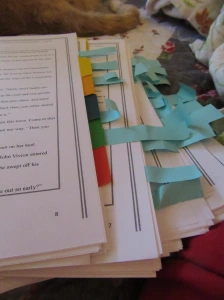
I’ve been reading a riveting book called How the Mind Changed, A Human History of Our Evolving Brain (2022), by neuroscientist Joseph Jebelli, who studies the genetic history of the human brain. I’ve had to put stickers and checks on so many pages!
Jebelli says that, starting about 7 million years (or 230,000 generations) ago, when humans split from chimps, our brains were only 350 cm3 big. Then 3.5 million years ago, when our ancestor Lucy came along, we got a new uniquely human gene that gave us a folding neocortex and nearly doubled our brain size to 650 cm3.
Later, he says, our brains bloomed to 900 cm3, when we began cooking (maybe 2.7 million years ago), then to 1000 cm3, about 2.5 million years ago, then to 1500 cm3 500,000 years ago, and then grew another 25% by the time, 300,000-400,000 years ago, when Homo sapiens appeared.
Later research shows—the bigger the brain, the bigger the social group. Id., 69.
And lucky Homo sapiens came along when our planet was in extreme ecological instability: “African megadroughts depleted the land’s fresh water; vanishing grasslands diminished the number of animals available…” Homo sapiens spread across the planet, interbreeding along the way with the Neanderthals (who went extinct around 40,000 years ago), and the Denisovans, Neanderthal cousins from Asia. Most humans outside Africa carry around 2 percent Neanderthal-derived DNA while today humans in Papua New Guinea and Australia possess up to 6% Denisovan DNA.
Now we have tools of advanced microscopy and molecular genetics to use “the mosaic of neurons, the constellation of synapses and the tributaries of molecules to learn the age of the brain and the transformations it has seen.” Îd., 21.
But it’s Jebelli’s discussion of brain research on “fair play” that I find most fascinating – whether the experiment uses rats, vampire bats, or humans. “Our minds intuitively draw a distinction between unfair equality (all students receiving the same…grades regardless of merit) and fair inequality (the doctor earning more than the cleaner). When push comes to shove, humans nearly always prefer fair inequality to unfair equality.” Jebelli goes on to explain that when we humans engage in fair play, we experience a surge of neural activity in our brain’s reward centers, releasing dopamine, oxytocin, serotonin and endorphins. Id., 68.
Watch out: scientists are identifying gene mutations that explain amazing things. “Non-monogamous brains tend to have a special kind of dopamine receptor gene called DRD4, which is linked to promiscuity and infidelity.” Id., 78. Use that in a plot, mystery-writers!
But I was thrilled by the focus on the link between strong imagination and intelligence in our “default network, a brain system that participates in daydreaming, mind wandering, reflective thinking and imagining the future….People who engage in these cognitive practices…have greater access to the states of mind necessary to solve complex problems.” Id., 115. Jebelli says our default networks are only active when we’re not focused on a task, “when the brain is cycling through thoughts not associated with the immediate environment.” In other words, the default network contrasts with our executive control network. Jebelli makes another leap: compassion also stimulates the default network. “Compassion requires imagination. ‘Climb into his skin and walk around in it,’ Atticus tells Scout.” But imagination also requires compassion. Id., 119.
Why has this book grabbed me? As a mystery writer I wrestle with why some humans will run into the street to save a child from a bus, and some will just watch; and why and how some humans invent gripping new imaginative worlds (Lord of the Rings, Harry Potter, Slough House, Yoknapatawpha County, the Forest of Arden, Hat Creek and the saga of Lonesome Dove) that tell of human struggles and victories, tragedies and comedies. Yes, writers who stimulate our “default networks”!
So you might like to take a peek at How the Mind Changed—check out the chapter on that age-old conundrum––what is consciousness? And the chapter on different minds, or neurodiversity, including genetic components. And the chapter on the new field of neurocriminology: what makes humans commit crimes? Which brain regions are responsible for violence? One possibility—it’s an area of the hypothalamus called the ventromedial hypothalamus, “an ancient brain region that has been conserved throughout mammalian evolution.” Yikes!
As Jebelli notes, plots will abound from this inquiry, this research. As always, inquiring minds want to know.
Meanwhile, it’s April! So let us now praise Geoffrey Chaucer – whose compassion and imagination gave us “Whan that April with his showres soote The droughte of March hath perced to the roote, And bathed every veine in swich licour, Of which vertu engendred is the flowr…”
And further to celebrate—Book 9 of my Alice MacDonald Greer legal thriller series has gone off for copy-edit. Yes, again the primal crime has been committed…!













 Ink-Stained Wretches