Naming Characters: Steve Dauchy MacCaskill

I’m working on a mystery novel—I’ve been working on it for years, but am now seeing the light at the end of the tunneland am faced with dilemmas too numerous to whine about in only one post, so I’ll move along.

I will instead write about the one pleasure of the writing life: creating and naming characters.

My novel is set in a little town very like my own hometown. I don’t base my plot on real events, and I don’t use real people as characters—with one exception: Steve Dauchy.

Not Steve, but close

Note: One of my readers, Dr. Cullen Dauchy, knows more about Steve than I do, especially about his early life, and I hope he’ll feel free to correct any errors.

Steve Dauchy was a career blood donor at Katy Veterinary Clinic in Katy, Texas. On retirement he moved to Fentress, where he lived with his veterinarian-owner’s parents, Joe and Norma Dauchy. Joe and Norma lived next door to me; in local terms, next door meant that my house was on one corner, then there was a half-acre “patch” of pecan and peach trees and grass and weeds, then a street, and then on the next corner, the Dauchy yard and their house. The point being that when Steve visited me, he didn’t just stroll across a driveway.

Joe was my dad’s first cousin, so I guess that makes Steve and me second cousins. I have a lot of cousins on that side of the family, although most are human.

Steve is a family name, with a story behind it. As I understand it, back in the ’20s or ’30s, my Great-uncle Cull (Joseph Cullen Dauchy, Sr.), enjoyed listening to a radio program about a Greek character who frequently spoke of “my cat Steve and her little cattens.” Uncle Cull was so amused by the phrase that he named a cat—probably one of the barn cats—Steve. And for the next forty or so years, he always had a cat named Steve.
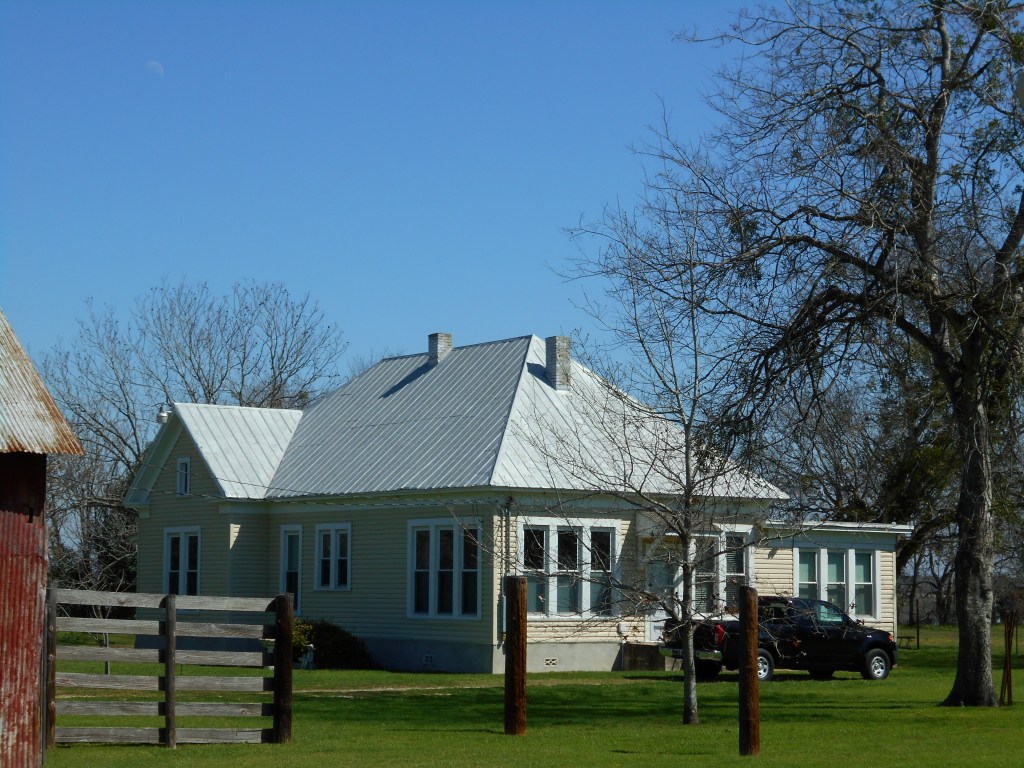
Uncle Cull and Aunt Myrtle Dauchy’s house, home of the first Steves

So when the clinic cat became part of the Uncle Cull’s son and daughter-in-law’s family, he became the latest in a long line of Steves.

How to describe Steve? He was a fine figure of a cat: a big tabby, deep orange, with an expression of perpetual boredom. His reaction to nearly everything translated as, “Meh.” I’ve heard that’s common among clinic cats.

Once when Steve was standing on my front porch, the neighbor’s Great Dane got loose and charged over. I was frantic, shouting at the dog, shouting at Steve. But when the dog hit the porch, Steve just looked up at him. Dog turned around and trotted home.

Some would say Steve was brave, and I’m sure he was. But I believe his grace under pressure had their roots elsewhere.

First, he had experience. He knew dogs. In his former employment, he’d observed the breed: big, little, yappy, whining, growling, howling, cringing, confined to carriers, restrained by leashes, sporting harnesses and rhinestone collars, hair wild and matted, sculpted ‘dos and toenails glistening pink from the OPI Neon Collection. He’d seen them all. He was not impressed.

Facing down a Great Dane, however, took more than experience. There was something in Steve’s character, an inborn trait that marked him for greatness: his overarching sense of entitlement. He was never in the wrong place at the wrong time. My porch was his porch. The world was his sardine.

Except for the kitchen counter. Steve thought kitchen counters were for sleeping, but Joe and Norma’s maid didn’t. Consequently, he stayed outside a lot. He took ostracism in stride and used his freedom to range far and wide. Far and wide meant my yard.
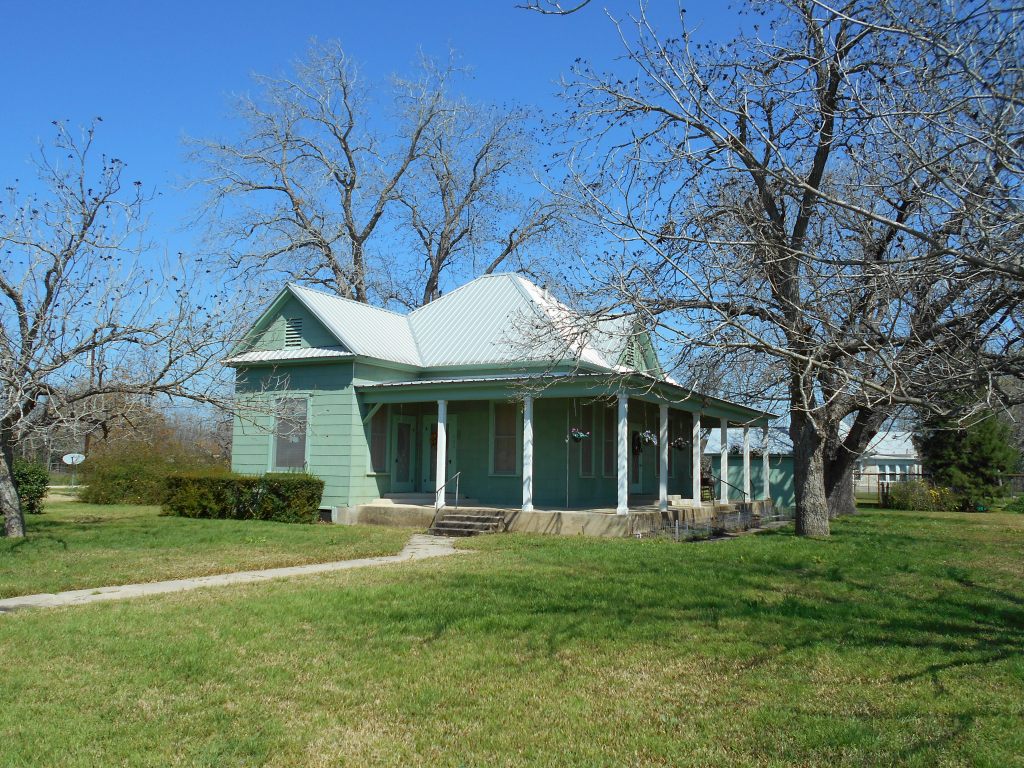
Steve’s house

At that time I had three indoor cats—Christabel, Chloe, and Alice B. Toeclaws—and a raft of outdoor cats. The outdoor cats started as strays, but I made the mistake of naming them, which meant I had to feed them, which meant they were mine. Chief among them was Bunny, a black cat who had arrived as a teenager with his gray-tabby mother, Edith.

One day Bunny, Edith, and I were out picking up pecans when Steve wandered over to pay his respects, or, more likely, to allow us to pay our respects to him. Bunny perked up, put on his dangerous expression, and walked out to meet the interloper. It was like watching the opening face-off in Gunsmoke.

But instead of scrapping, they stopped and sat down, face to face, only inches apart. Each raised his right paw above his head and held it there a moment. Next, simultaneously, they bopped each other on the top of the head about ten times. Then they toppled over onto their sides, got up, and walked away.

That happened every time they met. Maybe it was just a cat thing, a neighborly greeting, something like a Masonic handshake. But I’ve wondered if it might have had religious significance. Bunny was a Presbyterian, and Steve was a Methodist, and both had strong Baptist roots, and although none of those denominations is big on ritual, who knows what a feline sect might entail?

Steve had a Macavity-like talent for making himself invisible. Occasionally when I opened my front door, he slipped past and hid in a chair at the dining room table, veiled by the tablecloth. When he was ready to leave, he would hunt me down—Surprise!—and lead me to the door. Once, during an extended stay, he used the litter box. Christabel, Chloe, and Alice B. Toeclaws were not amused.
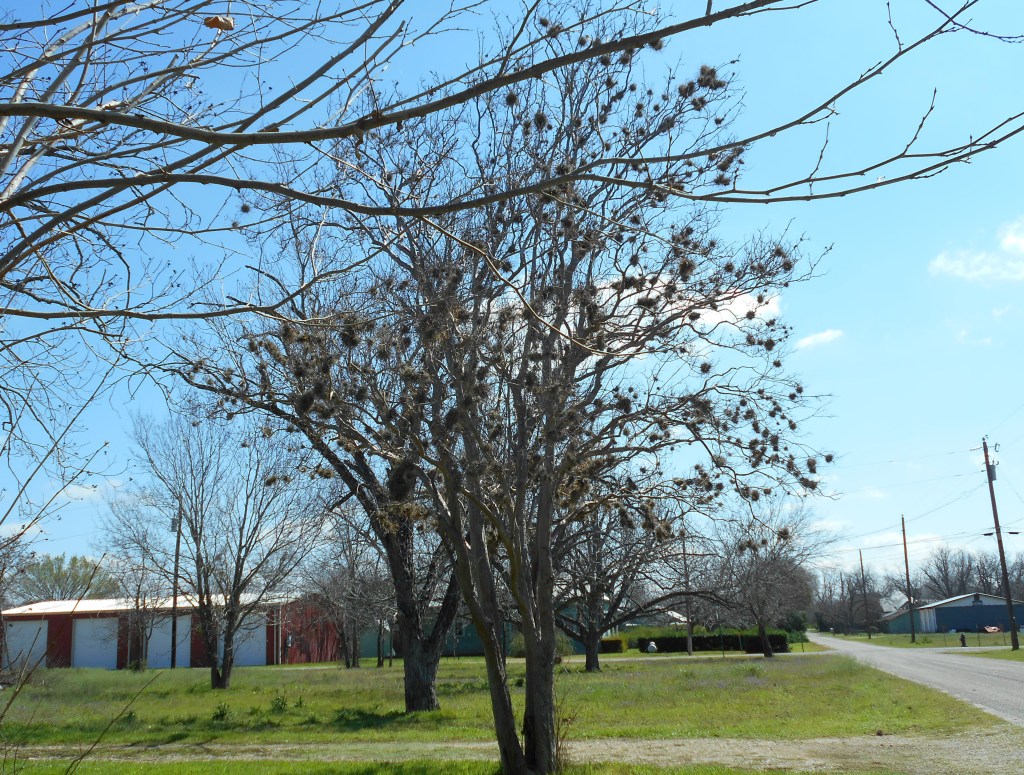
Distance Steve traveled between his house and mine. His house is way over there behind the trees.

Invisibility could work against him, though. Backing out of the driveway one morning, I saw in the rearview mirror a flash streaking across the yard. I got out and looked around but found nothing and so decided I’d imagined it. When I got home from work, I made a thorough search and located Steve under my house, just out of reach. I called, coaxed, cajoled. He stared. It was clear: he’d been behind the car when I backed out, I’d hit him, and he was either too hurt to move or too disgusted to give me the time of day.

It took a long time and a can of sardines to get him out. I delivered him to the veterinarian in Lockhart; she advised leaving him for observation. A couple of days later, I picked him up. Everything was in working order, she said, cracked pelvis, nothing to do but let him get over it.

“Ordinarily,” said the vet, “I would have examined him and sent him home with you the first day. I could tell he was okay. But you told me his owner’s son is a vet, and I was afraid I’d get it wrong.”

Although he was an indoor-outdoor cat, Steve managed plenty of indoor time at his own house, too, especially in winter, and when the maid wasn’t there. One cold day, the family smelled something burning. They found Steve snoozing atop the propane space heater in the kitchen. His tail hung down the side, in front of the vent. The burning smell was the hair on his tail singeing. They moved him to a safer location. I presume he woke up during relocation.

At night, he had his own bedroom, a little garden shed in the back yard. He slept on the seat of the lawnmower, snuggled down on a cushion. Except when he didn’t.

One extremely cold night, I was piled up in bed under an extra blanket and three cats. About two a.m., I woke up to turn over—sleeping under three cats requires you to wake up to turn over—and in the process, reached down and touched one of the cats. It was not my cat.

I cannot describe the wave of fear that swept over me. It sounds ridiculous now, but finding myself in the dark with an unidentified beast, and unable to jump and run without first extricating myself from bedding and forty pounds of cat—I lay there paralyzed.

Unnecessarily, of course. The extra cat was Steve. He’s sneaked in and, considering the weather forecast, decided that sleeping with a human and three other cats in a bed would be superior to hunkering down on a lawnmower.

Steve’s full name was, of course, Steve Dauchy. In my book, he will be Steve MacCaskill. MacCaskill was the name of a family who lived next door to my Aunt Bettie and Uncle Maurice. Their children were friends of my father and his brothers and their many cousins. They were a happy family.

“My family had to plan everything,” my dad’s cousin Lucyle Dauchy Meadows (Steve’s aunt) told me, “but the MacCaskills were spontaneous. If they decided they wanted to go to a movie, they just got into the car and went to a movie.” When Lucyle and the other girls helped their friend Mary Burns MacCaskill tidy her room before the Home Demonstration Agent came to examine it, one of the first things they did was to remove the alligator from the bathtub.

I heard so many delightful stories about the MacCaskill family that I decided they were too good to be true. Then, at Aunt Bettie’s 100th birthday party, my mother introduced me to Mary Burns MacCaskill, who had traveled from Ohio for the party.

So as an homage to that family, I’ve named my main character Molly MacCaskill. And when choosing a pet for Molly, I couldn’t choose a finer beast than Steve.

*

Note: Cullen Dauchy no longer owns Katy Veterinary Clinic, but he did when Steve worked there, and the clinic was Steve’s first home, so I’m leaving the link.

And I’m so glad the Home Demonstration agent didn’t inspect bedrooms when I was a girl. I didn’t have an alligator, but she might have thought I had something worse.

***

This post first appeared in Ink-Stained Wretches in 2021.

***

Kathy Waller blogs at Telling the Truth, Mainly. She has published short stories, and a novella co-written with Manning Wolfe. She is perpetually working on a novel.

A Little Burro Therapy

By Helen Currie Foster

The three burros who live with Alice MacDonald Greer, lawyer/amateur sleuth protagonist of my Texas Hill Country legal thrillers, bear a strong resemblance to the three burros who rule our patch of the Hill Country.

We manage our small piece of the planet for native grasses and birds under the county Wildlife Management Program. Today I received our spring box of blue grama and buffalo grass seed, for re-seeding bare patches with native grass. (More below on bare patches.)

The burro idea sprang full-blown into life at a wedding on the banks of the Blanco River years ago, when we were enchanted to see docile and well-behaved burros with panniers on their backs full of cold bottles of water and beer, being led to the guests by docile and well-behaved teenagers. Immediately I envisioned myself trekking up and down our fields leading a burro bearing panniers of grass seed which can be (believe it or not) heavy. As a bonus we knew the burros could help keep down tall dry grass–a concern during fire season.

The Platonic Ideal? Belle, a lovely donkey painted by Helene Feint. https://www.singulart.com/en/art-galleries/france/normandie/honfleur/feint-h%C3%A9l%C3%A8ne-16660

So just before Christmas we bought two smallish burros from the wedding venue, with certificates attesting to their conformation, heritage, and names (Amanda and Caroline, mother and daughter). Both were elegant, with classically lovely faces, straight legs, and dainty hooves.

This is the youngest, Caroline.

Per Random House Unabridged, “burro” is “a small donkey, especially one used as a pack animal in the Southwestern U.S.” (We use donkey interchangeably.) Let me say for the record that the “pack animal” concept went nowhere with Amanda and Caroline–they were deeply insulted at the idea of any burden on their backs. They made it crystal clear that they had not signed on to work. Still–they were decorative, and they ate down the grass.

Sebastian (left) and Amanda

But on Christmas morning when we looked across the pasture, my spouse asked, his voice disturbed: “How many donkeys do you see?” …Three.

The newcomer was shorter, pudgier, and male–well, an “altered” boy. Knock-kneed, chipmunk-cheeked, he seemed to keep a chewable cud in each cheek. He’d climbed through a fence to visit. We found his owner and bought him. Given his appearance (and the snootiness of Amanda and Caroline) we gave him a new and more dignified name: Sebastian.

While Amanda and Caroline are ladies of leisure, Sebastian has taken on two jobs. First, he’s our designated greeter. He brays a loud greeting as you drive through the gate. He brays again to salute the dawn (or pre-dawn).

Second, Sebastian has declared himself the official guard-donkey. In particular, he’s hell on canines. Pre-donkeys there were cows on the property–and coyotes. But no coyote dares invade Sebastian’s turf. He’d be happy to kick a coyote into the next county. Donkeys are shockingly fast on their feet and could easily catch a coyote. Earlier this year I found Sebastian standing triumphant and motionless in the middle of the dirt road, ears back, head up, posture stubborn, hooves planted–a picture of victory. Visible in the dirt? Tracks of a mama coyote with one pup, who’d erroneously strayed into forbidden territory. The tracks indicated a frantic exit. As he stood in the road, surveying his domaine, Sebastian was announcing, “I’m walkin’ here.”

Random House Unabridged includes a definition of “donkey” as “a stupid, silly or obstinate person.” Donkeys are not stupid. They are curious, persistent, intelligent, and acute of hearing. Are they silly? Well…Amanda and Caroline are aloof and standoffish, but Sebastian wants to play. With a bucket between his teeth, he’ll run over and whop Amanda on the hindquarters with it, then stand there. He so wants her to join in his favorite game, which is apparently called “I’ve got the bucket, now you come bite the bucket and yank it away, then you can hit me with it, then I will chase you, and then…?!?!?” So far, the girls steadfastly refuse to cooperate. When whopped with the bucket, Amanda chooses to bite Sebastian instead of biting the bucket. Maybe that’s a different game?

Obstinate? Oh, yes. They are persistent in searching for ways to get past the gate into the yard and eat the roses. They’re also very hard to stop when they want to go somewhere, and very hard to move when they intend to stay put.

Re-seeding bare patches? These three donkeys pick a spot, then take turns rolling on their backs until the grass gives up and a circular bare spot remains. Then, after rain, they race to the soggy bare spot and roll on their backs until they’re thoroughly muddy. Hence my constant race to re-seed bare patches.

Donkeys model companionship. Indeed, they need it. Despite their occasional spats, Sebastian, Amanda and Caroline spend their days and nights together, never more than about 100 feet apart.

Writers have to take breaks, or go nuts. https://www.masterclass.com/articles/taking-a-break-from-writing. I’m in that boat right now, because I’m almost but not quite finished with Book 9 in the Alice MacDonald Greer Mystery series. As is well known, writers in such circumstances can be subject to breakdowns–small rages, or tears, or snappishness, or overdosing on Cheezits.

I can recommend burro therapy. As I stand next to Sebastian, stroking his neck, and he leans back against me, I feel my heartrate slow and my breathing relax. Maybe that’s how burros feel too? Maybe this is their secret advantage, a resource that helps explain their long presence on the planet? Here’s how Alice puts it in Ghost Cat:

“Donkey hugs meant leaning into their sides, stroking their necks. The donkeys instantly settled, leaning back against her. The weird thing, Alice thought, was how the donkeys settled her. They weren’t dogs, loyal and needy, or cats, neutral and non-needy. Donkeys were ancient residents of the planet, tough, independent, curious herd animals with their own inner life.”https://amzn.to/431skan

And in Ghosted : “Finding herself needing a little burro therapy, …Alice stood in her driveway surrounded by the three. At the moment she was brushing Big Boy. He leaned against her; the warmth felt good in the late morning chill. Those eyelashes, those soft ears, Alice thought. No wonder Titania fell in love with Bottom.” https://bit.ly/3OXu3rm

Indeed, Queen Titania, seeing Bottom with his head magically changed to an ass’s head, says,

“I pray thee, gentle mortal, sing again.

Mine ear is much enamour’d of thy note;

So is mine eye enthralled to thy shape;

And thy fair virtue’s force perforce doth move me

On the first view to say, to sweat, I love thee.”

A Midsummer Night’s Dream, Act III, Scene II.

So if you’re in need of burro therapy, fellow writers, come on out. Bring some carrots!

Copyright 2024, Helen Currie Foster, All rights reserved.

Mining Family History for Characters

My father is the family genealogist. He did extensive research into both his family and my mother’s family. Dad’s family is rather straightforward—all arriving in Texas in the 1870s and 1880s from what is now the Czech Republic. My mother’s mother was Irish American. Her parents arrived in the US just before 1900, so she had aunts, uncles, and cousins in Cork. While some of my Czech and Irish relatives had life-threatening adventures in settling in the US, they didn’t inspire the characters in my short story, “Danger at Death’s Door.” That honor goes to my Danish relatives.

Lars Peter took the last name Ottosen after his step-father Otto.

One ancestor whose history I researched to create a character was one of my great-great-grandfathers on my mother’s father’s side, a man named Lars Peter. Lars Peter’s mother was unmarried when she gave birth to him in 1842 in Denmark. Family oral history says that she was employed at the court in Copenhagen, left to give birth, and was later ‘recalled’ to court. Her child, Lars Peter, was sent away to boarding school where he excelled scholastically. Among other things, he learned to speak, read, and write in both English and Danish. (We have proof of his lovely penmanship because later in life he was a US census-taker, and the names and addresses of his neighbors are recorded in his beautiful handwriting.) After leaving school, Lars Peter joined the military. He was a big man for his time, reaching over six feet tall and 190 pounds as a teenager.

In 1864, sick of Danish-German wars, Lars Peter left the military and signed on to crew a ship bound for the US from Denmark. He arrived in the midst of the US Civil War. Lars Peter jumped ship, ran for his life to avoid being forced into the Union Army by men seeking to draft newly arrive immigrants, made his way to the Great Lakes region, married, and settled on Washington Island. After presenting him with five children, three of whom survived, Lars Peter’s first wife died in childbirth along with a sixth child. The women on the island advised Lars Peter to remarry because he needed someone to care for his young children while he worked. So he crossed to the mainland on his sailboat and walked to farms, looking for an unattached female of marriageable age. He found a woman named Christine (apparently tripping and falling through her family’s front door).

Lars Peter and Christine

Christine also features in my story, although very briefly and under a different name. She was an immigrant from Denmark of the serf class, uneducated in anything but sewing and farm/household work. She also had one eye that wandered because she was born with it fused closed, and it didn’t open until she was three years old. Christine emigrated to escape near slavery, her life controlled by the Count who owned the estate where she was born, and to escape the scandal that attached to a woman if a man jilted her, refusing to marry her after a marriage had been arranged by their families. She was visiting relatives while recovering from an extended illness, when Lars Peter asked her to come care for his children, and if she liked the situation, get married. She agreed to go with him. Christine fell for his children, and possibly him, and they were married. They went on to have seven children, the last of whom was my great-grandfather, Robert, born in 1897.

Obituary for Lars Peter

Family history states that Lars Peter admitted knowing who his father was, but he refused to name the man. That line of the family tree remains a mystery. Lars Peter died in 1924, a highly regarded citizen of Washington Island, having served as census taker, postmaster, town clerk, town chairman, assessor, and roadmaster at various points in his life.

Lars Peter’s history provides much of the background for the character named Lars Pedersen in my short mystery story “Danger at Death’s Door.” My Lars Pedersen character is also an “educated bastard” from Denmark and a widower in need of a mother for his young children. I named one of the children in the story Robbie, after my great-grandfather Robert, even though he wouldn’t have been born yet. Robert died in 1990 in Texas and lives in my memory as Great-Gampie, a tall man, several inches over six feet, with broad shoulders and a penchant for storytelling.

In my story, my character Lars takes a voyage across the Great Lakes. During the voyage, the ship’s captain hands Lars “one more thing to worry about” when he asks him to investigate a crime aboard ship. As far as I know, the real Lars Peter never encountered a mystery aboard a ship that required him to act as a detective. That portion of the story is entirely fictional.

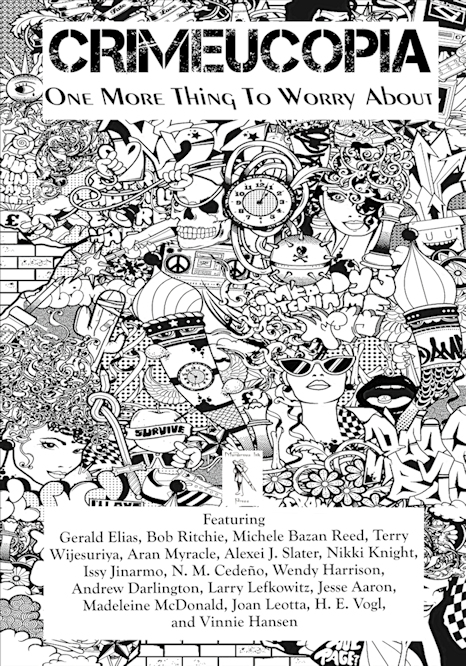
“Danger at Death’s Door” is scheduled for publication in March 2023 in the mystery anthology Crimeucopia: One More Thing to Worry About, from editor John Connor at Murderous Ink Press.

***

N. M. Cedeño is a short story writer and novelist living in Texas. She is active in Sisters in Crime- Heart of Texas Chapter and is a member of the Short Mystery Fiction Society. Find out more at nmcedeno.com

A Little Hitchcock, Two Stories, Plus Spoilers

by Kathy Waller

The summer  I was six, my cousin of the same age was visiting our spinster great-aunt and bachelor uncle who lived up the street. Uncle called one evening. Cousin was being a major pain. It was a weeknight, and the only amusement our miniscule town afforded, a roller skating rink, was open only on weekends. Great-aunt and uncle weren’t accustomed to dealing with children of the painful variety, so he did what he often did when desperate. He appealed to my mother: You’ve got to do something.

A veteran of dealing with a juvenile pain, she proposed the perfect solution. They loaded both of us into the car and took us fifteen miles to the drive-in movie.

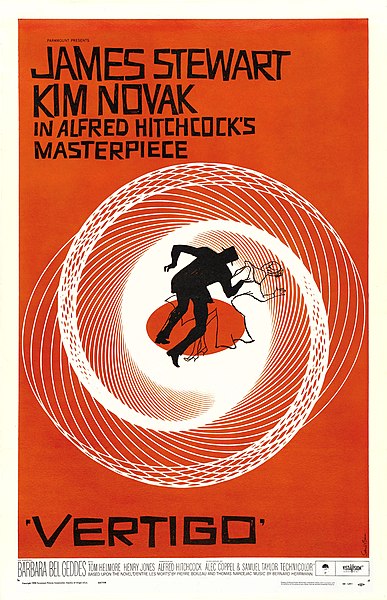
An excellent plan: Bugs Bunny, Porky Pig, trailers of coming attractions, and the feature film: Alfred Hitchcock’s Vertigo.

A synopsis of the novel from which the movie was adapted appears on Wikipedia:

A prosperous shipbuilder hires a former detective who suffers from vertigo to tail his wife Madeleine who is acting strangely. The detective falls in love with the shipbuilder’s wife but is unable to stop her committing suicide by jumping from a tower. Haunted by her death, he sees a woman who bears a strong resemblance to the dead woman, however, his attempts to get closer to this doppelgänger ultimately result in tragedy.

In these enlightened times, many, if not most, parents would be horrified at anyone’s allowing a first-grader to see such a nightmare-inducing movie. I, however, spent every afternoon glued to the Afternoon Movie. I guess my mother assumed that if I could handle Don Ameche trying to get rid of his wife, Claudette Colbert, by drugging her hot chocolate and then piping in repeated suggestions that she jump off her bedroom balcony, Hitchcock wouldn’t upset me.

And I’ve always been grateful to her, because that night at the drive-in, I fell in love. I watched Hitchcock’s television programs and all the movies I could manage. They were wonderful, and if they starred Cary Grant–Francine Paino wrote about one of those, North by Northwest, last week–that was icing on the cake.

Now Netflix, Prime, Roku, and other streaming services have allowed me to watch many of them again.

But this post isn’t a celebration of Hitchcock. It’s about two stories adapted for his television show. Watching them as an adult, I saw something I hadn’t seen years (and years) ago. I enjoyed both, but one had something extra.

The first is “The Second Wife,” in which a mail-order bride comes to believe that her husband plans to kill her. At the outset, he seems insensitive, unconcerned about her needs; when she says the laundry room in the basement is uncomfortably cold, he complains about the cost of installing a heater. She also hears stories: he took his first wife to visit her people at Christmas and she died and was buried there–or that’s what he claims.

Gossip fuels the second wife’s fears, and when the husband announces plans to take her home for Christmas, she acquires a gun. Before they leave, however, he insists she go down to the basement. She takes the gun and descends the stairs. He’ll follow in a moment.

The viewer feels her fear: The husband will kill the second wife, as he killed the first.

But there’s a literary catch. In a letter, Anton Chekhov stated one of his principles for writing fiction: “One must never place a loaded rifle on the stage if it isn’t going to go off. It’s wrong to make promises you don’t mean to keep.”

The wife has a gun. And this is Hitchcock; he keeps his promises.

The wife shoots and kills her husband, then realizes he’d only wanted to show her her Christmas present–the heating system he’d had installed in the laundry room.

A tragic ending, but satisfying in its irony.

The second story, “Night of the Owl,” however, has something extra, something unexpected.

A couple have reared an adopted daughter, now a teenager, a bright student, a well-adjusted, happy girl. But the parents have carefully guarded a secret: the girl’s father murdered her mother, then killed himself in prison. When a prison chaplain and his accomplice appear and blackmail the couple, then come back for more, the father considers his options: murder the blackmailer, or tell his daughter about her past. Both are unthinkable. Then one of the blackmailers is murdered. Evidence points to the father.

How can the plot be resolved? Did the father commit murder? He escapes being charged but can’t escape telling his daughter about her birth parents.

In “The Second Wife,” the resolution is either/or, and the viewer can almost certainly predict which it will be.

But the ending of “The Night of the Owl” isn’t predictable. Will the girl become hysterical? Fall into depression? Reject her adoptive parents? Run away? Harm herself?

Told the truth about the murder/suicide in her background, she expresses empathy. How unhappy her parents must have been, she says–what sad lives they must have lived.

I didn’t see that coming. A Hitchcock program with a happy ending. And an exceptional character.

Critics (professional and amateur) point to problems with both  programs. Fair enough. I didn’t watch for flaws. In fact, I didn’t watch for anything but the pleasure of seeing programs I’d first watched as a child. I just happened to see something more.

And to quote Osgood Fielding III, “Nobody’s perfect.”

***

“Night of the Owl” is available on Youtube.

*

Robert Bloch wrote the teleplay of “The Second Wife” based on a story by Richard Deming. It aired on The Alfred Hitchcock Hour on October 4, 1962.

Richard Fielder wrote the teleplay of “The Night of the Owl” based on a novel by Paul Winterton. It aired on The Alfred Hitchcock Hour on April 26, 1965.

*

Joe E. Brown appears as Osgood Fielding III in Some Like It Hot. He has the best line in one of the best, and funniest, movies ever made.

Research turned up this biographical item: “An ardent opponent of the Nazi regime, in 1939 Brown testified before the House Immigration Committee in support of a bill that would allow 20,000 German-Jewish refugee children into the United States. He would later adopt two German-Jewish refugee girls himself, naming them Mary Katherine Ann (born 1930) and Kathryn Francis (born 1934).”

*

Images are taken from Wikipedia. Both are in the public domain.

***

Kathy Waller blogs at Telling the Truth, Mainly.

THE PLOT THICKENS! Or, Your Suspicions May Be True

by Helen Currie Foster

Okay—Mom Genes is such a great title, it couldn’t not be used. But Abigail Tucker’s new book of that title doesn’t focus just on moms. Tucker, a New York Times best-selling science writer, dives deep into the burgeoning science examining parental behavior—genetic? hormonal? learned?

And you writers may find it a rich source for potential plots.

Moms will recognize Tucker’s description of the weird sensation of being kidnapped, of feeling like victims of an Invasion of the Body Snatchers. Not feeling quite yourself? In the first of a series of jaw-dropping recent research findings, Tucker reports, “Our children colonize our lungs, spleens, kidneys, thyroids, skin”—and brains. Far from being that familiar image of the one-way street, with mother’s blood, nutrients and even cells flowing into the fetus, the fetus also sends its own fetal cells into the mother. It’s “fetal microchimerism.” No wonder a burgeoning mom feels…she’s changed.

Tucker doesn’t dodge painful issues of maternal and paternal favoritism. “Some 80 percent of us allegedly … prefer one of our children to the others, and more than half of parents demonstrate so-called differential treatment toward various progeny.” The most striking predictor? “Moms appear to dote on their cutest kids.” Apparently “the components of infant attractiveness…are rigid and globally constant,” including big eyes, large forehead, small chin, and chubby cheeks. Tucker says this preference extends to nearly all baby mammals.

But dads apparently outperform moms on “child facial resemblance determination” – i.e., dads are more skilled at noticing whether a child looks like them. Indeed, one Senegal study found “kids grow up bigger and are better fed if they look and in fact smell more like their dads.” A different kind of favoritism…favoring the child which dad feels sure is his.

Jane Austen knew this. You remember that Mr. and Mrs. Bennet, the parents in Pride and Prejudice, have different favorites? Mrs. Bennet favors beautiful Jane; Mr. Bennet favors sensible Lizzy (Elizabeth). Mrs. Bennet scolds her husband: “Lizzy is not a bit better than the others; and I am sure she is not half so handsome as Jane, nor half so good-humoured as Lydia. But you are always giving her the preference.”

Humans share mothering tendencies across species. Will you recognize yourself if I mention “left-handed cradling bias”? In a “near-universal” mothering behavior, “Something like 80 percent of right-handed women and, remarkably, almost as many left-handed women hold their babies automatically on the left.” Check out many paintings of the Madonna, suggests Tucker. This “lefty” preference extends to other mammals. Why? It may allow the infant to “view the more expressive left side of the maternal face.”

Tucker points out it’s not all about genes. Life experience also affects maternal behavior. She describes studies of new monkey mothers showing that, of those roughly treated by their mothers, “more than half of the maltreated monkeys became abusive mothers. All the well-tended infants matured as competent mothers.” But when the scientists swapped some babies, so the abusive monkey moms took charge of the offspring of outstanding monkey moms, “the monkeys grew up to match the behaviors of their adoptive mothers, not their biological mothers.”

Here’s another potential genetic component. Canadian scientist Frances Champagne wondered why mother lab rats from the same genetic strain, living under identical conditions, engaged in different “licking/grooming” of their babies. When Champagne swapped the rat babies, so high-licking moms raised the babies of low-licking moms, the babies of below-average lickers followed in their adoptive mom’s footsteps. Then other scientists found they could program a baby rat’s future licking behavior by stroking it with a tiny paintbrush. “The physicality of getting licked somehow shaped the females’ instincts and behavior.” According to Champagne, “I wanted to show that the care you receive leads to epigenetic changes in infancy, and that this could replicate.” Epigenetics focuses on whether and how bits of genetic code may be “expressed.” Champagne found well-licked baby rats “were more likely to express their genes for certain estrogen receptors…” which made them more likely to express genes for oxytocin receptors and to grow more oxytocin neurons in their brains.

Fascinating research discusses how different bits of our genes “express” themselves, particularly in response to hormones. For instance, various sorts of stress can result in hormonal effects on gene expression: “Physiological changes that affect mRNA stability occur during development, nutritional stress, hypoxia, inflammation, cancer, and aging.”

The notion that our genes are static? Maybe not!

So…parental behavior factors include genes plus life experience with hormones kicking into action to affect gene expression.

Back to favoritism! Harry Potter? Reluctant adoptive parent Mrs. Dursley can’t abide her own sister’s son. The internet is full of books and studies on why parents have favorites and how favorites impact families, including impact on sibling rivalry.

Being a favorite can be dangerous, as Joseph learned. “Now Israel loved Joseph more than any other of his children…But when his brothers saw that their father loved him more than all his brothers, they hated him….” (Genesis 37.)

And I haven’t touched on what Tucker calls the “murderous tendencies of mothers,” citing Sarah Blaffer Hrdy’s theories on infanticide in Mother Nature.

Tucker’s final chapters look at the impact of our own stressful society on parents. “Social-support deficits and perinatal depression are intimately linked.” Tucker reports that compared to Dutch mothers, American mothers appeared comparatively quite miserable, with high levels of unhappiness and worry, because they don’t get enough support in their health care or workplace. To transform this problem “would involve taking on some of the most grinding and deadlocked political issues of our day: not only income inequality, but also health care, education, and other topics that have consistently stumped our government,” including racism (citing pregnant Black women’s higher blood pressure and elevated risks of prenatal diabetes, preterm delivery and death).

Tucker visited Erin Kinnally, a scientist at the UC Davis California National Primate Research Center. “Kinnally rattles off the factors that can shape primate moms…age, number of births, genetics, her own mother’s rearing history, the baby’s sex and other characteristics, access to food and shelter and sundry other environmental factors.” But the most potent force is “social chemistry.” The low-ranking macaque moms at the primate center “have weaker immune system and other distinct traits…the lowest ranking moms had four times the amount of stress hormones in their blood.” “Low-ranking [macaque] moms grasp that they have to be vigilant at all times. Fascinating studies have shown that these moms are much more likely to try to shush their infants’ cries when higher-ranked animals are around, for fear that the fussing will draw unwanted attention and attacks.”

Hormonal impact? Stress can mean a baby gets more cortisol in breast milk. In monkeys, “these high-cortisol babies grow unusually quickly, ‘prioritizing’ growth instead of social exploration…”

Tucker, like Bill Bryson in The Body, respects her readers enough to include a serious index. Hers is excellent: for her assertions in each chapter, she includes detailed links to the research studies involved.

We’re all from families; we’re all affected by our genes and our experiences, by how we were parented (and, indeed, how those who parented us were parented, and so on back up the long chain of humanity). Mom Genes confirms what writers already suspect: plots abound!

***

Helen Currie Foster lives north of Dripping Springs, Texas, supervised by three burros. She writes the Alice MacDonald Greer Mystery series. Ghost Daughter, Book 7 of the series, was published June 15, 2021. Helen’s active with Austin Shakespeare and Sisters in Crime – Heart of Texas chapter. Find out more at www.helencurriefoster.com.

Naming Characters: Steve Dauchy MacCaskill

I’m working on a mystery novel—I’ve been working on it for years, but now I’m working on itand am faced with dilemmas too numerous to whine about in only one post, so I’ll move along.

I will instead write about the one pleasure of the writing life: creating and naming characters.

My novel is set in a little town very like my own hometown. I don’t base my plot on real events, and I don’t use real people as characters—with one exception: Steve Dauchy.

Not Steve, but close

Note: One of my readers, Cullen Dauchy, knows more about Steve than I do, especially about his early life, and I hope he’ll feel free to correct any errors.

Steve Dauchy was a career blood donor at Katy Veterinary Clinic in Katy, Texas. On retirement he moved to Fentress, where he lived with his veterinarian-owner’s parents, Joe and Norma Dauchy. Joe and Norma lived next door to me; in local terms, next door meant that my house was on one corner, then there was a half-acre “patch” of pecan and peach trees and grass and weeds, then a street, and then on the next corner, the Dauchy yard and their house. The point being that when Steve visited me, he didn’t just walk across a driveway.

Joe was my dad’s first cousin, so I guess that makes Steve and me second cousins. I have a lot of cousins on that side of the family, although most are human.

Steve is a family name, with a story behind it. As I understand it, back in the ’20s or ’30s, my great-uncle Cull (Joseph Cullen) Dauchy, Sr., enjoyed listening to a radio program about a Greek character who frequently spoke of “my cat Steve and her little cattens.” Uncle Cull was so amused by the phrase that he named a cat—probably one of the barn cats—Steve. And ever after, he always had a cat named Steve.

Uncle Cull and Aunt Myrtle Dauchy’s house, home of the first Steves

So when the clinic cat became part of the Uncle Cull’s son and daughter-in-law’s family, he became the latest in a long line of Steves.

How to describe Steve. He was a fine figure of a cat: a big tabby, deep orange, with an expression of perpetual boredom. His reaction to nearly everything translated as, “Meh.” I’ve heard that’s common among clinic cats.

Once when Steve was standing on my front porch, the neighbor’s Great Dane got loose and charged over. I was frantic, shouting at the dog, shouting at Steve. But when the dog hit the porch, Steve just looked up at him. Dog turned around and trotted home.

Some would say Steve was brave, and I’m sure he was. But I believe his grace under pressure had their roots elsewhere.

First, he had experience. He knew dogs. In his former employment, he’d observed the breed: big, little, yappy, whining, growling, howling, cringing, confined to carriers, restrained by leashes, sporting harnesses and rhinestone collars, hair wild and matted, sculpted ‘dos and toenails glistening pink from the OPI Neon Collection. He’d seen them all, and he was not impressed.

Facing down a Great Dane, however, took more than experience. There was something in Steve’s character, an inborn trait that marked him for greatness: his overarching sense of entitlement. He was never in the wrong place at the wrong time. My porch was his porch. The world was his sardine.

Except for the kitchen counter. Steve thought kitchen counters were for sleeping, and Joe and Norma’s maid didn’t. Consequently, he stayed outside a lot. He took ostracism in stride and used his freedom to range far and wide. Far and wide meant my yard.

Steve’s house

At that time I had three indoor cats—Christabel, Chloe, and Alice B. Toeclaws—and a raft of outdoor cats. The outdoor cats started as strays, but I made the mistake of naming them, which meant I had to feed them, which meant they were mine. Chief among them was Bunny, a black cat who had arrived as a teenager with his mother, Edith.

One day Bunny, Edith, and I were out picking up pecans when Steve wandered over to pay his respects, or, more likely, to allow us to pay our respects to him. Bunny perked up, put on his dangerous expression, and walked out to meet the interloper. It was like watching the opening face-off in Gunsmoke.

But instead of scrapping, they stopped and sat down, face to face, only inches apart. Each raised his right paw above his head and held it there a moment. Next, simultaneously, they bopped each other on the top of the head about ten times. Then they toppled over onto their sides, got up, and walked away.

That happened every time they met. Maybe it was just a cat thing, a neighborly greeting, something like a Masonic handshake. But I’ve wondered if it might have had religious significance. Bunny was a Presbyterian, and Steve was a Methodist, and both had strong Baptist roots, and although none of those denominations is big on ritual, who knows what a feline sect might entail?

Steve had a Macavity-like talent for making himself invisible. Occasionally when I opened my front door, he slipped past and hid in a chair at the dining room table, veiled by the tablecloth. When he was ready to leave, he would hunt me down—Surprise!—and lead me to the door. Once, during an extended stay, he used the litter box. Christabel, Chloe, and Alice B. were not amused.

Distance Steve traveled between his house and mine. His house is way over there behind the trees.

Invisibility could work against him, though. Backing out of the driveway one morning, I saw in the rearview mirror a flash streak across the yard. I got out and looked around but found nothing and so decided I’d imagined it. When I got home from work, I made a more thorough search and located Steve under the house, just out of reach. I called, coaxed, cajoled. He stared. It was clear: he’d been behind the car when I backed out, I’d hit him, and he was either too hurt to move or too disgusted to give me the time of day.

It took a long time and a can of sardines to get him out. I delivered him to the veterinarian in Lockhart; she advised leaving him for observation. A couple of days later, I picked him up. Everything was in working order, she said, cracked pelvis, nothing to do but let him get over it.

“Ordinarily,” said the vet, “I would have examined him and sent him home with you the first day. I could tell he was okay. But you told me his owner’s son is a vet, and I was afraid I’d get it wrong.”

Although an indoor-outdoor cat, Steve did plenty of indoor time at his own house, too, especially in winter, and when the maid wasn’t there. One cold day, the family smelled something burning. They found Steve snoozing atop the propane space heater in the kitchen. His tail hung down the side, in front of the vent. The burning smell was the hair on his tail singeing. They moved him to a safer location. I presume he woke up during the process.

At night, he had his own bedroom, a little garden shed in the back yard. He slept on the seat of the lawnmower, snuggled down on a cushion. Except when he didn’t.

One extremely cold night, I was piled up in bed under an extra blanket and three cats. About two a.m., I woke up to turn over—sleeping under three cats requires you to wake up to turn over—and in the process, reached down and touched one of the cats. It was not my cat.

I cannot describe the wave of fear that swept over me. It sounds ridiculous now, but finding myself in the dark with an unidentified beast, and unable to jump and run without first extricating myself from bedding and forty pounds of cat—I lay there paralyzed.

Unnecessarily, of course. The extra cat was Steve. He’s sneaked in and, considering the weather forecast, decided sleeping with a human and three other cats in a bed would be superior to hunkering down on a lawnmower.

Steve’s full name was, of course, Steve Dauchy. In my book, he will be Steve MacCaskill. MacCaskill was the name of a family who lived next door to my Aunt Bettie and Uncle Maurice. Their children were friends of my father and his brothers and their many cousins. They were a happy family.

“My family had to plan everything,” my dad’s cousin Lucyle Dauchy Meadows told me, “but the MacCaskills were spontaneous. If they decided they wanted to go to a movie, they just got into the car and went to a movie.” When Lucyle and the other girls helped their friend Mary Burns MacCaskill tidy her room before the Home Demonstration Agent came to examine it (I am so glad the Home Demonstration Agent didn’t examine rooms when I was a girl), one of the first things they did was to remove the alligator from the bathtub.

I heard so many delightful stories about the MacCaskill family that I decided they were too good to be true until my Aunt Bettie’s 100th birthday party, when my mother introduced me to Mary Burns MacCaskill, who had traveled from Ohio for the party.

So as an homage to that family, I’ve named my main character Molly MacCaskill. And when choosing a pet for Molly, I couldn’t choose a finer beast than Steve.

***

Kathy Waller blogs at Telling the Truth, Mainly. She has published short stories, as well as a novella co-written with Manning Wolfe. She is perpetually working on a novel.

What’s in a Character Name?

Authors, how do you name your characters?

Name Cloud by Wordcloud

The average person only has to come up with names when they are naming their children. As anyone who has enjoyed the privilege of naming children knows, this task can be fraught with difficulties. Everyone has different criteria for what they consider important: family connections, name meaning, how well it fits with other family names, how well it sounds when yelled, how common or uncommon the first name is, how many other people have the exact same first and last name combination. Some names come easily months before they are needed and others aren’t finalized until someone threatens not to let a parent leave the hospital until a form is filled out.

Naming a character can be like naming a child. While my characters don’t have a flesh and blood life to ruin if I name them poorly, I do have readers’ responses to worry about. Will the name fit the character in a way that enhances the story? Will readers hate it? Will an unknown person somewhere in the world sue if the character has their name?

Some authors have a gift for inventive naming. J. K. Rowling, for instance, takes the prize for the most-creative names, as far as I’m concerned, with Ian Fleming as a close second. For a great review of some fabulous character names, see this blog post by John Floyd, who provides lists of character names placed in categories such as light-hearted, strong, mysterious, and evil.

Lacking a flair for naming, I resort to a baby name book and Google.

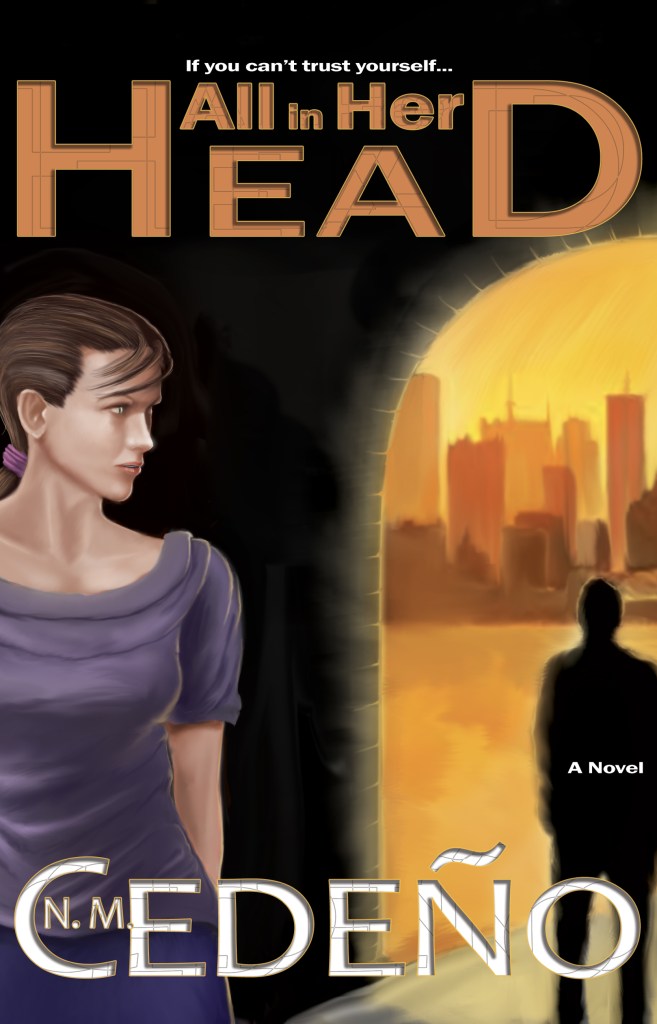
In my first book, a suspense novel called All in Her Head, the main character is named Martha because of the biblical story of Martha and her sister Mary. In that story, Martha is the worrier who doesn’t sit down and relax, the one trying to get everything done for her guests. My character in the book suffers from crippling anxiety. She’s the queen of worriers facing anxiety-inducing life changes: she recently relocated to a new city to start a new job and hasn’t made any friends yet. On top of that, I made her a witness to attempted murder. The poor girl has a lot to handle, but, in spite of her mental health issues, she fights to keep her focus in the face of murderous assaults, explosions, attacks, and car accidents.

In my second novel, a medical mystery entitled For the Children’s Sake, the victim and the main protagonist are twin brothers name Ingall and Ignatius. I chose the names by their meanings. The character of Ingall is a murdered, saintly Catholic priest, while his twin Ignatius is a red-headed Chemist with a temper, who fights to solve his brother’s murder. Ignatius means fiery, ardent, which fit the character. The name Ingall I chose for alliteration with Ignatius and because it was a variant spelling of Angell, meaning angel or messenger of God, which felt appropriate for a saintly clergyman.

Sometimes, I can’t come up with a first and last name combination that I like so I delay by only calling the character by one name. In my Bad Vibes Removal Services paranormal mystery series, the main character is a history graduate student who sees ghosts and likes to try out clothing and hairdo’s from ancient civilizations. Her first name, Lea, came to me easily. However, she didn’t have a last name through multiple short stories until I finally tagged her with Saroyan.

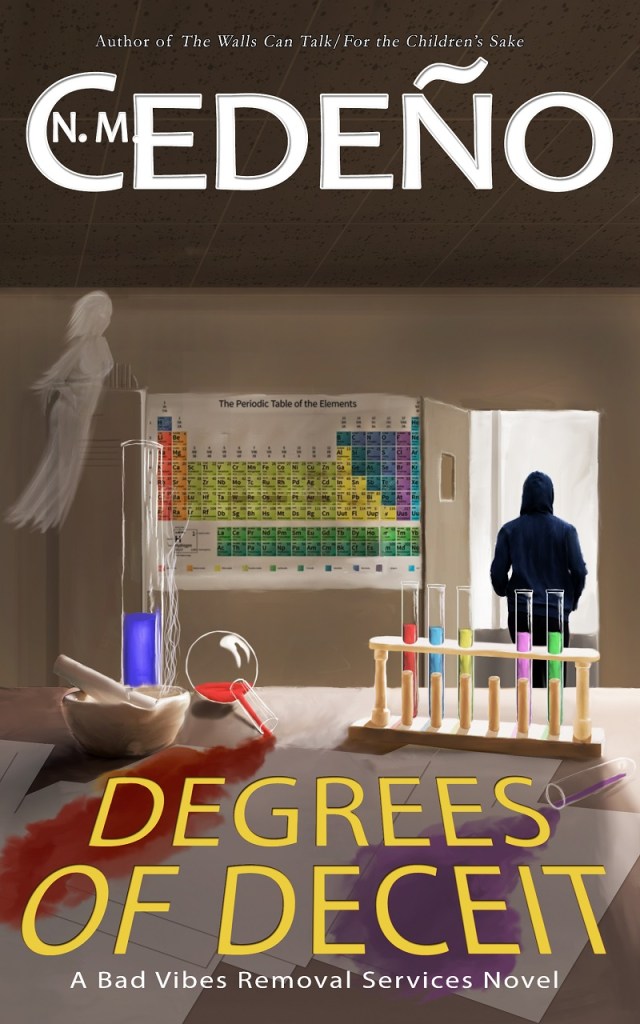
Lea’s detective/ inventor boss was named only as Mr. Montgomery in several short stories and through the novels. I finally gave him a first name in a bonus short story at the end of the second novel, Degrees of Deceit. Since Montgomery is described as six feet tall, pushing 300 pounds, and is a force to be reckoned with who seeks justice for others, I named him Orestes. Orestes means “mountain man,” which fit my mountain of a character, and the original Greek Orestes sought justice for his father’s murder. This delaying in naming a character may be the equivalent of not officially naming your kid until he’s four years old, but at least I got there in the end.

*****

N. M. Cedeño is a short story writer and novelist living in Texas. She is currently working on a paranormal mystery series called Bad Vibes Removal Services. The second novel in the series, entitled Degrees of Deceit, came out in August 2019.  Ms. Cedeño is active in Sisters in Crime- Heart of Texas Chapter.