It’s September 1. New school year! New shoes, after a hot barefoot summer! New outfit, for the first day of school! And then––new classes! New subjects, new teachers, new tools! New friends! New lockers, new classrooms, new hallways…. New season—new teammates, new coach, new plays.
Remember your first day back at school? Back to college, back to university? Do you remember the excitement, the nervousness, the anticipation?
Today is Labor Day. And now there will be apples, apple pie and apple crisp. There will be chrysanthemums, spilling out of baskets. Even in central Texas, leaves will change color—as Maxwell Anderson’s lyrics have it, “When the autumn weather turns the leaves to flame.” Here in the Hill Country, sumac and Spanish oak turn red, sweet gum turns yellow. No, not the glory of the maples, but a change in the landscape. Because finally, after the dog days of summer, that’s what September brings: something new.
It’s time to pull up the tired summer flowers and thank them for their service. Time to dig some holes and plant new trees, and order some bulbs. I’ll be planting the Mexican plum seedlings a friend gave me, and ordering narcissus bulbs for indoor blooming.
Then the Hill Country brings its own fall excitement. Dove season began today and a down-the-road neighbor, disturbed by shotgun pellets falling on her roof, had to call the sheriff, and have officers explain to a clueless (thoughtless? lawless?) neighbor that it’s contrary to law to allow your ammunition to cross your own fence line. Also unneighborly. But hmm, that could find its way into a future book plot….
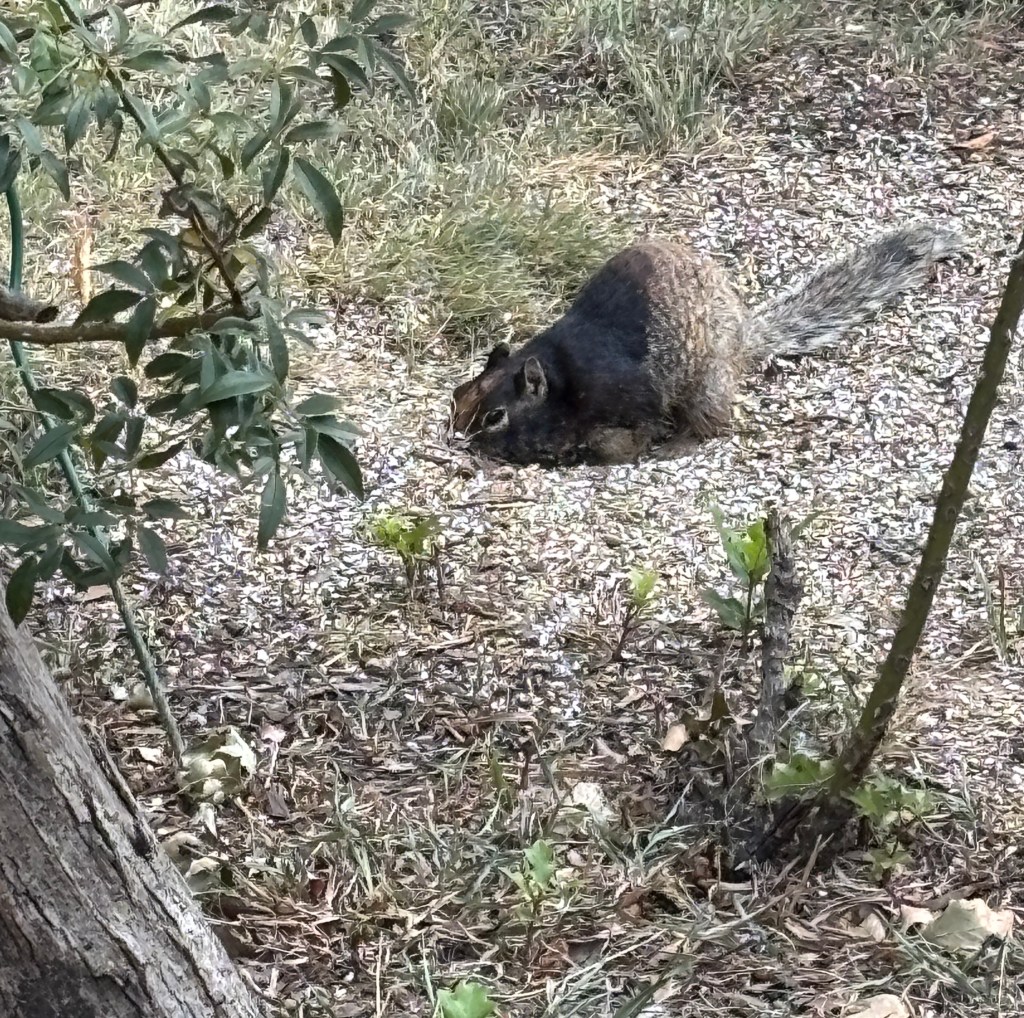
Our Hill Country holds surprises. One is the way water hides in the Hill Country—down in secret seeps and creeks, around curves and hollows. And what odd creatures live out here! For example, this fall we’ve seen again the rare and secretive rock squirrel.
(We’ve seen a solitary rock squirrel only once every few years.) We’ve heard the great horned owls that call at night, up and down the creek, and the herons who call, flying down the valley. The buzzards drone, annoyingly, from the tops of telephone poles. We treasure glimpses of the shy, gorgeous painted buntings who appear briefly at the bird feeder, then flit away. Porcupines visit. Roadrunners dart across the road.
And finally the dog days are over. (This year they were July 3-August 11, and these hot sultry days have borne their name from ancient times supposedly because it’s when Sirius, the Dog Star that accompanies Orion, rises with the sun.) https://www.almanac.com/content/what-are-dog-days-summer But during the dog days I took refuge at night reading two mystery series that were new to me, by British author Peter Grainger: the DC Smith Investigation series and the Kings Lake Investigation. http://bit.ly/4gmPsad
These wry British procedurals are set on the coast of Norfolk, providing a cool and rainy ocean-side backdrop for the appealing characters. At least I could read about rain and cool breezes. But the books offered not only a respite from ridiculous heat, but a welcome respite from writing. For the last few weeks I’ve been finishing Ghost Justice—Book 10 in my Alice MacDonald Mystery Series, set here in the Texas Hill Country. For me that process inescapably includes waking in the wee hours with my mind on plot additions and subtractions, dialogue, characters. For just such moments—when the characters wake me up at night voicing their further demands (yes, they come alive!)—I find mysteries provide absorbing distraction.
Watch for Ghost Justice this week!
Helen Currie Foster lives and writes the Alice MacDonald Greer Mystery series north of Dripping Springs, Texas, loosely supervised by three burros. She’s drawn to the compelling landscape and quirky characters of the Texas Hill Country. She’s also deeply curious about our human history and how, uninvited the past keeps crashing the party. Follow her at http://www.helencurriefoster.com.
Listening, I can just see, just feel, that “old blue shirt” that “suits him just fine.” I can imagine the old boots that let him “work all day” and then go “dance all night.” And of course that friend who “always shows up when the chips are down”––I’m thinking, my bestie. Just hearing about the shirt, the boots, the friend always leaves me with the same settled, restful confidence he’s describing. “Stuff that works!”
“Brown paper packages tied up with string” may have undeniable charm, “stuff that works” means stuff I turn to, go back to, and rely on. Like old travel pants with pockets that zip, soft shirts without a scratchy label, shoes that just carry me along, soles not too thick or thin.
What about you? Things that keep working, that stand the test of time? The pens that always work, the ink you like, the just-right-feel in your hand as you write? The car that always starts, the recipe you can count on?
Part of the charm of “stuff that works” is reliability – working each and every time.
Time, that deep human preoccupation! Is time reliable? Time messes with us. Time stands still. Time passes. Time flies. Time heals. Time runs out. Time grows short. The time changes…and times change. “Time, like an ever-flowing stream…” Sometimes an hour feels interminable; sometimes an hour passes in a flash. Albert Einstein’s theory of general relativity says that even in the universe, time is not constant, but is influenced by gravity. Yikes! (says the English major).
Writers struggle to analyze time’s impact on us. Just a couple of examples––Anthony Powell, A Dance to the Music of Time; Vladimir Nabokov, Speak, Memory;Virginia Woolf, particularly the “Time Passes” section of To the Lighthouse. Historians try to make sense of the impact of events over time, like Drew Gilpin Faust in This Republic of Suffering, on death and the Civil War.
Poets remind us of their mortality—and hence our own. Here’s Robert Frost, in Ten Mills, Part II, THE SPAN OF LIFE, from A Further Range (Henry Holt and Company, 1936):
The old dog barks backward without getting up.
I can remember when he was a pup.
Or Billy Collins at the beginning of “Life Expectancy” in Whale Day (2020):
On the morning of a birthday that ended in a zero,
I was looking out at the garden
When it occurred to me that the robin
On her worm-hunt in the dewy grass
Had a good chance of outliving me….
T.S. Eliot begins East Coker : “In my beginning is my end,” then:
…there is a time for building
And a time for living and for generation
And a time for the wind to break the loosened pane
Ad to shake the wainscot where the field-mouse trots
And to shake the tattered arras woven with a silent motto.
Sebastian Junger reflects on near-death experiences, including his own: In My Time of Dying (2024).
Of course animals can be aware of time. Right? The three donkeys– Sebastian, Amanda, and Caroline ––appear promptly at the gate in front of the house at 11:30 a.m., and again at 4:30 p.m., which, they are confident, are the hours when carrots ought to be offered. We know animals can mourn the loss of a member of their pod, their herd, their litter. But do they worry about their own mortality? Do our friends the non-human primates? Well, maybe! Um, time will tell! https://bit.ly/4mZqi4k
To be human is to be aware of our own mortality. And for humans, time is both reliable—tick, tock—and unreliable: we cannot know what the future holds. Fiction writers, however, get to make those decisions for their characters. In the mystery genre, we get to decide: who shall live? Who shall die? How, and why?
I’ve wrestled with these questions in my Alice MacDonald Greer Mystery Series: what happens next?Should I not have killed a particular character? Should a new character survive and reappear in the next book? It’s a heavy responsibility! We readers can become quite attached to characters. In the last few weeks, finishing Book 10, I took refuge in Laurie King’s Mary Russell/Sherlock Holmes series. She created a character I found particularly appealing in The God of the Hive. https://bit.ly/449Lugn
But then? The book made me revisit the pain of losing a beloved character to—well, literary death. Remember Gus in Larry McMurtry’s Lonesome Dove? I still miss Gus… Gus, don’t ride over that hill!
In addition to night-time plunges into Laurie King land, I found banging on the piano a helpful respite from the writing process. But after two broken wrists in the past two years (careless, careless) I’d had to quit the beloved boogie woogie lessons and feared I’d never be able to play those strenuous pieces again.
My brother the physician, when asked by his siblings for advice, often prescribes “a little tincture of time.” It’s amazing how often that prescription works. This past week, after (really quite a lot of) tincture of time, I persuaded our century-old piano once again to play boogie-woogie pieces from the 1942 All Star Boogie Woogie Piano Solos! Pete Johnson, Meade “Lux” Lewis, Pine Top Smith, Hersal Thomas, Albert Ammons. Suddenly—how long is “a little tincture of time”?––finger memory began to return. Not all the way back yet, but still! Maybe I’ll get to resume piano lessons with that Austin treasure of jazz, boogie, country and everything else, Floyd Domino.
Charles Darwin was not known to rush into print. In 1837 in Edinburgh he presented his first paper concerning the action of worms “on the formation of mould,” a topic he studied for over forty years. Not until 1881, after two scientists pooh-poohed his theories, during the Great British Agricultural Depression (1873-1896) he published The Formation of Vegetable Mould Through the Action of Worms on the work of earthworms. Curious about their senses, their awarenesss, their work, he studied how worms could tug leaves into their burrows, eat and digest them, and then produce worm casts—millions of tons of richer soil. His query as to whether earthworms were sensitive to light “led me to watch on many successive nights worms kept in pots, which were protected from currents of air by means of glass plates.” His summary after all those years? Darwin doubts “whether there are many other animals which have played so important a part in the history of the world” as earthworms. Producing stuff that works…!
For so many of us, books are the “stuff that works.” Hurrah for reading!
Award-winning author Helen Currie Foster lives and writes the Alice MacDonald Greer Mystery series north of Dripping Springs, Texas, loosely supervised by the three burros. She’s drawn to the compelling landscape and quirky characters of the Texas Hill Country. She remains deeply curious about our human history and how, uninvited, the past keeps crashing our party. Follow her at http://www.helencurriefoster.com and on Amazon, and find the books at Austin’s BookPeople!
So you start writing your post about the incomparable Josephine Tey’s mystery novels two weeks before it’s due but don’t finish, and then you forget, and a colleague reminds you, but the piece refuses to come together, and the day it’s due, it’s still an embarrassment, and the next day it’s not much better, and you decide, Oh heck, at this point what’s one more day? and you go to bed,
and in the middle of the night you wake to find twenty pounds of cat using you as a mattress, and you know you might as well surrender, because getting him off is like moving Jello with your bare hands,
so you lie there staring at what would be the ceiling if you could see it, and you think, Macbeth doth murder sleep…. Macbeth shall sleep no more,
and then you think about Louisa May Alcott writing, She is too fond of books, and it has turned her brain,
and you realize your own brain has not only turned, but has possibly come completely unhinged.
And you can’t get back to sleep, so you lie there thinking, Books, books, books. Strings and strings of words, words, words. Why do we write them, why do we read them?What are they all for?
And you remember when you were two years old, and you parroted, from memory, because you’d heard it so many times,
The owl and the pussycat went to sea in a beautiful pea green boat,
because happiness was rhythm and rime.
And when you were five and your playmate didn’t want to hear you read “Angus and the Cat,” and you made her sit still and listen anyway.
And when you were sixteen and so happy all you could think was, O world, I cannot hold thee close enough!, and you didn’t know who wrote it but you remembered the line from a Kathy Martin book you got for Christmas when you were ten.
And when you were tramping along down by the river and a narrow fellow in the grass slithered by too close, and you felt a tighter breathing, and zero at the bone.
And when you woke early to a rosy-fingered dawn and thought
By Dana Ross Martin, (CC BY-NC-ND 2.0)
I’ll tell you how the sun rose, A ribbon at a time, The steeples swam in Amethyst The news, like Squirrels, ran – The Hills untied their Bonnets –
And when you saw cruelty and injustice, and you remembered, Perfect love casts out fear, and knew fear rather than hate is the source of inhumanity, and love, the cure.
And when your father died unexpectedly, and you foresaw new responsibilities, and you remembered,
We never know how high we are Till we are called to rise.
And when your mother died, and you thought,
Oh, if instead she’d left to me The thing she took into the grave!- That courage like a rock, which she Has no more need of, and I have.
And at church the day after your father’s funeral, when your cousins, who were officially middle-aged and should have known how to behave, sat on the front row and dropped a hymnbook, and something stuck you in the side and you realized that when you mended a seam in your dress that morning you left the needle just hanging there and you were in danger of being punctured at every move, and somehow everything the minister said struck you as funny, and the whole family chose to displace stress by laughing throughout the service, and you were grateful for Mark Twain’s observations that
Laughter which cannot be suppressed is catching. Sooner or later it washes away our defences, and undermines our dignity, and we join in it … we have to join in, there is no help for it,
and that,
Against the assault of Laughter nothing can stand.
And when you fell in love and married and said with the poet, My beloved is mine and I am his.
And when, before you walked down the aisle, you handed a bridesmaid a slip of paper on which you’d written, Fourscooooorrrrrrre…, so that while you said, “I do,” she would be thinking of Mayor Shinn’s repeated attempts to recite the Gettysburg Address at River City’s July 4th celebration, and would be trying so hard not to laugh that she would forget to cry.
And when your friend died before you were ready and left an unimaginable void, and life was unfair, and you remembered that nine-year-old Leslie fell and died trying to reach the imaginary kingdom of Terabithia, and left Jess to grieve but also to pass on the love she’d shown him.
And when the doctor said you have an illness and the outlook isn’t good, and you thought of Dr. Bernie Siegal’s writing, Do not accept that you must die in three weeks or six months because someone’s statistics say you will… Individuals are not statistics, but you also remembered what Hamlet says to Horatio just before his duel with Laertes,
There’s a special providence in the fall of a sparrow. If it be now, ’tis not to come. If it be not to come, it will be now. If it be not now, yet it will come—the readiness is all.
And by the time you’ve thought all that, you’ve come back to what you knew all along, that books exist for pleasure, for joy, for consolation and comfort, for courage, for showing us that others have been here before, have seen what we see, felt what we feel, shared needs and wants and dreams we think belong only to us, that
Photograph of Helen Keller at age 8 with her tutor Anne Sullivan on vacation in Brewster, Cape Cod, Massachusetts (Photo credit: Wikipedia)
everything the earth is full of… everything on it that’s ours for a wink and it’s gone, and what we are on it, the—light we bring to it and leave behind in—words, why, you can see five thousand years back in a light of words, everything we feel, think, know—and share, in words, so not a soul is in darkness, or done with, even in the grave.
And about the time you have settled the question to your satisfaction, the twenty pounds of Jello slides off, and you turn over, and he stretches out and leans so firmly against your back that you end up wedged between him and your husband, who is now clinging to the edge of the bed, as sound asleep as the Jello is, and as you’re considering your options, you think,
The Owl and the Pussy-cat went to sea In a beautiful pea-green boat, They took some honey, and plenty of money, Wrapped up in a five-pound note. The Owl looked up to the stars above, And sang to a small guitar…
and by the time the Pussycat and the Elegant Fowl have been married by the Turkey who lives on the hill, and have eaten their wedding breakfast with a runcible spoon, and are dancing by the light of the moon, the moon, you’ve decided that a turned brain has its advantages, and that re-hinging will never be an option.
“A Mind Unhinged” appeared on Austin Mystery Writers on February 25, 2016.
***
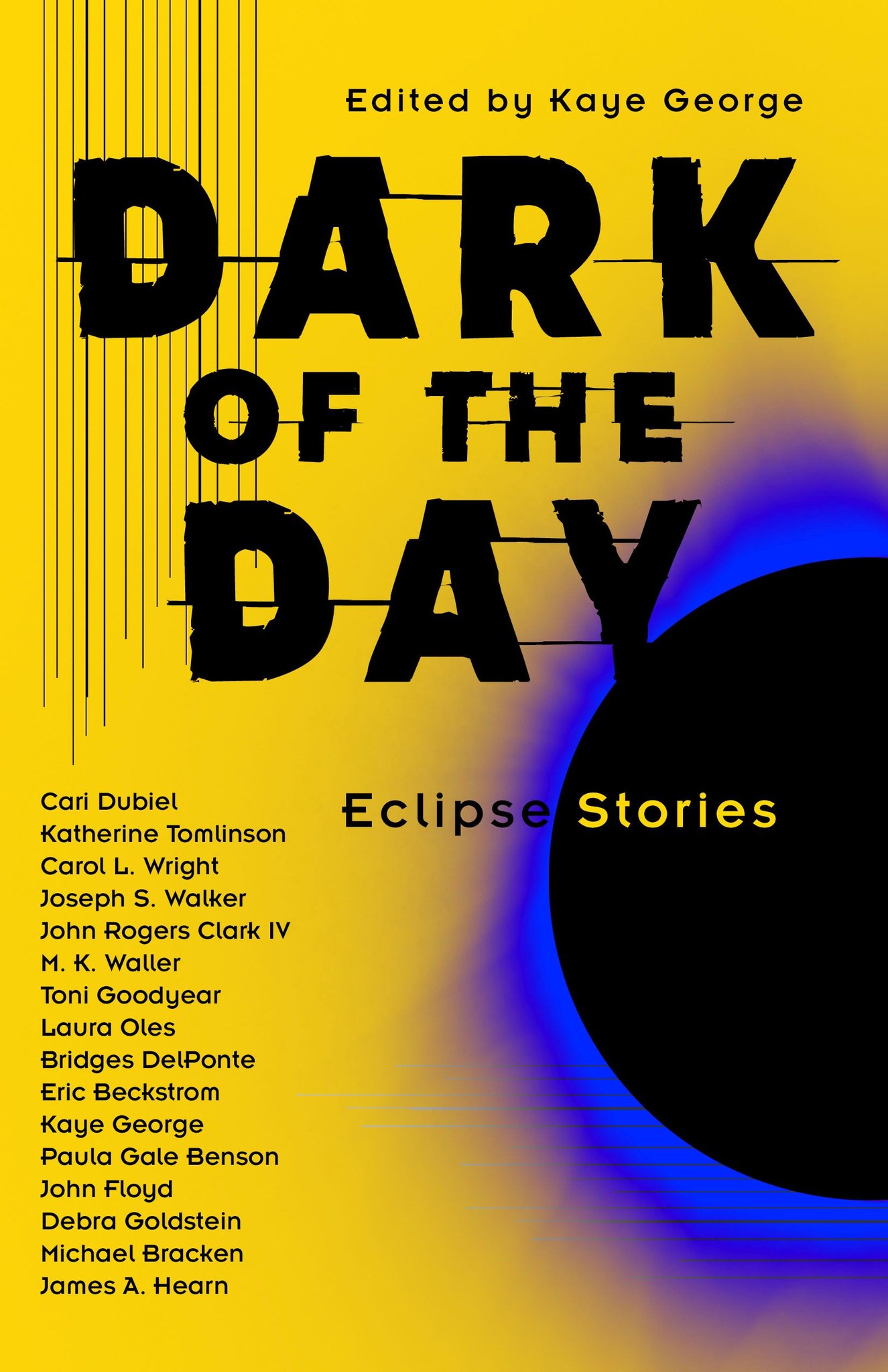
Kathy Waller [M. K. Waller] writes crime fiction, literary fiction, humor, memoir, and whatever else comes to mind. Her latest story, “Mine Eyes Dazzle,” which appears in Dark of the Day, was mentioned by Robert Lopresti as “The best mystery story I read this week” (Little Big Crimes, May 12, 2024).
Other short stories appear in other anthologies: the Silver Falchion Award winner Murder on Wheels, Lone Star Lawless, and Day of the Dark, as well as online. She is co-author, with Manning Wolfe, of the novella STABBED,
Memories of growing up in a small town on the San Marcos River in Central Texas, and life in a large extended family, inspire much of her work. She now lives in Austin.
Thinking today about Anais Nin’s statement, which she attributed to the Talmud–“We don’t see things as they are; we see them as we are”–I decided to write about how the idea applies to the way I read Donna Leon’s Inspector Brunetti mystery series. Then I remembered a post I wrote for Telling the Truth, Mainly, which serves as a lead-in. It isn’t really about R&J.
I’ll get to Brunetti next time.
*
One play. Twenty years.
***
When you reread a classic you do not see more in the book than you did before; you see more in you than was there before. ~ Clifton Fadiman
The first years I studiedRomeo and Juliet with my high school freshmen, when I was in my early twenties, I followed the Star-Cross’d Lovers school of literary criticism: Romeo and Juliet, two innocents, their eyes meeting across a crowded room, she teaches the torches to burn bright, he’s the god of her idolatry, he wants to be a glove upon her hand, she wants to cut him out in little stars—but the cruel world conspires to bring them down.
The way Juliet’s father tells her to thank him no thankings nor proud him no prouds but get to that church on Thursday next and marry Paris or he’ll drag her thither on a hurdle—what kind of father says that to a thirteen-year-old girl? Parents don’t understand. They don’t listen.
The kids might be a little quick to act, and goodness knows Romeo should have waited to talk to Friar Laurence before buying that poison. But who can expect patience of teenagers in love?
When I hit thirty, and had several years of teaching (and consorting with teenagers) under my belt, I shifted to the What Can You Expect When Teenagers Behave Like Brats? philosophy: Romeo and Juliet, a couple of kids in a hurry. He doesn’t even bother to drop in on his family, just runs off to crash Capulet’s party, proposes to a girl before the first date, insists on a jumped-up wedding, then gets himself kicked out of the city, and he still hasn’t been home for dinner.
She mouths off to her father, tells him what she will and will not do, and he’s just told her what a nice, rich husband–Paris, whom the Nurse says is handsome, “a man of wax”–he’s picked out for her. It’s no wonder he tells her to fettle her fine joints ‘gainst Thursday next or he’ll drag her to church on a hurdle. I mean, if you were a parent and your daughter spoke to you in that tone of voice, would you pat her hand and ask what’s wrong, or would you remind her who’s boss here?
If Romeo had just gone home in the first place, like any decent boy would have, instead of running off with his friends and crashing that party, this mess wouldn’t have occurred.
In fact, since Old Montague and Old Capulet had that very afternoon been sworn to keep the peace, they might have arranged a marriage between Romeo and Juliet—formed an alliance that way—and the whole of Verona would have lived happily ever after, and Montague would have been spared the expense of erecting a gold Juliet statue to honor her memory. Paris might have been a little put out at being jilted, but he’d have gotten over it. Kids! They don’t think.
Approaching forty, however, I detached a bit and developed the dogma of the Meddlesome Priest. Friar Laurence has no business performing a secret marriage between two minors without parental consent. He says he wants to promote peace, but he isn’t a diplomat. His field is pharmacology.
Furthermore, when Juliet informs him she’s about to acquire an extra husband, why doesn’t he go right then to her father and tell the man she’s married? Capulet wouldn’t have been pleased, but he wouldn’t have gone to the trouble of dragging Juliet on a hurdle thither. And he’d have gotten over it.
Instead, the Friar gives Juliet a sedative and stuffs her into a tomb with a passel of her relatives in varying stages of disrepair.
The Friar appears to mean well, but it’s also possible he intends to take credit for being the brains behind the peace accords.
Bunglesome or corrupt—the end is the same. With role models like this–a priest of all things–are we surprised that children run amok?
Soon after the last epiphany, I ended my stint as a classroom teacher. But I’ve wondered what would have happened if I’d continued studying Romeo and Juliet with students year after year.
Would I have had new insights? Developed new interpretations? Uncovered new layers of meaning?
How much more would I have shared with my students? Would I have continued to teach them respect and reverence? Would I have led them down the primrose path of dalliance and left them mired in levity?
How much more would I have seen in myself?
*
This post first appeared on Telling the Truth, Mainly on April 22, 2019, under the title “T Is for Time: #atozchallenge.” Later it was reposted under the title “AtoZ Challenge: R Is for Romeo, et al.”
Remarkable how a stolid, stick-like, straightforward
can, in a only a year, evolve into a curving, curling, growling dog’s name.***
###
***Nurse. Doth not rosemary and Romeo begin both with a letter?
Romeo. Ay, nurse; what of that? both with an R.
Nurse. Ah, mocker! that’s the dog’s name. R is for the dog: no; I know it begins with some other letter:–and she hath the prettiest sententious of it, of you and rosemary, that it would do you good to hear it.
No matter what they tell you, Texas isn’t all cowboys and cactus and bullets and brush.
Texas is also BOOKS, and this weekend there’s proof: This morning, the Texas Book Festival opens on the grounds of the State Capitol in Austin. Exhibitor tents and food trucks will line N. Congress Avenue from Colorado Street, on the west side of the Capitol, clear down to 8th Street. An international slate of authors—John Grisham, Malcolm Gladwell, Sarah Bird, Elizabeth Crook, Alexander McCall Smith, and Terry Tempest Williams among them— will speak and sign books, and appear on panels. There will be books for display and for sale.
BULLET BOOKS is the brainchild of Manning Wolfe, author of the Merrit Bridges, Lady Lawyer series. Each Bullet Book is co-authored by Manning and another writer of crime fiction. The books are short, designed to be read in two to three hours—the length of a plane or train ride, or an afternoon spent lying under an umbrella on the beach.
Twelve Bullet Books will be introduced today. They range from mystery to suspense to thriller. Among the characters are spies, lawyers, terrorists, gun runners, trash collectors, and teachers. Settings range from courtrooms, to classrooms, to comedy clubs, to embassies.
A trailer for each book appears on the website. Here’s a look at the trailer for Bullet Book #1, Bill Rogers’ KILLER SET DROP THE MIC:
Trailers for the other books can be viewed on the Bullet Books website (links below). Follow the link to Youtube if you’d rather watch there.
By the way, Bullet Books Speed Reads will meet an even wider audience next weekend at Bouchercon, the largest annual international convention of mystery readers and writers, which will take place in Dallas, October 31-November 3. Billy Kring, Laura Oles, Kay Kendall, Jay Brandon, Bill Rodgers, Manning Wolfe will participate in a Co-Authoring Panel, October 31 at 2:30 p.m.
Eleven Bullet Books authors will attend the convention. They’ll sign on November 2 at 3:30 p.m.
If you’re anywhere near Austin this weekend, stop by the Capitol and see a side of Texas that doesn’t get nearly enough press.
And be sure to visit the Starpath booth and let Manning Wolfe and the other authors introduce you to Bullet Books Speed Reads.






 Texas is also BOOKS, and this weekend there’s proof: This morning, the
 Ink-Stained Wretches