When Disinformation Leads to Death

N.M. Cedeño

Here in Texas over four hundred people have contracted measles in the past few months, resulting in the death of at least one child. Most of these cases were preventable with a vaccine. So why weren’t the victims immunized? Some are infants, too young to be vaccinated. A few may be people with compromised immune systems or other medical conditions that prevent them from receiving vaccines. However, the majority aren’t vaccinated because of conspiracy theories and false information being fed to parents, making them fear the vaccine.

Back in the 1990s, a British doctor, whose medical license was later revoked because of the medical hoax he perpetrated, falsified a study claiming to have identified a causal link between the vaccine for measles, mumps, and rubella, (the MMR vaccine) and autism. He published a massive lie that spread like wildfire and caused vaccination rates in Europe and the United States to plummet. By the time the fraud was revealed, the damage had been done.

As a parent of a child on the autism spectrum, I am absolutely certain the MMR vaccine did not contribute to the condition. I spotted variances in my child’s development by the time he was six months old. I knew something was different about the way he did and did not focus on motion months before he was given his first MMR vaccine. No vaccine caused his neurological differences. The most likely cause is a complex interaction of genetic factors.

Measles and rubella are not diseases that should ever be allowed to spread unchecked. Measles can kill, and when it doesn’t kill, it can obliterate the patient’s immune system, leaving them susceptible to a variety of infections. In countries where vaccination rates for measles are low, children who survive measles frequently die of other illnesses within a short time after having measles. Measles is also one of the most contagious diseases in the world, able to linger on surfaces and in the air for hours after an infected person has left the area.

William Morrow Paperback, reprint edition cover 2004

Rubella, depending on the stage of a woman’s pregnancy when she contracts the disease, can cause blindness, deafness, heart deformities, developmental abnormalities, and death for babies. Many infants only survive a short period after birth due to the damage caused in utero by rubella, also known as German measles. A well-known example of the harm caused by rubella was the case of actress Gene Tierney’s daughter, Daria, which inspired Agatha Christie’s novel The Mirror Crack’d from Side to Side.

Growing up, I heard the story of my uncle’s birth from my grandmother more than once. She contracted rubella while pregnant and decided not to go to the doctor for her check up that month because she knew that the doctor would push her to abort. In 1950s America, doctors saw so many deaths of newborns caused by rubella that they frequently advised a mother to abort if she contracted rubella while pregnant.

My grandmother made a choice, believing one should always give life a chance, knowing that her baby might not survive. My uncle was born at around three pounds, his growth and development stunted by the disease. He was deaf in one ear, had heart problems, had very poor vision, and only grew to about five feet tall. But he survived and lived to the age of 70, managing to get a driver’s license, go to community college, and work a variety of jobs.

As a parent, I have met other parents who chose not to vaccinate their kids. That decision, made by otherwise intelligent and educated people, still shocks and disheartens me. Reading that the parents of the child who died from measles still say that they wouldn’t have vaccinated their child scares me. How could they possibly think that the vaccine is somehow worse than the death of their child?

This current measles crisis is yet another example of conspiracy theories and false information being promoted over facts and truth to the detriment of society. Disinformation campaigns, conspiracy theories, and the current general distrust of any authority inspired me to write my latest story, entitled “Murder by Alternate Facts.” In the story a young woman named Arlene stumbles upon a wreck on a lonely country road and is forced to make a choice affecting who lives and who dies. The repercussions of Arlene’s choice inspire conspiracy theories, dividing her hometown and leading to murder.

“Murder by Alternate Facts” appears in the Murderous Ink Press anthology Crimeucopia: Chicka-Chicka Boomba! from editor John Connor.

*****

N. M. Cedeño is a short story writer and novelist living in Texas. She is active in Sisters in Crime- Heart of Texas Chapter and is a member of the Short Mystery Fiction Society. Find out more at nmcedeno.com.

Year End Assessments 2023- A Review

By N. M. Cedeño

December again. Time to assess this year’s writing. I’ll start off by saying, the year didn’t go as well as I’d hoped, but not as badly as I’d thought either. A number of issues combined to throw me off my schedule and destroy my focus, but I have learned some new things.

For instance, I learned that x-rays and sonograms successfully diagnose kidney stones about eighty percent of the time. If that path to diagnosis fails, doctors search for other causes. It may take six or eight months of tests to explore other possible diagnoses before the problem can be correctly diagnosed. This second path to diagnosis by eliminating other options is not one that I recommend. It prolongs pain, destroys work productivity, and ruins peace of mind.

I also learned in September that baseball-sized hail falling like rain can strike with no warning. We were extremely lucky no one was outside when the assault from the sky began or someone might have been killed. Repairs are ongoing (roof, deck, gutters, garden shed, light fixtures, A/C, windows, screens, cars, etc.). As of this writing, I am awaiting yet another contractor to complete yet another repair. Dealing with three separate insurance adjustors, talking to contractors, and scheduling repairs consumed all my time for October, then half of my time for November. Trying to get active teenagers to extracurricular events with cars out of commission was another challenge.

But without some strife we wouldn’t appreciate when things are actually going smoothly. Over the years, I’ve learned to take notice and enjoy the times when everything is running like a well-oiled machine. The easy times don’t last, but neither does the strife.

Now that I’ve covered the excuses, I’ll get to the writing numbers:

Stories submitted as of late November: thirty-five.

I plan to reach thirty-six or more before the end of December. I had hoped to submit four stories per month on average, but that was not to be this year. However, submitting an average of three stories per month in a difficult year is a victory in my book.

Acceptances were low this year, too– so far only two. I have twelve submissions still pending, so maybe I’ll see more acceptances in the new year.

Publications of stories: four.

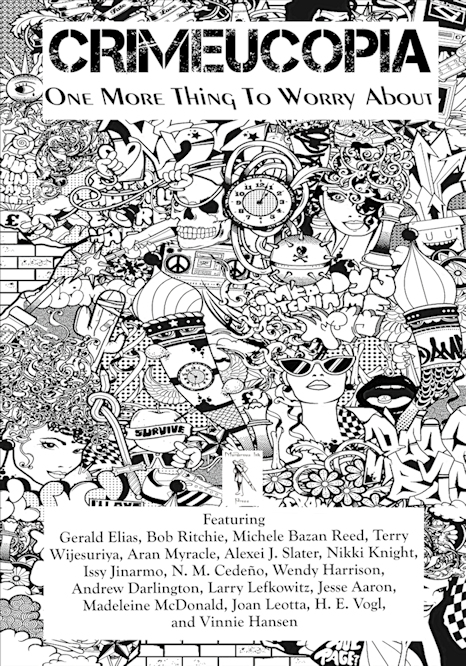
Three of my stories appeared in Black Cat Weekly courtesy of editor Michael Bracken. One appeared in an anthology-“Danger at Death’s Door” in Crimeucopia: One More Thing To Worry About from editor John Connor.

For the moment, I have one publication pending, a short story for an anthology coming out in the spring of 2024.

I did receive two invitations to contribute stories to projects this year. One I had to turn down thanks to a short deadline and the ongoing strife. The other offered a deadline far enough in the future that I could easily say yes. Also, a new editor asked me to contribute a story to a project, which I really appreciate. I had intended to reach out to new editors this year, but with the strife, that plan was postponed.

For 2024, I’m looking forward to setting new writing goals and working with more editors. I plan to watch my middle child graduate from high school in the spring and start college (!) in the fall, and see my youngest through driver’s license testing, the end of junior year, and the start of senior year (!) of high school. Also, someone else (Hooray, Pat Kelly!) will be taking over the duties of president for my Sisters in Crime Chapter, leaving me more time for writing. I’ve been on the board in various capacities since 2016 or 2017, and it’s time to bring in fresh blood. Here’s looking forward to a busy, productive 2024!

*****

N. M. Cedeño is a short story writer and novelist living in Texas. She is active in Sisters in Crime- Heart of Texas Chapter and is a member of the Short Mystery Fiction Society. Find out more at nmcedeno.com

Writing “Reaching for the Moon” for Crimeucopia: Say What Now?

by N. M. Cedeño

Although I may veer off into other areas, my reading pile usually comprises two main categories of books: mysteries and histories. Sometimes when I’m writing, those two categories collide, and I write historical mysteries. Two of my historical mystery short stories will be published in March and April 2022.

Available March 2022 from Murderous Ink Press

The first story, “Reaching for the Moon,” is part of an anthology edited by John Connor entitled Crimeucopia: Say What Now? from Murderous Ink Press. The second story, entitled “Nice Girls Don’t,”  will be published by Down & Out Books in Groovy Gumshoes: Private Eyes in the Psychedelic Sixties edited by Michael Bracken. 

I wrote about the inspiration for “Nice Girls Don’t” in my last post. Today, I’ll review what inspired “Reaching for the Moon.”

Moon landing, NASA photo, from Pixabay.

I’m a fan of the history of space exploration. From Hidden Figures to Apollo 13, I’ve always been fascinated by the massive effort behind sending the first people into space and bringing them home safely. The space program’s tragedies – from Apollo 1 to Challenger and Columbia – and triumphs – from the Mercury Program to the International Space Station – are the stuff of legends.

Anyone who has read anything about the first US astronauts knows that the test pilot / astronaut lifestyle took a toll on marriages. Marital infidelity was common among the astronaut corps who were frequently away from home for training. Consequently, the divorce rate after leaving NASA was very high. But, NASA wanted to present a wholesome, clean-cut image of their astronauts that didn’t include divorce or infidelity. Life Magazine did full spreads on each of the first astronauts that presented the men as squeaky-clean Boy Scouts with perfect home-lives. This discrepancy between the public persona and private reality of the astronauts inspired ideas about the possibility of blackmail.

Because I live in Texas, I’ve toured the Apollo mission control center at Johnson Space Center in far south Houston several times. Anyone who has visited Space Center Houston knows that a mere thirty or so miles farther south down Interstate 45 is Galveston Island on the Gulf of Mexico.

Walking on a granite jetty, Galveston Island, Cedeño family photo 2021

Galveston Island has its own remarkable history. The barrier island was used as a pirate base before it became a major port city in the 1800s. Then, the 1900 Hurricane nearly obliterated the city, forcing port activity to move inland to Houston. The island became a vacation and pleasure spot infamous for ignoring the laws against drinking and gambling during the Prohibition era. Galveston enjoyed a lawless, mafia-run heyday between 1920 and 1950. Much of the illegal activity centered on the Balinese Room, a Maceo Family owned gambling joint and restaurant that perched on a pier over the Gulf and drew top talent from Hollywood, including Frank Sinatra and Bob Hope, to provide entertainment for guests.

The space center’s proximity to Galveston made me wonder: what if a 1960s astronaut wandered south to Galveston Island to see the places once made famous by Hollywood stars and mobsters and got himself into trouble? What if he had to seek the aid of a private detective to resolve the issue? And so, with a few name changes here and there to protect the innocent or the guilty, as the case may be, my story “Reaching for the Moon” was born.

I’m thrilled to have my story published with so many other great stories in Crimeucopia: Say What Now?, the 10th anthology in the Crimeucopia series from Murderous Ink Press and editor John Connor.

****

For additional historical reading, I recommend Hidden Figures by Margot Lee Shetterly, Moon Shot by Barbree, Slayton, and Shepard, Failure Is Not an Option by Gene Kranz, Light this Candle: the Life and Times of Alan Shepard by Neal Thompson, and Isaac’s Storm by Erik Larson.

N. M. Cedeño is a short story writer and novelist living in Texas. She is active in Sisters in Crime- Heart of Texas Chapter and is a member of the Short Mystery Fiction Society. Find out more at nmcedeno.com.