JEWELS AND LEGENDS IN HISTORY

By

Francine Paino, a.k.a. F. Della Notte

Research for book four of the Housekeeper Mystery Series brought me to legends and myths connected to jewels and gemstones, many of which have traveled a long way in storytelling traditions. Often, a mystical aura goes beyond the material value of some precious stones and metals, and these stories show us how jewelry is not only beautiful to look at but also carries the power of love, misfortune, and protection. Some of the most famous are The Curse of the Hope Diamond, The Myth of Pearls, and The Legend of Cleopatra’s Emeralds.

According to the legend, the curse of the Hope Diamond originated when the diamond was stolen from a statue of a Hindu god in India. The priests of the temple placed a curse on whoever possessed it, and throughout history, many who owned it have suffered great misfortunes, including King Louis XVI and Marie Antoinette.  

Cleopatra, the last queen of Egypt, is said to have loved emeralds., which were symbols of fertility and protection in her time. Legend has it that Cleopatra possessed an enormous and valuable emerald that she wore often to show her power and divine status. The emerald was lost after her death, and its whereabouts have never been discovered.

The Myth of Pearls. Called Tears of God in many cultures, pearls became symbols of purity and femininity. In Greek mythology, pearls are said to be the tears of the goddess Aphrodite and were often used as wedding gifts to symbolize purity and happiness in marriage.

In Rome, onyx, especially sardonyx, which is a layered gemstone composed of bands of sard and onyx, both varieties of chalcedony (a variety of quartz (silicon dioxide) known for its fine, fibrous structure and waxy luster). Onyx is known for its striking contrast of colors, typically reddish-brown alternating with white or black onyx layers. This banded structure made it popular for jewelry and carvings and was considered a talisman for protection and good fortune. Onyx was favored by the Roman army. Soldiers often wore sardonyx amulets carved with images of Mars, the Roman God of War, or Hercules. The Romans believed that wearing onyx or sardonyx would instill bravery and courage in battle, bring good luck, and ensure success in combat while protecting the wearer. Many of these legends and myths began in connection with historical events, and such is the legend of the Miltiades Cross.

THE HISTORY: It began on October 28, 312 C.E. Miltiades, the first Christian bishop of Rome, was revered by his community and addressed as papa or father by his followers. He was a small man of 62 years and of humble means, working in the Roman marketplace. When he was summoned from his hiding place, a small house in an alleyway in Trastevere, by two centurions, he assumed he was about to meet his end since Christianity was outlawed in Rome and punishable by death. Wearing a threadbare robe, the poor little man made the sign of the cross and prepared to meet his fate as a martyr for Christ. He followed his Roman guards out into the sunlight and came face to face with the six-foot, imposing figure of Emperor Constantine, flanked by hundreds of soldiers, all of them, including the emperor, covered in blood and grime. They’d come from the battle of the Milvian Bridge, where Constantine had defeated his imperial rival, Maxentius. Constantine was now the sole ruler of the entire Roman Empire.

To Miltiades’s great shock, Constantine greeted him with a hug and had him wrapped in a purple robe. The emperor explained that he followed the instructions he’d received in a dream.,the night before the battle. He was told to paint the Chi Ro on his soldiers shields, and “in this sign, conquer,” and he did. After his victory, Constantine decided to make the god of the Christians his god and the god of the Roman Empire.

Instead of the gruesome death Miltiades expected, the emperor asked to be brought to the spot where the bones of Peter, Christ’s Apostle, were buried. In a little cemetery outside of Rome, Constantine dropped to his knees and swore to build a great basilica over those bones. Then, the emperor took the dazed bishop to a grand palace on Lateran Hill and decreed that, henceforth, all successors of Peter would live in that palace.

THE MYTH: Two weeks after Constantine’s conversion, Miltiades was again summoned to the Emperor. Terrified that Constantine had changed his mind, Miltiades again prepared to meet the fate. Trembling, the old bishop appeared before the emperor and knelt in respect, but Constantine pulled him upright. Around Miltiades’s neck, the emperor hung a gold chain with a gold cross studded with Servilia pearl, the most valued gemstone in Rome. Constantine then decreed that this cross should be handed down to all succeeding bishops of Rome. It was the cross Constantine had envisioned in the shape of the Chi Ro. Legend, has it that the cross was last seen on Pope Innocent I in 417 C.E. when he fled Rome before the invasion of the Visigoths. Over the following 1600-plus years, the position of the Catholic Church was that the cross either never existed or was taken by non-believers and refashioned.

In book four of the Housekeeper Mystery Series, Murder in the Cat’s Eye, Father Melvyn and Mrs. B. take a group of parishioners to Rome to study the lives of ancient Christians, where they become random victims of a criminal enterprise involving jewel theft and murder. This high-stakes web of deceit blurs the line between upholding and breaking the law, straddled by a police inspector when a not-so-scrupulous antiquities dealer disappears and a young woman is murdered. Organized crime, a member of Rome’s elite, and the Catholic Church face off when it’s discovered that among the stolen jewels is what may be the ancient and priceless Miltiades Cross, given to the first bishop of Rome by Emperor Constantine in 312.

Watch for Murder in the Cat’s Eye in the fall of 2025.

warfarehistorynetwork.com

The Vatican Exposed: Money, Murder, and the Mafia, by Paul L. Williams  pg. 10

Where Did This Come From?

Today’s post is by our friend and former Austin Mystery Writer Kaye George, author of several successful mystery series. When I asked Kaye to do a guest post, I told her to pick her own topic. She’s chosen to write about her newest project, a departure from the mystery.

***

Kathy Waller gave me free rein, so I can write whatever I want here, right? Okay, okay, I’ll stick to writing about writing.

My latest project is foremost in my mind. SOMEONE IS OUT THERE came out in April, but it’s still getting noticed, which makes me so happy. I’ve done several mystery series, cozies and traditional, but got it into my head one day that I could write a suspense novel. It does kinda make sense, since I love to read them.

I’m trying to remember where the first seed for this came from, but I don’t really know, now that it’s done. I do know what went into it. I wanted to use a disaster that occurred in Ohio when we lived there. We lived in Dayton for about six years and, one day when the sky looked ominous and my husband was on the golf course, a disaster struck Xenia, a small town nearby—a town we used to drive to for chopping down our Christmas trees on a farm nearby. A vicious tornado struck the town in 1974, killing and injuring many, and wiping out, obliterating at least half of that town. That year they had what they called the 1974 Super Outbreak, one of the worst tornado seasons in US history. I figured it would make a good backdrop to a tense story.

To be honest, I also fed in some of the stories the people in Wichita Falls told me about the similar disaster they had there in 1979. We lived outside that town in Holliday years after that, but they people who had gone through it had vivid memories of every second. We had our own experiences there, too. Our second night in Holliday, there was a straight line windstorm with 90 mph winds that took off many roofs and caved in the school gymnasium, which had just been evacuated, fortunately. The night we moved out, a tornado touched down a mile away.

Anyway, enough about storms. I also needed to work up some stormy characters. I used my knowledge of nursing (from my mother, who was a nurse, and from my nurses’ aide experience) to create my main character. Unbeknownst to me, I used subconscious knowledge to create her name, Darla Taylor. I had a good portion of the book written when I realized I have a Facebook friend named Darla Taylor! I had used her name! I was mortified, and messaged her about it. She was actually okay with that, so I kept going. And gave her a copy when the book was finished. She liked it and reviewed it! Whew!

Stalking seemed like a scary thing to build the plot on, so I did that, keeping the identity of the stalker hidden until the end. I threw in my son’s family dog, Henry, a big chocolate lab (and renamed him Moose), and gave Darla a hobby of archery, since I used to love doing that.

You can see that so much of the book came from my life, because, where else would it come from? Although I have never been stalked. And hope it never happens.

This site at Rowan Prose Publishing has links to the great trailer they made and places to get the book. https://www.rowanprosepublishing.com/kaye-george

And didn’t they do a great cover?

Thanks for having me here!

***

Kaye George is an award-winning novelist and short-story writer. She writes cozy and traditional mysteries, a prehistory series, and one suspense novel, which is her seventeenth book. Over fifty short stories have been published, mostly in anthologies and magazines. A horror story will come out in 2026. With family scattered all over the globe, she makes her home in Knoxville TN. You can find out more here: http://kayegeorge.com/

The Research Rabbit Hole: Jewel Theft 1950s-1960s

I’ve been researching background for another story featuring my character Jerry Milam, a World War II veteran and ex-cop turned PI. In looking for crimes for my detective to solve, I started digging into old newspapers for information on jewel thefts. I chose the topic because I’d read about the robbery of the American Museum of Natural History in New York in 1964. While the robbers were later caught, only ten of the twenty-four stolen gems were recovered. In researching that theft, I discovered that the Witte Museum in San Antonio was robbed in 1969, with a thief smashing a glass display case in order to snatch the forty-nine carat McFarlin Diamond, a canary yellow, emerald cut stone described as being the size of a hen’s egg, which was also never recovered.

Then, I fell down the rabbit hole.

Back in the days when J. Edgar Hoover was still in charge of the FBI, jewel thefts were all the rage in crime. Jewels, once removed from their settings, were impossible to identify because, unlike today, they had no microscopic serial numbers etched on them. Etching of jewels for identification purposes began in 1983. While watches had serial numbers, most people didn’t bother to make a note of theirs. Fences were happy to purchase stolen jewels and watches because they were so hard to link back to the original owners. Most gem stones were easily recut or reset and resold, vanishing forever.

Most jewel robberies in the 1950s and 1960s were committed by stealth, leading to the image of the lithe cat burglar crawling over rooftops firing the popular imagination. Alfred Hitchcock even made the movie To Catch a Thief, released in 1955, with Cary Grant playing a retired jewel thief known as the Cat.

Between 1959 and 1967, Lauren Bacall, Winston Churchill, Sophia Loren, Eva Gabor, and Yul Brenner, along with other famous and wealthy people, were relieved of their jewels by thieves. With the exception of Eva Gabor, none were present at the time of the theft. Thieves, likely the same ones who robbed the American Museum of Natural History’s gemological exhibit a few months later, waited for Eva Gabor and her husband to return to their hotel room in order to steal her twenty-five-thousand-dollar diamond ring, which they had been unable to locate while she was away from the room. They pistol whipped and bound Ms. Gabor and forced her husband to retrieve the ring from the hotel safe before making their getaway.

If you are wondering why one ring was enough for the thieves to risk adding armed robbery and kidnapping to the charges against them, consider that the average income in 1965 was less than seven thousand dollars a year. A twenty-five-thousand-dollar ring was worth several years income to most people.

My research led me to realize that even without serial numbers and etched identification codes, certain jewels would be easier to trace than others. Which jewels might be more traceable? Cabochon star rubies and sapphires. A rounded, polished shape, called a cabochon, was how all jewels were prepared before cutting was developed for gemstones. Opals are still prepared and set as cabochons.

Star rubies and star sapphires exhibit a phenomenon called asterism, a star pattern visible when light hits the stone. The star is created by long inclusions inside the stone. Stones with asterism are rounded and polished as cabochons, not cut, to preserve the star within them.

The Edith Haggin DeLong Star Ruby
By Vicpeters – Own work, CC BY 4.0, https://commons.wikimedia.org/w/index.php?curid=165353250

Star rubies and star sapphires are valued based on the clarity and size of their stars, the color saturation and transparency of the stone, by their shape, and by their inclusions and cloudy areas. These same features make the stones more easily traceable and identifiable. While other gems can be recut and reset to disguise them, star rubies and star sapphires can’t be cut because the rounded shape is what allows the star to be seen.

Is it any surprise that the most valuable stones recovered from the American Museum of Natural History robbery were the Star of India, one of the largest blue star sapphires in the world, and the DeLong Star Ruby, while the Eagle Diamond was never found?

That’s enough rantings from the rabbit hole.

*****

N. M. Cedeño is a short story writer and novelist living in Texas. She is active in Sisters in Crime- Heart of Texas Chapter and is a member of the Short Mystery Fiction Society. Find out more at nmcedeno.com.

A Well. A Story.

By Dixie Evatt

I recognize that sometimes I can be excessively literal. That’s why when Julia Cameron reminds us to make time to fill our creative well, I picture an actual old-timely water well. In my mind’s eye, ideas, quotes, games, puzzles, cartoons, pictures, and music pour into the well from every direction – a rainstorm of colors, smells and sounds.

I was first introduced to the concept when I joined an Austin creative community, led by the inestimable Ann Ciccoletta, Artistic Director of Austin Shakespeare. The group draws inspiration from Cameron’s self-help classic, The Artist’s Way – A Spiritual Path to Higher Creativity. Since its initial publication in 1992 it has been reprinted more than forty times and served as a catalyst for dozens of other inspirational works by Cameron. Her message is intended for everyone– writers, artists, photographers, actors, composers, dancers, poets, musicians, singers, and everyday folks alike alike — who want to unlock their inner creative self. Her advice:

Filling the well involves the active pursuit of images to refresh our artistic reservoirs. Art is born in attention. Its midwife is detail… In filling the well, think magic. Think delight. Think fun. Do not think duty. Do not do what you should do …Do what intrigues you, explore what interests you; think mystery, not mastery. A mystery draws us in, leads us on, lures us.

Once married to Martin Scorsese, Cameron’s life was a rollercoaster of good times-bad times-terrible times until she ultimately found sobriety. In an article about the 30th anniversary of her landmark book, The Guardian says:

Inspired by the Alcoholics Anonymous model, the book offers a programme for “artistic recovery”.

Cameron has benefited from her own advice with twenty-three titles on creativity to her credit along with seven books on spirituality; three works of fiction; one memoir; seven plays; five prayer books; four books of poetry; and one feature film.

The prompt for that bombardment of ideas to “fill the well” is can be the weekly Artist Date – another Cameron recommendation consisting of making an appointment with yourself to intentionally seek out sources of inspiration. In gardens. In museums. In craft stores. In coffee shops. Anyplace that can excite the senses is a destination for a date with oneself.

I find that it’s often a good idea to pair these dates with something to nudge you forward. For instance, I subscribe to Austin Kleon’s weekly newsletter (it drops into my email each Friday). It lists his “ten things worth sharing” with brief commentary and links to articles, songs, books, films, podcasts, events, and other content. Kleon is an Austin-based, best-selling author (Steal Like an Artist) who, like Cameron, writes to inspire others. More can be found at his website: https://austinkleon.com.

I was reminded of these never-ending sources of inspiration when, in late April, I had the good fortune to share a table with Spike Gillespie at the Austin Public Library’s second annual Greater Austin Book Festival (aka GAB Fest). Gillespie is well known in Austin writing circles for her unflinching commentary and multiple books. She lives on a ranch outside the city where she hosts gatherings for writers to find inspiration.

We had a chance to chat as we watched readers and fellow authors mill around the book festival, occasionally dropping by our table to ask about our book displays. Then a little girl – probably no more than seven or eight years old — approached to help herself to our free mints. She kept picking up one after another until her hands couldn’t hold anymore. After she walked away my conversation with Gillespie built on the encounter …and how often desire can exceed capacity. From there we talked about the importance of being a listening writer. To observe. To absorb. To listen.

I thought about this later and remembered what Cameron advised writers in her 2021 book, The Listening Path: The Creative Art of Attention:

We do not struggle to think something up; rather we listen and take something down. Very little effort is required; what we are after is accuracy of listening.

Inspiration can be right under your nose. It can come over the transom unexpectedly. It can spring from an unplanned conversation. It may drop into your email. Watch for it so you can fill the well.

CAPTIONS

Well — AI Generated

Photo — Dixie (L) and Spike (R) 2025 GABFest

The Tincture of Time

By Helen Currie Foster – June 9, 2025

I’ve always loved Guy Clark’s version of “Stuff that Works.” Dublin Blues, 1995.

https://www.youtube.com/watch?v=2mprD2MN5vo

Listening, I can just see, just feel, that “old blue shirt” that “suits him just fine.” I can imagine the old boots that let him “work all day” and then go “dance all night.” And of course that friend who “always shows up when the chips are down”––I’m thinking, my bestie. Just hearing about the shirt, the boots, the friend always leaves me with the same settled, restful confidence he’s describing. “Stuff that works!”

“Brown paper packages tied up with string” may have undeniable charm, “stuff that works” means stuff I turn to, go back to, and rely on. Like old travel pants with pockets that zip, soft shirts without a scratchy label, shoes that just carry me along, soles not too thick or thin.

What about you? Things that keep working, that stand the test of time? The pens that always work, the ink you like, the just-right-feel in your hand as you write? The car that always starts, the recipe you can count on?

Part of the charm of “stuff that works” is reliability – working each and every time.

Time, that deep human preoccupation! Is time reliable? Time messes with us. Time stands still. Time passes. Time flies. Time heals. Time runs out. Time grows short. The time changes…and times change. “Time, like an ever-flowing stream…” Sometimes an hour feels interminable; sometimes an hour passes in a flash. Albert Einstein’s theory of general relativity says that even in the universe, time is not constant, but is influenced by gravity. Yikes! (says the English major).

Writers struggle to analyze time’s impact on us. Just a couple of examples––Anthony Powell, A Dance to the Music of Time; Vladimir Nabokov, Speak, Memory;Virginia Woolf, particularly the “Time Passes” section of To the Lighthouse. Historians try to make sense of the impact of events over time, like Drew Gilpin Faust in This Republic of Suffering, on death and the Civil War.

Poets remind us of their mortality—and hence our own. Here’s Robert Frost, in Ten Mills, Part II, THE SPAN OF LIFE, from A Further Range (Henry Holt and Company, 1936):

The old dog barks backward without getting up.

I can remember when he was a pup.

Or Billy Collins at the beginning of “Life Expectancy” in Whale Day (2020):

On the morning of a birthday that ended in a zero,

I was looking out at the garden

When it occurred to me that the robin

On her worm-hunt in the dewy grass

Had a good chance of outliving me….

T.S. Eliot begins East Coker : “In my beginning is my end,” then:

…there is a time for building

And a time for living and for generation

And a time for the wind to break the loosened pane

Ad to shake the wainscot where the field-mouse trots

And to shake the tattered arras woven with a silent motto.

Sebastian Junger reflects on near-death experiences, including his own: In My Time of Dying (2024).

Of course animals can be aware of time. Right? The three donkeys– Sebastian, Amanda, and Caroline ––appear promptly at the gate in front of the house at 11:30 a.m., and again at 4:30 p.m., which, they are confident, are the hours when carrots ought to be offered. We know animals can mourn the loss of a member of their pod, their herd, their litter. But do they worry about their own mortality? Do our friends the non-human primates? Well, maybe! Um, time will tell! https://bit.ly/4mZqi4k

To be human is to be aware of our own mortality. And for humans, time is both reliable—tick, tock—and unreliable: we cannot know what the future holds. Fiction writers, however, get to make those decisions for their characters. In the mystery genre, we get to decide: who shall live? Who shall die? How, and why?

I’ve wrestled with these questions in my Alice MacDonald Greer Mystery Series: what happens next?Should I not  have killed a particular character? Should a new character survive and reappear in the next book? It’s a heavy responsibility! We readers can become quite attached to characters. In the last few weeks, finishing Book 10, I took refuge in Laurie King’s Mary Russell/Sherlock Holmes series. She created a character I found particularly appealing in The God of the Hive. https://bit.ly/449Lugn

But then? The book made me revisit the pain of losing a beloved character to—well, literary death. Remember Gus in Larry McMurtry’s Lonesome Dove? I still miss Gus… Gus, don’t ride over that hill!

In addition to night-time plunges into Laurie King land, I found banging on the piano a helpful respite from the writing process. But after two broken wrists in the past two years (careless, careless) I’d had to quit the beloved boogie woogie lessons and feared I’d never be able to play those strenuous pieces again.

My brother the physician, when asked by his siblings for advice, often prescribes “a little tincture of time.” It’s amazing how often that prescription works. This past week, after (really quite a lot of) tincture of time, I persuaded our century-old piano once again to play boogie-woogie pieces from the 1942 All Star Boogie Woogie Piano Solos! Pete Johnson, Meade “Lux” Lewis, Pine Top Smith, Hersal Thomas, Albert Ammons. Suddenly—how long is “a little tincture of time”?––finger memory began to return. Not all the way back yet, but still! Maybe I’ll get to resume piano lessons with that Austin treasure of jazz, boogie, country and everything else, Floyd Domino.

Charles Darwin was not known to rush into print. In 1837 in Edinburgh he presented his first paper concerning the action of worms “on the formation of mould,” a topic he studied for over forty years. Not until 1881, after two scientists pooh-poohed his theories, during the Great British Agricultural Depression (1873-1896) he published The Formation of Vegetable Mould Through the Action of Worms on the work of earthworms. Curious about their senses, their awarenesss, their work, he studied how worms could tug leaves into their burrows, eat and digest them, and then produce worm casts—millions of tons of richer soil. His query as to whether earthworms were sensitive to light “led me to watch on many successive nights worms kept in pots, which were protected from currents of air by means of glass plates.” His summary after all those years? Darwin doubts “whether there are many other animals which have played so important a part in the history of the world” as earthworms. Producing stuff that works…!

For so many of us, books are the “stuff that works.” Hurrah for reading!

Award-winning author Helen Currie Foster lives and writes the Alice MacDonald Greer Mystery series north of Dripping Springs, Texas, loosely supervised by the three burros. She’s drawn to the compelling landscape and quirky characters of the Texas Hill Country. She remains deeply curious about our human history and how, uninvited, the past keeps crashing our party. Follow her at http://www.helencurriefoster.com and on Amazon, and find the books at Austin’s BookPeople!

https://www.facebook.com/helencurriefoster

COOKIES, MYSTERIES AND MORE COOKIES – AND NOW PANETTONE

by

Francine Paino, a.k.a. F. Della Notte

Cookies. Who doesn’t love them?  Far and away, the American favorite is the Chocolate Chip cookie, a creation of the Wakefields of Massachusetts. (More on that later).  Over 53% of American adults prefer Chocolate Chip to other varieties.  But the most popular cookie worldwide, sold in over 100 countries… drum roll, please, is Oreo!  

The popularity of these cookies made me wonder what other fun facts I could find to entertain and inform, so I set out to investigate the origins of these sweet delights. 

Did you know Oreo is considered the number one copycat cookie? Two brothers, Joseph and Jacob Loose, battled for dominance over the Oreo. It was first produced by Hydrox. (Remember them? Or have I dated myself?) Then, it was baked and sold by the National Biscuit Company, now known as Na-Bis-Co.  See the link below for more information on the Battle of the Oreo.

With this in mind, one might imagine that the earliest origin of cookies began in a Western European country, perhaps in Great Britain, Ireland, or Scotland. It may have begun in one of the Romance Countries. The first was Italy, followed by France and Spain. In fact, the biggest surprise of all is that the cookie dates back to Persia, in the 7th century C.E.

It all began around 550 B.C.E. in the Persian Empire, conquered many times and most famously by Alexander the Great, who defeated Darius III. These luxurious little cakes were well-known, and as Persia evolved into a diverse nation in the Islamic world, its culture spread.  Sugar, which originated in the lowlands of S.E. Asia, was brought to Persia and cultivated there. It then spread through the eastern Mediterranean and into Europe, and bakers created beautiful cakes and pastries—for the wealthy, of course.

 After the Muslim invasion of Iberia in the 8th century, followed by the Crusades and the developing spice trade, cooking techniques and ingredients began to reflect different civilizations, especially the influence of Arabian cuisine. In fact, one of the most treasured desserts of Italy, the Cannoli originated in Sicily and reflected Arabic recipes – but back to the cookie.

According to culinary historians, the cookie’s origin had a more serious purpose. It was, in fact, a test cake. Small amounts of cake batters were dropped onto baking pans to test the temperatures of the ovens. These little cakes were the first crude thermostats used to determine when the fires, fueled by burning wood, were at the correct heat to cook without wrecking the food, and each region or nation developed its own little cakes for this purpose. Eventually, these little test cakes morphed into the dry, hard-textured cookies we know today, and the renaming of these little cakes first appeared in print in the early 18th century.  

Eventually, the cookie came to America via the British Empire, where they were and still are called biscuits. After the Revolutionary War, the newly minted Americans changed the name to further separate themselves from Great Britain. They chose the Dutch variation Koekje/koek, which evolved into the word cookie, but it wasn’t until 1924 that the most beloved of all American cookies was created: the Chocolate Chip.

Ruth Graves Wakefield, before marrying, was a graduate of the Framingham State Normal School Department of Household Arts (at that time not considered a slur or degradation of women). She worked as a dietician and lectured on food. In 1930 Ruth and hubby Kenneth purchased a Cape-Cod style inn, The Toll House, in Massachusetts. Constructed in 1709, the house was a stop-over for travelers in Colonial times where they paid their road toll, changed horses, and dined. Under the Wakefield’s ownership, the Toll House served traditional Colonial fare, and Ruth’s homemade desserts were quite popular. One day, in 1937, she discovered she didn’t have the baker’s chocolate required for her brown sugar cookies. Instead, she chopped a bar of Nestle’s Semi-Sweet Chocolate into tiny pieces, believing that adding them to the dough and baking would melt them, but the chocolate held its shape and softened to a creamy texture. The new cookie became very popular at the inn, and Ruth’s recipe was published in newspapers throughout New England, skyrocketing the sale of Nestle’s Semi-Sweet Chocolate Bars. Thus was born the Chocolate Chip Cookie. And there you have the basics of the origin of cookies. But what you might ask, has this to do with mysteries besides the secrets of various bakers and recipes?

Cookies, I have found, are not only popular desserts and treats; they play an essential and often intriguing role in many culinary mysteries, especially the cozies.  I logged onto Goodreads and searched mystery books with the word cookie in the title. I was intrigued to find 18+ pages, 20 titles to a page, representing approximately 360 books, excluding cookbooks and children’s books. And that was only on Goodreads. Some of the titles I found brought a smile to my face. In the interests of full disclosure, I haven’t read any of them, but among my favorite titles were A Tale of Two Cookies, And Then There Were Crumbs, Misfortune Cookie, Tough Cookie, and Murder of a Smart Cookie.  

Many authors of cozies and some traditional mysteries weave the art of cooking and baking into their stories. In the Housekeeper Mystery Series, set primarily in Austin, Texas, Mrs. B., a fine cook, keeps the priests of St. Francis de Sales supplied with her home-baked Italian Lemon Drop Cookies (Anginetti), while she and the pastor, Father Melvyn, help solve crimes and find answers.  For cookie enthusiasts, I’m happy to share my favorite Lemon Drop Cookie recipe. See the link below. (reprint from 2024) 

AND NOW – Add the most wonderful cake popular at Christmas: Pannetone. Why bother? Because it’s stories or myths are filled with as much drama, and richness as the bread itself.

Story One: In fifteenth century Milan, a young baker named Toni, accidentally created a sweet, rich loaf while preparing the Christmas feast for the Duke of Milan. During the banquet preparations for Ludovico Sforza’s Christmas banquet, the chef accidentally burnt the dessert. While the desperate chef agonized over the burnt dessert, a young kitchen assistant, Toni, grabbed leftover ingredients and a sourdough starter, and combined them into a sweet, rich leavened bread.

The Duke loved the bread so much that he named it “Pane di Toni,” (Tony’s bread) which eventually evolved into “Panettone”. 

Story Two: Ughetto and Adalgisa. A love story. Ughetto, a nobleman, disguised himself as a baker’s apprentice to win the heart of Adalgisa, the baker’s daughter, but his family opposed the match. When the baker’s assistant fell ill, to be near his beloved, Ughetto disguised himself to work in the kitchen assistant’s place. To impress her father, he came up with a combination of ingredients that enriched the original recipe being used, and it was a great success. Hence, the young man and his creation were recognized the young lovers were allowed to marry.

Story Three: Instead of Ughetto, we meet Sister Ughetta, a nun who lived in a poor convent. To brighten their Christmas, Sister Ughetta came up with a new cake then traced a cross in its dough with a knife. When the cake cooked, the rounded top where the cross was cut, opened revealing the treats contained inside.

Whichever story tickles your fancy, Panettone is a much loved dessert bread among Italians. It’s given as a gift, and Christmas wouldn’t be complete without it. The only mystery here is whether or not any of the stories of its origins are true.

You can buy it or try the recipe in the Bake from Scratch link.

Happy munching and happy reading.   

http://www.thenibble.com/reviews/main/cookies/cookies2/cookie-history2.asp

May is Upon Us! : A Spring Report

N.M. Cedeño

Derringer Awards: Short Mystery Fiction Society

I spent part of April reading to vote for the Derringer Awards and to come up with my nominations for the Anthony Awards. The Derringer Award Winners were announced May 1 by the Short Mystery Fiction Society. I’m happy to recommend all of the Derringer Awards winners to anyone looking to dip their feet into the world of mystery short stories. If you have time, read all of the Derringer finalists, too. All of the stories were extremely well done. The Anthony Award nominees also have been announced.

Then, April’s reading fun ended to make way for May’s madness.

May is one of those months that I hope to survive and not drop any of the many balls I’m trying to keep in the air while dealing with whatever curveballs the world throws at my family.

May brings the expected…

Torrential rains causing Flash Flooding. Tornado watches and warnings. Hail. A family birthday. Mother’s Day. AP Exams requiring early morning drop-offs. The end of the college semester and dorm move-out. Tech week for a senior showcase musical review plus two performances of the review. A high school graduation with a family party planned and invitations mailed to celebrate it. Etc.

These May events mark the passage of the season like clockwork. From the end of school events to the spring storms, I’m used to dealing with these things.

This May has also brought the unexpected.

This month’s unexpected events so far include a car wreck, knocking a vehicle out of commission, so that I have to drive my offspring everywhere again. This driving includes 7:30 am drop offs at the high school for AP exams and 9:00 pm pick-ups at the theater after rehearsal for tech week. As a bonus, I get to deal with two insurance companies calling and emailing me for information. On the bright side, the motorcycle rider who collided with the bumper of the car was miraculously uninjured. (The call telling me that the accident involved a motorcycle was heart-stopping. They aren’t called donor-cycles in hospitals for nothing.)

The second unforeseen event was the sad and horrific suicide of a high school senior that my daughter knew. Knowing that a girl so full of promise ended her life a mere three weeks before graduation is gut-wrenching for everyone, even those only tangentially connected to her. For my child, who saw her every day at school, the death came as a terrible shock.

So, of course, since my brain is spinning, I started an unnecessary project– stripping the paint from a 1960s Drexel secretary desk that is in need of refinishing. My dear brother, who goes to more estate sales than he should, dropped…er gifted the piece to me after his wife rejected it for their house. The process of refinishing the desk is coming along slowly since I’m only working on it an hour or two a day, here and there. I needed a somewhat mindless, manual project to work away some stress. Scraping and sanding has been therapeutic and soothing.

When I’m done with the refinishing project, I’ll have something tangible to show for my labors and a sense of satisfaction in a job well done, like the feeling I get from writing a story but without the deep concentration needed to invent a plot and characters. That deep concentration is eluding me at the moment, so I’ve been editing what I’ve already written more than writing new material. However, in spite of May’s madness, I have submitted three stories to magazines already this month. I hope to submit a few more since I’m behind schedule on my submissions for the year.

I do have three stories accepted for publication at the moment. I’ll provide more about those stories when I have fixed publication dates.

I hope your May is going well!

***

N. M. Cedeño is a short story writer and novelist living in Texas. She is active in Sisters in Crime- Heart of Texas Chapter and is a member of the Short Mystery Fiction Society. Find out more at nmcedeno.com.

JUST LOOK AROUND!

by HELEN CURRIE FOSTER

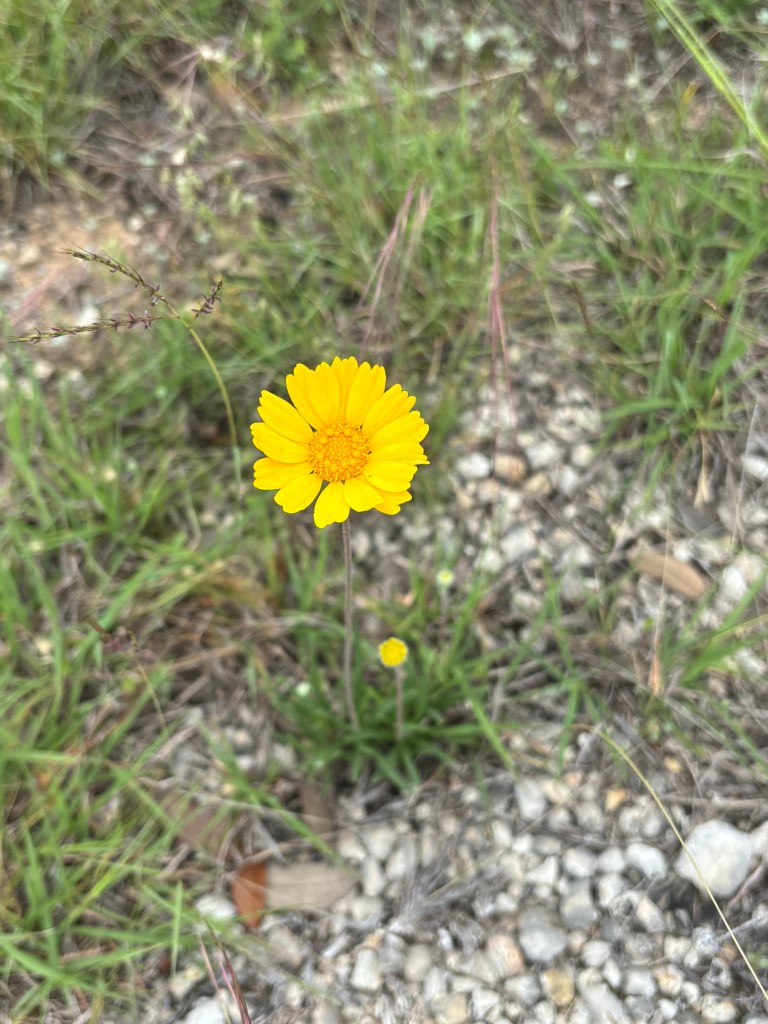
Not enough rain fell this year to allow the brilliant cerulean fields of Hill Country bluebonnets we usually expect, but the hardy lupines are busy making seedpods. “Maybe next year,” they say. Now instead we have the bright yellow coreopsis lanceolata, nodding their heads with any breeze,

the wine-cups with their indescribable color—a member of the mallow family, not quite fuchsia, not maroon, just—heart-stopping,

the milkweed flower globes beloved of monarch butter-flies, and others. Heaven includes a few prairie celestials, magically opening in early in the afternoon, then vanishing by dusk.

Also, “Sweet Mademoiselle,” planted a couple of years ago, and who has never bloomed, produced her first rose!

Meanwhile, the ever-interloping cactus hope to assuage my fury at them (remember those secretly spreading roots and the huge basal “plates” that help the Cactus Conspiracy spread?) by popping open their yellow flowers. I am not fooled. I’ll continue to battle them with shovel and hoe. And a picker-upper.

Now for some Hill Country facts.

BIG CATS?  Just in case you thought the animal that appears in my mystery Ghost Cat was, perhaps, unrealistic? Over-the-top? Mere fantasy? Couldn’t have played a part at beginning and end? Not so! https://www.statesman.com/story/news/state/2025/04/21/mountain-lion-san-marcos-trail-texas-sightings/83194256007/

See? Perfectly possible. It’s still wild out here in the Hill Country, even as suburbs press upon us. At dusk I often find myself glancing at the edge of the drop-off behind the house, wondering if I’ll see a pair of ears. You can say mountain lion, puma, cougar…they’re secretive, strong, and active in the spring.

But the big cat I once saw on Bell Springs Road west of here was likely a large bobcat. I was alone, driving home from the post office. Up ahead a golden vision, spotted, walked slowly to the edge of the asphalt. I stopped. The cat stood, gazed at me, and after a breathless (for me) interval, gracefully turned and vanished through a fence into thick cedar. A magical moment. Every time I drive that road, I hold my breath, longing for one more sighting of something looking like this:

https://images.app.goo.gl/K9VMv8bW92CpoSacA

ANCIENT BONES? I wrote about old bones in my Ghost Bones (2024)—and now have learned that our Hays County police deal with ancient bones more often than you’d think. One resident recently called to report she’d found a skull in her firepit. The skull, with its lower jaw present, was obviously fairly old, but in an unexplained death Hays County is not permitted to send a body to the Travis County Medical Examiner without including the name of the person whose skull it is. (Hays County doesn’t have its own medical examiner.) So this skull traveled instead to Texas State anthropologists who reported, after testing, that the skull apparently belonged to a long, long-ago teenager who’d gone through hard times, as was evident from the “enamel lines” (a bit like tree rings) in the teeth.

But how it wound up in that firepit? So far as I know, that’s still a mystery. We forget—until reminded by a skull in a firepit—how long humans have roamed these hills, drawn by hunger and thirst to spring water and the hunt for food.

We also forget the age and history of this landscape. Some trees have sheltered native Americans, deer, and buffalo. The Columbus Live Oak near the Colorado River in Columbus is estimated to be over 500 years old. Others may be as old as 1,000 years.

https://tfsweb.tamu.edu/websites/FamousTreesOfTexas/TreeLayout.aspx?pageid=26882; https://goodcalculators.com/tree-age-calculator/

I revere the live oak in our front yard as if it were a beloved ancient relative and a symbol of stability and the power of trees. If anything were to happen to it—woe! I tried to estimate its age—using the calculator instruction to measure girth in inches at 4.5 feet, divide by pi, then multiply by a “growth factor” of 4, which gave me 127 years old. Perhaps this tree was a sapling in 1900, before either World War, before the Viet Nam war, before our current fraught politics. On a nearby hill there’s an ancient patch of even bigger live oaks. Perhaps those particular oaks depend on the odd little ribbon of wet white clay that lies about five feet underground and has been there—who knows how long. But the feeling of walking in beneath these old live oaks can confer a sense of being in the protection of one’s elders.  

So, welcome to the Hill Country in spring—southeasterly winds from the Gulf, blowing the flowers back and forth; reasonably moderate temperatures; fields and trees as green as green, as far as you can see. At the bird feeder, more color! Purple house finch, yellow-throated vireo, lesser goldfinch with brilliant gold breasts, vermilion cardinals, black-crested titmouse, white-winged dove—and the shy and tiny, but utterly gorgeous, painted bunting. (Reportedly it loves millet.) They provide not just color but music, from the titmouse, the tiny but high-volume Carolina wren, plaintive doves, whistling cardinals, and, at night, chuck-will’s-widow.

Not for long, of course. In winter ice can wreak havoc on trees and people. Summer sun? Scorching. Autumn? Nothing like the colors of New England, but hey—the sumac turns red. So welcome, Spring, with your bluebonnets and live oaks, with bird music and color, and with your reminder of the power and beauty of nature!

Progress report: madly working on Book 10 of the Alice MacDonald Greer Mystery series, set in the Hill Country. Have ordered “Forest Bathing” by Dr. Qing Li. Would enjoy hearing what you all are reading too, and any reports of “forest bathing”!

Helen Currie Foster lives and writes the Alice MacDonald Greer Mystery series north of Dripping Springs, Texas, loosely supervised by three burros. She’s drawn to the compelling landscape and quirky characters of the Texas Hill Country. She remains deeply curious about our human history and how, uninvited, the past keeps crashing the party.

Follow Helen at http://www.helencurriefoster.com.

CATHOLICISM, THE MUNDANE AND THE PROFOUND.

By Francine Paino, a.k.a. F. Della Notte

Monday, April 21, 2025. “Jorge Bergoglio,” the Camerlengo tapped Jorge’s forehead gently with a silver hammer and repeated his birth name three times. The Camerlengo received no response and declared Pope Francis, the 266th successor to Peter, dead.

Of course, in today’s world, medical devices inform the state of man’s being, but the Catholic Church retains many of its rituals, and this is one. After declaring Pope Francis deceased, his ring was taken and destroyed using a special hammer to ensure it could not be stolen and its seal reused—a practical as well as ceremonial action.

The world is aware that the leader of 1.4 billion Catholics is dead, and Peter’s seat is empty until a new Pope is elected by the College of Cardinals. The world will observe the beloved rituals and ceremonies of the highest levels of clergy in the Catholic Church, and perhaps at this time, it is fitting to observe the lives of those of us who live the everyday, less exalted existences. Enter author Jon Hassler.

Catholicism, love it or hate it, is filled with traditions. Even today, after so many of the rules, ceremonies, and rites have been watered down, Hassler shows how Catholics are still impacted by their faith and how the changes have been received or rejected. He infuses his characters with insights and the deeper longings of our souls, to be respected, needed, loved, and part of a community. Being Catholic, Hassler writes with great authority about the perspectives and outlooks of this group of fictitious Catholics in the fictitious town of Staggerford, Minnesota. And, of course, non-Catholics will recognize and relate to these people. But why do we read fiction?

We read fiction to escape. Great adventures, mysteries, romance, and Sci-fi. But why read a book about a cast of characters whose lives are nothing special? Lives like our own, possibly? One can read these books and identify with different characters, their likes, dislikes, and situations. The progressive, touchy-feely nun, Sister Judy Juba, her obnoxious but elderly father. He wants a wife, but not for companionship as much as someone to care for him. Janet, Randy, and their young children. Father Finn and French, the Vietnam veteran with lingering PTSD, Who are these people? They are us!

Like sleepwalkers, we often move through the repetitive routines of life with our eyes half open or sometimes closed, as do the characters in Hassler’s books. In A Green Journey, we are introduced to his small town and its residents as they work their way through days of routine, nothing-special tasks. They’re not Hollywood stars, singers, or men and women of great wealth or political power. What this core group has in common is they are all influenced by the rules and requirements of being Catholic, and they are influenced by a steadfast, and still devout Catholic heroine, Agatha McGee.

Agatha is a crusty, disciplined disciplinarian and an ‘old maid’ who wants the best for everyone. She’d taught most of them over decades in St. Isadore’s elementary school. Agatha is also an old-fashioned Catholic who voluntarily observes rules that had been relaxed by the Second Vatican Council, like not eating meat on Friday.

While she does her best not to become despondent over the changes in the church, the end of her teaching career, and her aloneness without a husband or children, she involves herself in the lives of other residents of Staggerford, including her dearest friend, Lillian Kite, Lillian’s daughter Imogene, Father Finn, the pastor at St. Isadore, and a host of others. They all slog through life’s ups and downs with Agatha’s advice and assistance – or interference, depending on the point of view. While doing her best to help her neighbors, Agatha begins an innocent long-distance pen-pal relationship with James O’Hannon, a kindred spirit, in Ireland. She pours out her heart and the troubles and opinions of the community to him. After five years and a mutual growing affection, she can travel to Ireland to meet him. That trip holds great surprises for our heroine and James O’Hannon.

In the second book, Dear James, Agatha is back in Staggerford after her trip to Ireland and continues to respond to James’s letters but doesn’t mail them. Instead, she saves his in her desk drawer, unsure if she will ever fully reestablish their communications. After Thanksgiving, Father Finn invites her to join a pilgrimage to Rome with him and his brother, a college professor. There, she reconnects with James. As they work through what their relationship can and cannot be, at home, in Staggerford, Lillian’s spiteful daughter, Imogene, invites herself into Agatha’s house, searches it and finds James’s letters. Imogine reads them and is furious by what Agatha wrote. She takes an evil delight in spreading the news that Agatha has been sharing unflattering gossip about the townspeople. Upon her return from Rome, Agatha is greeted by a chill worthy of the deepest Minnesota freeze. How will they rise above their hostilities? Can they come together again?

Hassler was a gifted writer whose ability to infuse what we’d consider the mundane with deep insights into the greater, profound life that each of us contains, is brilliant. As no two people on Earth have the same fingerprint, no two have identical soul prints. And therein, we find the truer meanings of the small, seemingly commonplace things in life.   

A New Woman is book three of the Staggerford Series. I look forward to reading about the later phases of Agatha’s 88-year life.

Until next time, Happy Reading.

Review: Ella Minnow Pea

by Kathy Waller

The quick brown fox jumps over the lazy dog.

Last week I re-posted about the difficulty I experienced trying to compose a blog post when my keyboard malfunctioned: I pressed a key, no letter appeared; I pressed another, no letter appeared. And so 0n. Communication broke down. But on a very minor scale. After an hour of teeth-grinding, I saw the humor. No harm done.

Resurrecting that post reminded me of a novel I read years ago: Ella Minnow PeA: a progressively lipogrammatic epistolary, by Mark Dunn. An epistolary novel, written as a series of letters and notes. In the society Dunn envisions, when  letters disappear, the events that ensue are funny. And not.

The book is set on the fictional island of Nollop, off the coast of South Carolina, and named for Nevin Nollop, author of the sentence, The quick brown fox jumped over the lazy dog. Islanders have honored Nollop with a cenotaph bearing his famous sentence. Leaders of Nollop, which declared its independence from the United States in 1870, have “sought to uplift its black and white citizens through almost monastic devotion to liberal arts education and scholarship, effectively elevating language to a national art form, while relegating modern technology to the status of avoidable nuisance.” Life is good.

Trouble begins when the tile displaying the letter Z falls from the cenotaph and shatters. Residents wonder why. Nineteen-year-old Ella Minnow Pea   thinks it’s only logical–after a hundred years, the glue gave way. She recounts the events that ensue in a letter to her Aunt Tissie.  The Council, suspicious of everything since a “predatory armada” of land speculators from the United Stated tried to buy real estate and turn the island paradise into a tourist trap,  rejects offers to repair and reattach the tile; instead, they meet long and often, seeking to “grasp sign and signal” from the loss. Their decision:

the fall of the tile bearing the letter “Z” constitutes the terrestrial manifestation of empyrean, Nollopian desire, that desire most surely being that the letter “Z” should be utterly excised–fully extirpated– absolutely heave-ho’ed from our communal vocabulary.

Nollop has spoken from beyond the grave. Z is forbidden.

Penalties for speaking or writing any word containing the letter, or for possessing written correspondence containing it, range from a public oral reprimand to death.

Nollop’s sentence now reads,

The quick brown fox jumps over the la*y dog.

Letters fly from niece to aunt to cousin and back, discussing preparations for the Day the law goes into effect. Children under the age of seven will receive special dispensation to use the letter. But Uncle Zachary will have to be called Isaac;  Zeke has applied to change his name to “Prince Valiant-the-Comely.” It could be worse. Maybe.

But islanders will no longer speak of “the topaz sea which laps our breeze-kissed sh0res” or of “azure-tinted horizons.” Nor will they order frozen pizza or booze, or waltz, or see Tarzan movies, or wheeze and sneeze, or recognize hazardous organizations of zealots . . .

Minutes before the midnight deadline, the clear-sighted Ella writes, “Immobilized we iz. Minimalized. Paralyzed.” And, “CRAZY.”

That’s just the beginning. Soon a second letter falls. Then a third.

Day by day, the alphabet shrinks, taking the vocabulary with it. Oddly enough, getting to the point now requires more words, and characters struggle to find synonyms. Under normal circumstanced, they would consult the thesaurus. But when Z was banned, so were all books.

Conditions deteriorate. Penalties are assessed; punishment is swift. The Council, certain it knows the will of Nollop, tolerates no opposition.

Before long, islanders wake up to the fact the Council has gone from banning one letter of the alphabet to banning the right to free expression.

After all, what can be said using only three consonants and one vowel? The islanders have no language. How can people forbidden to use language assert their rights? How can a government forbidden to use language deliberate or explain its actions? But since the government’s actions  have caused the island go descend into chaos, perhaps it prefers to do neither.

It does, h0wever, offer dissidents one hope: prove that Nollop is not omniscient and all twenty-six letters of the alphabet will be restored. There’s only one method of proof, and it’s an impossible task, but Ella Minnow Pea accepts the challenge.

The book starts as a comedy, a farce, a romp through the ridiculous, wordplay at its best. But beneath the surface, it’s dead serious. Wikipedia highlights three themes: totalitarianism, freedom of  speech, and good citizenship vs. freedom. I would add freedom of th0ught. Without words, how can you think?

Publisher’s Weekly calls Ella Minnow Pea “a novel bursting with creativity, neological mischief and clever manipulation of the English language.”

School Library Journal says it’s “perfect for teens fond of wicked wit, wordplay, and stories that use the absurd to get at the serious.”

I say, I have no more words, except these: Ella Minnow Pea is a funny book. A timely book. An important book. Read it.

*

Ella Minnow Pea  is sometimes subtitled  A  Novel without Letters.

  • *

Kathy Waller (aka M.K. Waller) writes crime/suspense fiction, literary fiction, humor, and whatever else comes to mind. Her stories appear in anthologies and online. She’s co-author of the novella STABBED, written with Manning Wolfe. Currently, she’s working on a who-dun-it set in small-town Texas. A native of such a town (minus murders, of course), she lives in Austin. She no longer has two cats but is happy to still have one husband.

***

Cover of Ella Minnow Pea via Amazon
Image of fox by Yvonne Huijbens from Pixabay
Image of bulldog by Pitsch from Pixabay
Image of keyboard by tookapic from Pixabay
Image of pizza by Mian Shahzad Raza from Pixabay