
“Alice’s ghost is rumored to haunt the dorm, but don’t worry, she’s a benevolent ghost. She likes to watch over students. Here is her picture,” said the tour guide escorting the new freshmen residents around the Alice Littlefield Residence Hall on the day I moved into the dorm at the University of Texas at Austin back in my college days.

Littlefield Hall was built in 1927 and is the oldest residence hall, or dormitory, on campus. George Littlefield, a former university regent, cattleman, banker, and Confederate soldier[1], donated the money for the building’s construction, specifying that it should be named for his wife Alice and that it should house only women students, to give them a homelike environment while attending the university. Alice and George’s children didn’t survive early childhood, a common tragedy of the late 1800s, so they used their wealth to educate their 17 nieces and 12 nephews, paying for all 29 to attend the University of Texas. The Littlefields monitored a revolving door of student relatives from their Victorian mansion on the edge of the campus. Perhaps this is why Alice is rumored to still be watching over students.
In my two years of residence in Littlefield Hall, I never saw any ghosts, but I could see how the age and character of the historic building could inspire ghost stories. At that time, the building still featured an ancient Otis elevator that required the user to manually close, first, a gate and, then, a door before it would operate. Residents were only allowed to use that elevator if injured or if they were moving something heavy to an upper floor. The dorm rooms themselves had original doors, with giant old-style keyholes and transom windows painted shut above the door. Utility pipes added in decades after the building was completed ran along the walls in the rooms. Windowsills were crusted deep with layer upon layer of ancient paint. Air conditioning units had been added to the rooms under the windows, which we were forbidden to open, but many girls opened anyway. The building had atmosphere and charm, and was very old: the perfect place to imagine ghosts.

In fact, some of my fellow residents insisted that they had experienced something paranormal in the dorm. One girl described seeing her books move off her desk and fall to the floor. Another swore to me that she had seen a ghostly girl, wearing only panties and bra, standing in front of the mirror inside one of the two walk-in closets in her third-floor dorm room. When I visited the dorm recently, one of the residents told me that she had selected the building because it was the closest she could get to living in a Hogwarts dorm[2].
 Therefore, when I decided to set one of my Bad Vibes Removal Services paranormal mysteries at the University of Texas, I didn’t have to look very far to find inspiration. My former residence’s history and reputation for ghosts inspired me to use a fictional version of Littlefield Hall as the setting for my paranormal mystery novel, Degrees of Deceit. And, of course, my fictional dorm, called Dellonmarsh Dorm, is occupied by a benevolent female ghost, looking out for the residents as they are harassed by a malevolent prankster intent on disrupting the academic semester.
*****
N. M. Cedeño is a short story writer and novelist living in Texas. She is currently working on a series called Bad Vibes Removal Services. The second novel in the series, entitled Degrees of Deceit, came out in August 2019. Ms. Cedeño is active in Sisters in Crime- Heart of Texas Chapter.
Footnotes:
[1] George Littlefield is a controversial figure. He was a generous philanthropist and supporter of women’s education, and a former slave-owning, proud Southerner with the attendant prejudices of that position. His heroes were Confederate generals, and he paid for their statues to be placed on the UT campus. Those statues were removed from campus several years ago.
[2] The fictional Harry Potter school also known for its stately antiques and ghosts.
 The story Victorian Vibes features my characters Lea and Kamika finding a gory, sealed room inside of a house under renovation. This story, which opens the collection, was inspired by a
  Texas Frontier Vibes was partially inspired by reading the book Empire of the Summer Moon: Quanah Parker and the Rise and Fall of the Comanches, the Most Powerful Indian Tribe in American History by S. C. Gwynne. The long and bloody battle between the Comanches and every wave of settlers that tried to take their land is fertile ground for ghost stories. In the story, a collection of arrow heads is bound to the ghost of the person who died being shot with the arrows. While the injuries sustained by the character in the story are drawn directly from history, the idea that the arrow heads could be haunted was inspired by my father’s inheritance of a collection of points, axes, scrapers, and other stone tools from his deceased brother who had been a lifelong collector of these items.


 the United States, authors have to do research depending on their setting. Without a national standard, each state and frequently each county within a state sets its own rules for handling unexpected deaths. In January, Sisters in Crime: Heart of Texas Chapter was fortunate to have Tiffany Cooper-Aguilar, a licensed funeral director and embalmer, walk authors through the legalities of collecting, handling, and storing bodies after death in small town Texas.
 and the medical examiner determines the cause of death. Less populous counties aren’t legally required to have medical examiner’s offices. They rely on contracted mortuary services or funeral homes to collect the bodies of the dead. Lacking a medical examiner, these counties rely on a justice of the peace to decide if a cause of death is apparent or if a body should be sent for an autopsy to determine the cause of death.
 enforcement personnel in less populous counties leave the body where it is discovered, so that the funeral director and assistant have to go into water, fields, ditches, wrecked cars, or other locations to retrieve the decedent.
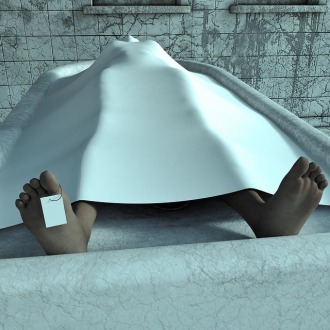 The justice of the peace orders autopsies when the cause of death is unknown or questionable. If an autopsy is required, the body will be transported to the medical practitioner responsible for carrying out the autopsy. Small counties may contract with larger counties to use their medical examiner for autopsies. After the autopsy is complete and the body is released for burial, the legal next of kin must sign a release allowing a funeral home to collect the remains from the medical examiner and prepare them for burial or cremation.
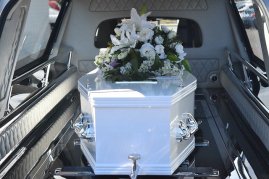 Burial may take place as soon as the family is ready. Texas law does not require embalming to occur before burial. Cremation, however, requires additional legal paperwork which can take up to two weeks to be completed. While reducing human remains to ash can be accomplished in a matter of hours, acquiring the paperwork needed to begin the process takes time. Getting authorization for cremation is a longer process because a buried body can be dug up and studied if foul play is suspected at a later date, a cremated one can’t.
 Ink-Stained Wretches