The Tincture of Time

By Helen Currie Foster – June 9, 2025

I’ve always loved Guy Clark’s version of “Stuff that Works.” Dublin Blues, 1995.

https://www.youtube.com/watch?v=2mprD2MN5vo

Listening, I can just see, just feel, that “old blue shirt” that “suits him just fine.” I can imagine the old boots that let him “work all day” and then go “dance all night.” And of course that friend who “always shows up when the chips are down”––I’m thinking, my bestie. Just hearing about the shirt, the boots, the friend always leaves me with the same settled, restful confidence he’s describing. “Stuff that works!”

“Brown paper packages tied up with string” may have undeniable charm, “stuff that works” means stuff I turn to, go back to, and rely on. Like old travel pants with pockets that zip, soft shirts without a scratchy label, shoes that just carry me along, soles not too thick or thin.

What about you? Things that keep working, that stand the test of time? The pens that always work, the ink you like, the just-right-feel in your hand as you write? The car that always starts, the recipe you can count on?

Part of the charm of “stuff that works” is reliability – working each and every time.

Time, that deep human preoccupation! Is time reliable? Time messes with us. Time stands still. Time passes. Time flies. Time heals. Time runs out. Time grows short. The time changes…and times change. “Time, like an ever-flowing stream…” Sometimes an hour feels interminable; sometimes an hour passes in a flash. Albert Einstein’s theory of general relativity says that even in the universe, time is not constant, but is influenced by gravity. Yikes! (says the English major).

Writers struggle to analyze time’s impact on us. Just a couple of examples––Anthony Powell, A Dance to the Music of Time; Vladimir Nabokov, Speak, Memory;Virginia Woolf, particularly the “Time Passes” section of To the Lighthouse. Historians try to make sense of the impact of events over time, like Drew Gilpin Faust in This Republic of Suffering, on death and the Civil War.

Poets remind us of their mortality—and hence our own. Here’s Robert Frost, in Ten Mills, Part II, THE SPAN OF LIFE, from A Further Range (Henry Holt and Company, 1936):

The old dog barks backward without getting up.

I can remember when he was a pup.

Or Billy Collins at the beginning of “Life Expectancy” in Whale Day (2020):

On the morning of a birthday that ended in a zero,

I was looking out at the garden

When it occurred to me that the robin

On her worm-hunt in the dewy grass

Had a good chance of outliving me….

T.S. Eliot begins East Coker : “In my beginning is my end,” then:

…there is a time for building

And a time for living and for generation

And a time for the wind to break the loosened pane

Ad to shake the wainscot where the field-mouse trots

And to shake the tattered arras woven with a silent motto.

Sebastian Junger reflects on near-death experiences, including his own: In My Time of Dying (2024).

Of course animals can be aware of time. Right? The three donkeys– Sebastian, Amanda, and Caroline ––appear promptly at the gate in front of the house at 11:30 a.m., and again at 4:30 p.m., which, they are confident, are the hours when carrots ought to be offered. We know animals can mourn the loss of a member of their pod, their herd, their litter. But do they worry about their own mortality? Do our friends the non-human primates? Well, maybe! Um, time will tell! https://bit.ly/4mZqi4k

To be human is to be aware of our own mortality. And for humans, time is both reliable—tick, tock—and unreliable: we cannot know what the future holds. Fiction writers, however, get to make those decisions for their characters. In the mystery genre, we get to decide: who shall live? Who shall die? How, and why?

I’ve wrestled with these questions in my Alice MacDonald Greer Mystery Series: what happens next?Should I not  have killed a particular character? Should a new character survive and reappear in the next book? It’s a heavy responsibility! We readers can become quite attached to characters. In the last few weeks, finishing Book 10, I took refuge in Laurie King’s Mary Russell/Sherlock Holmes series. She created a character I found particularly appealing in The God of the Hive. https://bit.ly/449Lugn

But then? The book made me revisit the pain of losing a beloved character to—well, literary death. Remember Gus in Larry McMurtry’s Lonesome Dove? I still miss Gus… Gus, don’t ride over that hill!

In addition to night-time plunges into Laurie King land, I found banging on the piano a helpful respite from the writing process. But after two broken wrists in the past two years (careless, careless) I’d had to quit the beloved boogie woogie lessons and feared I’d never be able to play those strenuous pieces again.

My brother the physician, when asked by his siblings for advice, often prescribes “a little tincture of time.” It’s amazing how often that prescription works. This past week, after (really quite a lot of) tincture of time, I persuaded our century-old piano once again to play boogie-woogie pieces from the 1942 All Star Boogie Woogie Piano Solos! Pete Johnson, Meade “Lux” Lewis, Pine Top Smith, Hersal Thomas, Albert Ammons. Suddenly—how long is “a little tincture of time”?––finger memory began to return. Not all the way back yet, but still! Maybe I’ll get to resume piano lessons with that Austin treasure of jazz, boogie, country and everything else, Floyd Domino.

Charles Darwin was not known to rush into print. In 1837 in Edinburgh he presented his first paper concerning the action of worms “on the formation of mould,” a topic he studied for over forty years. Not until 1881, after two scientists pooh-poohed his theories, during the Great British Agricultural Depression (1873-1896) he published The Formation of Vegetable Mould Through the Action of Worms on the work of earthworms. Curious about their senses, their awarenesss, their work, he studied how worms could tug leaves into their burrows, eat and digest them, and then produce worm casts—millions of tons of richer soil. His query as to whether earthworms were sensitive to light “led me to watch on many successive nights worms kept in pots, which were protected from currents of air by means of glass plates.” His summary after all those years? Darwin doubts “whether there are many other animals which have played so important a part in the history of the world” as earthworms. Producing stuff that works…!

For so many of us, books are the “stuff that works.” Hurrah for reading!

Award-winning author Helen Currie Foster lives and writes the Alice MacDonald Greer Mystery series north of Dripping Springs, Texas, loosely supervised by the three burros. She’s drawn to the compelling landscape and quirky characters of the Texas Hill Country. She remains deeply curious about our human history and how, uninvited, the past keeps crashing our party. Follow her at http://www.helencurriefoster.com and on Amazon, and find the books at Austin’s BookPeople!
https://www.facebook.com/helencurriefoster

COOKIES, MYSTERIES AND MORE COOKIES – AND NOW PANETTONE

by

Francine Paino, a.k.a. F. Della Notte

Cookies. Who doesn’t love them?  Far and away, the American favorite is the Chocolate Chip cookie, a creation of the Wakefields of Massachusetts. (More on that later).  Over 53% of American adults prefer Chocolate Chip to other varieties.  But the most popular cookie worldwide, sold in over 100 countries… drum roll, please, is Oreo!  

The popularity of these cookies made me wonder what other fun facts I could find to entertain and inform, so I set out to investigate the origins of these sweet delights. 

Did you know Oreo is considered the number one copycat cookie? Two brothers, Joseph and Jacob Loose, battled for dominance over the Oreo. It was first produced by Hydrox. (Remember them? Or have I dated myself?) Then, it was baked and sold by the National Biscuit Company, now known as Na-Bis-Co.  See the link below for more information on the Battle of the Oreo.

With this in mind, one might imagine that the earliest origin of cookies began in a Western European country, perhaps in Great Britain, Ireland, or Scotland. It may have begun in one of the Romance Countries. The first was Italy, followed by France and Spain. In fact, the biggest surprise of all is that the cookie dates back to Persia, in the 7th century C.E.

It all began around 550 B.C.E. in the Persian Empire, conquered many times and most famously by Alexander the Great, who defeated Darius III. These luxurious little cakes were well-known, and as Persia evolved into a diverse nation in the Islamic world, its culture spread.  Sugar, which originated in the lowlands of S.E. Asia, was brought to Persia and cultivated there. It then spread through the eastern Mediterranean and into Europe, and bakers created beautiful cakes and pastries—for the wealthy, of course.

 After the Muslim invasion of Iberia in the 8th century, followed by the Crusades and the developing spice trade, cooking techniques and ingredients began to reflect different civilizations, especially the influence of Arabian cuisine. In fact, one of the most treasured desserts of Italy, the Cannoli originated in Sicily and reflected Arabic recipes – but back to the cookie.

According to culinary historians, the cookie’s origin had a more serious purpose. It was, in fact, a test cake. Small amounts of cake batters were dropped onto baking pans to test the temperatures of the ovens. These little cakes were the first crude thermostats used to determine when the fires, fueled by burning wood, were at the correct heat to cook without wrecking the food, and each region or nation developed its own little cakes for this purpose. Eventually, these little test cakes morphed into the dry, hard-textured cookies we know today, and the renaming of these little cakes first appeared in print in the early 18th century.  

Eventually, the cookie came to America via the British Empire, where they were and still are called biscuits. After the Revolutionary War, the newly minted Americans changed the name to further separate themselves from Great Britain. They chose the Dutch variation Koekje/koek, which evolved into the word cookie, but it wasn’t until 1924 that the most beloved of all American cookies was created: the Chocolate Chip.

Ruth Graves Wakefield, before marrying, was a graduate of the Framingham State Normal School Department of Household Arts (at that time not considered a slur or degradation of women). She worked as a dietician and lectured on food. In 1930 Ruth and hubby Kenneth purchased a Cape-Cod style inn, The Toll House, in Massachusetts. Constructed in 1709, the house was a stop-over for travelers in Colonial times where they paid their road toll, changed horses, and dined. Under the Wakefield’s ownership, the Toll House served traditional Colonial fare, and Ruth’s homemade desserts were quite popular. One day, in 1937, she discovered she didn’t have the baker’s chocolate required for her brown sugar cookies. Instead, she chopped a bar of Nestle’s Semi-Sweet Chocolate into tiny pieces, believing that adding them to the dough and baking would melt them, but the chocolate held its shape and softened to a creamy texture. The new cookie became very popular at the inn, and Ruth’s recipe was published in newspapers throughout New England, skyrocketing the sale of Nestle’s Semi-Sweet Chocolate Bars. Thus was born the Chocolate Chip Cookie. And there you have the basics of the origin of cookies. But what you might ask, has this to do with mysteries besides the secrets of various bakers and recipes?

Cookies, I have found, are not only popular desserts and treats; they play an essential and often intriguing role in many culinary mysteries, especially the cozies.  I logged onto Goodreads and searched mystery books with the word cookie in the title. I was intrigued to find 18+ pages, 20 titles to a page, representing approximately 360 books, excluding cookbooks and children’s books. And that was only on Goodreads. Some of the titles I found brought a smile to my face. In the interests of full disclosure, I haven’t read any of them, but among my favorite titles were A Tale of Two Cookies, And Then There Were Crumbs, Misfortune Cookie, Tough Cookie, and Murder of a Smart Cookie.  

Many authors of cozies and some traditional mysteries weave the art of cooking and baking into their stories. In the Housekeeper Mystery Series, set primarily in Austin, Texas, Mrs. B., a fine cook, keeps the priests of St. Francis de Sales supplied with her home-baked Italian Lemon Drop Cookies (Anginetti), while she and the pastor, Father Melvyn, help solve crimes and find answers.  For cookie enthusiasts, I’m happy to share my favorite Lemon Drop Cookie recipe. See the link below. (reprint from 2024) 

AND NOW – Add the most wonderful cake popular at Christmas: Pannetone. Why bother? Because it’s stories or myths are filled with as much drama, and richness as the bread itself.

Story One: In fifteenth century Milan, a young baker named Toni, accidentally created a sweet, rich loaf while preparing the Christmas feast for the Duke of Milan. During the banquet preparations for Ludovico Sforza’s Christmas banquet, the chef accidentally burnt the dessert. While the desperate chef agonized over the burnt dessert, a young kitchen assistant, Toni, grabbed leftover ingredients and a sourdough starter, and combined them into a sweet, rich leavened bread.

The Duke loved the bread so much that he named it “Pane di Toni,” (Tony’s bread) which eventually evolved into “Panettone”. 

Story Two: Ughetto and Adalgisa. A love story. Ughetto, a nobleman, disguised himself as a baker’s apprentice to win the heart of Adalgisa, the baker’s daughter, but his family opposed the match. When the baker’s assistant fell ill, to be near his beloved, Ughetto disguised himself to work in the kitchen assistant’s place. To impress her father, he came up with a combination of ingredients that enriched the original recipe being used, and it was a great success. Hence, the young man and his creation were recognized the young lovers were allowed to marry.

Story Three: Instead of Ughetto, we meet Sister Ughetta, a nun who lived in a poor convent. To brighten their Christmas, Sister Ughetta came up with a new cake then traced a cross in its dough with a knife. When the cake cooked, the rounded top where the cross was cut, opened revealing the treats contained inside.

Whichever story tickles your fancy, Panettone is a much loved dessert bread among Italians. It’s given as a gift, and Christmas wouldn’t be complete without it. The only mystery here is whether or not any of the stories of its origins are true.

You can buy it or try the recipe in the Bake from Scratch link.

Happy munching and happy reading.   

http://www.thenibble.com/reviews/main/cookies/cookies2/cookie-history2.asp

JUST LOOK AROUND!

by HELEN CURRIE FOSTER

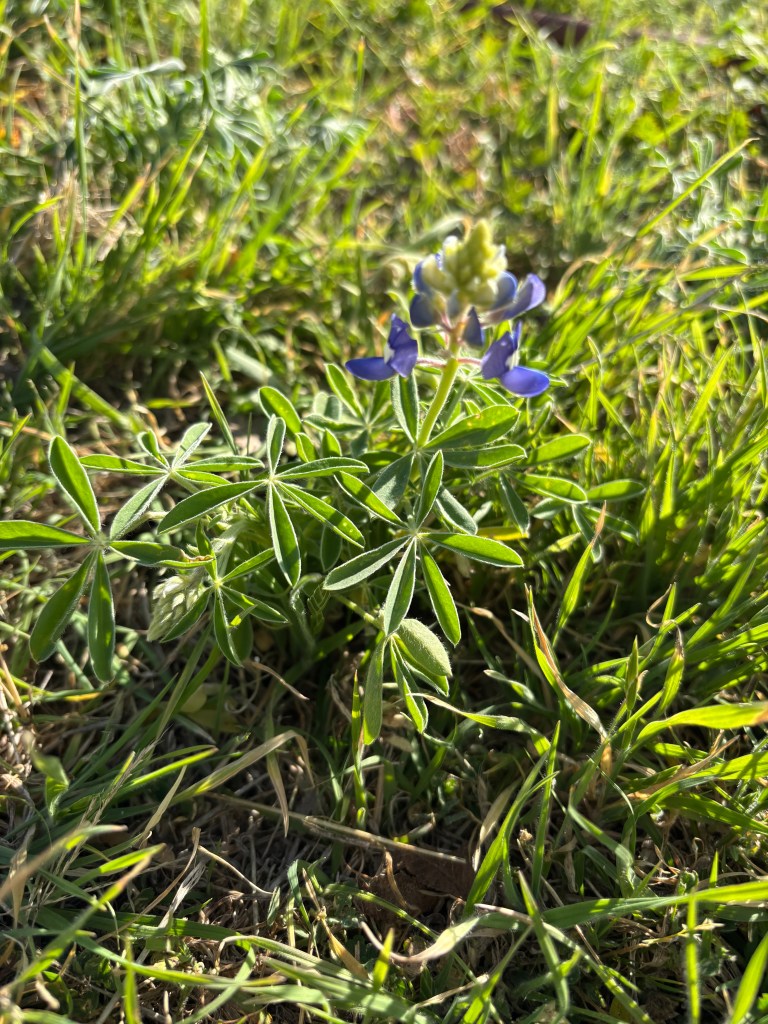
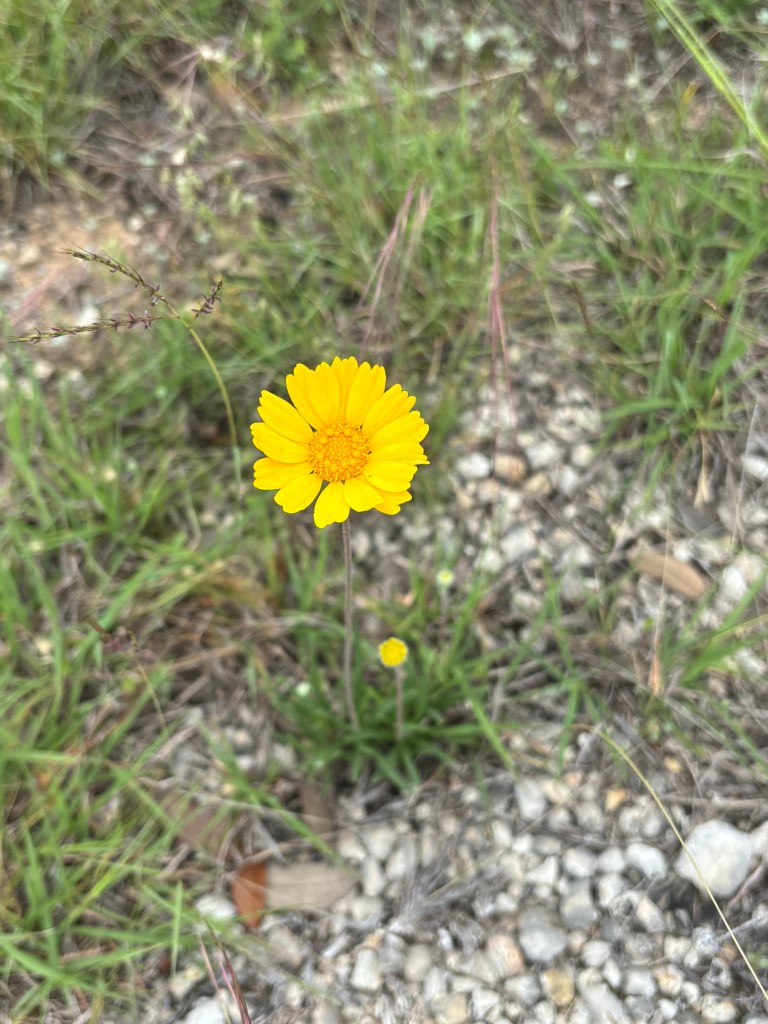
Not enough rain fell this year to allow the brilliant cerulean fields of Hill Country bluebonnets we usually expect, but the hardy lupines are busy making seedpods. “Maybe next year,” they say. Now instead we have the bright yellow coreopsis lanceolata, nodding their heads with any breeze,

the wine-cups with their indescribable color—a member of the mallow family, not quite fuchsia, not maroon, just—heart-stopping,

the milkweed flower globes beloved of monarch butter-flies, and others. Heaven includes a few prairie celestials, magically opening in early in the afternoon, then vanishing by dusk.

Also, “Sweet Mademoiselle,” planted a couple of years ago, and who has never bloomed, produced her first rose!

Meanwhile, the ever-interloping cactus hope to assuage my fury at them (remember those secretly spreading roots and the huge basal “plates” that help the Cactus Conspiracy spread?) by popping open their yellow flowers. I am not fooled. I’ll continue to battle them with shovel and hoe. And a picker-upper.

Now for some Hill Country facts.

BIG CATS?  Just in case you thought the animal that appears in my mystery Ghost Cat was, perhaps, unrealistic? Over-the-top? Mere fantasy? Couldn’t have played a part at beginning and end? Not so! https://www.statesman.com/story/news/state/2025/04/21/mountain-lion-san-marcos-trail-texas-sightings/83194256007/

See? Perfectly possible. It’s still wild out here in the Hill Country, even as suburbs press upon us. At dusk I often find myself glancing at the edge of the drop-off behind the house, wondering if I’ll see a pair of ears. You can say mountain lion, puma, cougar…they’re secretive, strong, and active in the spring.

But the big cat I once saw on Bell Springs Road west of here was likely a large bobcat. I was alone, driving home from the post office. Up ahead a golden vision, spotted, walked slowly to the edge of the asphalt. I stopped. The cat stood, gazed at me, and after a breathless (for me) interval, gracefully turned and vanished through a fence into thick cedar. A magical moment. Every time I drive that road, I hold my breath, longing for one more sighting of something looking like this:

https://images.app.goo.gl/K9VMv8bW92CpoSacA

ANCIENT BONES? I wrote about old bones in my Ghost Bones (2024)—and now have learned that our Hays County police deal with ancient bones more often than you’d think. One resident recently called to report she’d found a skull in her firepit. The skull, with its lower jaw present, was obviously fairly old, but in an unexplained death Hays County is not permitted to send a body to the Travis County Medical Examiner without including the name of the person whose skull it is. (Hays County doesn’t have its own medical examiner.) So this skull traveled instead to Texas State anthropologists who reported, after testing, that the skull apparently belonged to a long, long-ago teenager who’d gone through hard times, as was evident from the “enamel lines” (a bit like tree rings) in the teeth.

But how it wound up in that firepit? So far as I know, that’s still a mystery. We forget—until reminded by a skull in a firepit—how long humans have roamed these hills, drawn by hunger and thirst to spring water and the hunt for food.

We also forget the age and history of this landscape. Some trees have sheltered native Americans, deer, and buffalo. The Columbus Live Oak near the Colorado River in Columbus is estimated to be over 500 years old. Others may be as old as 1,000 years.

https://tfsweb.tamu.edu/websites/FamousTreesOfTexas/TreeLayout.aspx?pageid=26882; https://goodcalculators.com/tree-age-calculator/

I revere the live oak in our front yard as if it were a beloved ancient relative and a symbol of stability and the power of trees. If anything were to happen to it—woe! I tried to estimate its age—using the calculator instruction to measure girth in inches at 4.5 feet, divide by pi, then multiply by a “growth factor” of 4, which gave me 127 years old. Perhaps this tree was a sapling in 1900, before either World War, before the Viet Nam war, before our current fraught politics. On a nearby hill there’s an ancient patch of even bigger live oaks. Perhaps those particular oaks depend on the odd little ribbon of wet white clay that lies about five feet underground and has been there—who knows how long. But the feeling of walking in beneath these old live oaks can confer a sense of being in the protection of one’s elders.  

So, welcome to the Hill Country in spring—southeasterly winds from the Gulf, blowing the flowers back and forth; reasonably moderate temperatures; fields and trees as green as green, as far as you can see. At the bird feeder, more color! Purple house finch, yellow-throated vireo, lesser goldfinch with brilliant gold breasts, vermilion cardinals, black-crested titmouse, white-winged dove—and the shy and tiny, but utterly gorgeous, painted bunting. (Reportedly it loves millet.) They provide not just color but music, from the titmouse, the tiny but high-volume Carolina wren, plaintive doves, whistling cardinals, and, at night, chuck-will’s-widow.

Not for long, of course. In winter ice can wreak havoc on trees and people. Summer sun? Scorching. Autumn? Nothing like the colors of New England, but hey—the sumac turns red. So welcome, Spring, with your bluebonnets and live oaks, with bird music and color, and with your reminder of the power and beauty of nature!

Progress report: madly working on Book 10 of the Alice MacDonald Greer Mystery series, set in the Hill Country. Have ordered “Forest Bathing” by Dr. Qing Li. Would enjoy hearing what you all are reading too, and any reports of “forest bathing”!

Helen Currie Foster lives and writes the Alice MacDonald Greer Mystery series north of Dripping Springs, Texas, loosely supervised by three burros. She’s drawn to the compelling landscape and quirky characters of the Texas Hill Country. She remains deeply curious about our human history and how, uninvited, the past keeps crashing the party.

Follow Helen at http://www.helencurriefoster.com.

CATHOLICISM, THE MUNDANE AND THE PROFOUND.

By Francine Paino, a.k.a. F. Della Notte

Monday, April 21, 2025. “Jorge Bergoglio,” the Camerlengo tapped Jorge’s forehead gently with a silver hammer and repeated his birth name three times. The Camerlengo received no response and declared Pope Francis, the 266th successor to Peter, dead.

Of course, in today’s world, medical devices inform the state of man’s being, but the Catholic Church retains many of its rituals, and this is one. After declaring Pope Francis deceased, his ring was taken and destroyed using a special hammer to ensure it could not be stolen and its seal reused—a practical as well as ceremonial action.

The world is aware that the leader of 1.4 billion Catholics is dead, and Peter’s seat is empty until a new Pope is elected by the College of Cardinals. The world will observe the beloved rituals and ceremonies of the highest levels of clergy in the Catholic Church, and perhaps at this time, it is fitting to observe the lives of those of us who live the everyday, less exalted existences. Enter author Jon Hassler.

Catholicism, love it or hate it, is filled with traditions. Even today, after so many of the rules, ceremonies, and rites have been watered down, Hassler shows how Catholics are still impacted by their faith and how the changes have been received or rejected. He infuses his characters with insights and the deeper longings of our souls, to be respected, needed, loved, and part of a community. Being Catholic, Hassler writes with great authority about the perspectives and outlooks of this group of fictitious Catholics in the fictitious town of Staggerford, Minnesota. And, of course, non-Catholics will recognize and relate to these people. But why do we read fiction?

We read fiction to escape. Great adventures, mysteries, romance, and Sci-fi. But why read a book about a cast of characters whose lives are nothing special? Lives like our own, possibly? One can read these books and identify with different characters, their likes, dislikes, and situations. The progressive, touchy-feely nun, Sister Judy Juba, her obnoxious but elderly father. He wants a wife, but not for companionship as much as someone to care for him. Janet, Randy, and their young children. Father Finn and French, the Vietnam veteran with lingering PTSD, Who are these people? They are us!

Like sleepwalkers, we often move through the repetitive routines of life with our eyes half open or sometimes closed, as do the characters in Hassler’s books. In A Green Journey, we are introduced to his small town and its residents as they work their way through days of routine, nothing-special tasks. They’re not Hollywood stars, singers, or men and women of great wealth or political power. What this core group has in common is they are all influenced by the rules and requirements of being Catholic, and they are influenced by a steadfast, and still devout Catholic heroine, Agatha McGee.

Agatha is a crusty, disciplined disciplinarian and an ‘old maid’ who wants the best for everyone. She’d taught most of them over decades in St. Isadore’s elementary school. Agatha is also an old-fashioned Catholic who voluntarily observes rules that had been relaxed by the Second Vatican Council, like not eating meat on Friday.

While she does her best not to become despondent over the changes in the church, the end of her teaching career, and her aloneness without a husband or children, she involves herself in the lives of other residents of Staggerford, including her dearest friend, Lillian Kite, Lillian’s daughter Imogene, Father Finn, the pastor at St. Isadore, and a host of others. They all slog through life’s ups and downs with Agatha’s advice and assistance – or interference, depending on the point of view. While doing her best to help her neighbors, Agatha begins an innocent long-distance pen-pal relationship with James O’Hannon, a kindred spirit, in Ireland. She pours out her heart and the troubles and opinions of the community to him. After five years and a mutual growing affection, she can travel to Ireland to meet him. That trip holds great surprises for our heroine and James O’Hannon.

In the second book, Dear James, Agatha is back in Staggerford after her trip to Ireland and continues to respond to James’s letters but doesn’t mail them. Instead, she saves his in her desk drawer, unsure if she will ever fully reestablish their communications. After Thanksgiving, Father Finn invites her to join a pilgrimage to Rome with him and his brother, a college professor. There, she reconnects with James. As they work through what their relationship can and cannot be, at home, in Staggerford, Lillian’s spiteful daughter, Imogene, invites herself into Agatha’s house, searches it and finds James’s letters. Imogine reads them and is furious by what Agatha wrote. She takes an evil delight in spreading the news that Agatha has been sharing unflattering gossip about the townspeople. Upon her return from Rome, Agatha is greeted by a chill worthy of the deepest Minnesota freeze. How will they rise above their hostilities? Can they come together again?

Hassler was a gifted writer whose ability to infuse what we’d consider the mundane with deep insights into the greater, profound life that each of us contains, is brilliant. As no two people on Earth have the same fingerprint, no two have identical soul prints. And therein, we find the truer meanings of the small, seemingly commonplace things in life.   

A New Woman is book three of the Staggerford Series. I look forward to reading about the later phases of Agatha’s 88-year life.

Until next time, Happy Reading.

Review: Ella Minnow Pea

by Kathy Waller

The quick brown fox jumps over the lazy dog.

Last week I re-posted about the difficulty I experienced trying to compose a blog post when my keyboard malfunctioned: I pressed a key, no letter appeared; I pressed another, no letter appeared. And so 0n. Communication broke down. But on a very minor scale. After an hour of teeth-grinding, I saw the humor. No harm done.

Resurrecting that post reminded me of a novel I read years ago: Ella Minnow PeA: a progressively lipogrammatic epistolary, by Mark Dunn. An epistolary novel, written as a series of letters and notes. In the society Dunn envisions, when  letters disappear, the events that ensue are funny. And not.

The book is set on the fictional island of Nollop, off the coast of South Carolina, and named for Nevin Nollop, author of the sentence, The quick brown fox jumped over the lazy dog. Islanders have honored Nollop with a cenotaph bearing his famous sentence. Leaders of Nollop, which declared its independence from the United States in 1870, have “sought to uplift its black and white citizens through almost monastic devotion to liberal arts education and scholarship, effectively elevating language to a national art form, while relegating modern technology to the status of avoidable nuisance.” Life is good.

Trouble begins when the tile displaying the letter Z falls from the cenotaph and shatters. Residents wonder why. Nineteen-year-old Ella Minnow Pea   thinks it’s only logical–after a hundred years, the glue gave way. She recounts the events that ensue in a letter to her Aunt Tissie.  The Council, suspicious of everything since a “predatory armada” of land speculators from the United Stated tried to buy real estate and turn the island paradise into a tourist trap,  rejects offers to repair and reattach the tile; instead, they meet long and often, seeking to “grasp sign and signal” from the loss. Their decision:

the fall of the tile bearing the letter “Z” constitutes the terrestrial manifestation of empyrean, Nollopian desire, that desire most surely being that the letter “Z” should be utterly excised–fully extirpated– absolutely heave-ho’ed from our communal vocabulary.

Nollop has spoken from beyond the grave. Z is forbidden.

Penalties for speaking or writing any word containing the letter, or for possessing written correspondence containing it, range from a public oral reprimand to death.

Nollop’s sentence now reads,

The quick brown fox jumps over the la*y dog.

Letters fly from niece to aunt to cousin and back, discussing preparations for the Day the law goes into effect. Children under the age of seven will receive special dispensation to use the letter. But Uncle Zachary will have to be called Isaac;  Zeke has applied to change his name to “Prince Valiant-the-Comely.” It could be worse. Maybe.

But islanders will no longer speak of “the topaz sea which laps our breeze-kissed sh0res” or of “azure-tinted horizons.” Nor will they order frozen pizza or booze, or waltz, or see Tarzan movies, or wheeze and sneeze, or recognize hazardous organizations of zealots . . .

Minutes before the midnight deadline, the clear-sighted Ella writes, “Immobilized we iz. Minimalized. Paralyzed.” And, “CRAZY.”

That’s just the beginning. Soon a second letter falls. Then a third.

Day by day, the alphabet shrinks, taking the vocabulary with it. Oddly enough, getting to the point now requires more words, and characters struggle to find synonyms. Under normal circumstanced, they would consult the thesaurus. But when Z was banned, so were all books.

Conditions deteriorate. Penalties are assessed; punishment is swift. The Council, certain it knows the will of Nollop, tolerates no opposition.

Before long, islanders wake up to the fact the Council has gone from banning one letter of the alphabet to banning the right to free expression.

After all, what can be said using only three consonants and one vowel? The islanders have no language. How can people forbidden to use language assert their rights? How can a government forbidden to use language deliberate or explain its actions? But since the government’s actions  have caused the island go descend into chaos, perhaps it prefers to do neither.

It does, h0wever, offer dissidents one hope: prove that Nollop is not omniscient and all twenty-six letters of the alphabet will be restored. There’s only one method of proof, and it’s an impossible task, but Ella Minnow Pea accepts the challenge.

The book starts as a comedy, a farce, a romp through the ridiculous, wordplay at its best. But beneath the surface, it’s dead serious. Wikipedia highlights three themes: totalitarianism, freedom of  speech, and good citizenship vs. freedom. I would add freedom of th0ught. Without words, how can you think?

Publisher’s Weekly calls Ella Minnow Pea “a novel bursting with creativity, neological mischief and clever manipulation of the English language.”

School Library Journal says it’s “perfect for teens fond of wicked wit, wordplay, and stories that use the absurd to get at the serious.”

I say, I have no more words, except these: Ella Minnow Pea is a funny book. A timely book. An important book. Read it.

*

Ella Minnow Pea  is sometimes subtitled  A  Novel without Letters.

  • *

Kathy Waller (aka M.K. Waller) writes crime/suspense fiction, literary fiction, humor, and whatever else comes to mind. Her stories appear in anthologies and online. She’s co-author of the novella STABBED, written with Manning Wolfe. Currently, she’s working on a who-dun-it set in small-town Texas. A native of such a town (minus murders, of course), she lives in Austin. She no longer has two cats but is happy to still have one husband.

***

Cover of Ella Minnow Pea via Amazon
Image of fox by Yvonne Huijbens from Pixabay
Image of bulldog by Pitsch from Pixabay
Image of keyboard by tookapic from Pixabay
Image of pizza by Mian Shahzad Raza from Pixabay

My Keys Won’ Work


by Kathy Waller


It’s been quite a while since I posted,* and I should wait until my turn rolls around again. But today a fellow Wretch shared something that had happened to her, and that reminded me of something that happened to me, and this is an Open week on ISW, so I decided to share what my friend’s remark reminded me of. Right now. Before I forget.

This is a repost of a repost of a post I wrote for Telling the Truth, Mainly in 2010, using my first laptop.  A monster Dell, it weighed at least fifty pounds, or seemed to at the time, but I loved it and lugged it everywhere. My introduction to coffee-shop writing, it was a sort of movable feast. But—there was one little problem. Two or three times. Read on.

*


INTRO, PART 2

While I was writing a post one evening, my laptop keys stopped working–one at a time, in no particular order. No matter how hard or in which direction I tapped, they didn’t depress, and nothing appeared on the screen. I considered giving up, then decided to keep a-goin’. The next day, I called technical service, was told I could replace the keyboard myself, visited Radio Shack for tools, used them, nearly stripped a screw, called tech service, received a visit from a tech, and got a quick fix.

An easily replaceable keyboard isn’t usually much to worry about, but in my keyboard’s case, there were extenuating circumstances. I was afraid something beneath the keyboard might be causing the malfunction, and that the tech might think so too. He might know how it got there and give me a look of reproof, possibly a mild reprimand. He might even sneer.

William Davis & Bookworm

I would have to stand there, blushing, and take it. My innate honesty would prevent me from saying my husband did it.

To learn why I would have blushed, you’ll have to read to the end.

Hint #1 : A single e might mean tech. But it might not. An a might mean a, or not.

Hint #2: The thing I was afraid was under the keyboard–it wasn’t cat hair. Cat hair wouldn’t have made me blush.

Hint #3: Don’t sweat the small stuff. Whatever you don’t get is small stuff. You’ll get the drift.

Hint #4: If you’re tempted to stop, please, at least skim to the end. I’ve added a translation of the last few lines. Last lines are usually important, and I’d like these to be understood. In addition, I managed to throw in a couple of words from Hamlet. 

Well, finally, here’s the post.

*****

THE POST

Wa do you do wen your keyboard malfunions?

Wen my spae bar sopped working, I aed online wi Dell e suppor.  e e old me I would reeie a new keyboard in e mail. I was supposed o insall i.

“Me?” I said. “Insall a keyboard?”

e e said i would be a snap. If I needed elp, e would walk me roug i.

I go e keyboard and looked up e insruions, wi said I ad o unsrew e bak. I jus knew I would be eleroued.

Bu I boug a se of srewdriers a RadioSak and flipped e lapop oer, remoed e baery, and aaked e srews.

e srews wouldn’ budge. I exanged a srewdrier for anoer srewdrier. I used all six. None of em worked.

I wen online again o a wi Dell. e e lisened, en old me o ry again.

I oug abou e definiion aribued o Einsein: Insaniy is doing e same ing oer and oer and expeing a differen resul.

“I wouldn’ urn,” I old e e.

He said e would send a e ou o e ouse o insall e keyboard for me. (I’m no dummy. Wen I boug e lapop, I boug a e o go wi i.)

Anyway, e nex day a e ame. He go ou is se of 3500 srewdriers, remoed e srews, ook off e old keyboard, and insalled e new one. He said I didn’ ave e rig size srewdrier. en e asked wa else I needed.

“I know you don’ ae an order for is, bu ould you wa me insall is exra memory a Dell e said I’m ompenen o insall myself?” He said e’d o i for me. I oug a was ery swee.

Anyway, i’s appened again, exep is ime i’s more an e spaebar. I’s e , , , and  keys.

I’e used anned air. So far all i’s done is make ings worse. Wen I began, only e  key was ou.

How an I wrie wiou a keyboard?

So tomorrow I’ll chat with my Dell tech and—

Well, mercy me. I took a half-hour break and now all the keys are working again. I wonder what that was all about.

Nevertheless, I shall report the anomaly. Call me an alarmist, but I don’t want this to happen a third time. I might be preparing a manuscript for submission. I’m being proactive.

But still—I’m torn. If I do need a another new keyboard, I want a tech to make a house call. I don’t have the proper screwdriver, I don’t know what size screwdriver to buy, and I don’t want to tamper with something that is still under warranty.

On the other hand, I have to consider the worst-case scenario: The tech takes out his screwdriver, loosens the screws, turns the laptop over, removes the keyboard, and sees lurking there beneath the metal and plastic plate the reason for my current technical distress: crumbs. 

And—sneer—”Been eating Oreos while you type, huh?”

e same, e earae, e disgrae a being found guily of su a soleism. e prospe is oo illing o spell ou.**

Bu for the sake of ar, I sall submi myself o e proud man’s onumely. omorrow I sall a wi Dell.***

[TRANSLATION OF ** and ***, ABOVE}

The shame, the heartache, the disgrace at being found guilty of such a solecism. The prospect is too chilling to spell out.

But for the sake of art, I shall submit myself to the proud man’s contumely. Tomorrow I shall chat with Dell.

***

I intended to wrap things up with a brief book review, but enough is enough.  I’ll save the review for next time. Anyway, the book is too good to be an add-on. It deserves to have a space all to itself.

***

Image of keyboard by Simon from Pixabay

Image by Michael Schwarzenberger from Pixabay

Image of William Davis playing Bookworm by MKW

*

Kathy Waller (aka M.K. Waller) writes crime/suspense fiction, literary fiction, humor, and whatever else comes to mind. Her stories appear in anthologies and online. She’s co-author of the novella STABBED, written with Manning Wolfe. Currently, she’s working on a who-dun-it set in small-town Texas. A native of such a town (minus murders, of course), she lives in Austin. She no longer has two cats but is happy to still have one husband.

*Kathy wishes she could say she’s been too busy doing Good Works to post,  but she hasn’t, and she doesn’t believe in telling fibs, and nobody who knows her would believe the Good Works story anyway. She’ll say only that she’s been on hiatus.

Words, words, words . . .


By Dixie Evatt


Words, words, words . . .
~ Shakespeare

Before we had powerful computers in our pockets or on our laps, we had reference books. . . shelves and shelves of them.

One of my favorite possessions is a vintage Webster’s dictionary, published 1956 – when I was 10 years old. All 11-plus pounds of the five-inch-thick book teeter on a top shelf in my office. I can no longer safely lift it and the pages are laid out in three columns of typeface so tiny that my aging eyes strain to make out the words.

My book is a holdover from the days when library dictionaries were housed and opened on a specialized wooden lectern. I wonder, do libraries still have these throwbacks to that bygone day or have the enormous books all made their way to the shredder?

I never look at mine that I’m not reminded of the 1950s movie, Born Yesterday, starring Judy Holliday. She won an Oscar for her portrayal of the brassy girlfriend of an uncouth tycoon. Her character tries to overcome her limited education and rudimentary vocabulary by reading, among other texts, Alexis de Tocqueville’s Democracy in America. In one of the more humorous scenes, she struggles to make meaning of the archaic text and is advised to simply check the dictionary if she encounters any words she doesn’t understand. The increasingly frustrated Holliday would no more than read a sentence before she is up again, consulting a dictionary. Word by word. Trip by trip. Written today, the scene would surely lose its charm since she would likely be reading Tocqueville on a Kindle where all you must do is press and hold a finger on a word for the meaning to flash before you.

Like Holliday with a Kindle, writers don’t have the need for shelves full of reference books since language prompts are everywhere from the demons in autocorrect to the drop-down menus in word processing programs that produce synonyms.

The 19th Century French author Jules Renard is credited with saying, “What a vast amount of paper would be saved if there were a law forcing writers to use only the right word.

Yet, finding the right word isn’t always so easy even with all our modern assets. Luckily there are still some reference sources to help. Here are a few:

Evan Esar’s “20,000 Quips & Quotes: A Treasury of Witty Remarks, Comic Proverbs, Wisecracks and Epigrams.” If she’d thumbed through this one, Holliday would have learned that Tocqueville said, “The last thing a political party gives up is its vocabulary.”

“The Allyn & Bacon Handbook” by Leonard J. Rosen and Laurence Behrens. You must love any book that is willing to devote 22 pages to the uses and misuses of the comma alone.

Theodore M. Bernstein’s “Dos, Don’ts & Maybes of English Usage.” For instance, he explains why Mark Antony didn’t say “Friends, Romans, countrymen, loan me your ears.”

“Describer’s Dictionary: A Treasury of Terms & Literary Quotations,” by David Grambs and Ellen S. Levine. It indexes illustrative passages of more than 600 authors from travel writer Paul Theroux to contemporary British novelist Zadie Smith.

Eli Burnstein’s “Dictionary of Fine Distinction Book,” offering a humorous look at often misused words and phrases. For instance, couch vs. sofa.

Valerie Howard’s “1,000 Helpful Adjectives for Fiction Writers,” promises to spice up characteristics, qualities or attributes of a noun when a writer is having trouble capturing just the right word.”

Bill Bryson’s “Dictionary of Troublesome Words: A Writer’s Guide to Getting it Right” sets out to decipher the idiosyncrasies of the English language. Things such as 126 meanings of “set” when used as a verb and another 58 when used as a noun.

Brian Shawver’s “The Language of Fiction: A Writer’s Stylebook.” Need to be reminded when to use a comma or semicolon? Shawver’s there to help.

Kathy Steinemann’s “The Writer’s Lexicon: Descriptions, Overused Words, and Taboos.” Among other things, she offers writers cures for overused modifiers (I’m talking about you “very”).

John B. Bremner’s “The Columbia Dictionary for Writers: Words on Words.” Here you can learn the history of H. L. Mencken’s inspiration for coining the term “ecdysiast” to replace “striptease.”

Christine Lindberg’s “The Oxford American Writer’s Thesaurus.” Writing about bread? How about a baker’s dozen choices: dal, pita, rye, naan, tortilla, focaccia, ciabatta, challah, corn, sourdough, pumpernickel, baguette, etc.

“Associated Press Stylebook and Briefing on Media Law” has been found on the desk of every journalist for decades since it dictates uniform rules for grammar, punctuation, style for capitalization and numbers, preferred spelling, abbreviations, acronyms, and such.

“Words, words, words,” is the sarcastic response Hamlet gave when Polonius asked him what he was reading. Fortunately, authors still have no shortage of excellent reference books to help them find the right ones.

***

A former political reporter in Austin, Dixie also taught writing at Syracuse University. When she teamed up with Sue Cleveland to write fiction, they sold a screenplay to a Hollywood producer. Although the movie was never made, the seed money financed ThirtyNineStars, their publishing company. Through it they published two award-winning thrillers (Shrouded and Digging up the Dead) under the pen name, Meredith Lee. Dixie’s first solo mystery was Bloodlines & Fencelines, set in a tiny Texas town near Austin. Kirkus reviews described the book as, “A twisty whodunit that’s crafted with care and saturated with down-home Southern charm.” She is working on second mystery in the series. www.dlsevatt.com

***

Image of dictionary by PublicDomainPictures from Pixabay

Publicity photo of William Holden and Judy Holliday for Born Yesterday via Wikipedia

Image of tablet  by Gerd Altmann from Pixabay

EQUINOX!

by Helen Currie Foster

March 14, 2025

“An excess of animal spirits”–springtime! Really? Molly Ivins was right as usual when she wrote, “Texas–land of wretched excess!” We’ve had ridiculous lows, unseen for decades. Early daffodils and hyacinths came, shivered, and shriveled in the unholy cold winds roaring across the plains. But we’ve also had the earliest 90 degrees in decades! Wretched excess indeed!

Just two days until the vernal equinox on March 19, and spring. What makes us wander outside, searching for the first bluebonnet, the first violet? What makes us huddle outside the garden store, searching through the little plants shivering in the breeze, fingering seed packets, carrying home small pots of basil and blue salvia even though the weather’s far too untrustworthy for planting? What is this proto-agricultural spirit that makes us lug home the potting soil, hoe the garden bed? More sunlight? Cabin fever? Some early human gene? We, the Animal Kingdom, working with the Plant Kingdom?

I’m rereading Barry Cunliffe’s Europe Between the Oceans: 9000 BC-AD 1000 (https://amzn.to/3RfJzj6), a book I value not just for the stunning photographs of prehistoric sites and art, but for describing a history of human inventiveness. Cunliffe, Oxford Professor Emeritus of Archeology since 2007 (many books–– https://bit.ly/3XZkmNA), says “massive transformation” occurred in Europe between 1300-800 BC. Population growth required developing more crops than wheat and barley, including lentils, peas and—“the celtic bean (Vicia faba).”

Immediately I ordered a giant pack of fava bean seeds.

This image has an empty alt attribute; its file name is img_0981.jpg

Then I read the label: they’re mostly a winter crop–but this year I’m desperate. With last year’s blistering hot drought, I wound up with only one pot of cherry tomatoes on the porch and a dozen wilting jalapeno plants in the garden. Cunliffe’s reference to Vicia faba fired my imagination—envisioning myself harvesting large fuzzy green pods, containing delectable beans, and adding a little vinaigrette…olive oil (since 4000 BC) and vinegar (3000 BC). Using an ancient bean and ancient vinaigrette recipe! Possibly those beans were harvested, and the vinaigrette shaken, by some long-ago ancestor 3000 years ago, making me wonder if we have genetic preferences, genetic recipe roots? After all, we of the Animal Kingdom depend on the Plant Kingdom (oxygen, vinaigrette, and wine!).

Mysteries offer escape—a protagonist we like, an intriguing plot, a vivid setting. Like plants, favorite old mysteries offer much when we revisit. Mystery writers? They’re good to “talk to.” This morning I discovered on the shelf my dad’s 1934 Modern Library edition of Dashiell Hammett’s The Maltese Falcon, with a brief bio and the “new introduction” by Hammett.

This image has an empty alt attribute; its file name is img_0980.jpg

I didn’t know Hammett had worked as an operative for Pinkerton’s Detective Agency before he started writing! “Drifting through a miscellany of ill-paid jobs, he found a temporary solution to his economic problem by shadowing real malefactors with what might be called conspicuous success.” Then came the World War: “He won a sergeantcy and lost his health.”

Hammett can remember where he got his characters. Here’s a snippet of what he says about The Maltese Falcon:

“Dundy’s prototype I worked with in a North Carolina railroad yard; Cairo’s I picked up on a forgery charge in Pasco, Washington, in 1920; Polhous’s was a former captain of detectives…Effie’s once asked me to go into the narcotic smuggling business with her in San Diego…”

Hammett then muses about his own protagonist. “Spade had no original. He is a dream man in the sense that he is what most of the private detectives I worked with would like to have been and what quite a few of them in their cockier moments thought they approached. For your private detective does not—or did not ten years ago when he was my colleague—want to be an erudite solver of riddles in the Sherlock Holmes manner; he wants to be a hard and shifty fellow, able to take care of himself in any situation, able to get the best of anybody he comes in contact with, whether criminal, innocent by-stander or client.”

What a great description, and didn’t Humphrey Bogart nail it?

It strikes me that this new character of his upended the vision of the members of the London 1930 Detectives Club—Hammett gave the wide-eyed mystery audience a protagonist who is not a secret member of the aristocracy (Albert Campion) or a perfect gentleman (Roderick Alleyn) or a hyper-particular French veteran drinking tea and waxing his moustache (Hercule Poirot)…but a “hard and shifty fellow…able to get the best of anybody.” Welcome to the New World’s new-style mystery protagonists, the children of Hammett, Raymond Chandler, Sara Paretzky and others…including that hybrid protagonist, Mary Russell, in Laurie King’s Mary Russell and Sherlock Holmes series.

For Mary Russell and Sherlock Holmes, the scent of honey is a repeat theme (her Holmes is a beekeeper). I like her Holmes, I like her Russell, and just finished her Garment of Shadows (2012). https://bit.ly/4iTwmYZ King has chosen a fascinating and ambitious setting: the 1920’s, with Spain and France fighting for control of Morocco, each coveting its crucial strategic location at Gibraltar, while various Moroccan groups—Berber and otherwise—fight for independence. King uses first person point of view for Mary Russell, who’s suffering from acute amnesia—forgetting her childhood and even her marriage––but uses third person POV for Holmes’s chapters. Those shifts sometimes confused me. But her depth of history and geography, and her vivid descriptions of the magical city of Fez with its souk, bring the setting alive. Mary Russell herself has become quite a protagonist, with linguistic skills—including Arabic––and the imagination and drive to devise a daring escape from a horrible prison. I’d like to learn knife-throwing like Mary Russell (she keeps one in her boot) but the likelihood seems dim.

Writer/theologian Bruce Reyes-Chow mentioned how, when stuck, he’d “talk through ideas with myself, my plants…” I intend to follow his lead. On our deck sit five jasmine plants we’ve toted around since the seventies. I think they sometimes do communicate with me—“I’m dry-y-y-y!” But from now on, when I’m stuck on a plot, I’ll go consult them. Every spring, those jasmine produce tiny white flowers with an unmatchable scent. In search of even more scent, this year I’ve planted another mix of old and new. Rose de Recht is a fragrant pink heirloom damask, Fragrant Blush promises pink perfume, and Star of the Republic is tough, like her name, but delicate pink with exquisite fragrance.

This image has an empty alt attribute; its file name is img_0978.jpg

And now suddenly the redbuds, with their irresistible yet evanescent fuchsia buds, are blooming. I’ve seen our first bluebonnet,

This image has an empty alt attribute; its file name is img_0974.jpg

and the first purple prairie verbena. The live oaks know it’s almost the equinox—they’ve flung down their old leaves (aided by the fierce winds) and are preparing their catkins and baby leaves. The cedar elms have put out tiny chartreuse leaves just in the last two days.

This image has an empty alt attribute; its file name is img_0973.jpg

So it’s spring! Grab that trowel! And after all your work, you deserve to loll on the couch at night with a good mystery. I’m halfway through the tenth book in my Hill Country murder mystery series. This one raises a question I find intriguing and difficult. Can justice be served when, unauthorized to pronounce justice, we take justice into our own hands? Is that still justice? I’m discussing it with the plants. More to come….

This image has an empty alt attribute; its file name is img_1776.jpg

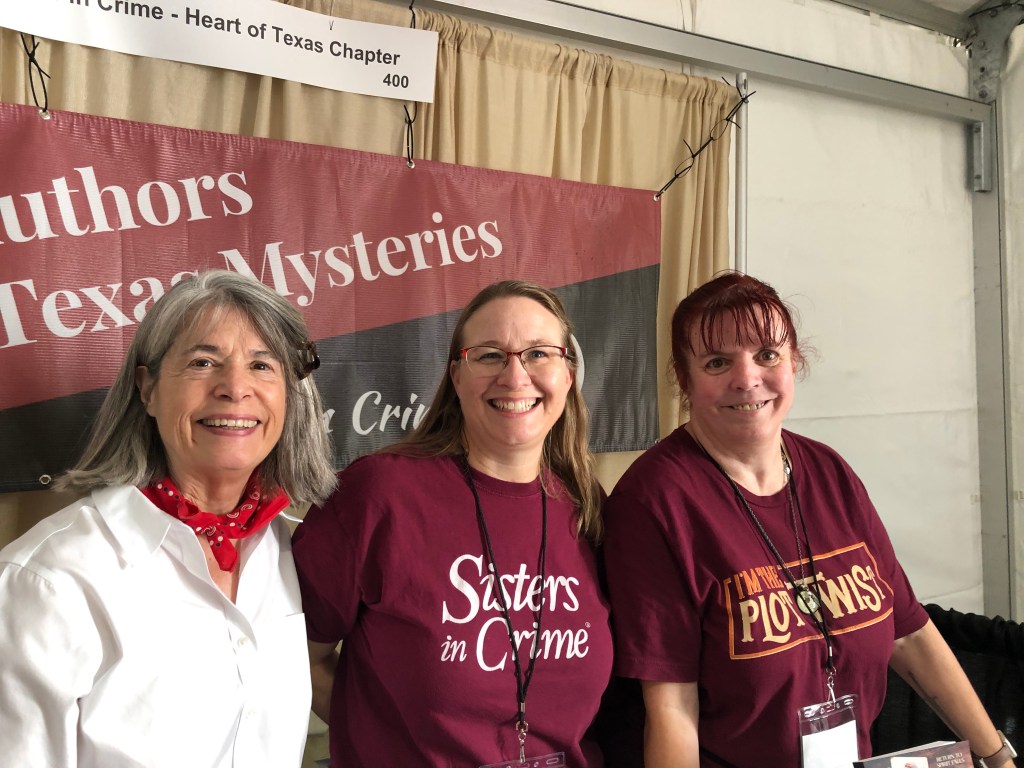
Here are Helen, Noreen Cedeno, and Juanita Houston at the Texas Book Festival!–Heart of Texas Sisters in Crime

Award-winning Helen Currie Foster lives and writes the Alice MacDonald Greer Mystery series (9 volumes so far) north of Dripping Springs, Texas, loosely supervised by three burros. She’s working on Book 10. She’s drawn to the compelling landscape and quirky characters of the Texas Hill Country. She’s also deeply curious about our human history and how, uninvited, the past keeps crashing the party.

Follow her at http://www.helencurriefoster.com and at https://www.amazon.com/stores/Helen-Currie-Foster/author/B00R1X9RXK?https://www.facebook.com/helencurriefoster

WRITING CHARACTERS’ EMOTIONS

BY

Francine Paino, a.k.a. F. Della Notte

People don’t stand or sit like stone statues, unless there’s a reason. They move, breathe, and respond to situations with emotions, internally and externally, and so they should in stories. Thus, the author must find words to bring the reader into the character’s heart and mind. Writers spend hours thinking about what their characters are feeling. How do we show the reader those emotions?  Eyes are one of the most popular tools to convey feelings.

Yes, those spherical bodies of different shapes, colors, and densities are called the windows of the soul. Thousands of pages have been dedicated to the power of the eyes.  There are hundreds, of eye expressions, including wild, frightened, gooey, flinty, evil and the list goes on. Each one of those words or phrases evokes a sense of the person’s feelings. For a writer, those eyes may be a windows of the story. But wait— Are they enough? How else may we show a character’s emotions?

Body language is one. He slouched, lowering his eyes. That may indicate disappointment to the reader. She flung her long blond hair back over her shoulder and lifted her chin. Conceit? Defiance? It could be either, depending on the scene. However, there is another often overlooked part of the body that exhibits emotions: hand gestures.

Hand gestures may emphasize words, or be used in place of words. Communication experts have recently added hand gestures to the lexicon of terms revealing emotions and thoughts.

An NIH, National Library of Medicine, 2014 article on gestures’ roles in speaking, learning, and creating language concludes, “gestures provide both researchers and learners with an ever-present tool for understanding how we talk and think,” and hand gestures are used in many cultures and societies.

In Around the World in 42 Gestures, we travel with examples of hand motions and their meanings and learn reasons to familiarize ourselves with them when visiting foreign lands. While polyglots speak many languages, for the majority, some prep time learning a few regional hand gestures would be easier and more effective than trying to master language skills. With hand gestures, one can say a lot with one move instead of struggling through vocabulary, grammar, and pronunciation combinations, and it would be wise to understand if a positive Western gesture isn’t welcome in a foreign land. For example, the gesture we use—crossed fingers to wish good luck, in Vietnam is an anatomically-themed insult.

Tapping your forehead with bunched fingers in Peru means, “I don’t get it. I’m not smart enough, and in France, touching your index finger below the eye indicates, “I don’t believe you.” Moving on to Spain, passing your forefinger and middle finger (V formation)  down your face from your eyes indicates, “I’m broke.” Moving east to Russia, pulling your left hand behind your head and scratching your right ear, says, “This is getting too complicated.” Indeed, that is the right gesture for such a sentiment.

Coming back west, we end our short tour in Italy, a country one cannot visit, in reality or in fiction, without understanding the loaded meanings of at least some of the gestures so common in Italian culture.

Italians are universally known to incorporate hand movements with words and often in place of them. The Italian Language Center identifies roughly 250 hand gestures that are part of Italian conversations. Why so many?

Theories suggest that the iconic hand gestures result from a long history of Italy being invaded by many nations that imposed their languages, cultures, and mannerisms. From the Ancient Greek colonization along the Mediterranean coast to subsequent invasions by the Carolingians, Normans, Visigoths, Arabs, and Germans, these hand gestures developed as a means of communication among people with no common language – and have stuck around ever since. The hand gestures may have sprung up to ease communication.”

Although many of these motions vary by region, among the most common and generally understood by all are bunching all five fingers on one hand and bringing them to the lips in a symbolic kiss, which expresses appreciation for any masterpiece, even in cooking.

There is one Italian gesture, however, one should use sparingly, if at all. Holding four fingers together and swiping them outward from under the chin can mean, “I don’t give a damn,” but it also has a ruder meaning. As a visitor to Italy, I think it’s best not to test that one.

In book four of the Housekeeper Mystery Series, Murder in the Cat’s Eye, Father Melvyn and Mrs. B. take a group of eccentric parishioners to Rome to learn about the lives of the earliest Christians. In this adventure, the reader will encounter the quirks of the travel group that could land them in the hoosegow, a series of crimes that engulf the unsuspecting travelers from Austin, Texas, an Italian detective, and several characters who are not what they seem. It will serve the reader well to understand the hand motions that are part of Italian communications. Perhaps this book will require a glossary of gestures.

Buon viaggio e buona lettura.

 (Have a good trip and happy reading.)

https://www.worktheworld.com/infographics/around-world-42-hand-gestures,

https://pubmed.ncbi.nlm.nih.gov/22830562/

Rain, rain go away. . .

By: Dixie Evatt

It might just be the Texas temperatures that have been rocking from the 20s to the 80s since the first of the new year. Or maybe it’s the ominous news reports about melting ice caps or the drought conditions paired with hurricane-force winds that helped fuel the Los Angeles wildfires. Whatever the case, I find my mind traveling again and again to thoughts of weather and the influence it has on stories, both fictional and real. 

As writers we’ve inherited wise advice about incorporating weather into our stories. For instance, Number One in Elmore Leonard’s Ten Rules for Good Writing is “never open a book with weather.” While that advice is close to dogma, it has been debated (see: Jo-Anne Richards bit.ly/41a4oCk and Roz Morris bit.ly/3WUcAEk

Richards, an internationally published novelist, says of the admonition to avoid opening your novel with weather isn’t an iron-clad rule. It’s a prompt to the writer to if the story is stronger by opening with a paragraph where you find people doing something. That doesn’t mean a weather opening never works. She gives this example of an opening from Maggie O’Farrell’s “The Hand that First Held Mine.”

Listen. The trees in this story are stirring, trembling, readjusting themselves. A breeze is coming in gusts off the sea, and it is almost as if the trees know, in their restlessness, in their head-tossing impatience, that something is about to happen.

Morris, a former ghost writer who writes the “Nail Your Novel” blog, offers an example of a weather opening that she likes because it is intensely descriptive and the storyteller lures in the reader. Her sample story opening is from “The Rapture” by Liz Jensen.

That summer, the summer all the rules began to change, June seemed to last for a thousand years. The temperatures were merciless …It was heat to die in, to go nuts in or to spawn. Old folk collapsed, dogs were cooked alive in cars…The sky pressed down like a furnace lid, shrinking the subsoil, cracking concrete, killing shrubs from the roots up…

Although the advice about beginning a story with weather can be debated, there’s also the middle and end of the story to consider. Susanne Bennett, a German-American writer, identified seven ways writers can use weather to tell their story in her 2022 post on “Writers Write”: conversation starter; backdrop; sensual experience; foreshadowing; sense of conflict; motif; and acting force. In fact, she advised, the weather can stand as the last word (where it is almost another character).  bit.ly/4hSBBYq

Bennett also reminds us that the old saw about showing not telling is likewise true for weather. For example, she edited the sentence, “On a sunny day, Jane went to the public library” to read “A T-shirt is enough,” Jane thought, glad to put her cardigan aside… Who needed extra baggage on a day like this?”

“The Great Gatsby” by F. Scott Fitzgerald is chock full of weather references, many illustrating Bennett’s points. One researcher counted 111 separate weather references, from heat, to wind to sun to rain, most of which can be linked to mood or passion in the story.

Weather can also emerge out of the obscurity of background symbolism to overtly influence action. There’s an oft-cited example of one snow scene in “Catcher in the Rye” by J.D. Salinger when Holden Caufield makes a snowball but is so conflicted he is unable to throw it. Would Agatha Christie’s closed-room mystery “And Then There Were None” even have been possible if a ferocious storm hadn’t trapped the ten victims on an isolated island off the Devon coast? Or, how about the necessity of a crop-killing drought to cause the Joad family to pick up stakes and abandon their home in John Steinbeck’s “Grapes of Wrath”?

Weather might incite action or prevent it. My book club recently read “To the Lighthouse” by Virginia Woolf and one of the most memorable refrains is about weather. In the story, the family plans, again and again, to visit the lighthouse the next day but only if the weather is “fine.” It almost never seems to be. 

Would the passionate and cruel relationships in “Wuthering Heights” by Emily Brontë feel the same without a violent storm “rattling over the Heights in full fury,” taking down tree limbs in its wake? Wuthering, after all, means tumultuous storms.

Sometimes weather carries double duty, carrying both mood and action, as in “The Scarlet Letter” by Nathaniel Hawthorne; “Misery” by Stephen King; and “Transit of Venus” by Shirley Hazzard. When the long-suffering Hester Prynne in “The Scarlet Letter” removes her cap and then the scarlet letter she is awash in sunlight. 

In “Transit of Venus” you just know Ted Tice is going to have a rough go of it when he arrives, soaked through. “He looked up from his wet shoes and his wet smell and his orange blotch of cheap luggage. And she looked down, high and dry.”

Not unlike Annie Wilkes the weather is unsettling and unpredictable in “Misery.” As the weather changes, she changes, leading Paul Sheldon, the author she holds captive, to conclude, “I am in trouble here. This woman is not right.”

There are so many other memorable weather scenes in literature that Pulitzer Prize winning writer Kathryn Schultz pulled from her almanac of examples in a 2015 article in “New Yorker” magazine. bit.ly/3WVj0D9

And, finally the 2024 Academy-Award nominated movie “The Room Next Door,” brings together all of the advice about injecting weather into a story. We see its use to create mood, develop characters and foreshadow events when the dying Martha (played by Tilda Swinton) recites parts of James Joyce’s “The Dead” to her friend Ingrid (played by Julianne Moore).

It had begun to snow again. He watched sleepily the flakes, silver and dark, falling obliquely against the lamplight..His soul swooned slowly as he heard the snow falling faintly through the universe and faintly falling, like the descent of their last end, upon all the living and the dead.

Dixie Evatt (DLS Evatt)

A former political reporter in Austin, Dixie also taught writing at Syracuse University. When she teamed up with Sue Cleveland to write fiction, they sold a screenplay to a Hollywood producer. Although the movie was never made, the seed money financed ThirtyNineStars, their publishing company. Through it they published two award-winning thrillers (Shrouded and Digging up the Dead) under the pen name, Meredith Lee. In 2021 Dixie launched a solo mystery (Bloodlines & Fencelines) that Kirkus described as, “A twisty whodunit that’s crafted with care and saturated with down-home Southern charm.” She is working on a prequel (Gravel Roads & Shallow Graves) set to launch in 2025. www.dlsevatt.com