The Woods Are Lovely: A Passion for Trees

Helen Currie Foster

October 29, 2024

The mystery is solved! In my search for  what I recalled as “the “Blitzkuchen” once served at Schwamkrug’s outside New Braunfels, in the Texas Hill Country, I had the name wrong. It’s a blitz torte, not a blitz kuchen! Several readers sent recipes from German cookbooks indicating that “Blitzkuchen” is a quick cake, usually one layer only. My memory, though? A tall two-layer confection, baked with meringue and almond flakes on top and between the layers! And in my memory, more meringue on the outside, plus some moistness in the filling.

Online I found Oma Gerhild’s “Oma’s Blitz Torte Recipe ––Lightning Cake.” https://www.quick-german-recipes.com/german-blitz-torte-recipe.html  Each almond-flavored layer is baked with meringue and sliced almonds on top of the batter. The recipe offers either custard filling or whipped cream filling. I opted to finish off with whipped cream with powdered sugar and vanilla, not just inside, but around the cake (and in blobs all around the kitchen).
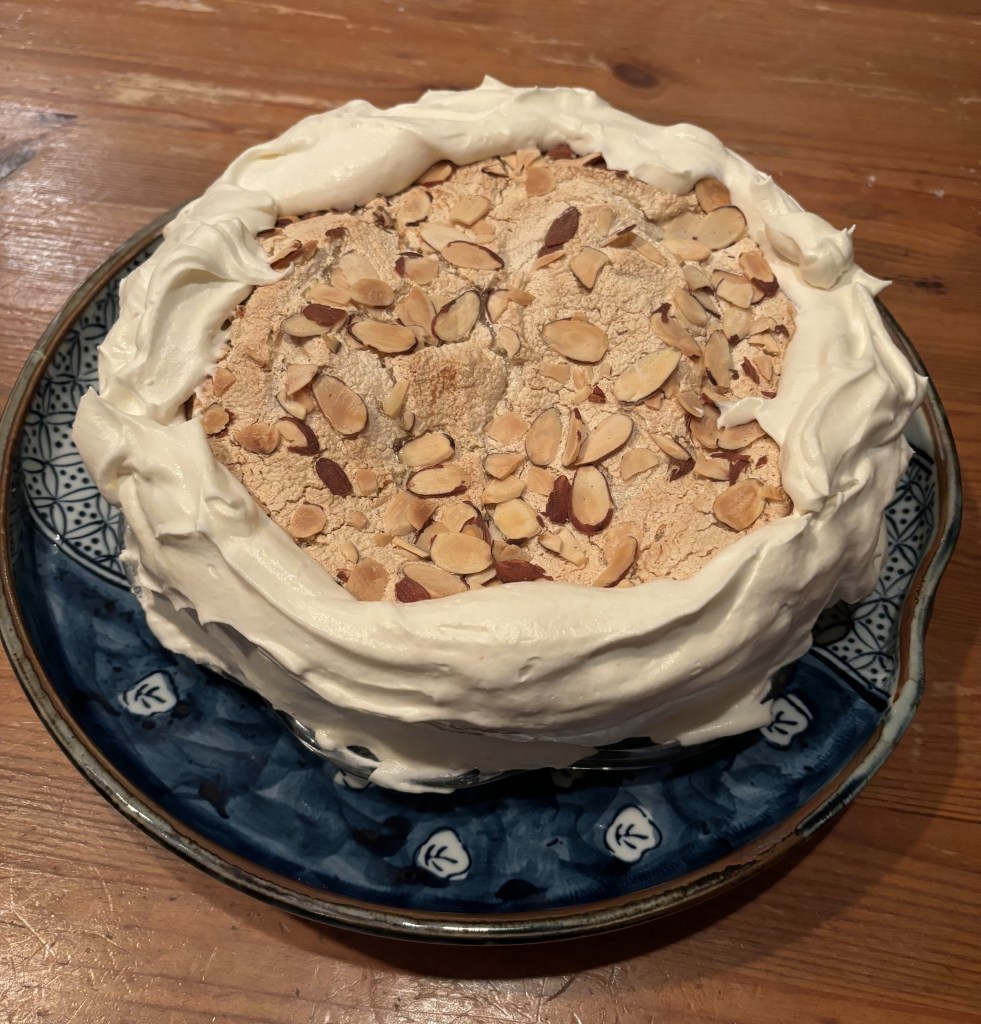
FINALLY! First, that lovely almond taste. Plus, everyone at the table now wore an attractive little white mustache of whipped cream. You don’t get that with a madeleine and a cup of tea, do you, M. Proust?

As October runs into November, Texas Hill Country towns are celebrating Oktoberfest, or, in New Braunfels, Wurstfest. Normally by now our trees would show some fall color––nothing like New England, of course. The cypresses by Lake Austin are turning bronze. Out here north of Dripping Springs, the possum haws are showing their red berries. The cedar elms turned bright yellow, then slowly lost their leaves. The live oaks, thankfully, stay green.

But this year? Drought brings bad news for trees. Cypress-lined creeks are dry…the cypresses’ arched roots groping into the earth for water. Downhill at our place Barton Creek is dry, and I mean dry, with only occasional small pools. Up on the limestone plateau the leaves on some smaller saplings just turned brown and fluttered to the ground, with the tree already looking dead. We’re watering, but in Stage 2 drought restrictions. Will our wells run dry? Have we drained the Trinity aquifers that lie hundreds of feet below?

So, to general geopolitical angst, I’ve added…tree worry.

Trees in books play such a role in our imaginations. After reading Johann David Wyss’s Swiss Family Robinson (1812)—where the shipwrecked family builds a tree-house on their desert island––I always wanted to live in a tree-house! https://en.wikipedia.org/wiki/The_Swiss_Family_Robinson We’re drawn to forests, home of the trees—scary, but sometimes the safest place. In The Sword in the Stone by T. H. White (1939), first of the four volumes that make up The Once and Future King, the Wart (the young Arthur, under Merlin’s tutelage) and Kay meet Little John who tells them about Robin Wood (explaining why it’s not “Robin Hood” and why he lives in the woods (or “‘oods”):

“They’m free pleaces, the ‘oods, and fine pleaces. Let thee sleep in ‘em, come summer, come winter, withouten brick nor thatch, and huntin’ ‘em for thy commons lest thee starve; and smell to ‘em with the good earth in the springtime; and number of ‘em as they brings forward their comely bright leaves, according to order…”

There the boys, the future King and Sir Kay, approach “the monarch of the forest. It was a lime tree as great as that which used to grow at Moor Park in Herefordshire, no less than one hundred feet in height and seventeen feet in girth, a yard above the ground….” Headquarters for Robin Wood and Maid Marian! And there begins a great and perilous adventure for Kay and Wart, who break into the castle of Morgan le Fay, Queen of Air and Darkness—to rescue prisoners paralyzed by magic. (Speaking of paralyzed victims of witches—note how C.S. Lewis later describes turned-to-stone courtyard figures in his first foray into fantasy, The Lion, the Witch and the Wardrobe (1950).)

One writer, Elisabeth Brewer, notes that “The Sword in the Stone shows a passion for trees that White shared with Tolkien. https://bit.ly/3Ceqk. How about the Ents we meet in Fangorn Forest, in J. R. R. Tolkien’s Middle-Earth? Trees that walk…and tend other trees. Not all trees are benign––including the wicked old willow which captures Frodo and friends (rescued by Tom Bombadil).

I’m reading a fascinating graphic (yes, graphic!) book about Tolkien and his close friend C.S. Lewis: The Mythmakers: The Remarkable Fellowship of C.S. Lewis and J.R.R. Tolkien, by John Hendrix. https://bit.ly/4hqiyFr

Tolkien and Lewis met in 1929 in Oxford, where they were, famously, members of a writers’ group, the Inklings, and shared many hours at The Eagle and Child. That’s not all they shared. In 1916, both men experienced horrific warfare on the Western Front in France. Young and just married, Tolkien fought in the trenches, then contracted life-threatening trench fever. At nineteen, Lewis was wounded by shrapnel (from friendly fire) on the Somme, and carried shrapnel in his body the rest of his life. Hendrix’s wonderful book uncovers the sort of salvation two disillusioned veterans found in the healing power of imagination, including Norse mythology and the European fairy tale. Tolkien knew of Yggdrasil, the sacred ash tree central to Norse mythology. https://en.wikipedia.org/wiki/Yggdrasil; https://dc.swosu.edu/cgi/viewcontent.cgi?article=2130&context=mythlore

And how the worlds created by Lewis and Tolkien fired our imaginations! The fantasy world of C.S. Lewis’s Narnia emerged when The Lion, the Witch and the Wardrobe was published (1950). Tolkien’s The Hobbit, or There and Back Again, was first published in 1937 but became a pop-culture phenomenon only in 1960’s, when the paperback edition became available. https://time.com/4941811/hobbit-anniversary-1937-reviews/

Both Lewis and Tolkien had copies of The Sword in the Stone early on. Indeed, in 1939 it was a Book-of-the-Month Club selection. T. H. White 1964 obituary, https://nyti.ms/4hlasht. Curiously, Hendrix’s book on Tolkien and Lewis doesn’t mention T. H. White, perhaps because Hendrix focuses on the impact of war; T.H. White 1906-1964) was born too late to serve in World War I. Nor was he an Oxonian. While C.S. Lewis reportedly disparaged The Sword in the Stone in 1940, he later invited T. H. White to the Inklings if he ever visited Oxford. https://bit.ly/4f4wcww (“Dickieson post”). Perhaps Hendrix doesn’t mention T. H. White because unlike Tolkien and Lewis, though he creates a fantasy world, White grounds The Once and Future King firmly in England.

But Elisabeth Brewer commented in T.H. White’s The Once and Future King that The Sword in the Stone shows a passion for trees that White shared with Tolkien. (Dickieson post.)

What about powerful trees in more recent books? Consider the Whomping Willow, in J. K. Rowling’s Harry Potter and the Wizard of Azkaban? https://bit.ly/4f1koex Magic—but terrorizing—it reveals the secret passage which ultimately allows Harry and friends to discover––well, remember? Indeed, Harry reminds us of T. H. White’s Wart, both with an earnest determination to do right, and a magical tutor.

Maybe children are especially open to tree power because they still climb trees. My dad swooped us off to grad school in Atlanta, and then to Charlotte, before we moved back to Texas. In the southeast I discovered the power of pine trees. We children built an admirable and secret treehouse in the woods, where we surveyed the world from on high. No parents came near to scold or warn: deep in the trees we ruled our own domain. Later in Carolina at eleven, I could climb the neighbors’ big back yard pine all the way to the top. The tree swayed slowly back and forth, but I could see the entire neighborhood and beyond. Tree power.
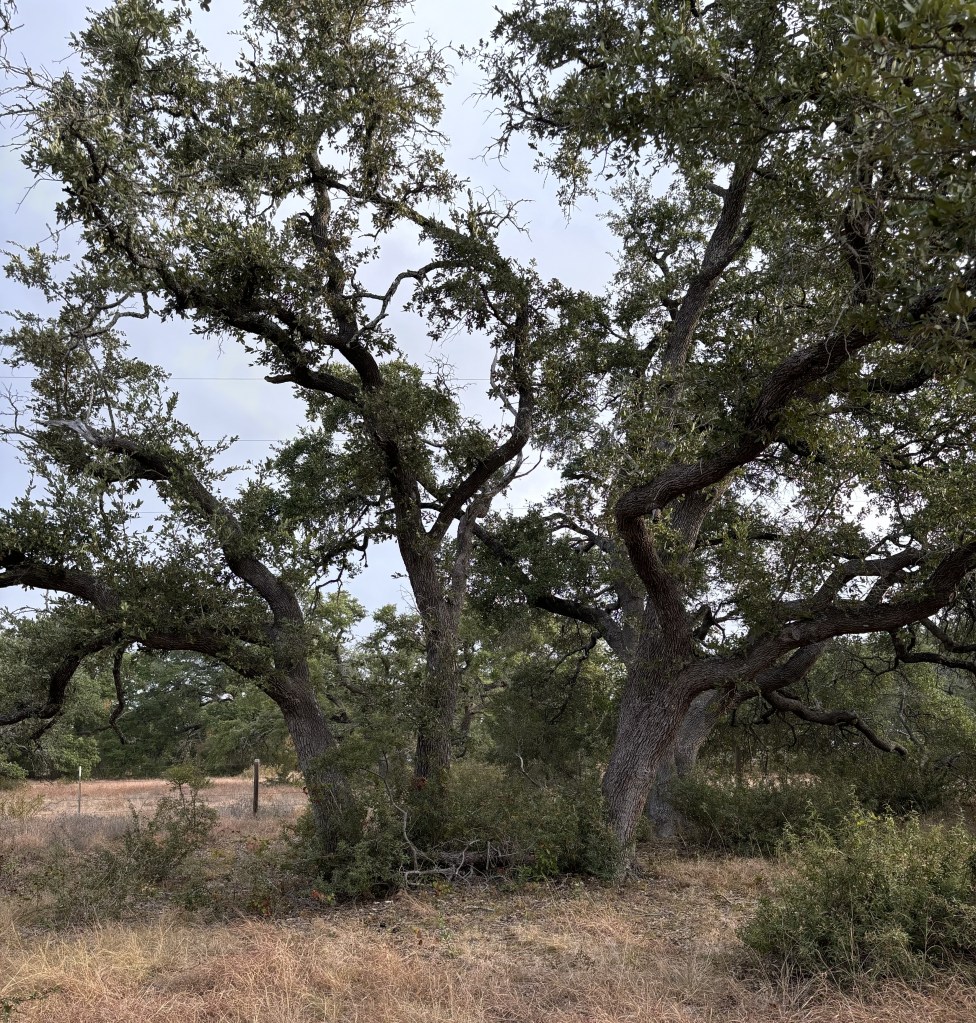
Out here on the Edwards Plateau, in the rugged karst landscape above a hill country creek, live oaks rule. The big evergreens, up to sixty feet tall, with a wide crown and massive limbs close to the ground, are Quercus Virginiana. They often grow in a circle—and you know they are communicating through their root systems. https://www.npr.org/sections/health-shots/2021/05/04/993430007/trees-talk-to-each-other-mother-tree-ecologist-hears-lessons-for-people-too

The way live oaks vary their leaves makes identification tough. On the Edwards Plateau, the species passes into the “shrubby Texas Live Oak”—shorter with smaller trunks: “…[I]ntermediate forms occur between the variety and the species and the distinctions are often difficult,” per Robert Vines, Trees, Shrubs and Woody Vines of the Southwest (1960). Well, thanks.
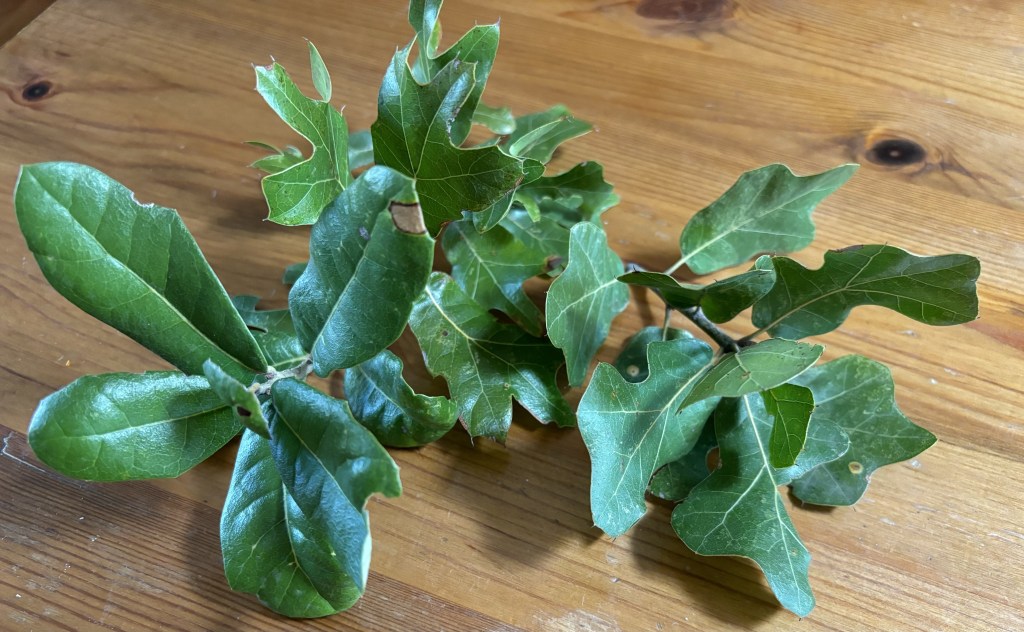
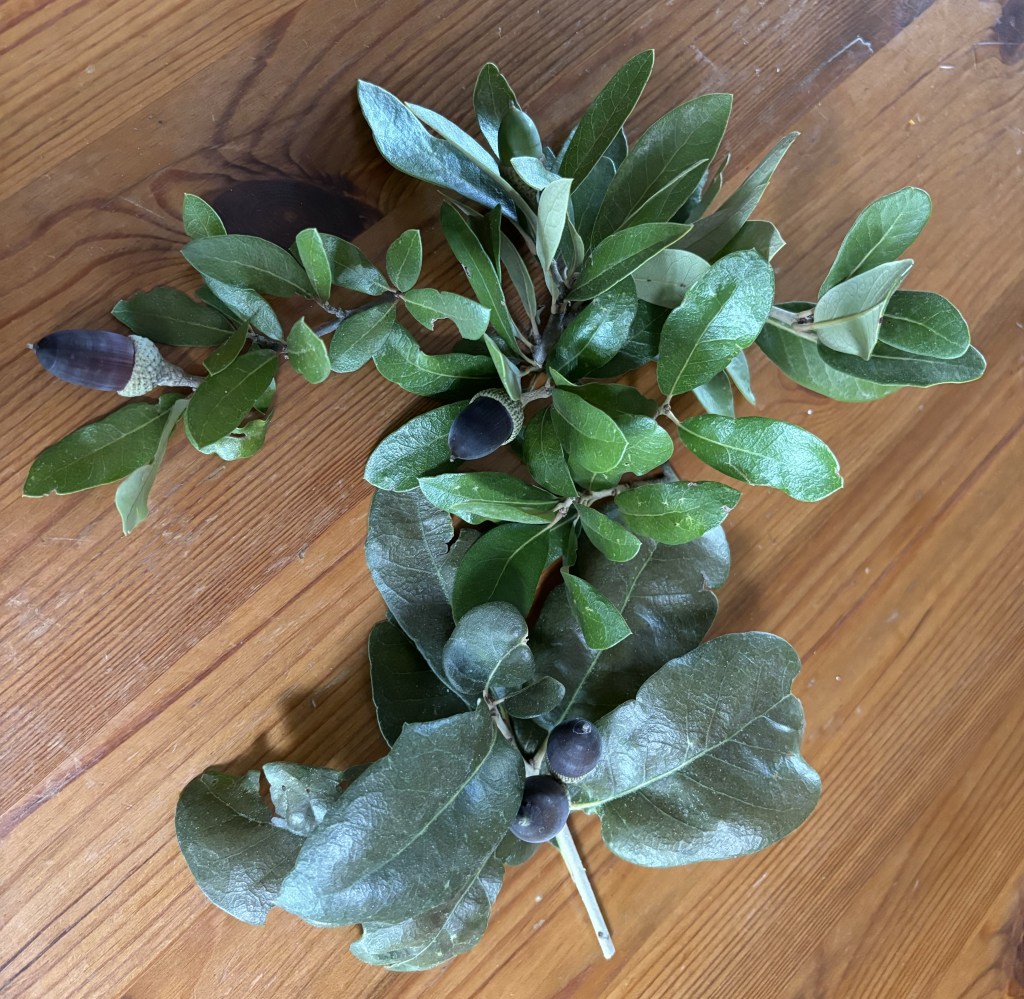
Now, in drought, with grass turned grayish tan, with dirt powder-dry beneath our feet, we treasure the blessed green of live oaks, often home to swings and hammocks, and providing wide shade to houses, pastures, and somnolent cattle.

Trees inspire us. We know Shakespeare’s song: “Under the greenwood tree, who loves to lie with me…” (As You Like It). The first poem in Wendell Berry’s A Timbered Choir begins, “I go among trees and sit still.”

Mary Oliver’s “Honey Locust” begins,

“Who can tell how lovely in June is the

honey locust tree, or why

A tree should be so sweet and live

            in this world?”

Robert Frost knows his trees: The Road Not Taken, Stopping by Woods on a Snowy Evening, Tree at My Window, Spring Pools, so many. Of course, his Birches:

“When I see birches bend to left and right

Across the lines of straighter darker trees,

I like to think some boy’s been swinging them…”

Frost makes it easy to imagine “some boy” swinging the birches—or Frost imagining that, as he marched through a yellow wood.

And then e.e. cummings, My Father Moved Through Dooms of Love—I like this verse:

“My father moved through theys of we,

Singing each new leaf out of each tree

(and every child was sure that spring

Danced when she heard my father sing)”

And Gerard Manley Hopkins, Spring and Fall:

“Margaret, are you grieving

Over Goldengrove unleaving?”

Yes, trees: later in the poem we find when “worlds of wanwood leafmeal lie.”

The forecast calls for rain. Please cross your fingers.

Helen Currie Foster lives and writes the Alice MacDonald Greer Mystery Series north of Dripping Springs, Texas, loosely supervised by three burros. She’s drawn to the compelling landscape and quirky characters of the Texas Hill Country. She’s also deeply curious about our human history and how, uninvited, the past keeps crashing the party. Currently she’s working on Book 10. Her protagonist, Alice, gets into legal drama, and matters of the heart. Alice does have a treehouse.


“PURE WRITERS…”

By Helen Currie Foster

A treat awaits at the end of the Audible recording of The Last Devil to Die, Book 4 in Richard Osman’s Thursday Murder Club series. https://bit.ly/4bJ55EP

The narrator, actress Fiona Shaw, interviewed Osman, who declared that, like so many of us, he believes in Stephen King’s On Writing. Thus his commitment: “Use no adverbs!” As Osman works on a scene he asks—“Is the scene propelling the action”? If not—out it goes. And how to propel the action? “Do it all with dialogue!”

I still believe mystery readers need to love (or at least like, or at the very least admire) their favorite protagonists. Osman says he loves his characters. He tells Shaw that he knows how each one talks. If you’ve read any of the Thursday Murder Club series you know that each character has a distinctive voice. Elizabeth, the retired spy, does not sound like Joyce, the voluble  diary-writer, or Ibrahim, the psychiatrist, or Ron, the finally-grown-up Tough Guy. Or Bogdan, the mysterious and indispensable…sometime criminal? Osman issues a challenge to fellow writers: consider what you yourself, or a particular character, would not say? (And maybe—what happens when you—or they––do say it?)

Another treat—this month we have two new books to relish! Daniel Silva gives us A Death in Cornwall, with his now retired Israeli spy Gabriel Allon rebuilding his original life as a restorer of old paintings. https://bit.ly/3LoP7Vz  Donna Leon presents Commissario Brunetti in A Refiner’s Fire, confronting and trying to understand youth gangs terrorizing the antique squares of Venice. https://bit.ly/46duLIE  Both books center on highly contemporary topics tied to—you guessed it—old sins in old wars.

Daniel Silva takes us on a deep dive into the almost unimaginably corrupt world of the ultra-rich, centered on the Geneva Freeport, where, Silva explains in his Author’s Note, 1.2 million paintings are stored, including more than a thousand by Picasso. Silva doesn’t mince words in describing one way the planet’s ultrarich escape paying taxes: they rent vaults at the Freeport using anonymous shell companies and avoid taxation if they sell paintings (or other assets) to another offshore anonymous shell company—in “transactions largely invisible to tax authorities.” https://en.wikipedia.org/wiki/Geneva_Freeport

A darker side to the Freeport vaults? Hiding works stolen from European Jews before and during World War II, with new “provenances” and new histories. Silva engages us from the beginning with Allon’s return to the Cornwall setting, the mysterious light burning in the cottage of a British art expert who has identified a Picasso stolen in 1943, and the return of young Timothy Peel, a lonely Cornwall lad befriended by Allon years earlier, and now an exceptionally able young policeman.

Add in a corruption issue involving British politics and Russian oligarchs and I predict you’ll be turning the pages. The famous spy doesn’t work singlehandedly, either—we travel to Corsica to find Allon’s mysterious colleague Christopher, then to Monaco with the computer whiz Ingrid, ready to steal documents from the Freeport, and then? As to telling the story with dialogue, and a separate voice for each character, maybe the way Allon chooses what not to say is what pushes the action.

Three days ago I picked up Donna Leon’s new A Refiner’s Fire at 8 a.m. Then I could not put it down. The first chapter starts fast (in a dark Venetian piazza), then accelerates. Meanwhile, Leon must reintroduce her characters. Her mastery of dialogue lights them up. One example: Commissario Brunetti must tread cautiously around Vice-Questore Patta, the vain and arrogant head of the police and not a Venetian, hence untrustworthy. Patta has lost at least five kilos in a new training program at a gym. A colleague tells Brunetti she overheard a compliment paid to Patta by the subtle and dazzling Signorina Elettra, the secretary who quietly controls the entire Questura office. Patta wore a new suit one day; Elettra admired it, saying “it was bolder than what he usually wore,” “[b]ecause it was single-breasted and thus more . . . revealing.” Elettra then complimented Patta “on his dedication to his vitality programme.” Brunetti whispers: “The Vice-Questore’s ‘vitality programme.’” He shakes his head a few times, “marvelling at Signorina Elettra’s ability to seduce people with a few kind words.” This exchange—combining a very Venetian fixation on exquisite fashion with the subtlety with which Elettra manages her boss––leave no doubt that she will also manage to extract from top-secret national computer systems the information Brunetti will need to resolve the crime wave Venice faces.

As in A Death in Cornwall, A Refiner’s Fire links new crimes––ongoing midnight gang battles and a vicious attack on the elderly Questura crime scene officer––to old crimes, committed during Italy’s participation in the Iraq war.

One more recommendation. I reread Dog Will Have His Day, from the Three Evangelists series by French archeologist-mystery writer Fred Vargas, set in Paris and Brittany. https://bit.ly/3WlR7nT  This time our protagonist, Louis Kehrweiler, bears the psychic wounds of an old war, World War II, with a German father and French mother. Kehrweiler is still investigating crimes by certain government officials—even though he’s been dismissed from the investigating ministry, he keeps watch over certain apartment buildings where potential targets live. When the book opens he’s watching people who walk their dogs, because he has found dog excrement on a grate by a bench…and then, after rain, when the excrement is rained away, he’s found that a bone remains. A bone from a human toe. Now he’s looking for the dog–and the victim. I found myself liking Kehrweiler a great deal—he’s a subtly drawn character. And Vargas? Oh, you must mean Fréderique Audoin-Rouzeau, French archeologist, historian and novelist, known for her work on the Black Death. and wildly creative with deep roots in French legends, tales, and countryside. https://www.fpa.es/en/princess-of-asturias-awards/laureates/2018-fred-vargas.html?texto=trayectoria&especifica=1;https://www.theguardian.com/books/booksblog/2009/jul/17/fred-vargas-deserves-prizes

Writers and readers both can enjoy Foul Matter, a 2004 sendup of the New York publishing world by Martha Grimes, author of the 25-book Richard Jury mystery series. https://bit.ly/3WnoqqJ

 (“Foul matter” is a sarcastic term for original manuscripts, galleys, and proofs which have been superseded by revised (i.e. edited) versions or the bound book and returned by the printer to the publisher.) Grimes’s Foul Matter threatens to morph into a murder mystery, even a thriller, while making fun of genre classifications and publisher behavior. The plot begins with a wildly successful author engaged in his own devious plot. His first step: “What Paul needed was hard to find: a pure writer.” He meant “a writer of a certain kind, one who didn’t really think about the arena of publishing.”

It’s fun to hear Foul Matter’s characters comment on their writing processes. One hates writers’ retreats, “Because we love to complain about not having enough time, or that we lack a proper writing environment. We don’t want any more time, and any environment will do, if we’re honest. Writing’s just damn hard. It can be torturous.. I don’t want to torture myself any more than is absolutely required. Besides, can you imagine having to sit down to dinner with thirty or forty other writers?”

Another character mocks this “writing is torture” complaint: “You can’t be blocked if you just keep on writing words. Any words. People who get ‘blocked’ make the mistake of thinking they have to write good words.” She analogizes to Field of Dreams: “Write it, and they will come.” A would-be writer asks, “Do you need to start with an idea?” No, says one writer: “If you want to write a mystery, just start with a body draped over a gate.” But do you need talent? “You just take out your yellow legal pad and pen and just start.”

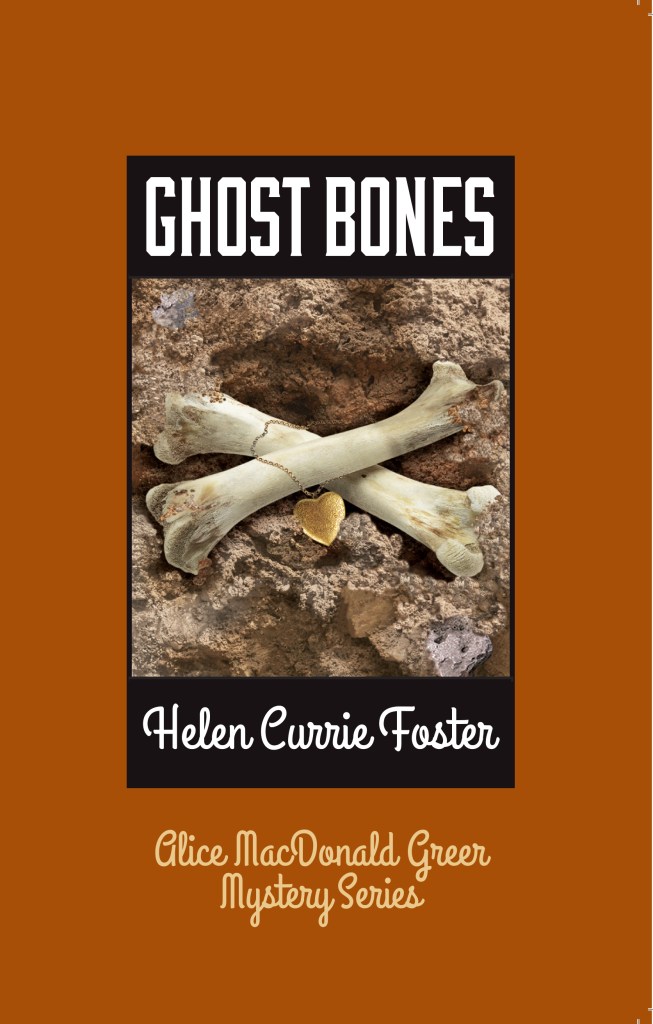
Okay, fellow writers. Laugh, then pick up your pens. I can say that since momentarily I’m in the wonderful space where a book has just come out—Ghost Bones! (Book 9 in the Alice MacDonald Greer Mystery series)—and a new book is just beginning to ferment. 

Helen Currie Foster lives and writes the Alice MacDonald Greer Mystery series, set in the iconic Texas Hill Country, north of Dripping Springs, loosely supervised by three burros. She’s active with Heart of Texas Sisters in Crime, Austin Shakespeare, and Hays County Master Naturalists.

Follow her at http://www.helencurriefoster.com, and https://www.facebook.com/helencurriefoster/

Closely Observed!…

by Helen Currie Foster

When you read a passage and experience words that strikes home forcefully–so forcefully that you almost gasp–what did the writer do that moved you so?

I’m collecting examples. For my husband it’s John Steinbeck’s tide pool in Cannery Row:

“…When the tide goes out the little water world becomes quiet and lovely. The sea is very clear and the bottom becomes fantastic with hurrying, fighting, feeding, breeding animals…Starfish squat over mussels and limpets, attach their million little suckers and then slowly lift with incredible power until the prey is broken from the rock…”

I’ve never seen a Monterey tide pool. Yet Steinbeck made me feel I have. I want to sit at the edge of the tide pool, hear “the snapping shrimps with their trigger claws pop loudly” and see the “black eels poke their heads out of crevices and wait for prey.”

Why? Steinbeck’s description is so closely observed…it’s as if my own eyes and ears saw and heard.

What about food? Proust’s memory of a madeleine crumb dipped in his aunt’s tea didn’t initially resonate with me (a madeleine seemed too bland; I would’ve preferred a buttery, crunchy, tender croissant!)–until I read his analysis.

When Proust discovered that his second and third bites of the madeleine lacked the same impact–“the potion is losing its magic”–he stretched his mind further. He writes that the source of memory was not his sense of sight (though his description of the scalloped pastry is charming). Instead, his memory came from taste and smell: “But when from a long-distant past nothing subsists, after the people are dead, after the things are broken and scattered, still, alone, more fragile, but with more vitality, more unsubstantial, more persistent, more faithful, the smell and taste of things remain poised a long time, like souls, ready to remind us, waiting and hoping for their moment,…and bear unfaltering…the vast structure of recollection.”

No French bakery in my grandmother’s small Texas town, Itasca. But the memory of her kitchen still comes back when I smell lavender, or yeast–my grandfather’s lavender talc, my grandmother’s ineffably delicious yeast rolls.

Here’s another powerful example from The Orphan Keeper by Camron Wright, about a young man, kidnapped from his home in India, then sent to a dishonest orphanage which places him for adoption in America where he rejects any Indian heritage and suppresses all his memories that aren’t “American.”

As a student in England he’s taken to an Indian restaurant where–reluctantly–he smells, then tastes, what’s offered:

“The scent that swirled around his neck had started rubbing his shoulder, reminding him softly that once, a very long time ago, they had met….[He] took his first bite. The spices in his mouth grabbed hands and began dancing in rhythm across his tongue–cumin, garlic, peppers, ginger, tamarind, cinnamon, and more. They weren’t just dancing–they were cheering, clapping, celebrating, singing, reminiscing. They were pulling out wallets and showing each other pictures of their kids….The mingling spices, the familiar taste, it felt like a whisper arriving with the wind, more message than memory.”

Curry, of course. Just reading this made me long for mango chutney! And I thought it a powerful description, because closely observed, and particularly because until this moment we know the protagonist has been stubbornly resistant to anything Indian.

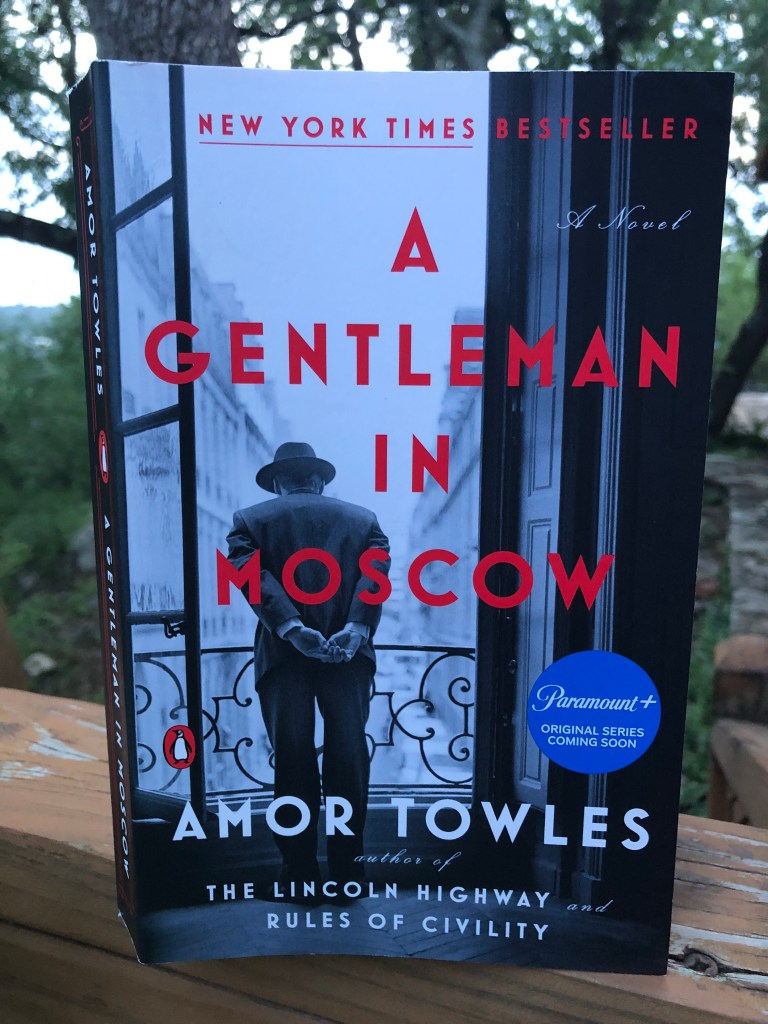
In A Gentleman in Moscow, by Amor Towles, do you recall the bouillabaisse scene? The three conspirators have carefully gathered the ingredients–hard to come by in Moscow; have picked up their spoons; and have taken their first taste. Count Rostov closes his eyes “to attend more closely to his impressions”:

“One first tastes the broth–that simmered distillation of fish bones, fennel, and tomatoes, with their hearty suggestions of Provence…One marvels at the boldness of the oranges arriving from Spain and the absinthe poured in the taverns. And all of these various impressions are somehow collected, composed, and brightened by the saffron–that essence of summer sun…[W]ith the very first teaspoonful one finds oneself transported to the port of Marseille–where the streets teem with sailors, thieves, and madonnas, with sunlight and summer, with languages and life.”

Bouillabaisse! Your memories may differ. Were you reading Julia Child and launching a kitchen experiment? Were you visiting Marseille, and were there still sailors, thieves and madonnas?

The Count has shared his memories, aroused by fish bones, fennel, tomatoes, shellfish and saffron. But your memories are your own. Also, the scene is powerful not just because it is closely observed, but also because it reminds the reader forcefully that at this point the Count has only his memories–he can’t leave the Moscow hotel, much less travel to Marseille.

I’m puzzled not to find food more “closely observed” in novels. A favorite moment: Virginia Woolf famously describes the boeuf en daube at the dinner party which is a central feature of the first half of To the Lighthouse. Mrs. Ramsay is thinking the cook “had spent three days over that dish,” as she prepares to serve it to her guests:

“…An exquisite scent of olives and oil and juice rose from the great brown dish as Marthe, with a little flourish, took the cover off. …[Mrs. Ramsay] peered into the dish, with its shiny walls and the confusion of savoury brown and yellow meats, and its bay leaves and wine, and thought, This will celebrate the occasion…”

Cookbooks, of course, intend to awaken our senses as we peruse the recipes. But the description of boeuf en daube in To the Lighthouse, with the mouthwatering anticipation it creates, has a different impact. It places us in the scene. It almost makes us, as readers, feel like guests sitting at Mrs. Ramsay’s table, alongside the odd characters Woolf has already introduced. Or possibly we also feel a bit like Mrs. Ramsay, the hostess, hoping to delight and reassure her houseguests, who are a difficult lot.

I’d love to hear other examples from readers. A “closely observed” passage can make us do just what the author wants: turn the page and keep reading! Right now I’m engrossed in Someone Always Nearby, Susan Wittig Albert’s fascinating novel about two real people, Georgia O’Keefe and Maria Chabot. I’m finding this a daring literary adventure about two daring and adventurous women, the artist you know and the woman who wanted to be indispensable to her.

It’s May–bluebonnets are gone, summer approaches. What tastes and smells bring back your summer memories? Grape popsicles, melting on the tongue? The clean bluegreen smell of Austin’s Barton Springs, mixing creek water and artesian spring water? The faint smell of chlorine from a pool crowded with splashing children? A mountain trail in the Rockies, with the cool green odor of aspen groves rising up from a creek? Dust blowing at the ball park, freshly mowed lawns, the faint rubbery smell of a sprinkler on a hot day? The smell of a roasting marshmallow just before it bursts into flame?

Good news from where I write: Ghost Bones, Book 9 in my Alice MacDonald Greer Mystery series set in the small town of Coffee Creek, Texas, will soon be out! With mystery, legal drama, and matters of the heart.

Helen Currie Foster lives and writes north of Dripping Springs, Texas, loosely supervised by three burros. She’s drawn to the compelling landscape and quirky characters of the Texas Hill Country. She’s also deeply curious about our human history and prehistory, and how, uninvited, the past keeps crashing the party. Ghost Daughter, Book 7 in The Alice MacDonald Greer Mystery series, was named Finalist in the 2022 Eric Hoffer Book Award Grand Prize Short List. Follow her:

https://www.helencurriefoster.com

and https://facebook.com/helencurriefoster/

copyright 2024 Helen Currie Foster all rights reserved

Thanksgiving–for Books Reread

by Helen Currie Foster

Now and then, when I sneak a book off the shelf, glancing around to be sure no one notices it’s a children’s book…or pick up an old LeCarré…I’m grateful for the joy of rereading.

Rather like upcoming Thanksgiving dinners! Think of their literary content! Suspense, of course–is that turkey really done? Imminent peril–are the drippings sufficient for decent gravy? Strong characters–the usual suspects are arriving at the table! Ethical challenges–no comments on the burnt marshmallow topping on the yams. And, hopefully, enough whipped cream for a happy ending!

Of course an invitee may decide to bring Something New. (I refer to an aunt’s “Pumpkin Chiffon” creation, still infamous years later. I mean, it wasn’t pumpkin pie and never would be.) In the face of such unwonted (unwanted) novelty we draw back: we don’t want something new: we want…reassurance.

So many good books are out now, deserving our attention–Lawrence Wright’s Mr. Texas, Paulette Jiles’s Chenneville, Paul Woodruff’s Living Toward Virtue, and my dear friend Dr. Megan Biesele’s amazing memoir about her anthropological adventures in the Kalahari, Once Upon a Time Is Now. https://amzn.to/3MSVL7y

But sometimes I return to the old faves, craving (especially these days)…reassurance.

What sort of reassurance? How about vindication for a beloved character in trouble? See the end of William Faulkner’s Intruder in the Dust (1948), a murder mystery where Lucas Beauchamp with his gold toothpick is saved from lynching with the help of two teens and an old lady. It’s a precursor to Harper Lee’s To Kill a Mockingbird (which has a sadder ending).

Children’s books require vindication of the hero. Lucy receives that in The Lion, the Witch and the Wardrobe, when her older siblings finally follow her through the back of the wardrobe into Narnia and discover her amazing story is true.

As a Le Carré follower, I remain thrilled by A Legacy of Spies (2017). And yes, like many of his spy thrillers, it’s a murder mystery. Our first-person narrator is “young Peter Guillam” who won our hearts earlier as the man that master spy George Smiley could always count on. White-haired, a bit deaf, and back home on the Breton coast, he’s no longer protected by the now-retired Smiley, and Britain’s foreign service (the “Circus”) has hauled Guillam to England and arrested him. The Circus is plotting an unconscionable rewrite of agency history, with Guillam cast as the villain.

But this old dog still knows old tricks, and, yes, is vindicated! We rejoice, reassured, when Peter Guillam once again is strolling the Breton coast, with a furious Smiley about to descend with a vengeance on the Circus.

Other great rereads for reassurance: Patrick O’Brian’s Aubrey-Maturin sea novels. The last pages of The Commodore (Book 17) provide classic vindication for our surgeon-spy, Stephen Maturin. After many perils, barely surviving yellow fever, and finally encountering his beloved potto https://en.wikipedia.org/wiki/Potto, Maturin learns of the death of a most vicious but hitherto unnamed enemy, who has plotted Maturin’s downfall, even his murder, for years (through many volumes). Just pages later Maturin experiences the wild joy of an unexpected reunion with his lost Diana. O’Brian’s unsurpassed powerful brevity can create the sudden turns and arouse the fierce emotions that satisfy a happy (re)reader.

My housemate reports that his rereads include The Cruel Sea by Nicholas Monserrat, Cannery Row, Pride and Prejudice, certain sections of Moby Dick, and more.

This Thanksgiving I give thanks for books, new and old. Do you remember learning to read? I do. Early one morning, age five, I opened a new book titled Children’s Book of Knowledge. The long strings of separate curly letters abruptly morphed into words. Like a bolt of lightning! I could read! Words became magnetic: I couldn’t keep my eyes away. I read everything–stray magazines, newspapers, the Cheerios box. I was now independent. No waiting for grown-ups to dispense information: I could simply read for myself! (With a library book stashed inside my desk at East Elementary–unfortunately confiscated by the teacher.)

Reading sets us free, gives us resources, gives us respite, gives us independence..and reassurance. Happy Thanksgiving!

I’m working on the ninth novel in the Alice MacDonald Greer Mystery series set in Coffee Creek, Texas, in the Hill Country. You can be sure the inhabitants insist on cornbread dressing and pumpkin pie with whipped cream. The burros will hope for leftovers.

Why They’re Favorites…? On Rereading

BY HELEN CURRIE FOSTER

What’s your favorite place to read? A certain chair? The one with a lamp that shines on your book, not in your eyes? Perhaps a ferryboat seat, where you glance up at the horizon, then down at your book? On a plane, or train?

When I was young our house had an elm tree in the back yard which was not only climbable, but offered two branches that stuck out at the perfect angle for a lounging pre-adolescent. Even better—the lounger was invisible from the house. I could scramble up, arrange myself, open my book—and be left unfound, undisturbed, for some time.

A later joy was climbing on the New Haven RR in Boston after final exams (Chaucer, Shakespeare), armed with the latest James Bond and the very biggest Hershey bar with almonds, and being rocked south for miles along the coastline. Uninterrupted.

And I confess to rereading books. I further confess to rereading children’s books. Maybe a more accurate word is: revisiting. At least every two years, I pick up Kipling’s Kim, finding my way to the part where Kim guides his Tibetan lama, who seeks a sacred river, on a pilgrimage into the high deodar forests of the Himalayas. I can almost smell the trees. There Kim steals the Russian spies’ notes––his own initiation into the Great Game. Even more satisfying? The long afternoon where, exhausted, he is “taken apart” by Eastern massage and finally stumbles out, recovered, to find his lama at the brink of—well, no spoilers.

Why this gravitational pull of favorite children’s books?

Maybe because the best children’s books feature enterprise, surprise, disguise. And—most important––the discovery of identity.

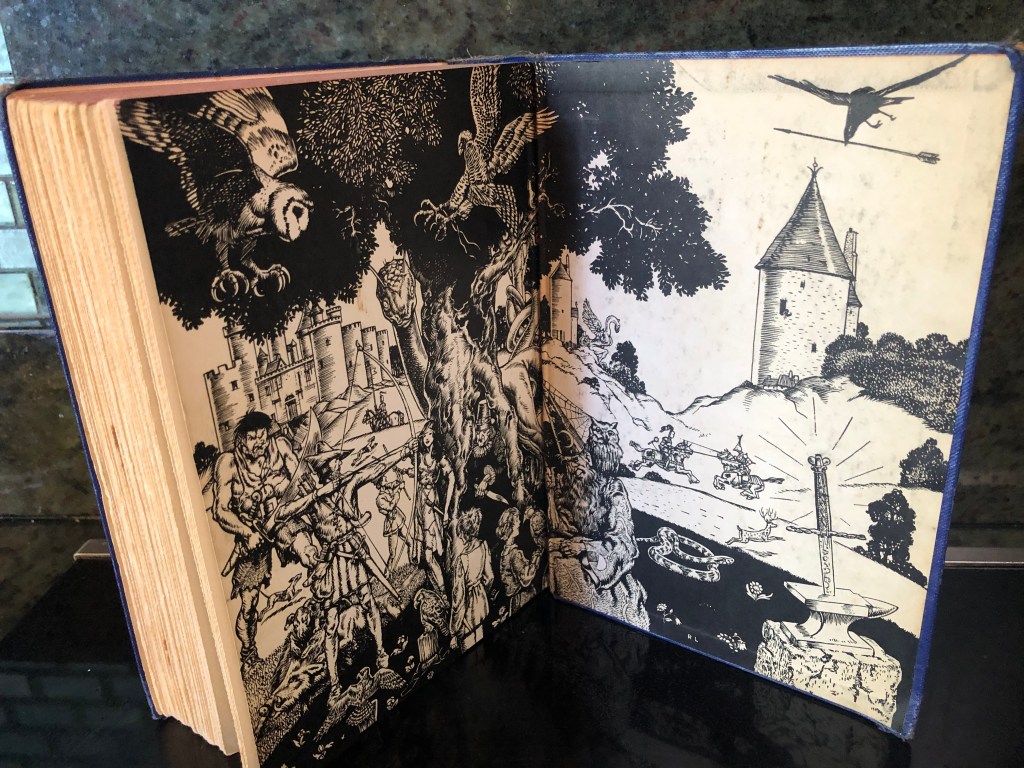
Consider The Sword in the Stone, where Merlin transforms Wart into various animals (badger, owl, fish) who teach him survival techniques (“put your back into it!”). And magic! Giants! Griffins! The Queen of Air and Darkness! (See volume below–griffin looming behind tree.) One favorite moment? When Merlin transforms Wart to a raptor—a small merlin––who must sit for desperate minutes during his formal initiation, near the maddened and perilous Peregrine. Why does Wart need Merlin’s special tutelage? Because of his identity, which he and we will finally discover.

Others I still pull off the shelf: The Wind in the Willows, especially Mole’s tearful return home, where he recognizes his true self.

Also Susan Cooper’s The Dark Is Rising. Maurice Sendak’s Nutshell Library – memorizing all the poems. I sneak back to Harry Potter—a feast of enterprise, surprise, disguise, and Harry’s search for his own identity. Occasionally I return to Lord of the Rings––especially the battle for Gondor. You’ll note I missed out on Jack London and many others. But there’s always The Lion, the Witch and the Wardrobe—remember that wondrous moment when Lucy slips through the back of the wardrobe, past all the mothballed coats…into magic? Into the snowy landscape where she meets Mr. Tumnus the faun? Into the realm where––as Lucy later discovers––she is Queen Lucy?

You have your favorites. So do our collective children and grandchildren. Bookstore shelves still offer children tales of enterprise, surprise, disguise—and characters discovering their own identities.

And fortunately, children’s books needn’t follow the 1930 Detection Club’s 10 Rules for Writing a Mystery. Rule #2: “All supernatural or preternatural agencies are ruled out as a matter of course.” Following Rule #2 would let out magic, of course, and its enormous space for imagination. (If you, like me, crave an occasional touch of magic for grown-ups, try Remarkably Bright Creatures by Shelby Van Pelt. amzn.to/44iIoVj)

As a mystery writer/reader I usually write about mystery. But thinking lately about the bibliophile’s favorites—favorite reading spots, favorite chairs, favorite characters––has sent me down a different path. Why reread? Wait––why revisit?

What is it about the end of Kim, or the plight of Frodo and Samwise in Shelob’s lair, or Harry Potter’s first moment on his broom, learning how good he is at Quidditch––that whispers, “read it again!”

I reread mysteries too. Have you reread a Dorothy Sayers, a Ngaio Marsh, a Sherlock Holmes? Or John le Carré? How many times have you read Tinker, Tailer, Soldier, Spy, or Smiley’s People? (Come on, spy thrillers are part of the mystery-thriller-spy novel genre.) And why do we reread le Carré? One character in particular: George Smiley.

Smiley first appears on page 1 of chapter 1, titled “A Brief History of George Smiley,” in Call for the Dead, le Carré’s first book, published in 1961. Smiley’s marriage to the aristocratic Lady Ann Sercomb has ended when she abandoned him, and he’s described as follows: “Short, fat and of a quiet disposition, he appeared to spend a lot of money on really bad clothes, which hung about his squat frame like skin on a shrunken toad.”

We learn of his deep love of 17th century German literature, his success at Oxford, his recruitment by MI-6, his dangerous service abroad as a spy in WWII. Not a commanding figure, no. But le Carré allows us to glimpse his sharp mind, his penetration, his ability to absorb all he hears. Smiley’s work as an intelligence officer provides him “with what he had once loved best in life: academic excursions into the mystery of human behaviour, disciplined by the practical application of his own deductions.”

Smiley appears next in A Murder of Quality (1962), where Smiley’s solution to the murder rests on a scathing critique of the snobbishness of British public schools (le Carré despised his own experience at such a school).

By the time we reach Tinker, Tailor, Soldier, Spy (1974), Smiley has been put out to grass at MI-6 under the new regime headed by Bill Haydon, who has seduced Smiley’s wife Ann and taken over London Station after causing the bitter dismissal of Control as its head.

In Tinker, Tailor, Smiley is plucked out of retirement to interview a somewhat dubious British agent who claims the Russians may have placed a mole inside MI-6. Here’s Smiley, listening to the agent’s tale:

“He sat leaning back with his short legs bent, head forward, and plump hands linked across his generous stomach. His hooded eyes had closed behind the thick lenses. His only fidget was to polish his glasses on the silk lining of his tie, and when he did this, his eyes had a soaked, naked look that was embarrassing to those who caught him at it.”

Smiley’s investigation marches ahead. The BBC wants to make a series of Tinker, Tailor. And John le Carré has an actor in mind: Alec Guinness. https://www.theguardian.com/tv-and-radio/2019/sep/05/tinker-tailor-soldier-spy-40-years-on-alec-guinness

Le Carré’s letter to Sir Alec Guinness (3 March 1978) appears in A Private Spy / The Letters of John le Carré, at 213. He tells Sir Alec:

“Apart from plumpness, you have all the other physical qualities: a mildness of manner, stretched taut, when you wish it, by an unearthly stillness and an electrifying watchfulness. In the best sense, you are uncomfortable company, as I suspect Smiley is. An audience wishes––when you wish it––to take you into its protection. It feels responsible for you, it worries about you. I don’t know what you call that kind of empathy, but it is very rare, & Smiley and Guinness have it: when either of you gets his feet wet, I can’t help shivering.”

I love that “as I suspect Smiley is.” Does the author’s own speculation about George Smiley explain, in part, why we readers become so attached to this character? What drives us to Smiley’s side? Is it his apparent ineffectualness, his vulnerability, his stillness, his watchfulness, entwined with our certainty that he will somehow keep going?

Not until 1979 in Smiley’s People does Smiley achieve final vindication, catching the Russian master-spy who conceived the long set of steps that led to Haydon’s seduction and Control’s fall. At the climax, we (along with Smiley and his fellow spy Peter Guillam) await the possible arrival of the Russian in cold war Berlin, at the crossing point from East Germany. Will the spy make it across the bridge? Guillam asks what cover the Russian will use:

Smiley sat opposite him across the little plastic table, a cup of cold coffee at his elbow. He looked somehow very small inside his overcoat.

“’Something humble,” Smiley said. “Something that fits in. Those who cross here are mostly old-age pensioners, I gather.’ He was smoking one of Guillam’s cigarettes and it seemed to take all his attention.”

At book’s end, we are waiting with Smiley. It’s cold there by the Berlin bridge. I expect Smiley’s feet are wet. Like the author, “I can’t help shivering.” When we know a character’s vulnerabilities, we begin to perceive true identity.

For Smiley, for all the characters created by their authors with such vividness and such vulnerability that we seem to feel what they feel, for such characters–I reread. Yes, the better word is revisit: I go back just to be sure the characters are still there, still available, still waiting quietly on the shelf. And, yes, just as good as I thought they were.

I’d love to hear your favorites (reading spots, children’s books) and the favorite characters you…revisit.

March Madness?!

by Helen Currie Foster

“MARCH MADNESS”? In the Texas Hill Country, “March Madness” doesn’t only mean NCAA basketball. Its alternate form: Demented Spring Gardening. Too early, you say? Well, according to the snakes, spring’s already here.

Of course it’s not officially spring yet. Just three weeks ago, here north of Dripping Springs, Texas, the entire landscape—every tree, every leaf–was shrouded in solid ice. But this week, well before the equinox, beneath the oaks you’ll spot the amazing heartbreakingly beautiful fuchsia of the redbuds.

And roses! The tender yellow flowers of the Lady Banksia rose are cascading from the oak tree that serves as her trellis.

On other branches you can see the first luxurious pink buds of Souvenir de Malmaison, named for Empress Josephine’s rose garden, beginning to open.

In the garden the ineffably fragrant Zephirine Drouhin is performing her slow tease, loosening the green sepals, delicately unveiling her bright pink petals.

I’ve already planted two new and reputedly very fragrant roses––Madame Plantier, and Cramoisi Superieur. (What a name!) And I replanted Buff Beauty, which produces buff and yellow and apricot blooms. Still waiting for two more—Savannah and Sweet Mademoiselle, both promising strong fragrance. Seriously, a rose without fragrance? Isn’t it disappointing to lean forward into a rose, inhale…and…nothing? As Shakespeare points out in Sonnet 56:

The rose looks fair, but fairer we it deem

For that sweet odour which doth in it live.

But for sheer fragrant spring bravado, tinged with peril, what about the ridiculous grape Kool-Aid smell of Texas mountain laurel? Intoxicating and loopy. The plant—sophora secundifolia–– isn’t called “Texas mescal bean” for nothing. https://www.wildflower.org/plants/result.php?id_plant=sose3: “The brilliant red seeds contain the highly poisonous alkaloid cytisine (or sophorine) – this substance is related to nicotine and is widely cited as a narcotic and hallucinogen.”

Poets give us strong language for the power of spring. From Dylan Thomas: “The force that through the green fuse drives the flower…”  https://poets.org/poem/force-through-green-fuse-drives-flower

From “in-Just” by e.e. cummings:

in Just- 

spring          when the world is mud- 

luscious the little 

lame balloonman 

whistles          far          and wee 

“Mud-luscious!” Cummings captures the joys of digging, planting, splashing—of being a child in spring. https://www.poetryfoundation.org/poems/47247/in-just

“A Light exists in Spring” by Emily Dickinson was new to me. I treasure her recognition, her human diagnosis, of that first moment when we notice the magical presence of spring. It begins:

A Light exists in Spring
Not present on the Year
At any other period —
When March is scarcely here

A Color stands abroad
On Solitary Fields
That Science cannot overtake
But Human Nature feels.

bit.ly/420VlSC

More symptoms of March Madness? The powerful, even uncontrollable, urge to fill your cart full of geraniums, dirt, mulch, annuals, perennials, unknown roses, tomato plants, new trees… Trudging a quarter mile from the local native plants emporium to your car, lugging a red wagon full of blue sage, lantana, and other plants hopefully accurate in describing themselves as “deer-resistant”… Other symptoms include impassioned online review of rose varieties, frantic ripping open of seed packets and daily watering of small unlabeled pots, then staring at tiny emerging seedlings and wondering—what are you? Is that the fennel or the Aji Crystal Pepper or the Mexican plum?

I’d never heard of Mexican plum until a friend gave me a jar of her amazing Mexican plum jam. She described the trees as small, with fragrant white blossoms. So I ordered seeds. The very small print on the seed packet required “stratification” in the refrigerator. Well, I tried. Every morning I peer at the still-empty pots of dirt… little plants, where are you? Can you live in the Hill Country?

Also—perhaps prematurely—we dragged hay bales into the garden and embarked on the great Haybale Tomato experiment:

Supposedly, according to our favorite local well-driller, this approach produces for one local rancher “the most beautiful tomatoes in the Hill Country.” Our donkeys kept sticking their muzzles through the fence, trying to eat the bales. Watch this space. https://www.youtube.com/watch?v=z2jjIHgmypM

Gardens can be perilous. Think of Eden. But how many murder mysteries are set in gardens, or involve garden poisons? If you haven’t already become a fan of Reginald Hill, you might try Deadheads. Dalziel and Pascoe solve virtually every murder presented to them in their Yorkshire police headquarters. In this one, roses abound, beginning on the first page. And rose culture. And… murder. bit.ly/3Fgce23

Texas author Susan Wittig Albert knows her way around poisonous plants, in Texas or elsewhere. I just finished her Hemlock, Book 28 in her China Bayles series. This mystery—impressively researched, and fast-moving–takes the reader to the Blue Ridge mountains and theft of a rare botanical book, with deft historical backstory.  https://susanalbert.com/hemlock-book-28/

For more on Texas mountain laurel, its power and peril – see Ghost Dog, Book 2 in my Alice MacDonald Greer Mystery series. bit.ly/3YIotv5

The weather report threatens another cold snap this week—even (gasp!) a possible freeze. But right now it’s 74 degrees. Geraniums to plant. Blue sage. Tomatoes to water. Yes, it’s hubris, exposing these tender plants so early to the vagaries of Hill Country weather, but—I can’t help it. I just saw a big bud on Star of the Republic! I swear it wasn’t there yesterday. March Madness reigns!

Find Helen Currie Foster on Facebook or at http://www.helencurriefoster.com. The eight books of the Alice MacDonald Greer Mystery series, including the most recent, Ghosted, amzn.to/3YrJBXf, are available at Austin’s BookPeople as well as on Amazon (Kindle and Paperback).

Waking or Sleeping?

by Helen Currie Foster

This week out here on the creek I was iced in, with no power.

I was sitting by the fireplace wrapped in a blanket, when I came upon an unfamiliar word: HYPNOGAGIA. “Hypnagogia is the transition between wakefulness and sleep. During this state, it’s common to experience visual, audio, or other types of hallucinations. It’s also common to experience muscle jerks and sleep paralysis.” https://www.healthline.com/health/hypnagogia#:~:text=Hypnagogia%20is%20the%20transition%20between,to%20hypnagogia%20to%20stimulate%20creativity

Some people purposefully try to induce to hypnagogia to stimulate creativity. Id. According to Allison Eck, Harvard Gazette (Autumn 2022), hypnagogia is “widely thought of as a sweet spot for creativity.” https://hms.harvard.edu/magazine/sleep/behind-veil-hypnagogic-sleep. Eck describes the experience of scientist August Kekulé in the mid 1800’s during his search for the structure of the compound benzene, as he dozed before his fireplace in Ghent. “[A]s he dozed, images hinting at its structure appeared in his mind’s eye. He later wrote that he saw dancing atoms beaded together along an invisible string, ‘twisting in snake-like motion.’ The atoms morphed into an ouroboros” (another new word for me: a snake eating its own tail). Kekulé realized benzene’s structure was a ring  of carbon atoms, each attached to a hydrogen atom.

Scientists and innovators like Einstein and Edison, and writers like Vladimir Nabokov, “have transited this cerebral pathway in search of solutions to problems.” Id.

Have you experienced hypnagogia? I think I have, a few times, in mystery-writing, most recently in my newest, Ghosted. https://www.amazon.com/Ghosted-Alice-MacDonald-Greer-Mysteries/dp/1732722927/ref=tmm_pap_swatch_0?_encoding=UTF8&qid=1675707798&sr=8-1

On each occasion I’ve gone to bed with my mind on a plot problem, or a scene that needs to take shape. Preliminary requirements appear to include being ensconced under the covers, on my left side, envisioning a possible scene as I slide into sleep—then watching the scene begin to unfold. I try to remind my brain to remember this solution. While most dreams fly away with sunrise, these solutions have come back in the morning. If I could make this happen whenever I want (so far, no dice), a book would get finished so much faster!

This occasional experience may be “lucid dreaming,” the state of being aware that you’re dreaming. “When you wake up from a lucid dream, you actually have a more positive mood in the morning,” writes researcher Michelle Carr, Department of Psychiatry at the University of Rochester, in Aeon. https://aeon.co/essays/in-sleep-the-body-is-a-channel-to-communicate-with-the-dreaming-mind. Carr describes herself as a dream scientist: “I want to uncover ways to repair nightmares and, in their place, engineer dreams for healing.”

Hypnogagia is a big topic these days. A team of engineers and scientists at the MIT Media Lab developed a glove-like tool to help decipher dreams. Researchers are testing whether the glove may allow people to manipulate their hypnagogic experiences, which could help sufferers from PTSD and nightmare disorders feel a stronger sense of control.  Again, as Eck puts it, “…[A]t the very least, drawing attention to our hypnagogic personas may bring us newfound ideas that we can act on when we wake.”  Id.

Charles Dickens, inveterate insomniac, walked the streets of London at night and used dream states in his books, including, famously, A Christmas Carol. https://www.frontiersin.org/articles/10.3389/fpsyg.2021.700882/full

Could we term it “lucid dreaming” when Scrooge is shown visions—then decides to change the dreadful outcomes by his future actions? He begs the Ghost of Christmas Yet to Come, “Assure me that I yet may change these shadows you have shown me, by an altered life?” He promises, “I will honour Christmas in my heart, and try to keep it all the year. I will live in the Past, the Present, and the Future…” Then Scrooge sees the phantom’s hood and dress collapse into his bedpost, scrambles out of bed, repeating that last sentence––and heads out to buy the prize Christmas turkey for the Cratchits.

Vladimir Nabokov kept a dream diary, and in his autobiography, Speak, Memory, wrote about the procession of  what he called “hypnagogic mirages,” images he would see ‘just before falling asleep,” often accompanied by “a neutral, detached, anonymous voice which I catch…”

He emphasizes he is still aware during “the visions that pass before my closed eyes. They come and go, without the drowsy observer’s participation, but are essentially different from dream pictures for he is still master of his senses” (emphasis added). Lucid dreaming? https://www.loa.org/books/8-novels-memoirs-1941-1951?gclid=Cj0KCQiA54KfBhCKARIsAJzSrdotSuqt8CbUDCbTtegLG4hvxHker5ZZVuIwntp0lTzrNsY0PD5UeA8aAmQyEALw_wcB

Tolstoy’s notes show he envisioned characters in such visions. For a deeper dive, see https://ciaotest.cc.columbia.edu/olj/socsci/socsci_99pev01.html

(Side note––in Speak, Memory Nabokov also describes his synesthesia, where each letter of the alphabet appeared in its own color—depending on the language. In English a long “a” was the tint of weathered wood, but in French was polished ebony. Other letters were green, blue, yellow and so on. He also could not bear the sound of music. An unusual brain!) https://www.google.com/search?gs_ssp=eJzj4tLP1TcwTjMxr8gxYPQSKMtJTMnMzSxSyEtMys_OLwMAiy0J6w&q=vladimir+nabokov&oq=vladimir+n&aqs=chrome.1.69i57j46i131i433i512j0i512l2j46i512j0i512l3j46i512.8717j0j15&sourceid=chrome&ie=UTF-8

We mystery writers can mine hypnagogic moments for ideas on character and scenes––but the genre suggests a limit.

A good mystery offers the reader the chance to solve a puzzle. As set forth in the original rules of London’s Detection Club, “The detective must not light on any clues which are not instantly produced for the inspection of the reader.” Nor can the detective solve by “an unaccountable intuition.” https://murder-mayhem.com/the-detection-club-rules

Meeting of the Detection Club in 1936.

 Indeed, is there anything more irritating to a mystery reader than the tardy mention of a clue? No! Mystery readers are entitled to all clues, as soon as that clue is found, and clues are facts. The mystery writer offers a collaboration to the reader, in which the detective and reader are on the same page—fact-wise. We readers want evidence. A character’s dreams may offer insight into a character—but not evidence.

Besides—while most of us are at least mildly interested in our own dreams, unless we’re also therapists we’re not usually too interested in the dreams of others. Do you remember your interest level the last time someone began describing a dream to you? I confess my eyes can begin to glaze. Of course it’s hard to convey dreams with the color and speed and power the dreamer experienced. But in the world of mysteries, we are greedy for facts. In Martin Walker’s “Bruno, Chief of Police” series, set in a small town in the French Dordogne, Bruno’s activities are fascinating––his cooking, his love life, his detection––and while we know he had a difficult military service in Bosnia, the author doesn’t dwell on Bruno’s dreams about those days. Instead he provides us with what we want: Bruno’s memories. Those contain facts, at least Bruno’s versions of facts, for which the reader is grateful. http://www.brunochiefofpolice.com/

So I’m cautious. In my Alice MacDonald Greer Mystery series, at least so far, Alice doesn’t share her dreams. For one thing, as observed in the New Yorker, “As for writing about them, even Henry James, who’s seldom accused of playing to the cheap seats, had a rule: ‘Tell a dream, lose a reader.’” Dan Piepenbring, “The Enthralling, Anxious World of Vladimir Nabokov’s Dreams” (February 8, 2018). https://www.newyorker.com/books/page-turner/what-vladimir-nabokov-saw-in-his-dreams

The ice has melted! And Ghosted is out! Book 8 in the series is available now in paperback and also on Kindle via pre-order delivery on February 10, on Amazon. Also coming soon to Austin’s BookPeople!

Follow me at www.helencurriefoster.com.

https://www.facebook.com/helencurriefoster

https://www.instagram.com/helencurriefoster/