My Dirty Little Secret

by K.P. Gresham

Up to now, I’ve avoided a particular phrase in describing my Pastor Matt Hayden Mystery Series. And the secret is…I write Christ-centered mysteries.

To me, this term is more accurate in describing my books than calling it Christian fiction. Of course, it is Christian fiction. However, a lot of folks who read Christian fiction expect there will be no swear words, no blood on the page, nothing that would be considered “controversial.”

In my Christ-centered mysteries, I like to acknowledge the real world, just as Christ lived in the real world during His time on earth. He ate with taxpayers, drank wine (heavens, His first miracle was to create some awesome wine for a wedding banquet at His mother’s request), hung out with tax collectors and bad guys. Although He was incredibly within His rights to judge others, He did not. Instead, He loved them.

My character, Pastor Matt Hayden, has existed in the real world. He came from a police family. His father was a police captain, his brother was an officer on the bomb squad, and Matt was an undercover cop on the Miami docks. Then a corrupt police chief killed both his father and brother as they had been getting too close to outing the chief’s crimes. Finally, the chief came after Matt. A confrontation ensued, and Matt had the opportunity to kill the chief. God stayed his hand. And Matt was called to become a pastor, which he did when he entered the Federal Witness Protection Program.

Matt becomes a pastor who is very familiar, maybe too familiar, with the real world. He knows, as Jesus knew, people who were crooks, prostitutes, alcoholics–you get the gist. And Matt does not condemn them. He holds them to account, of course. But his main goal is to love them.

So, in my books, you’re going to hear swear words, ‘cuz bad guys swear. And Matt’s girlfriend owns a bar. And bad stuff happens to good people, and good people sometimes slip up and do bad things.

That’s life. 

I have to acknowledge this reality, because I saw folks lie to my dad a lot. My dad was an incredible Lutheran minister. The messages from his pulpit were all about love. But what I saw, that dad didn’t always see, was the “act” some folks were pulling on him. Whenever we’d go to a parishioners home, the family Bible was always on display, the best china was on the table, everyone was dressed nicely, and we all said grace before and gave thanks after a delicious meal. But I knew that some people weren’t always so crystal clean. Not everyone, by a long shot. I love the people of those churches. Good, loving people. But there were a few that had issues. One of my dad’s “good” friends was a regular at a questionable bar in town with a woman on his lap who wasn’t his wife. Dad never knew this; I didn’t want to break his heart. This type of thing happened from time to time.  Sometimes dad’s world wasn’t real.

Jesus, on the other hand, couldn’t be hoodwinked. And I wanted Matt to come into his ministry with his eyes wide-open. And I want my books to show Matt’s faith and desire to love in a real-world setting.

So, if you go to the link above to get my books, you will see that this is the first time I’m saying my books are Christ-centered mysteries. And when you get there, you will see the name of this promotion is…

November Edgy Christian Fiction.

So, I guess I’m living on the Edge. But now you know my secret.

K.P. Gresham, Author

Professional Character Assassin

K.P. Gresham is the award-winning author of the Pastor Matt Hayden Mystery Series as well as several stand-alone novels.  Active in Sisters in Crime and the Writers League of Texas, she has won Best Novel awards from the Bay Area Writers League as well as the Mystery Writers of America.

Click here to receive K.P.’s newsletter and a get a free short story!

Website: http://www.kpgresham.com/

Email: kp@kpgresham.com

Blogs: https://inkstainedwretches.home.blog/

https://austinmysterywriters.com/

Facebook: https://www.facebook.com/kpgresham

Books by

K.P. Gresham

Three Days at Wrigley Field

The Pastor Matt Hayden Mystery Series

The Preacher’s First Murder

Murder in the Second Pew

Murder on the Third Try

Four Reasons to Die

THE WITCHING HOURS OF HALLOWEEN

It’s time…for ghosts, goblins, witches, warlocks, and, of course, the dead. It’s Halloween.But what was it about in ancient times, and where did it begin?

The customs of Halloween can be traced back to the Druid priests of the Celtics. It was the second most significant holiday of their year. The first was Beltane – the growing season celebrated from April 30– May 1. The second, October 31, was Samhain when the crops were reaped. It was believed that by harvesting all the crops by October 31, there would be no damage to them by ‘evil or mischievous spirits’ who’d return on the first evening of the dark half of the year. 

Druid rituals, deeply ingrained in the Celtic belief system, consisted of lighting huge bonfires, animal sacrifice, and burnt offerings of foods. The priests disguised themselves with animal masks to confuse the spirits.

When Christian missionaries set out to convert England, Pope Gregory, the head of the Church from 590 to 604 A.D., advised them not to force the conversion to end their culture but to incorporate as much of it as possible. It wasn’t a far stretch to succeed since saints in Christianity were credited with miraculous events that were supernatural in nature. Thus, the name Samhain, on October 31, morphed into All Hallows Eve – the night before the saints were revered. 

All Hallows Eve, over time, became Halloween, and the old beliefs did not completely disappear. The concept of spirits returning survived, and Christianized customs grew out of the old ways, with each country developing its own practices.    

In France, Halloween holds little attraction or fanfare. It is considered a very American tradition, and the French are never anxious to adopt American ways. Halloween in France is overshadowed by All Saints Day, on November 1, a national public holiday. The French attend specific religious services and visit cemeteries to lay flowers on deceased relatives’ graves.

The same may be said for the Netherlands. They, too, consider Halloween an American and commercial endeavor rather than a cultural institution. On November 11, the Dutch observe Sint-Marten, a children’s feast that resembles the American celebration of Halloween and is more widely practiced.

In Asia, Halloween has become popular. Hong Kong, the American festival has caught on, and in Japan, where it was first celebrated at the 2000 Tokyo Disneyland, it has taken on a life of its own. 

In Haiti, Fet Gede, or the Festival of the Dead, has an entirely different cultural backdrop. On November 1, All Saints, and on November 2, All Souls, those who practice Voodoo, the Vodouisants, pay their respects to Baron Samedi, the father of deceased spirits. Vodouisants dance in the streets, commune with the dead, and walk through graveyards, leaving food for their ancestors from their own tables. It more resembles Mardi Gras than Halloween.

In Italy, La Festa di Ognissanti (the feast of All Saints) or Hallowmas – short for All Hallows Mass, on November 1, is celebrated by spending time with family. On all Souls, Italians leave chrysanthemums on loved ones’ graves and bake cookies called fave dei morti. They are made with almond, butter, and flour and represent the beans of the dead, a tradition that has survived from ancient Roman times, when beans were used in funerary rites. 

Perhaps my favorite Halloween ritual is from Mexico: Dia de Los Muertos – the Day of the Dead. Mexicans wear bright makeup and dazzling costumes to parade, sing, and dance. A unique aspect of Dia de Los Muertos is the building of altars in tribute to deceased ancestors. Upon these altars are sugar skull-shaped confections and bottles of tequila, along with flowers and pictures of the dead. These offerings are believed to attract the spirits and reunite them with their living families. Other traditions include gathering at the cemeteries dressed in eye-catching costumes with colorful floral decorations, including symbolic marigolds. There, they enjoy traditional foods like pan de muerto (bread of the dead) and Calaveras (sugar skulls). From Mexico, we come to the United States, where all of our American Halloween traditions evolved from other countries.

Carved Jack-o-Lanterns began with a legend about a man named Stingy Jack who trapped the Devil and only let him go on condition that Jack would never go to Hell. When Jack died, Heaven didn’t want him, so he wandered the earth as a ghost for eternity, with a burning lump of coal in a carved-out turnip (now a pumpkin) to light his way. Eventually, people began carving frightening faces on their pumpkins to scare away evil spirits.

The custom of wearing creepy costumes began with Samhain. The Celts believed that in costume, they would be mistaken for ghosts and left alone by actual spirits. And then, there is Trick-or-Treat. 

One theory is that during the Middle Ages, on All Souls Day, children and some adults collected food and money from neighbors in return for their prayers for the dead. Eventually, that was replaced with non-religious practices, including songs, jokes, and other tricks if the treat wasn’t forthcoming. The ritual of door-to-door seeking handouts has long been part of Halloween, but we are long past the days of giving fruits, nuts, coins, and toys. We now are every dentist’s dream, devouring $3 billion-plus dollars of candy.

Bobbing for Apples is not as American as Apple Pie. It stems back to a courtship ritual of the Roman festival honoring Pomona, the goddess of agriculture and abundance. Young men and women could “predict their future relationships based on the game. When the Romans conquered the British Isles in 43 A.D,” the Pomona festival melded with Samhain. 

No discussion would be complete without Pranking. Playing pranks varied by region, but the pre-Halloween tradition known as “Devil’s Night” included good-natured mischief. When Irish and Scottish immigrants came to the U.S., they brought the practice of celebrating Mischief Night as part of Halloween.

Igniting huge bonfires also began with the Druids, and over time, believed to light the way for souls seeking the afterlife. Bonfires are no longer common, at least not in big cities. In today’s world, souls need good eyesight because the most they get is candlelight.

  So, my witches, warlocks, ghosts, goblins, and mischief makers, you now have some customs, traditions, and history. Enjoy it with the candy and treats. 

Happy Halloween!

Francine Paino a.k.a. F. Della Notte

THE PULL OF EMPTY SPACES

by Helen Currie Foster~October 17,2023

Last week, trudging up a rocky trail to an abandoned abbey high above an Italian valley in the Sabine Hills, I heard another walker ask this: after the Romans defeated the Sabines, were any Sabine ruins left?

“Yes,” said the guide. “A temple to the goddess of empty spaces.”

The goddess of empty spaces? Her name?

“Vacuna.”

Even in fourth year Latin at McCallum High, our beloved teacher, Miss Bertha Casey, never mentioned Vacuna.

The walker’s question—any Sabine ruins?—had never occurred to me.

Questions by others can open empty pages in our own minds.

Vacuna’s authority remains a mystery—appropriate, if she was, among other powers, in charge of empty spaces. Or moments of rest, of vacancy, of relaxation. One writer says, “Vacuna was the Sabine goddess of water, nature, forests and fertility, but she was also the goddess of rest.” https://worldhistory.us/ancient-history/vacuna-the-hidden-goddess-veiled-in-the-mist-of-history.php; https://www.romeandart.eu/en/art-nimphs-floating-island.html; https://en.wikipedia.org/wiki/Vacuna

From this hill to the next hill stretched a vast empty space.

Well, not exactly empty––the air seemed visible, with sunlight glinting on bits of dust and mist. But the enormous not-exactly-empty openness fired imagination. The land below contains houses, farms, fences, vineyards—all presumably considered to belong to someone. But watching the air shimmer above the valley I wondered—does that openness belong to Vacuna? To anyone looking out across the valley?

Wait—it didn’t belong to anyone. Not to a hang-glider, nor a kite-flier, nor a drone.  Long after they’d folded their toys and gone home, empty space would still be there, stirring imagination, raising questions, dreams, ideas.

How do you respond to the words “blank page”? To a new notebook? To a waiting empty screen—a “new document” in Word? Your pencil is sharp. Your fingers are poised. What will you write, draw, scribble on that blank page? The very sight of the words “blank page” makes you pause, doesn’t it, making you wonder what you might write? Blank pages prick the imagination.

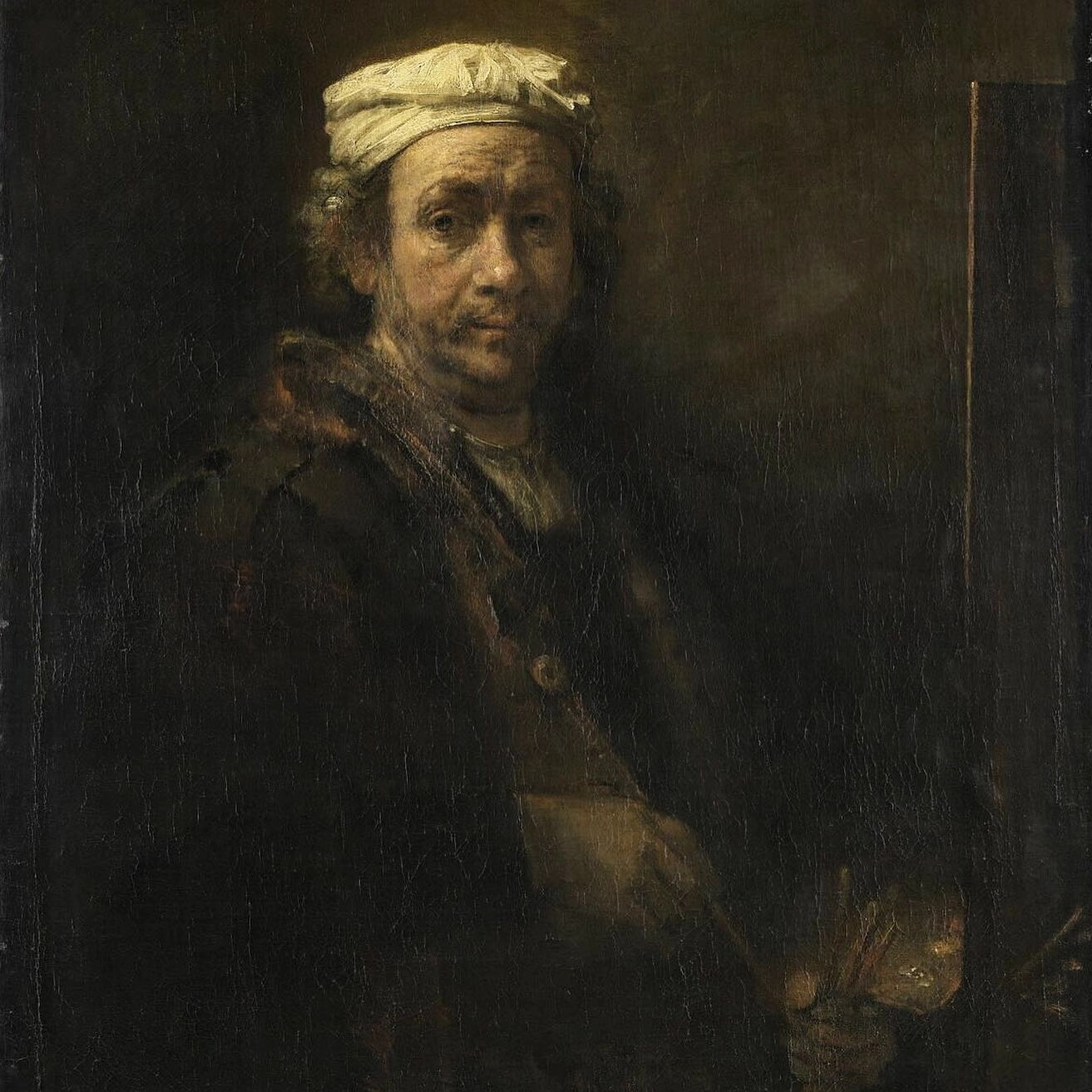
Or you’re an artist, brush in one hand, a vivid palette of colors in the other, confronting a blank canvas. The choices! Red? Violet? Ochre? Viridian? Think of Rembrandt’s self-portrait, as the artist lifts his brush, staring directly at us while coyly hiding the canvas. For us, his canvas is blank. What’s the artist thinking? What do we imagine he’s painting? Of course the tricky master has already painted the canvas we’re looking at, and he included his staring eyes, his ruthless assessment of himself, every wrinkle, every wart.

https://www.louvre.fr/en/what-s-on/life-at-the-museum/a-masterpiece-of-the-louvre And you? What would you paint?

I think of Lily Briscoe in Virginia Woolf’s To the Lighthouse, fiercely concentrating on finishing the portrait she began years ago. We can’t see her painting, but we feel the intensity of her decision-making as to precisely why, where, and how she’ll move her brush for the last stroke.

“Blank canvas”? Emptiness…better, openness; availability; possibility. Imagination calls.

I spend hours revisiting mysteries, reveling in the craftsmanship of the greats, and the enormous creativity that blossoms from the first page, where the canvas is empty before the reader. This week I’ve revisited “Fred Vargas” (writing name) – the French archeologist whose mysteries about her Pyrennean police commissaire, Jean Baptiste Adamsberg, lead the unsuspecting reader into wild leaps of imaginative plotting. https://fr.wikipedia.org/wiki/Fred_Vargas In An Uncertain Place, for instance, when Adamsberg goes to London for an international police conference, his English counterpart, Inspector Radstock, drags him to Highgate Cemetery where someone has left at the entrance 18 pairs of shoes with human feet in them. https://highgatecemetery.org/ The feet have been chopped off dead bodies awaiting burial in funeral parlors. Oh, wait—that’s 17 pairs plus one solo shoe with a solo foot. Adamsberg returns to France, still mulling this weirdness, and confronts a grisly murder where the corpse has been chopped into confetti, with special attention to the big toes and hands and feet. Why? And is the wild-eyed twenty-something who invaded Adamsberg’s Paris house really his undreamed-of son? The plot turns on Serbian vampire stories and the rumor that when Victorian artist/poet Dante Gabriel Rossetti exhumed his dead wife Elizabeth Siddal seven years after her death—ostensibly to retrieve his manuscript volume Poems—she was still rosy and pink. https://nonfictioness.com/victorian/the-exhumation-of-elizabeth-siddal/

From a blank page, to dead poets, to vampires and tombs in Serbia, to…well, check it out! Let me know if you actually identify the murderer before the end. Adamsberg’s one of my favorite characters. Still don’t know why he wears two watches and can’t tell time.

How do fiction writers fill the blank page? By that mysterious process—imagination. In the October 16, 2023 New York Times, Italian physicist Carlo Rovelli asks how we can learn about black holes—places we can neither travel to nor see. His answer? “To travel to places that we cannot reach physically, we need more than technology, logic or mathematics. We need imagination.”

Per Merriam Webster, “The meaning of IMAGINATION is the act or power of forming a mental image of something not present to the senses or never before wholly perceived in reality.” J.K. Rowling: “Though I personally will defend the value of bedtime stories to my last gasp, I have learned to value imagination in a much broader sense. Imagination is not only the uniquely human capacity to envision that which is not, and therefore the fount of all invention and innovation. In its arguably most transformative and revelatory capacity, it is the power that enables us to empathise with humans whose experiences we have never shared.” https://news.harvard.edu/gazette/story/2008/06/text-of-j-k-rowling-speech/

Our genre requires imagination. Mystery writers need a vivid, tangible setting, especially for the murder. My mind has taken me to a rock-art painted cave atop a bluff high above an old ranch, to a music recording studio, to a dining room where a horse rears. We need characters. Protagonist! Murder victim! Suspects! Subsidiary characters who adds color, flavor, depth—like Eddie LaFarge, the retired pro football center who limped into the Central Garage in my imaginary town of Coffee Creek.

And I find something unexpected has happened to me, writing the Alice MacDonald Greer murder mystery series. In the middle of the night, my characters now feel as real as relatives. I watch them driving, kissing, feeding the burros, worrying. Sometimes they pause for a moment, imagining what they’ll do next.

Thank you, Vacuna, goddess of empty spaces.

Those croissants? We’re recovering in Paris from hiking, where these, from the Maison Julien patisserie on Rue Cler, may be the best ever. Letting melting butter create those empty spaces between the layers? Genius.

Helen Currie Foster writes the Alice MacDonald Greer Mystery series (now working on the 9th) north of Dripping Springs, Texas, in the Hill Countrloosely supervised by three burros. She’s active in Austin Shakespeare and the Hays County Master Naturalists and very much enjoys talking to book groups. The 7th mystery, Ghost Daughter, published June 15, 2021, was named The Eric Hoffer Award 2022 Mystery/Crime Category First Runner-up, and also 2022 National Indie Excellence Award Finalist, Mystery.

The Good, the Bad, the Cleanup

by N.M. Cedeño

First, some good news! My story entitled “A Matter of Trust” was published in Black Cat Weekly #110 on October 8 via editor Michael Bracken. The story features genetic genealogy private investigator Maya Laster who first appeared in “Disappearance of a Serial Spouse” in Black Cat Weekly #79 in March 2023. In this, her second published case, Maya is working to help her client, Bob Rolland, prove that he’s an heir to a forgotten trust fund, when violence ensues. With Bob’s life hanging in the balance, Maya races to discover who might want to stop him from claiming his inheritance.

“A Matter of Trust” is my first story inspired by a click-bait title that I didn’t click. The article was something about a dead billionaire leaving everything in trust for his reincarnated self to inherit. I imagined a vast fortune sitting forever, waiting for an heir to step forward. I thought, what if someone left everything in trust for possible future grandchildren? And what if the only link to the information about the trust died without telling anyone? From those seeds grew a story of lost family relationships requiring a genetic genealogist to reconnect the missing pieces.

So, for those who always ask: yes, story ideas really do come from everywhere.

Next, the bad news. Two events within five days gave me ample material to consider for use in future stories, and I would not wish either of them on anyone.

First, The Hail.

Photo taken by a neighbor.

One Sunday evening, my neighborhood was hit by baseball-sized hail. If you’ve never experienced a storm like that, it’s hard to imagine the sheer power behind that kind of precipitation. Windshields and car rear windows exploded when hit by enormous hail falling at terminal velocity. Coming down in sheets like rain, pummeling everything in its path, it left its mark everywhere, from the soil, the concrete, and the asphalt to cars, roofs, light fixtures, patio furniture, and trees. It even killed birds.

My family hid in a closet, listening to what sounded like a bombardment. The weather notification that baseball-sized hail was coming arrived on our phones five minutes after we had already retreated to the closet with the dog because of the fury of the storm. The warning came far too late to try to protect anything outside, but did confirm our instinct to take cover away from windows.

Next, The SWATTING.

Four days after the storm, someone decided to commit a crime against the community by calling in a false attack at my children’s high school. For those who don’t know, per the Oxford dictionary, “swatting” is defined as “the action or practice of making a prank call to emergency services in an attempt to bring about the dispatch of a large number of armed police officers to a particular address.” Seven different agencies responded to the high school in full gear, expecting to find an active shooter.

Someone intentionally terrorized hundreds of teachers and almost four thousand students at one school. It’s an enormous high school with a dozen buildings spread over a quarter mile wide. People in one building have no idea what may be happening in another building. So when the school locked down, many kids assumed the worst was happening somewhere and texted their parents from hiding places in darkened rooms and storage areas.

The number of swatting incidents in the US rose so quickly in the past few years that the FBI has created a database to aid in tracking and investigating them. Three high schools in two districts in my area were “swatted” in one day. In my youth such incidents could be ascribed to individual teenagers playing pranks or trying to avoid a test. While that may explain a few isolated cases, evidence suggests that many of the recent swatting incidents are linked to common perpetrators, many of whom may not be in the US. Terrorists have realized that they can sow fear with a spoofed phone call.

Once I have some distance from these events and can put them in perspective, details from one or both incidents may appear in a story. For the moment, I’m still cleaning up the mess.

*****

N. M. Cedeño is a short story writer and novelist living in Texas. She is active in Sisters in Crime- Heart of Texas Chapter and is a member of the Short Mystery Fiction Society. Find out more at nmcedeno.com

Mystery Tomorrow. Comedy (& Some Tragedy) Tonight.

Thinking today about Anais Nin’s statement, which she attributed to the Talmud–“We don’t see things as they are; we see them as we are”–I decided to write about how the idea applies to the way I read Donna Leon’s Inspector Brunetti mystery series. Then I remembered a post I wrote for Telling the Truth, Mainly, which serves as a lead-in. It isn’t really about R&J.

I’ll get to Brunetti next time.

*

One play. Twenty years. 

***

When you reread a classic you do not see more in the book
than you did before;
you see more in you than was there before. 
~ Clifton Fadiman

The first years I studied Romeo and Juliet with my high school freshmen, when I was in my early twenties, I followed the Star-Cross’d Lovers school of literary criticism: Romeo and Juliet, two innocents, their eyes meeting across a crowded room, she teaches the torches to burn bright, he’s the god of her idolatry, he wants to be a glove upon her hand, she wants to cut him out in little stars—but the cruel world conspires to bring them down.

The way Juliet’s father tells her to thank him no thankings nor proud him no prouds but get to that church on Thursday next and marry Paris or he’ll drag her thither on a hurdle—what kind of father says that to a thirteen-year-old girl? Parents don’t understand. They don’t listen.

The kids might be a little quick to act, and goodness knows Romeo should have waited to talk to Friar Laurence before buying that poison. But who can expect patience of teenagers in love? 

When I hit thirty, and had several years of teaching (and consorting with teenagers) under my belt, I shifted to the What Can You Expect When Teenagers Behave Like Brats? philosophy: Romeo and Juliet, a couple of kids in a hurry. He doesn’t even bother to drop in on his family, just runs off to crash Capulet’s party, proposes to a girl before the first date, insists on a jumped-up wedding, then gets himself kicked out of the city, and he still hasn’t been home for dinner.

She mouths off to her father, tells him what she will and will not do, and he’s just told her what a nice, rich husband–Paris, whom the Nurse says is handsome, “a man of wax”–he’s picked out for her. It’s no wonder he tells her to fettle her fine joints ‘gainst Thursday next or he’ll drag her to church on a hurdle. I mean, if you were a parent and your daughter spoke to you in that tone of voice, would you pat her hand and ask what’s wrong, or would you remind her who’s boss here?

If Romeo had just gone home in the first place, like any decent boy would have, instead of running off with his friends and crashing that party, this mess wouldn’t have occurred.

In fact, since Old Montague and Old Capulet had that very afternoon been sworn to keep the peace, they might have arranged a marriage between Romeo and Juliet—formed an alliance that way—and the whole of Verona would have lived happily ever after, and Montague would have been spared the expense of erecting a gold Juliet statue to honor her memory. Paris might have been a little put out at being jilted, but he’d have gotten over it. Kids! They don’t think.

Approaching forty, however, I detached a bit and developed the dogma of the Meddlesome Priest. Friar Laurence has no business performing a secret marriage between two minors without parental consent. He says he wants to promote peace, but he isn’t a diplomat. His field is pharmacology.

Furthermore, when Juliet informs him she’s about to acquire an extra husband, why doesn’t he go right then to her father and tell the man she’s married? Capulet wouldn’t have been pleased, but he wouldn’t have gone to the trouble of dragging Juliet on a hurdle thither. And he’d have gotten over it.

Instead, the Friar gives Juliet a sedative and stuffs her into a tomb with a passel of her relatives in varying stages of disrepair.

The Friar appears to mean well, but it’s also possible he intends to take credit for being the brains behind the peace accords.

Bunglesome or corrupt—the end is the same. With role models like this–a priest of all things–are we surprised that children run amok?

Soon after the last epiphany, I ended my stint as a classroom teacher. But I’ve wondered what would have happened if I’d continued studying Romeo and Juliet with students year after year.

Would I have had new insights? Developed new interpretations? Uncovered new layers of meaning?

How much more would I have shared with my students? Would I have continued to teach them respect and reverence? Would I have led them down the primrose path of dalliance and left them mired in levity?

How much more would I have seen in myself?

*

This post first appeared on Telling the Truth, Mainly on April 22, 2019, under the title “T Is for Time: #atozchallenge.” Later it was reposted under the title “AtoZ Challenge: R Is for Romeo, et al.”

Remarkable how a stolid, stick-like, straightforward

can, in a only a year, evolve into a curving, curling, growling dog’s name.***

###

***Nurse.
Doth not rosemary and Romeo begin both with a letter?

Romeo.
Ay, nurse; what of that? both with an R.

Nurse.
Ah, mocker! that’s the dog’s name. R is for the dog: no; I
know it begins with some other letter:–and she hath the
prettiest sententious of it, of you and rosemary, that it would
do you good to hear it.

~ Romeo and Juliet, Act II, scene iv

###

In Hamlet, rosemary takes on a darker tone.

Ophelia.
There’s rosemary, that’s for remembrance.
Pray you, love, remember. And there is pansies,
that’s for thoughts.

Laertes.
A document in madness: thoughts and remembrance
fitted.

Hamlet, Act IV, scene v

#

Ophelia is a sweet, innocent girl. The men in her life drive her to madness. The older I get, the sadder I feel for her.

Just thought I’d throw that in.

*

Kathy (M. K.) Waller’s stories appear in Murder on Wheels: 11 Tales of Crime on the Move, Lone Star Lawless: 14 Texas Tales of Crime, and Day of the Dark: Stories of Eclipse, and on Mysterical-E. She’s still working on a novel set in a town very much like her minuscule hometown of Fentress, Texas.

She belongs to Austin Mystery Writers, Sisters in Crime, and Sisters in Crime Heart of Texas Chapter.

She lives in Austin, Texas, with her husband.

Currently, she looks forward to viewing the annular eclipse this October and the total eclipse next April.

Bouchercon Honors Sara Paretsky

by K.P. Gresham

The 54th Bouchercon National Mystery Convention in San Deigo honored Sara Paretsky with the David Thompson Memorial Special Service Award. This award honors the memory and contributions to the crime fiction community, and Sara Paretsky, a force of nature to be sure, certainly deserved this recognition.

Bouchercon, the largest and oldest mystery fan convention in the world, is a non-profit organization that relies on mystery fans. The four-day event highlights books in all the forms that “mystery” covers. Featured speakers at this year’s event included David Baldacci, Ann Cleaves, C.J. Box and Kate Carlisle.

Now let’s talk Sara Paretsky. When she introduced V.I. Warshawski in her 1982 novel, INDEMNITY ONLY, Paretsky revolutionized the mystery world. By creating a female detective with the grit and smarts to take on the mean streets, Paretsky challenged a genre where women were historically vamps or victims. INDEMNITY ONLY was followed by twenty more V.I. novels. Paretsky’s books are international best sellers, appearing in almost thirty languages.

While Paretsky’s fiction changed the narrative about women, her work also opened doors for other writers. In 1986 she created Sisters in Crime, a worldwide organization to advocate for women crime writers, which earned her Ms. Magazine’s 1987 Woman of the Year award. More accolades followed: the British Crime Writers awarded her the Cartier Diamond Dagger for lifetime achievement; BLACKLIST won the Gold Dagger from the British Crime Writers for best novel of 2004.

Called “passionate and “electrifying,” V.I. reflects her creator’s own passion for social justice. After chairing Kansas University’s first Commission on the Status of Women as an undergraduate, Paretsky was a community organizer on Chicago’s South Side during the turbulent race riots of 1966. Since then, Paretsky’s volunteer work included advocating for healthcare for the mentally ill homeless; mentoring teens in Chicago’s most troubled schools and working for reproductive rights. Through her “Sara & Two C-Dogs foundation, she also helps build STEM and arts programs for young people.

Hats off to Bouchercon for honoring this incredible woman. And Sara Paretsky, thank you for opening the mystery writing world to women.

K.P. Gresham, Author

Professional Character Assassin

K.P. Gresham is the award-winning author of the Pastor Matt Hayden Mystery Series as well as several stand-alone novels.  Active in Sisters in Crime and the Writers League of Texas, she has won Best Novel awards from the Bay Area Writers League as well as the Mystery Writers of America.

Click here to receive K.P.’s newsletter and a get a free short story!

Website: http://www.kpgresham.com/

Email: kp@kpgresham.com

Blogs: https://inkstainedwretches.home.blog/

https://austinmysterywriters.com/

Facebook: https://www.facebook.com/kpgresham

Books by

K.P. Gresham

Three Days at Wrigley Field

The Pastor Matt Hayden Mystery Series
The Preacher’s First Murder

Murder in the Second Pew

Murder on the Third Try

Four Reasons to Die

BOWLING AND PIN-MONKEYS

By

Francine Paino, aka F. Della Notte

Mundane worlds can become amazing when writers are plunged into them. Looking through old family photographs, I came upon a picture of a handsome young man whose start in this country could have been better. He worked as a pin-boy in a New York City Bowery bowling alley a hundred years ago. My story, The Runaway Pin Boy, was inspired by this long-deceased uncle’s difficult adjustment to a new country and culture.

 Francesco Libretti was born in Sassano, Italy, in 1910, emigrated to the U.S. in 1921, and by age 14, he began his short-lived career as a runaway who found work as a pin-boy in a Bowery bowling alley, but here, the similarity stops. 

But where did it begin, what was it like back then? How were the mechanics of setting up pins handled?  

Bowling. A sport that feels as American as Apple Pie is not an American invention. It’s traced back to ancient Egypt, 5200 years ago, in articles found in the tomb of an Egyptian child. Described in its primitive form, nine pieces of stones were set up, and a rounded stone “ball” was rolled to first make its way through an archway made of three pieces of marble. The sport spread from its Egyptian roots into Western Europe, and was brought to the U.S. by the first English and Dutch settlers. It gained popularity through the mid-1800s, played by men only, as it was not the clean family sport we enjoy today. Thus, it faltered when the do-gooders associated it with gambling. Any yet, by 1850, there were four-hundred plus bowling alleys in New York, earning the city the title “Bowling Capital of North America.”

The sport revived in the late 19th century and remained popular during the Great Depression, at least for those with a disposable income. Bowling was a game for  roughnecks and the wealthiest who could afford to build their own private lanes. For the common man the game took place in honky-tonk bars where lanes were built to increase income, with or without alcohol,  and by 1939, there were 4,600 bowling alleys across the U.S. 

Until 1952, when the automatic pin-setters were introduced, picking up and resetting the pins fell to pin boys, often called pin monkeys. They stood at the end of the lanes, perched on narrow ledges or standing up in trenches, waiting for the heavy balls to fly down and slam the heavy wood pins. The pin boys then scrambled to each lane, reset the pins, and gave the heavy ball a hard enough push to get back to the bowler but not hard enough to roll off the track and upset the player in any way. And if he did, there were consequences.

Pin boys were kids, mostly teens, and despite their young years, they were tough characters,  paid meager wages and often taken from the Skid Rows of cities, including New York City’s Bowery. It was hard labor and resulted in frequent injuries, including  broken ribs, severely bruised chins, arms, hands, and smashed fingers, especially when the bowler threw the ball extra hard and fast, just to see if they could make the pins fly.

In the 1830s, the Knickerbocker Hotel in New York City opened three lanes, using clay instead of wood, but no matter the surface, the pin monkeys were at the end of every alley, hoping they wouldn’t be too injured to work again the next day or night. 

Although Child Labor Laws were codified in New York in 1913, these youngsters slipped through the net by lying about their age or being hired by unscrupulous owners. The lives of the pin boys in those early years of the sport were not enviable, but many were willing to endure physical and psychological pain in order to eat.

In The Runaway Pin Boy, the year is 1925, In the Lower East Side ghetto of New York Cityknown today as Little Italy.  Frankie Martone’s mother dies of consumption, and his alcoholic and destitute father abandons him. After witnessing what happens to other immigrant children without families, Frankie flees the authorities, deciding to fend for himself in the anonymity of Skid Row. He learns to beg, borrow, or steal. One night, while he rummages through a trash pail outside the Pin King bar,  a formidable man stinking with sweat and cigar smoke grabs him by the collar. 

“Whatcha doin’ there, boyo?” asks the barrel-chested man with a grizzly turned-up mustache.  Frankie didn’t answer, afraid his thick Italian accent would get him kicked down the street.

“You’re a straggly lookin’ thing, but I need another boy inside. Let’s see what you can do. “He flings Frankie through the door to the bar. “Hey Joe,” he yelled in his Irish brogue. “Broughtcha another.”

Turning to Frankie, he thrusts him forward and points to the trench behind the bowling lanes. Frankie sees a ledge of boys sitting and three more in the trenches. The thunder of balls rolling down the alleys, pins flying and falling, and drunks yelling was deafening, but Frankie understood what needed to be done, and jumped right in.  

That was the first night of Frankie’s life as an overworked, underpaid, often injured pin boy determined to get out of this nowhere life on the fringes of Skid Row. 

When the Character Steps off the Page…

by Helen Currie Foster

You go to a play, you’re reading the program, you’re waiting for the curtain to go up. It does. And onstage a character comes alive. You not only believe in that character—suddenly you feel that character is real.

After the play, in the lobby, out comes a chattering group of actors, one of whom is—the character you believed in! But it’s merely…another human being!

This happens to me over and over at Austin Shakespeare productions. I remember sitting riveted, watching Othello preparing to smother Desdemona, his face just a few feet from the front row of the Rollins Theatre. “No, no!” I wanted to scream. Minutes later, still quaking from the death scene, I watched the actors come back out for their traditional after-talk with the audience. I watched brokenhearted Othello plop down in a folding chair and grin at us––morphed from Othello into actor Mark Pouhé. At Free Shakespeare outdoors in Austin’s Zilker Park I held my breath, watching young Romeo climb the balcony to talk with Juliet, enchanted––like Juliet––by every word he uttered. Then at intermission, still in costume, actors came out and climbed the hillside, shaking buckets for donations, including…Romeo! Jarring to think he’d time-traveled from sixteenth century Verona to an Austin hillside. https://www.austinshakespeare.org/

You may be thinking, “I know all about that––it’s just the ‘willing suspension of disbelief.’ Coleridge, right? Maybe you’ve just got an aggravated case!”

https://en.wikipedia.org/wiki/Samuel_Taylor_Coleridge

But the question is—how exactly can actors do that? Maybe because Shakespeare has made Othello and Romeo so active, so appealing, so fascinating, so human, so alive in their loves and hates, that we believe in them, and we must hear their story. Others call such fixations our willing contract with actors, in exchange for being entertained––so long as the illusion is not spoiled. See The Actor’s Edge Online, https://www.youtube.com/watch?v=zdGM7QzFJhM

As always, Shakespeare says it best. In the Prologue to Henry V, his Chorus begs the audience to use their own imaginations to make the small wooden stage come alive with the war between the “two mighty monarchies,” England and France:

“Think, when we talk of horses, that you see them/

Printing their proud hoofs I’ th’ receiving earth./

For ‘tis your thoughts that now must deck our kings,/

Carry them here and there, jumping o’er times,

Turning the accomplishment of many years/

Into an hour-glass…” Henry V, Prologue.

That’s genius.

Coleridge himself recalled his agreement with Wordsworth as follows: that while Wordsworth would write poems about the charm of everyday things,

“It was agreed, that my endeavours should be directed to persons and characters supernatural, or at least romantic, yet so as to transfer from our inward nature a human interest and a semblance of truth sufficient to procure for these shadows of imagination that willing suspension of disbelief for the moment, which constitutes poetic faith.” (Emphasis added.)

https://en.wikipedia.org/wiki/Suspension_of_disbelief [Also spoken of as “the concept that to become emotionally involved in a narrative, audiences must react as if the characters are real…”] https://www.oxfordreference.com/display/10.1093/acref/9780199568758.001.0001/acref-9780199568758-e-267

By buying a theatre ticket, or a movie ticket, we’re inviting an agreement like the one between the child who begs, “Tell me a story!” and the adult who responds, “Once upon a time…” In those two phrases, the contract is made. The child agrees—likely longs––to suspend disbelief, and the storyteller promises a world where the unexpected (even the unbelievable) can happen. Talking animals…bears with beds and chairs…

You and I happily suspend our disbelief when the characters become real to us, even though the events may be beyond “belief.” Harry Potter! Indiana Jones and the Dial of Destiny! Lord of the Rings! Star Wars!

What does this have to do with mysteries? At least the protagonist in any mystery must come alive for us. If you’re a Louise Penny fan, you appreciate how Gamache smiles at his wife, how he strokes his dog. As for Donna Leon’s Inspector Brunetti, I know him well; I’ve followed him upstairs to his Venetian apartment so many times, practically huffing with him on that last staircase. I’ve watched him choose a panini to have with coffee in his favorite coffee bar—indeed, I can practically smell the espresso. I’ve stood with him in the police boat as it bounces across the lagoon to a murder scene. He’s become so familiar, so…well, real to me. V.I. Warshawski in the Sara Paretzky novels? I know the emotion she feels when she touches her mother’s cherished wine glasses, I feel my blood pressure rise with hers over injustice. And Robert Galbraith’s team, Robin and Cormoran? I ache with the pain of Cormoran Strike’s prosthetic as he runs, trying to catch a suspect; I feel Robin’s fear as she opens a door to a dark hallway. I peer over Joyce’s shoulder as she writes in her journal in Richard Osman’s The Thursday Murder Club series.

A story (play, movie, mystery novel) demands a setting in which the protagonist comes alive for us. We’ve suspended disbelief when our favorite mystery characters no longer exist merely as ink on a page, as lines in a Kindle. Coleridge’s goal was to create “a human interest and a semblance of truth sufficient to procure for these shadows of imagination that willing suspension of disbelief for the moment.” We’re interested in what happens—a “semblance of truth”––to a character who arouses our “human interest.” The author, actor, director, has made us feel in league with our favorite characters. We’ve become collaborators with them, sharing their adventures, their frustrations, their fears. Suspending disbelief may be why we’re so anxious when our protagonists face danger, why we’re indignant when they’re treated badly, why we’re so relieved when they’re vindicated.

Of course a mystery plot may challenge imagination. The perfectly timed rescues in Daniel Silva’s spy thrillers…and the magnificent art restoration skills of his hero, Gabriel? The exquisitely choreographed capture and totally successful interrogation of Grigoriev in John Le Carré’s Smiley’s People?

Or the clever solutions deftly reached by ex(?)-spy Elizabeth and her friend Joyce at a foreign agent’s swimming pool suspended high above London, in The Bullet that Missed? https://amzn.to/45NxJlE

Knowing how reality usually works, we worry how plans go awry, how colleagues disappoint, how villains can foil. We shake our heads, fearfully anticipating that the plan will fail, and our character’s bluff will be called. But we’re still hoping, and holding our breath every second. And we keep turning the page.

MURDER, MAYHEM, CRIME

AND THE GRANDE DAMES OF MYSTERY

Reprint by Francine Paino AKA F. Della Notte

Originally submitted in 2021, I thought the story of the grand old men and women of mystery was worth a reprint. At the end, I have added three books not on the original list, presenting additional feisty, not-to-be ignored seniors who make their way through crimes – sometimes committing them.  

Overall, fiction provides a brief respite from the realities in our lives. In those few precious hours of distraction, we shut off the conscious minds’ worries and efforts to find solutions to problems or imagine worst-case scenarios. In real-life crises, the subconscious must see an issue with fresh eyes and a different perspective, perhaps even finding a new approach. The most popular category for that escape in the U.S., as revealed by Nielson Bookscan Services, is the mystery/thriller/crime novels, which beat all others by two to one. But if we seek to escape from real-life problems, why is this genre more popular than romance or comedy?  

Explanations are offered everywhere, even in psychology periodicals. One reason for the popularity of murder, mayhem, and crime is that they allow a safe way to immerse oneself in high drama without the destructive aftermath touching the reader in reality. Another is that it is exciting to be emotionally flung about as if on an amusement park ride. Then there is the experience of entering the criminal’s mind—oh, horror—something we don’t get to see in real life—at least not before the evil deed is done. Readers can also figure out, see, or at least suspect what will happen before it happens, and hopefully, by the end, there is the satisfaction of Yes. Makes sense. It was in the clues all along. Most often, that is not the case in real life. These reasons help explain why this genre is the most popular, but why are stories with elderly sleuths so well-liked?

Unlike the many Mediterranean, Native American Indian, and Asian cultures, and despite the growing economic difficulties and stresses on those societies’ families, their elderly are respected; their knowledge and wisdom are put to good use, whereas in the U.S., youth has become a preoccupation. It has the mind of younger people so entrapped in worrying about maintaining youthful looks that they often miss the grace, wisdom, and knowledge acquired with age and experience. 

 Aging in a culture that puts enormous emphasis on being young or appearing youthful creates a constant struggle for those susceptible to that fetish. Yet,—interest in stories employing older people in mysteries is widespread – even among the more youthful readers.

 In mystery fiction, older protagonists have already made the mistakes that younger detectives haven’t yet experienced. Whether professional or amateur, senior detectives see the world through more experienced and seasoned eyes. Thus, their mistakes are different and perhaps even more enjoyable. 

Neha Patel, writing for Book Riot, suggests several mystery thriller books starring older women, starting with the Grande Dame of Mystery, Miss Marple, who at age 70 solved the first of her 13 mysteries in Murder at the Vicarage, by Agatha Christie.  

Before She Was Helen, by Caroline B. Cooney, explores the dangers of confronting your own past life.

In Three Things About Elsie, by Joanna Cannon, the sleuth is 84 years old, and in Partners In Crime, by Gallagher Gray, Lil is a feisty woman of 84 who considers herself “84-years-young,” and has a love of playing detective and Bloody Marys. (My kinda-gal!) 

A metaphysical mystery/thriller, Death in Her Hands by Ottessa Moshfegh, has a 72-year-old widow coming across a haunting. The only clue is a note saying, “Her name was Magda.”

Writing for Early Bird Books, Paul Wargelin offers a list of feisty, intelligent, and frequently underestimated amateur sleuths over 60, beginning with Grey Mask, by Patricia Wentworth, about a retired governess. Written two years before Agatha Christie’s first Miss Marple novel, Ms. Wentworth went on to write 32 Miss Silver mysteries.  

In Tish Plays the Game, by Mary Roberts Rinehart, Tish Carberry isn’t suited for retirement activities, preferring to use her idle hands and mind to solve mysteries.

Stephanie Matteson’s Murder at the Spa introduces Charlotte Graham, a successful actress who, after four decades of screen and stage success, takes on the role of a sleuth in real life.  

“Does age really bring wisdom?” asks Rochelle Melander. She writes, “Recent studies affirm this adage. Older adults…recover quickly after making mistakes and use their brains more efficiently than younger adults.” In Melander’s article Crime Fiction: Savvy Sleuths Over 50, she offers some fascinating crime stories featuring elderly sleuths.

Celine, by Peter Heller. Celine is an artist and P.I. in her late 60s. In Rage Against the Dying, by Becky Masterman, a 59-year-old ex-FBI agent is haunted by the unsolved murder of her protégé. After an attempt on her life, she needs to unearth the truth. 

Not to be accused of gender discrimination, here are two books starring elderly gentlemen. Don’t Ever Get Old, by Daniel Friedman, is about an 87-year-old retired Memphis police officer, Buck Schatz, who learns that a Nazi officer who’d tortured him might still be alive with a stash of hidden gold. He teams up with his grandson, and they get more than they bargained for.

Summer of the Big Bachi, by Naomi Hirahara, is set in L.A. and Hiroshima. Japanese-American gardener Mas Arai, age 69, is hiding a secret. He faces bachi—the spirit of retribution when a stranger asks about his old gambling buddy Joji Haneda. Joji is murdered, and Mas must try to make things right.

Perhaps one of the qualities that fascinate readers, and they may not even realize it, is that often the elderly almost disappear, even standing in plain sight. They are overlooked, leaving them free to move about, observe, listen, eavesdrop, and study circumstances without anyone realizing what they’re doing. 

These, and many other senior Grande Dames and Grands Hommes of mystery, show how being older does not mean life stops. There is still inquisitiveness, a desire for adventure, and the need to use one’s brain. There are still mysteries and crimes to be solved—they do it with humor, grace, and aplomb.

Grab a bunch and enjoy!

PS: Add to the original list:

 Richard Osman’s The Thursday Murder Club, series, featuring the senior citizens of a retirement home.

Catherine Ingel-Sundberg’s, The Little Old Lady who Broke All the Rules, starring 79-year-old Martha Anderson and her four oldest friends, self-dubbed, the league of pensioners.  

Robert Thorogood’s, The Marlow Murder Club, headed up by feisty 77-year-old, Judith Potts.  

Most Memorable

Writers are always told to read widely and voraciously because you can’t write if you don’t read. With that suggestion usually comes a list of recommended reading, stories which are meant to exemplify the best writing.

I’ve been contemplating “best of” and “recommended reading” lists of short stories lately. I like to peruse the lists to see which stories would make my own personal list, which ones I’ve read, and which ones I haven’t read. Sometimes the lists inspire me to seek out the titles I haven’t read. Other times, I shrug my way through a list, wondering why someone thought “that” title deserved such a coveted spot.

Some stories on the lists went in one ear and out the other, leaving little behind other than the ability to say, “Oh, yeah, I read that.”

Other stories moved into my brain and took up residence. For the purposes of this blog, I’m calling those stories the most memorable.

The first short stories I remember reading that affected me so profoundly that they stuck in my memory with a single reading were by Ray Bradbury. “All Summer in a Day,” which I first read in junior high, made me feel ill, horrified by the casual cruelty of children towards their classmate. A few years later, I remember the sense of dread from reading “There Will Come Soft Rains.” While I read Richard Connell’s “The Most Dangerous Game” around the same time as I read “All Summer in a Day,” and I remember it clearly, it didn’t haunt me the way the Bradbury stories did.

Poe, 1849 “Annie” Daguerrotype, Wikipedia.

In fact, when I began to make a personal list of short stories that stuck with me over the years, I realized that many of the short stories I remembered the best had inspired unease, dread, or anxiety. Of course, in the case of Edgar Allan Poe, making a shiver run down one’s spine was his goal. Who isn’t made uneasy by the idea of being walled into a basement and left to die, as in “The Cask of Amontillado”?

While what one human could do to another or to humanity as a whole is terrifying, somehow, when the enemy is nature and the danger is impersonal and implacable, the dread I felt was even worse. That is why Jack London’s “To Build a Fire” stayed with me.

Disgust made Kafka’s “Metamorphosis” memorable. The less said about that novella, the better.

The characters willing to give up their prized possessions for each other in O. Henry’s “The Gift of the Magi,” rather than inspiring me, perplexed and annoyed me. I remember thinking that if those people had communicated better, the end result would have been much better. But then I’m not one for trying to surprise people with gifts. The story remained in my brain though. Of O. Henry’s works, I preferred “The Ransom of Red Chief” for its humor.

Humor is why Thurber’s “Sitting in the Catbird Seat” and “The Secret Life of Walter Mitty” stayed with me in spite of their more serious themes.

For humor coupled with shock and horror, I have to list Flannery O’Connor’s “A Good Man is Hard to Find.” I did not see where that one was going, so it shocked me. The form of the story is also startling, disobeying all the rules one is generally taught for short story writing.

Arthur Conan Doyle’s Sherlock Holmes stories made an impact en masse. But I read them long after Encyclopedia Brown short stories taught me the form of a detective story as a child.

I can think of other memorable stories, but the ones above top my list. Listing memorable novels would take a whole separate blog. How about you? Do you have a particular story or list of stories that have stuck with you when others have faded away?

*****

N. M. Cedeño is a short story writer and novelist living in Texas. She is active in Sisters in Crime- Heart of Texas Chapter and is a member of the Short Mystery Fiction Society. Find out more at nmcedeno.com