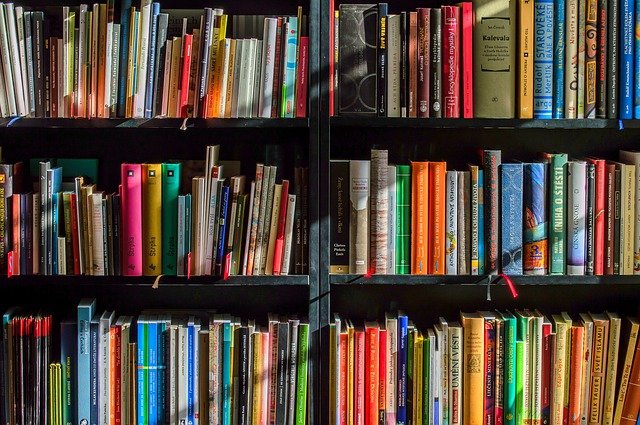
Curiouser and Curiouser!

Helen Currie Foster, October 25, 2021

At book groups I ask the beloved readers: “Why do we read mysteries?”
After a pause, for modesty, one honest person says: “We like to figure it out!”

Yes, we do. Why? Writer Patricia Cornwell, who created the forensic pathologist Kay Scarpetta, gives this answer as to why readers are fascinated by murder forensics: “To me, this goes back to our tribal survival instincts. If you can re-create a situation in your mind about what happened to someone, how that person died, there’s a better chance it won’t happen to you…[I]t’s part of the life force compelling us to look death in the face…We want to learn what happened…so we’ll feel less vulnerable about the same thing happening to us. It’s the kind of curiosity that propels us to study monsters.” https://amzn.to/3vQ3fPe

We want to know. Who killed Cock Robin? Who killed the two princes in the Tower—was it really Richard III? https://www.medievalists.net/2021/02/new-study-strengthens-claims-richard-iii-murdered-the-princes-in-the-tower/

 Was Henry II complicit in his knights’ gruesome slaughter of Archbishop Thomas Becket in Canterbury Cathedral? https://blog.britishmuseum.org/thomas-becket-the-murder-that-shook-the-middle-ages/ Curious humans still ask, who’s the guilty party?

Astrophysicist Mario Livio has been curious enough about curiosity to write a book on it: “Why? What Makes Us Curious.” https://amzn.to/3Gm7jLW

“Other animals are curious,” he says, “but only humans are worried and curious about reasons and causes for things. Only humans really ask the question, ‘Why?’” https://www.pri.org/stories/2017-08-27/why-are-humans-so-curious

While survival provides an evolutionary purpose for curiosity, Livio points out, “One of the things that researchers still don’t have an answer to, is that we, as humans, seem to be much more curious than what is just necessary for survival.”

According to Livio, we have two basic types of curiosity that show up in two different parts of our brains during MRI scans. One type is “perceptual curiosity”—what we feel when something surprises or puzzles us. “It is felt as a sort of uneasiness, an unpleasant situation … like an itch you need to scratch…,” he says. Yes, that creepy feeling, the hair on the nape of your neck prickling, because something doesn’t feel quite right. https://knowledge.wharton.upenn.edu/article/makes-us-curious/

The interesting thing about murder is that we seem convinced that ultimately, the murderer will be found out. At least as early as the 14th century, in The Canterbury Tales, Geoffrey Chaucer (c. 1343-1400) knew readers were sure they could identify a murderer. “The Priest’s Tale” tells us, “Though it may skulk a year, or two, or three, Murder will out…”

In Hamlet (c.1602)King Claudius fears detection of his murder of Hamlet’s father. He confesses at prayer, “O, my offence is rank, it smells to heaven; it hath the primal eldest curse upon it, a brother’s murder.” Act III, Scene 4. Hamlet has already announced in a soliloquy, “For murder, though it have no tongue, will speak with most miraculous organ.” Hamlet, Act II Sc. 2. Hamlet intends to play detective, sure that he himself can detect the king’s guilt by watching the king’s reaction to the play he has the actors perform: “I’ll observe his looks…if he but blench, I know my course.” 

Literary agent Anne Tibbets says mystery readers insist on understanding what happened. We are outraged if the author dares hide or suppress clues: we want a fair shot at solving the murder. We evaluate each potential suspect; we note physical clues; we scrutinize alibis; we use our own human experience to test the strength of each suspect’s motives. But as readers, of course we depend on the protagonist asking the right questions for us, identifying the victim, interviewing witnesses, examining the crime scene, noticing every salient detail. Each murder mystery effectively presents us with a miniature history of a crime, and we must absorb, and dissect, that history in order to satisfy ourselves we know “what happened.” 

Because we’re curious. Or, as Alice observes in her visit to Wonderland, “Curiouser and curiouser.” Lewis Carroll dubbed Alice “this curious child” and indeed, following Alice down the rabbit hole, we too want to know what the golden key will open and what’s behind the little door.
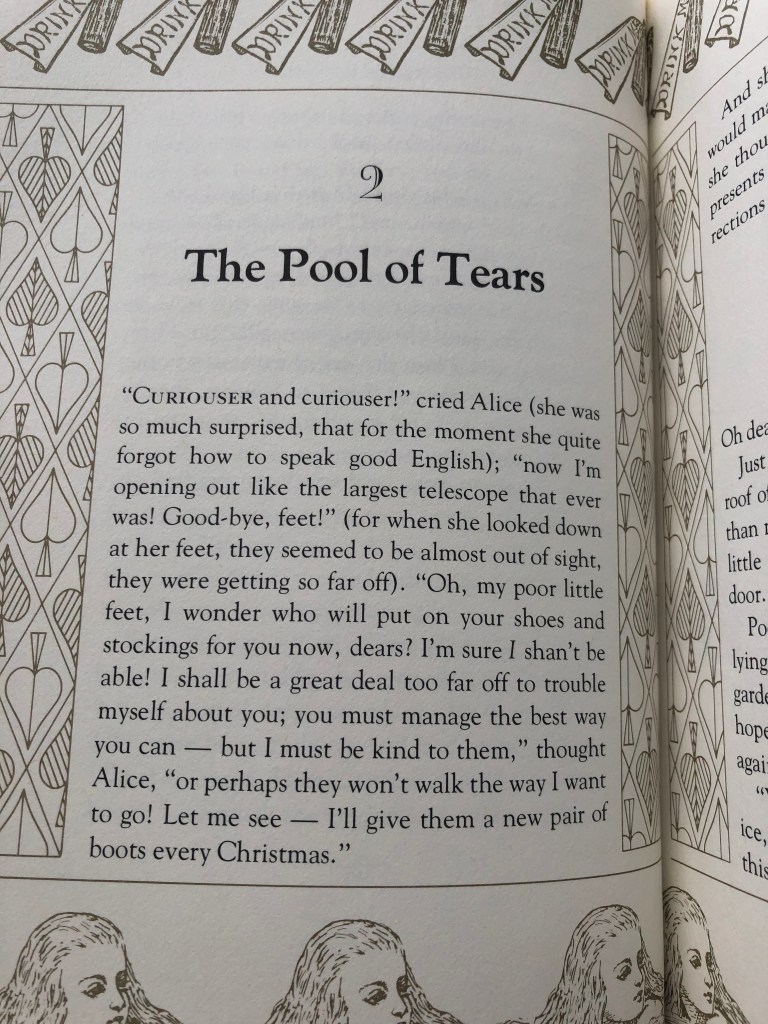
Alice is an indefatigable questioner. For instance, quizzing the Mock Turtle about his school days, she asks, “What else had you to learn?”

“Well, there was Mystery,” the Mock Turtle replied…”Mystery, ancient and modern, with Seaography…”
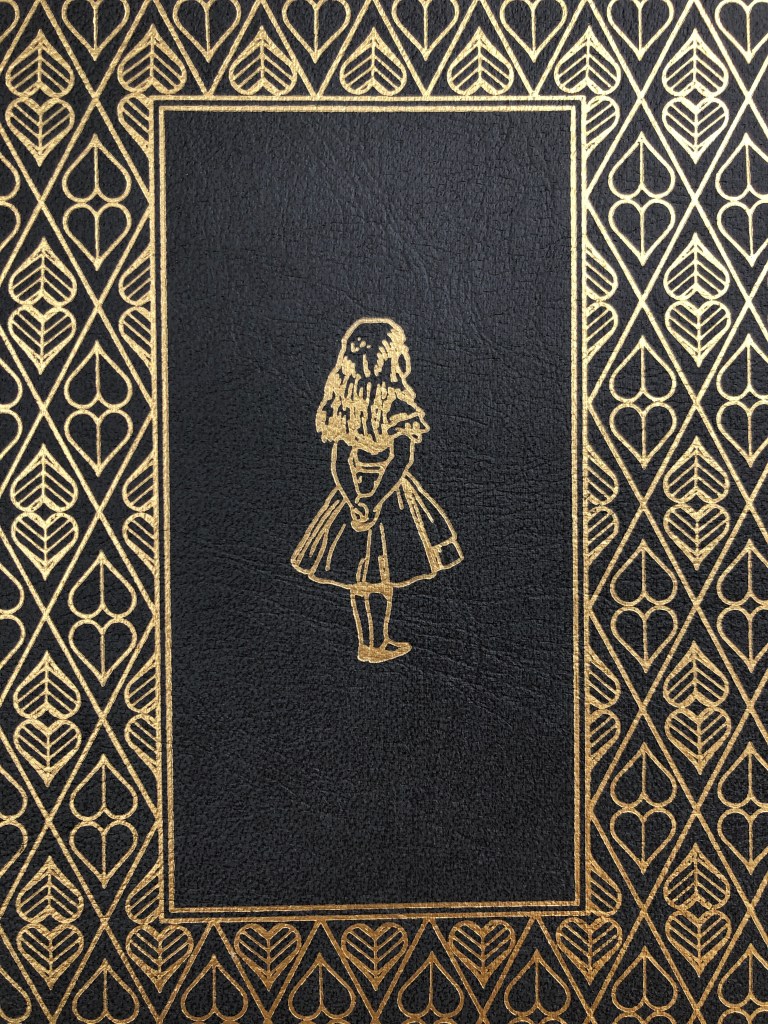
Mystery, for history, ancient and modern. The Mock Turtle is spot on. So much of history remains a mystery: no matter how many questions we ask, no matter how skilled and diligent the historian, no matter how thick the tome or how voluminous the footnotes,  we never have all the documents, all the testimony, needed to understand everything that happened during, say, the great convulsions of history. Just think of the unknown moments buried during Reconstruction, or the Spanish Civil War, or the Russian Revolution, or…  

Like Alice, mystery readers are “curiouser and curiouser.” The joy of being a mystery reader, after experiencing the miniature history within a good murder mystery, we reach the conclusion we’ve awaited. For once, at least, our curiosity is satisfied. We know “what happened.”

Author Helen Currie Foster lives and writes north of Dripping Springs, Texas, supervised by three burros. She writes the Alice MacDonald Greer mysteries, set in the small town of Coffee Creek, Texas, somewhere west of Dripping Springs and east of Fredericksburg. In Book 7, Alice finds herself in a lethal battle over hidden art and the victim’s will. Available on Amazon and IngramSpark, and at BookPeople in Austin.
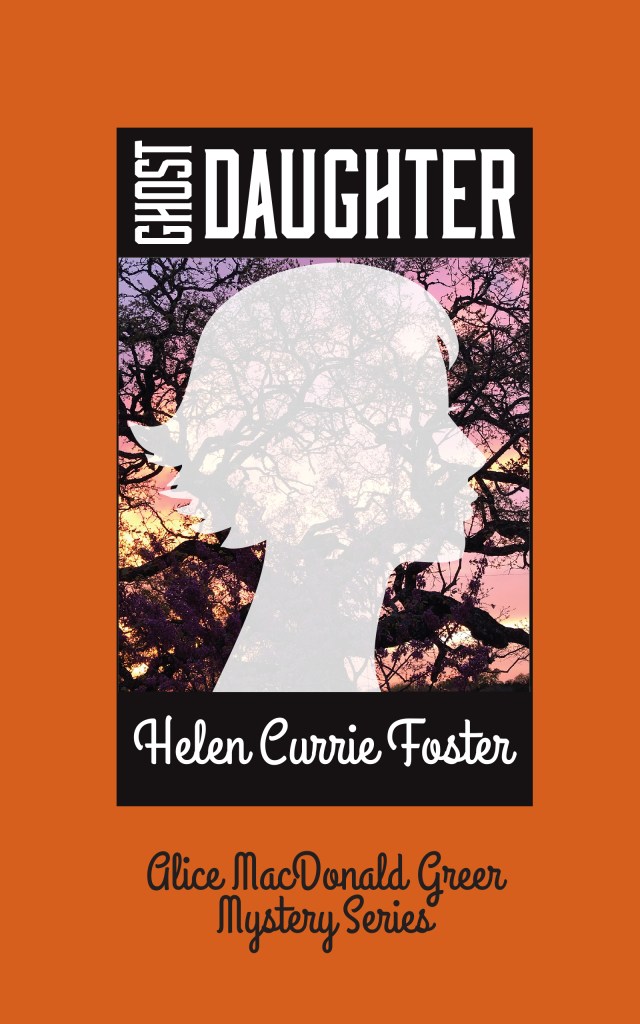
https://www.amazon.com/s?k=Helen+currie+foster+GHOST+DAUGHTER&

Find her online: http://helencurriefoster.com/ and
https://www.amazon.com/Helen-Currie-Foster/e/

https://www.facebook.com/helencurriefoster/

Do You Enjoy Speculative Fiction?

By N.M. Cedeño

Do you enjoy speculative fiction? Do you know what speculative fiction is?

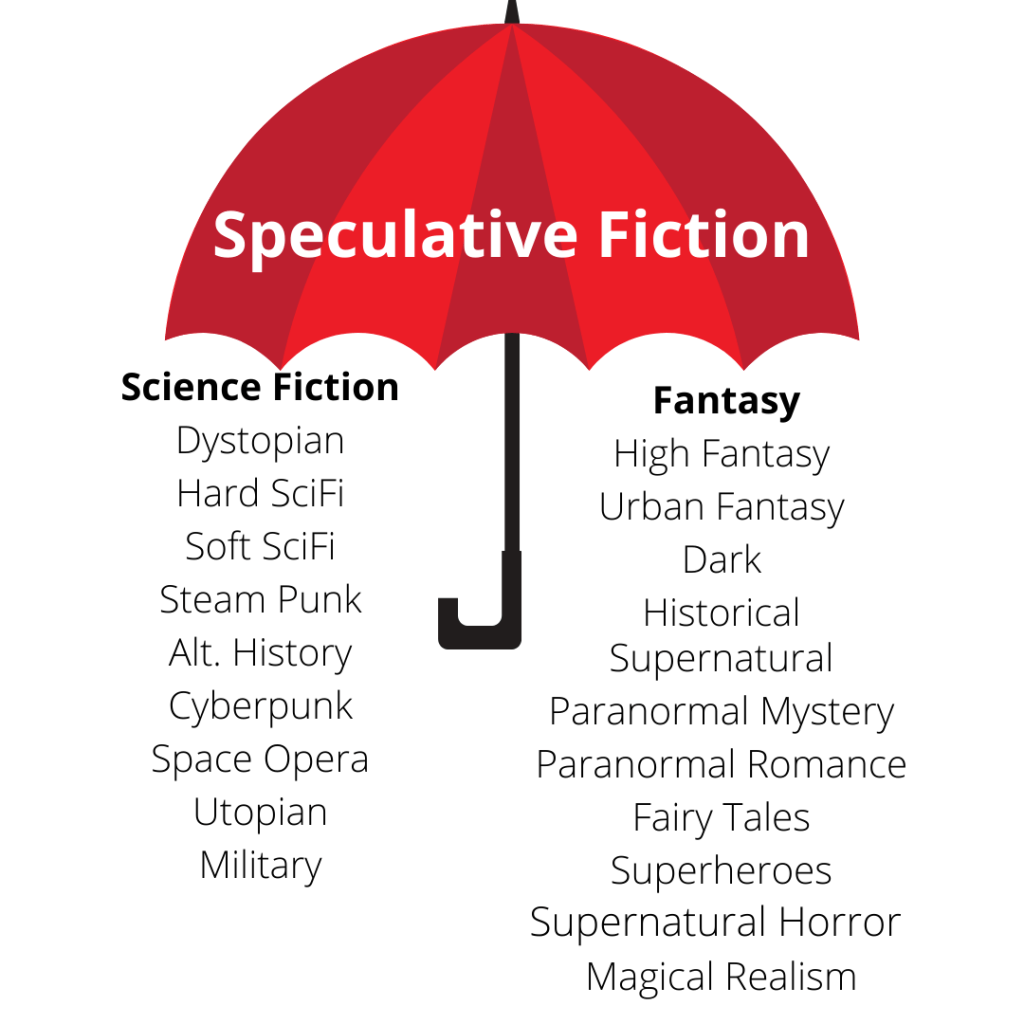
The dictionary defines speculative fiction as “a genre of fiction that encompasses works in which the setting is other than the real world, involving supernatural, futuristic, or other imagined elements.” The genre is an umbrella under which lies science fiction, fantasy, and even some kinds of horror. From fairy tales to space operas, from paranormal stories to alternative histories, any kind of fiction containing imagined elements that exist outside of known reality can be classified as speculative fiction. Many well-known books and series fall into this category.

Works of dystopian fiction like Brave New World by Huxley, 1984 by Orwell, and Ray Bradbury’s Fahrenheit 451 are speculative fiction. The Hunger Games dystopian series is speculative fiction.

Gabriel Garcia Marquez’s work of magical realism, One Hundred Years of Solitude, is speculative fiction.

Stephen King’s horror novel It and his time travel novel 11/22/63 are speculative fiction.

Star Wars, Buck Rogers, and other space operas are speculative fiction.

The Twilight romance series featuring werewolves and vampires is speculative fiction.

The Harry Potter fantasy series is speculative fiction.

The Martian, a work of hard science fiction by Andy Weir, is speculative fiction.

Janet Evanovich’s Lizzy and Diesel urban fantasy series is speculative fiction.

Dean Koontz’s Odd Thomas paranormal thriller series is speculative fiction.

Wonder Woman and other superhero stories are speculative fiction.

Irish folk tales about leprechauns or banshees are speculative fiction.

Given all the stories and genres that can be classified as speculative fiction, it might be easier to ask what isn’t speculative fiction than to go through all the examples of what it is. If a work of fiction is entirely realistic in its setting and involves no magical, supernatural, futuristic, or other elements that don’t yet or might never exist, then it isn’t speculative fiction. A mystery, police drama, or romance set in the present day with no imaginary elements added would be categorized as realistic fiction. Horror, thriller, and suspense novels that feature only human evil or terrors that are based in the real world are realistic fiction. A historical drama that accurately reflects life in a given time period would also be realistic fiction.

Speculative fiction allows for flights of imagination, presenting other worlds, dream worlds, and future worlds rather than depicting the world how it is or was. Realistic fiction stays within the bounds of known reality.

As an author, some of my writing falls under the mantle of speculative fiction. My Bad Vibes Removal Services paranormal mysteries featuring Lea, a woman who can see and talk to ghosts, definitely fits into the category. My romantic suspense / mystery novel All in Her Head also features paranormal elements.

My novel For the Children’s Sake is a murder mystery featuring an imaginary medical condition where some people’s skin oils cause other people to go into anaphylactic shock and die. That imaginary condition makes the book speculative fiction, even though the rest of the book is based in reality.

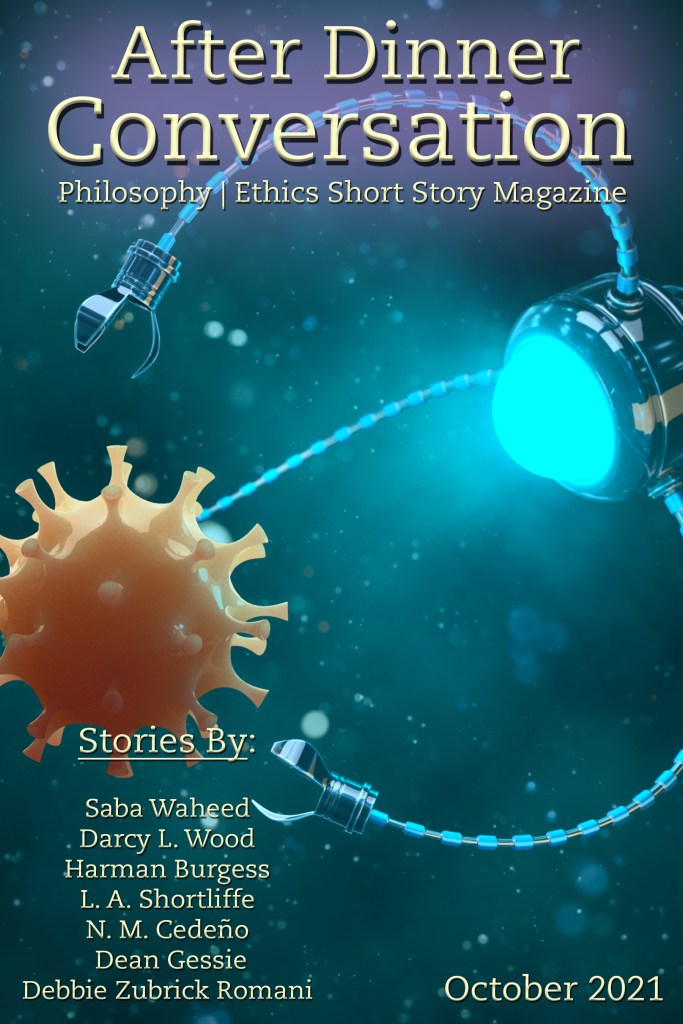
October 2021 issue

Several of my short stories are classified as social science fiction, set in possible future worlds. For example, my short story entitled A Reasonable Expectation of Privacy is a private detective story set in a world with no privacy rights.

My latest release is also a work of science fiction. The Wrong Side of History is currently available in the October 2021 issue of After Dinner Conversation: Philosophy and Ethics Short Story Magazine. The Wrong Side of History is a tale of blackmail set in a world recovering from a near-extinction event and featuring a 130-year-old politician trying to keep his legacy intact in a world with values that differ widely from those considered acceptable in his youth.

So back to the original question. Do you enjoy speculative fiction?

*****

N. M. Cedeño is a short story writer and novelist living in Texas. She is currently working on a paranormal mystery series called Bad Vibes Removal Services. Ms. Cedeño is active in Sisters in Crime- Heart of Texas Chapter. Find out more at nmcedeno.com.

Self-Publishing and Going Wide

By K.P. Gresham

Since publishing my first book in 2016, all my ebooks were exclusive to Amazon KDP. Now, four books into The Pastor Matt Hayden Mystery Series, I decided to “go wide” and offer my ebooks on all ebook platforms: Kindle, Nook, Google, Apple, etc. For the record, this is not a “bash Amazon” blog. Amazon paved the way for me to get to this point, and I’m grateful. It’s just that now I have an audience that wants more choices, so I decided to take the plunge and “go wide.”

The first step in this process was talking to and learning from my fellow authors who have already gotten the t-shirt for knowing the process. Anna Castle who writes historical fiction and fantasy short stories was a tremendous help, but there have been wonderful helpful hints from many folks in the writing community.  It’s important to understand that most authors are willing to bend over backwards to help each other out. Sisters in Crime is an organization based on that premise.

So here are the steps to going wide.

  1. Finish manuscript.
  2. Edit manuscript.
  3. Get feedback (think critique group or book doctor or beta readers, etc.)
  4. Fix manuscript.
  5. Get manuscript edited.
  6. Decide on your book’s cover.
  7. Get book formatted. Or not. (More on that later.)

Seriously. If you’re going to self-publish your work, or you have a contract with a small press, complete ALL these steps. If you’re publishing, that means you want to sell books. Respect your audience, swallow your pride and never assume your first draft is the best you can put out.

Now for the actual “going wide” part. From here on out, this is what I did to get my books out on all the ebook platforms. There are other ways, but this process worked for me.

  1. Upload your edited, polished manuscript to Draft2Digital. Steps to Using Draft2Digital will list the instructions on doing this. Please note, you do not have to use Draft2Digital to format your book. I had an already prepared EPUB file that I uploaded. An EPUB file is the format needed to publish ebooks. You can either contract with a formatting business (I highly recommend Jesse Gordon at adarnedgoodbook!), use the Apple Vellum app, or do it yourself. Whatever floats your boat, but get your manuscript on Draft2Digital.
  • Once you have a finished product from Draft2Digital, upload your book to Books2Read. This is a reader-facing site featuring book discovery tools. They are 100% indie and 100% free.

    They currently offer two free services: New Release Notifications and Universal Book Links. Universal Book Links provide a single URL that an author, publisher, or fan can share online. Instead of linking to just one digital bookstore (or posting lots of links to lots of different stores), an author can share one Universal Book Link, and readers can follow it to reach the book on their favorite store.
  • After you have uploaded your book to Books2Read, you hit the magic button that sends your book to all of the ebook publishers you select. Then you wait for those platforms to accept your book. Yes, you might have to do a little jiggling to get a platform here or there to upload your book, but I found it easy to use.

And voila! Your ebook is now available for all to read, and you can start your promotions.

Thanks to all my fellow authors for helping me to this point in my writing career. It takes a village, and you all are the best.

K.P. Gresham, Author

Professional Character Assassin

K.P. Gresham is the award-winning author of the Pastor Matt Hayden Mystery Series as well as several stand-alone novels.  Active in Sisters in Crime and the Writers League of Texas, she has won Best Novel awards from the Bay Area Writers League as well as the Mystery Writers of America.

Click here to receive K.P.’s newsletter and a get a free short story!

Website: http://www.kpgresham.com/

Email: kp@kpgresham.com

Blogs: https://inkstainedwretches.home.blog/

https://austinmysterywriters.com/

Facebook: https://www.facebook.com/kpgresham

Books by

K.P. Gresham

Three Days at Wrigley Field

The Pastor Matt Hayden Mystery Series

The Preacher’s First Murder

Murder in the Second Pew

Murder on the Third Try

Four Reasons to Die

AND THE EYES HAVE IT!

BY

Francine Paino AKA  F. Della Notte

What exactly are these spherical bodies contained in the skull?  They appear as an orbit of different shapes, some round or oblong, curved, and dense, with a white membrane surrounding a circular colored portion called the iris.  The pupil centered in the iris is an opening through which light passes to the retina, making eyes the windows to the world. But they are so much more. As the saying goes, they are also the outside world’s windows to the soul. 

     There are over one hundred biblical references to the power of eyes. However, most in the Bible reflect the good and evil in the inner man/woman. In Matthew 5:28: But I say to you that everyone who looks at a woman with lustful intent has already committed adultery with her in his heart. Perhaps my favorite is Proverbs 21:4: Haughty eyes and a proud heart, the lamp of the wicked, are sin.  Moving from biblical times to today, eyes have not lost their power. 

Eyes are the most written about body parts as a symbolic expression and revelation of human emotions in songs. Body language too speaks, showing tension, joy, fear, mystery, but emotions pool in and project most powerfully from the eyes. The eyes are not limited in expression. Love, hate, justice, judgment, clairvoyance, even horror can be reflected in the eyes. 

As in biblical times, even in today’s world, these blinkers are often an extension of how the human soul projects itself. Some song titles express an individual quest. In The Eye of the Tiger, an athlete drives himself to reach the top of his game. In You Can’t Hide Your Lying Eyes, a woman cheating on her husband tries to tell him that she’s going to comfort a friend. Still, in her eyes, he sees the truth contradicting her words, and in Goodbye in her Eyes, a young man reads the end of a relationship in the eyes of the woman he loves.  

The range of emotions expressed in just one look runs the gamut from the depths of love to the depths of hate, and everything in between, including pain, jealousy, and mystery. Does anyone have difficulty understanding “his eyes blazed with fury,” or “her eyes softened with love when they placed the newborn baby in her arms?”  

On Goodreads, one finds a list of 278 books with body parts in the titles. But the eyes are used the most. In the words of Flannery O’Connor, who said that writers are painters with words, “Everything has its testing point in the eye, and the eye is an organ that eventually involves the whole personality and as much of the world as can be got into it.” One look can say more than a thousand words. Even closed eyes speak. Is the person avoiding something, someone, grieving, hiding?

Sometimes we even compare human eyes to animal’s. The fierceness of Tiger eyes as used in the above song title; the gentle loyalty of the dog gazing into his master’s eyes. Cats have fascinating eye language. Dilated pupils on a cat indicate excitement, while constricted pupils mean watch out!  This cat is angry and may be ready to attack. And, as all cat owners know, in those quiet moments, squinting eyes reveal a relaxed, happy feline, sometimes ready to fall asleep.  

As a writer, I’m very aware of the power of expression emanating from my human and feline characters.  In my Housekeeper Mystery Series, I can see their eyes and feel their emotions and the reaction those expressions generate in others. In the third book in the series, The Church Murders and the Cat’s Prey, one character has unusual amber-colored eyes with thick black lashes. Not only is the eye color striking, but one look from those eyes sends chills down our protagonist, Mrs. B.’s arms.  

There is no underestimating the importance of painting characters with words and showing the reader their body language, facial expressions, and most of all, the power of the messages cast from those orbits. Who doesn’t have warning bells go off when reading, “he smiled, but the smile didn’t reach his eyes,” or, “she said, ‘no harm done,’ but her eyes said there’d be hell to pay.”

There is even a blog about what the eye color tells you. Have some fun and try it at https://blog.freepeople.com/2013/09/eye-color-meaning/ 

Eyes can be so expressive, and in reality, words alone are not always necessary to have a conversation. 

Thus, the eyes do have it.


Biblioholism: The Literary Addiction – Book Review

By Renee Kimball

Biblioholism *. . .book, of books; the habitual longing to purchase, read, store, admire, and consume books in excess.  Tom Raabe

In Biblioholism – The Literary Addiction, author Tom Raabe hilariously details what happens to those who are unable to contain their compulsion to purchase, collect . . .well, HOARD books.  And if you wonder if there are still certain people who do this in the age of Ebooks- – – then YES is the answer.  Biblioholics still exist, while collecting books in all its myriad forms available today.

Raabe wrote the first edition of Biblioholism – The Literary Addiction in 1991, it was revised and re-published in 2001.  Raabe’s insights are entertaining, that is, unless you are a BOOK HOARDER – and, well, then reading about it can be uncomfortable, even painful. 

So, for the record, I am biased, I am not impartial, I am a Book Hoarder.

Today’s book world is much, much different than that of Raabe’s.  Book stores, places of wonder, have greatly diminished, other online sellers have cornered the book-buying-market.  Technology has transmogrified lengthy volumes into tiny bits and bytes.  Centuries of the written word are now carried along with phones, tucked into portable cases or satchels, purses, and even pockets, read whenever the owner chooses, wherever the owner can get a satellite signal.

But still, Biblioholics that remain continue to treasure the heft of the physical book.  They are behind the scenes, ferreting out those remaining bookstores, garage sales, thrift stores, Thriftbooks, Ebay and Etsy, and public library sales for the real thing…that tome of paper–the physical book.  Dusty, dirty, old, frayed, new, crisp, silly, serious we keep looking and bringing home BOOKS

Raabe asks: Do you suffer from Biblioholism

“What another addiction? . . . Don’t we have enough addictions to worry about —drugs, alcohol, nicotine, caffeine, gambling eating, not eating, shopping shoplifting, sex, chocolate, work, television watching, fitness, religion, and who know that else—without having to worry about books too?” Raabe (p. 12-13).

What are the effects of Biblioholism?  Raabe enlightens us (the following is paraphrased, for a full accounting, please obtain the book) . . .

  1.  The first thing to go is your eyesight.  “This is because biblioholics, by definition, read everywhere…We must read and considerations, like proper lighting are not sufficient to sway us from our passion. . .” (p. 14).
  2. Losing your ability to see, is second to the change in our body (neck, arms, chest, fanny, bum, backside). Nothing worse than the effect of a tilting head and neck after years of reading in bed. “Browser’s neck” appears but that is small compared to the “every spreading” dynasty of flesh which becomes the derriere you never wanted and has “spread to the size of the Mississippi Delta.” (p. 14).
  3. “Proper hygiene,” and “time,” come last to finishing that last chapter.  If you can push yourself to read a few more sentences, then taking a spit-bath is far more attractive than a full shower or arriving to work with pressed clothes and sparking teeth.  The financial result (both in pay) and ability to buy more books, suffers.
  4. As the Biblioholic’s living space becomes constricted with books (stacked everywhere and on everything), their social world contracts as well –soon, encased by books, a recluse is born.  You can’t invite anyone in, you can’t safely open the door.”

When the Biblioholic finally realizes they need “help,” it may be too late. . . Books have taken over his/her life. 

At this stage, there is little or no money (it has all been spent on books), and because books have taken the place of human company, there are few friends to call on for assistance.  Only after the Biblioholic comes to his senses, can he finally confront his book-addiction and turn his life around.

If you believe you may be a Biblioholic and need a guide to determine if you are a true “book addict,” then review Raabe’s “checklist,’ for a more targeted approach.  Following a sample of Raabe’s questions found in: “Taking the Test: Are you a Biblioholic?” (pg. 25-30) . . .

“Have you ever bought the same book twice without knowing it?

At Christmastime, do you buy your loved ones books that you want to read?

Do you have a personal library on an entire subject, note of which you have read?

When at a garage sale, is the first thing you look at the books?

Have you ever become suddenly deeply interested in an obscure topic and immediately bought six or more books on that topic?”. . .

I must answer “Yes” to all of the above, I even have more than two copies of the same book (even three).  While there is much more to Raabe’s lighthearted but serious book, he closes with a chapter detailing a suggestion for a cure:

“. . . and now you’re probably ready to bask in the good news of a cure and get on with life, right?  Well, not to put too fine a point on it, but wrong. Because the operative rule for this disease is: Biblioholic, heal thyself.” (p. 156).

Wait! After all this about the disease, how do I cure myself, you ask?  Raabe glibly offers the following: “Total Abstinence,” “Find Something Else to Love,” (as in marriage, or supplant with another addiction: “shopping, religion, fitness, rage, chocolate, sex, work, pizza…who knows what else.” (p. 159).  And lastly, much like aversion therapy, Raabe finally suggests: “Buy Till It Hurts.” (p. 163). 

“. . .nothing works unless we want to be cured. . .And in order to hit that bottom we have to buy until it hurts, until every dollar forked over for a book brings with it concomitant pain and guilt.

          We can’t be cured until we want help; we can’t want help until we hit bottom; and we can’t hit bottom until we become absolute book fools and buy until it causes us so much pain we will want help. . .

          How else can we be healed?  The disease must run its course. . .Only in total defeat is there victory. Only from the bottom can we see the top. Once we get there, we can turn it around.  But as they say, getting there is half the fun.”. . . (Raabe 163).

What will you try?  I think I will continue to implement Raabe’s last suggestion – I will keep buying till it hurts. 

After all, when has “Total Abstinence” ever worked for any addiction?

References:

Raabe, Tom. Biblioholism: the Literary Addiction. Fulcrum Publishing, 2001.  Photo courtesy of Amazon.

The Biblioholic. Biblioholism: n. [BIBLIO + HOLISM] book, of books: the habitual longing to purchase, read, store, admire and consume books in excess. Columbia Edu – OnLine http://www.columbia.edu/~fuat/biblioholic.com/

Photos courtesy of Pixabay. 

A former paralegal, Renee Kimball has a master’s degree in criminal justice. Among her interests are reading, writing, and animal advocacy. She fosters and rescues both dogs and cats and works with various organizations to find them forever homes

Two Roads Diverged…

by Helen Currie Foster, September 13, 2021

Have you noticed that the roads diverged in a yellow wood?

So Frost was thinking of fall, in “The Road Not Taken” (1916). Leaves turn yellow—and not just in New England. I admit Texas Hill Country fall colors are a little muted. Bluestem bunch grass makes silvery seed-heads.

big bluestem…

And our cedar elms turn yellow green, then yellow, and then madly fling golden confetti into the air.

Yellow leaves! When new roads appear and diverge, right? New fall clothes, perhaps (even with climate change) sweaters! New books, new subjects, new teachers, new classmates.

We awake with new ideas, new projects, new dreams. On weekends the parks fill up with soccer players. Football begins. 

All our years of fall classes leave many of us with a compelling interior calendar. In September, two roads—at least two roads!—diverge. We feel energetic, restless. Do we seek the old ways again or do new roads beckon? Do we join the Master Naturalists? Take a photography class? Go for a master’s degree? We feel September’s time pressure, expressed as a desire to learn new things, tread new paths, move further into the world, even with the stultifying blanket of the pandemic heavy on our shoulders.

As Yogi Berra famously advised, “When you come to a fork in the road, take it.”

Because—as Kurt Weill and Maxwell Anderson put it—

“It’s a long, long time from May to December,

But the days grow short when you reach September;

When the autumn weather turns leaves to flame

One hasn’t got time for the waiting game.”

You can hear Willie sing it, or Ella Fitzgerald, or Frank Sinatra, or others. https://www.youtube.com/watch?v=UslWN3LqPvYhttps://www.youtube.com/watch?v=f88yoLs0yl0

No, when September hits, we haven’t got time for the waiting game. It’s the first day of nursery school…third grade…middle school…senior year. We can’t just stay home and watch the leaves turn to flame. 


Now for Book 8. People ask about the “writing process.” It’s like standing at the crossroads in the yellow wood. Which path? But no time for the waiting game! 

Book 8 began to take shape with wakeful nights, with a couple of strong images, where Alice must identify a body in the Aberdeen mortuary. Then a new character barged in, demanding time onstage. I’m always amazed at how characters insist on doing what I hadn’t foreseen, taking their lives in their own hands. The plot arc is there but further decisions will be made. I’m sending chapters to the critique group, and the manuscript’s got at least a provisional name. The future murder victim in Coffee Creek hasn’t yet learned her fate (sorry, honey). So it’s still wakeful nights, then pacing around the kitchen island, then sitting and writing, then pacing again, then sitting and writing, then more pacing.

Just a moment ago it was summer. But as Frost also wrote, “Nothing gold can stay” (1923). The fall equinox approaches on September 22. Following Yogi Berra’s advice, faced with all the decisions ahead––who lives? Who dies, and how?––I’m heading down the road, yellow leaves and all.

AUTHOR Helen Currie Foster lives and writes north of Dripping Springs, Texas, supervised by three inquisitive burros. Find her books at BookPeople in Austin, and at IngramSparks and Amazon.

https://www.amazon.com/Helen-Currie-Foster/e/B00R1X9

You can follow Helen at

https://www.facebook.com/helencurriefoster/

Please visit the website at https://www.helencurriefoster.com


Ink-Stained Wretches


Don’t Delete “Unsuccessful” Manuscripts

By N.M. Cedeño

A number of the stories sitting in files on my computer were written years ago, some over ten years ago, and have never been published. At times, when cleaning up my laptop, I’ve been tempted to delete some of these old stories, but I restrain myself.

Don’t move those files to trash!

Most of these old manuscripts fall into three categories. The first category consists of early writing efforts that reflect my learning process. These stories are not publication-worthy, but the ideas aren’t all bad and may warrant revisiting. The second category contains stories that could be publishable, but still need work. These stories need revision to be ready for submission or publication, but aren’t finished because I haven’t found a solution to whatever needs fixing. The last category consists of stories that are finished, but that haven’t been published even after being submitted multiple times. These manuscripts tend to be stand-alone short stories because I usually self-publish the ones in my Bad Vibes Removal Services paranormal mystery series.

Instead of deleting these unsuccessful works, I hold onto them because I know someday I may determine how to fix the unfinished ones or I may see a call for submissions or a new market that fits the finished pieces.

For example, earlier this year I discovered a call for cozy mysteries was coming, and I knew I had an old story that might fit the guidelines. The piece was a Christmas mystery set during an ice storm with all the suspects trapped together. The first draft was written in 2011 or earlier. Around 2018, I reviewed the story, updated it, and tweaked the characters, giving them more depth than they’d had in the first draft. I also changed the ending several times before I declared the manuscript done and started submitting it to markets. It was rejected eight times.

from Pixabay

As I reread the story while considering whether it fit the new call for submissions, I changed one or two lines and double-checked the editing. Then, I submitted the story, and it was accepted for publication by Black Cat Mystery Magazine. The story will come out next year, but I don’t have a date yet. More details will be coming on this one later.

Another one of my stories, a science fiction crime piece entitled “The Wrong Side of History” that features a 130-year-old politician being blackmailed over the political stances he held in his youth, was first written in 2015 or 2016. This story was finished long ago and ready for publication. I held off submitting it anywhere, at first, because it didn’t quite fit any of the publication niches I could find. The story was set in a future, post-apocalyptic society that handled a number of problematic social issues differently than we do today. Those issues include topics that are politically divisive. For a brief time, the thought of being “canceled” also held me back from submitting the story.

Eventually, I decided not submitting the story out of fear of offending someone was cowardly and exactly matched the form of self-censorship described by Ray Bradbury in Fahrenheit 451. I began submitting the story to magazines. Nine times the story was rejected. The rejections weren’t surprising since the story didn’t completely fit the niches available and because some magazines will shy away from difficult issues in stories.

After Dinner Conversation October 2021

Then, I found another market for the story, a magazine called After Dinner Conversation that specifically features short fiction that includes ethical and philosophical issues. After nine rejections, having the tenth response call the story a wonderful piece that the editor would love to publish was reason to get up and dance. It was nice to know that I was right. The story was ready for publication. I simply needed to find the right niche for it. And so the “Wrong Side of History” is now available for pre-order in the October issue of After Dinner Conversation.

And that is why I don’t delete “unsuccessful” old manuscripts. Sometimes they only need a few changes to be successful. Other times, they just need to find the right editor at the right magazine.

*****

N. M. Cedeño is a short story writer and novelist living in Texas. She is currently working on a paranormal mystery series called Bad Vibes Removal Services. Ms. Cedeño is active in Sisters in Crime- Heart of Texas Chapter. Find out more at nmcedeno.com.

Dreaming in Santa Fe

by Helen Currie Foster

Driving into New Mexico with my husband (favorite long-time travel companion) I peer anxiously out the car window—I won’t be happy until I spot the first antelope, tiny, almost invisible, bounding across vast pale green ranch pastures below a string of distant mesas. First I look for a white splotch (tell-tale antelope rump), then suddenly spot an entire flock, spread out in the grass. Then, where I-25 crosses the south-running Pecos River, we see the sinuous length of Rowe Mesa, all red rock and green conifers, running for miles to the west. At Ribera we exit south on State Road 3, then climb an impressively steep gravel road to the adobe house of my cherished college classmate friend and her husband. Their house sits in the lap of Rowe Mesa, looking across the broad Pecos valley at its companion, Bernal Mesa. The old house is formal, plastered white inside, with a beautiful ceiling of beams (vigas) supporting the roof. Sticks, or latillas, lie in a formal herringbone pattern between the vigas.

Walking across the property in the cool morning we spot chips from arrowhead manufacture. Our friends have found a spot far above on the edge of the mesa littered with many such chips, where centuries ago an expert sat under a piñon in the shade, “knapping” (flaking) stones to make arrowheads and points. We saunter along, picking up turquoise-colored pebbles from the played-out turquoise mine, reveling in the view across the valley. We hear nothing but the wind in the junipers and piñons and the occasional faraway buzz of a small plane.

My friend has taken us down along the Pecos to see the extensive adobe ruins of the Spanish customs office that once controlled the river crossing into Spanish New Mexico. Further down the river we see the irrigation ditches—acequias—feeding water into Pecos farm plots, before the Pecos narrows into a canyon.

We love this place. But Santa Fe is calling.

To celebrate the June 2021 publication of Ghost Daughter, we’re on Otero Street in Santa Fe, with beauty everywhere. Carved wooden beams over doorways. Intensely colored flower gardens in yards. Curved human-scale adobe houses. Blue sky above adobe walls.

Downtown, Santa Fe offers layers of history—Pueblo architecture, Territorial architecture. In 1920 City officials ordered that buildings in the city be built Pueblo-style. The warm tan of adobe and the cool greens and blue-greens of balconies and window-frames feel soothing, low-rise, solid. Art is in the air, in the gardens, in the architecture, in the shop windows. I double-dog-dare you not to take pictures. Plus there’s an appreciation of burros (which warms the hearts of my three burros).

Along Palace Avenue by the New Mexico Museum of Art, heavy bronze sidewalk plaques celebrate Santa Fe artists. Each plaque features a helmeted conquistador…which seems incongruous for celebrating, say, Georgia O’Keefe or my hero, Gustave Baumann, the German immigrant whose vivid woodcuts tantalize my protagonist Alice in Ghost Daughter. But maybe it’s not incongruous. Baumann says he was drawn by the powerful presence of intermixed layers of history when he jumped off the train in New Mexico in 1918. And the sheer beauty! Mountains and streams! Pueblos! Golden cottonwoods in fall! He left such contributions of art and joy to Santa Fe, with his spectacular prints and the beloved marionette shows in his living room.  https://www.youtube.com/watch?v=i516sAlDgS0

In Ghost Daughter, Alice’s trips to Santa Fe were too fraught. Although she enjoyed El Rey Court, and a hurried lunch at Café Pasqual’s, she missed so much, including the room of Baumann prints in the Owings Gallery. So we go in her stead, riveted by Baumann’s precision and freedom, his intense colors so delicately layered. I want to see his old German printing press…but rats! It’s locked up and unavailable at the history museum.

After wallowing in the Baumanns, we console ourselves with ice cream, sitting in a shady corner by La Lecheria. It’s fun watching passersby. The solitary ones walking briskly by have unsmiling faces like eagles, alert eyes fixed straight ahead. What are they thinking about so intently? Where to lay the next brushstroke on a canvas? Memorizing lines for a play? Where are they going? Then the younger people swoop by with great style, dramatic clothes and makeup, hurrying to work. And of course tourists like us.

Santa Fe calls itself the “City Different.” I feel different here too. Somehow an invisible bubble over the city blocks my usual sharp-edged worries…children, work, the state of the world. At home, open-eyed at some awful hour, I sometimes find refuge in half-awake creativity, envisioning plot possibilities, imagining scenes, hearing characters say surprising things. I’m grateful for a midnight refuge which may (not infallibly, though) trigger ideas for the next day’s writing while distracting me from cares.

But  in Santa Fe, if I wake, I listen to the quiet, peer out at the moon and…go back to sleep. After days in Santa Fe, a place weighty with history, so vividly creative, so confident in mixing the very old and very new, the traditional and startling, I feel emboldened.

Thanks, Santa Fe! Like so many…I’ll be back.

***

Helen Currie Foster lives north of Dripping Springs, Texas, supervised by three burros. She writes the Alice MacDonald Greer Mystery series and is active with Austin Shakespeare and Sisters in Crime, Heart of Texas Chapter. Follow her at www.helencurriefoster.com, on Facebook at https://www.facebook.com/helencurriefoster/, and on Amazon at https://www.amazon.com/s?k=helen+currie+foster

The Nightingale—A Novel by Kristin Hannah—And . . . Admitting When You Are Wrong

The NightingaleA Novel by Kristin Hannah is a weighty 564 pages.  The cover has shades of blue and grey with the embossed golden image of a bird in a tree- delicate, feminine, appealing.  The story is not delicate; however, it is a dark surprise, and one worth reading, even re-reading.

A bit of personal honesty is in ordergoing in, I was prepared to dislike this book.  I do not read romantic based historical fiction. I told myself that Hannah was a romantic author, very popular, but still, romance. NOPE, nope, not for me.  Not my cup of tea.

Fate intervened.  My on-line book club chose Hannah for the Author of the Month selection.  Despite moaning and muttering, I bought the book, read the book, and here we are.

Let me get it out now, I was wrong about Hannah and wrong about The Nightingale.  This novel is much more than a delicate cover. 

The novel is set during the WWII Nazi occupation of France.  Hannah weaves her story while detailing the brutal German oppression and murder of the French people, the cruel dislocation of French Jews and other targeted groups, and the incredible bravery of the members of the French Resistance.

The writing is sparse; there are no literary flourishes — it fits the story.  The novel evolves around the lives of two sistersVianne (Rossignol) Mauriac and Isabelle Rossignol, at odds with one another since early childhood.  Interweaving the present with the past, and the past into the present, the sisters’ experiences become a single thread of unmet expectations and misunderstandings, that in the end, show an unrelenting depth of love and respect between them.

The reader learns that, when they were very young, their mother suddenly died.  Ignored by their grieving father, the girls raised themselves.  Years of parental indifference caused the girls to become emotionally distanced, then resentful towards each other.  The older sister, Vianne Rossignol (Mauriac), becomes pregnant, escaping Paris through marriage and moving to the French countryside and far away from her sister.

The younger daughter, Isabelle Rossignol, an unabashed rebel, continues acting out, and as she is dismissed from one convent school to the next, the sisters become even further estranged.  Vianne settles into motherhood and country life, while Isabelle continues her ever increasing wild behavior in Paris.

Hannah forces the reader to watch as the Nazis enter Paris and expel French Jews from their homes and herd them into railway boxcars.  The reader walks the French countryside alongside hundreds of French citizens while above, German pilots indiscriminately release bombs on the crowds below.  Just as suddenly, the reader stands by as messages are secreted to members of the French Resistance.  The reader watches as downed American and British pilots are guided in the freezing cold while attempting to avoid roving German patrols, through the Pyrenees Mountains to safety in Spain.   

As the novel progresses, each sister, unknown to the other in their own way, secretly fights the Nazi occupation.  One sister becomes an undercover member of the French Resistance and the guide known as The Nightingale.  The Nightingale is the one who leads downed American and British pilots over the Pyrenees mountains to safety.  The sisters’ father makes a fateful and touching reappearance and with a surprising twist (no spoilers here).

Hannah’s research is faultless.  The Nightingale successfully mirrors the turbulence of war through the lens of a French family who deeply love France and one another.  The deprivations, hunger, fear, and reactions are visceral.  Hannah forces the reader to remember the atrocities of WWII, and cautions us to never forget this part of our history—we must all ensure that it can never happen again.  We cannot become complacent; we cannot take our freedoms for granted.

My mother once told me that a sign of maturity is admitting when you are wrong, and as much as I hate to admit it, I was wrong about this book.  Find a copy of The Nightingale, read it, and share it with other like-minded reading friends, and spread the message: we must never forget.

***

References

Hannah, Kristin. The Nightingale: A Novel. 1st ed., St. Martin’s Press, 2015.

Photo of Novel courtesy of Amazon. Com

Photo of Eiffel Tower by Free Photos

Photo of Nazi in Paris. Wikimedia Commons : -(Nazi-parading-in-elysian-fields-paris-desert-1940.png  German Nazi officers parading in the deserted Foch avenue, Paris, France (1940). Screenshot taken from the 1943 United States Army propaganda film Divide and Conquer (Why We Fight #3) directed by Frank Capra and partially based on, news archives, animations, restaged scenes and captured propaganda material from both sides.)  (https://commons.wikimedia.org/wiki/File:Nazi-parading-in-elysian-fields-paris-desert-1940.png)

***

A former paralegal, Renee Kimball has a master’s degree in criminal justice. Among her interests are reading, writing, and animal advocacy. She fosters and rescues both dogs and cats and works with various organizations to find them forever homes. 

Working with Editors

by N. M. Cedeño

Nothing makes a writer feel more like a know-nothing novice than a marked-up manuscript from an editor. Whenever I get a document back from an editor, I take a deep breath before reading the comments because I know seeing the number of errors I made will knock the breath out of me.

Here’s how writing and editing short stories usually works for me:

Image by John Conde from Pixabay

1. Write story draft.

2. Review draft and add all the stuff left out of the first draft.

3. Let story sit a while in order to see it with fresh eyes.

4. Review the story and fix all the glaring errors and plot problems.

5. Review the story again, and again, and again, and again. Cut extraneous and wordy bits. Send the story to a beta reader or critique partner for comments.

6. Read the story aloud or have MS Word read it to me to catch errors and awkward wording.

7. Submit the story to markets.

8. Receive rejections while writing other stories. Submit the story over and over again until it’s accepted for publication somewhere.

9. Receive the edited version back from the editor and try not to be overwhelmed by all the stupid errors missed in the dozens of reviews completed before submitting the story. Hope the editor is wrong about some of the comments and redline markings. Carefully read the editor’s comments.

10. Acknowledge that the editor is right and fix the errors. Return the manuscript to the editor.

Image by Anne Karakash from Pixabay

I’ve worked with editors I’ve hired as well as editors from magazines and anthologies. With one exception, every professional editor with whom I’ve worked has improved my writing. I’m grateful to all of them, especially the one that said “your climax needs more conflict” and still accepted the story for publication.

Overdoing description is a fault of mine so each of the great editors recommended deleting wordy areas. Each made comments in the margins asking questions that I had to decide the best way to answer. They made suggestions on fixes, but left the rewriting to me.

The one bad editor I encountered was one I was considering hiring to help me edit a book. I sent that editor a sample chapter. When she returned it, every single line of the manuscript had been changed. I was stunned by the amount of red on the page. She had changed a character’s behavior and responses to another character, in effect rewriting the character. She changed the entire tone and voice of the story, making it her story instead of mine. Her version of editing stood out in stark contrast to the great editors that I had previously used. The bad editor didn’t make comments and leave the fixing to me. She came up with her own fixes and inserted them.

Consequently, that one editor taught me how to tell a good editor from a bad editor. Good editors tell writers what needs fixing and why. They may make suggestions on what might work to fix a problem, but they don’t do the rewriting themselves. Good editors leave the rewriting up to the writer. Great editors edit. They don’t rewrite.

****

N. M. Cedeño is a short story writer and novelist living in Texas. She is currently working on a paranormal mystery series called Bad Vibes Removal Services. Ms. Cedeño is active in Sisters in Crime- Heart of Texas Chapter. Find out more at nmcedeno.com.