When Disinformation Leads to Death

N.M. Cedeño

Here in Texas over four hundred people have contracted measles in the past few months, resulting in the death of at least one child. Most of these cases were preventable with a vaccine. So why weren’t the victims immunized? Some are infants, too young to be vaccinated. A few may be people with compromised immune systems or other medical conditions that prevent them from receiving vaccines. However, the majority aren’t vaccinated because of conspiracy theories and false information being fed to parents, making them fear the vaccine.

Back in the 1990s, a British doctor, whose medical license was later revoked because of the medical hoax he perpetrated, falsified a study claiming to have identified a causal link between the vaccine for measles, mumps, and rubella, (the MMR vaccine) and autism. He published a massive lie that spread like wildfire and caused vaccination rates in Europe and the United States to plummet. By the time the fraud was revealed, the damage had been done.

As a parent of a child on the autism spectrum, I am absolutely certain the MMR vaccine did not contribute to the condition. I spotted variances in my child’s development by the time he was six months old. I knew something was different about the way he did and did not focus on motion months before he was given his first MMR vaccine. No vaccine caused his neurological differences. The most likely cause is a complex interaction of genetic factors.

Measles and rubella are not diseases that should ever be allowed to spread unchecked. Measles can kill, and when it doesn’t kill, it can obliterate the patient’s immune system, leaving them susceptible to a variety of infections. In countries where vaccination rates for measles are low, children who survive measles frequently die of other illnesses within a short time after having measles. Measles is also one of the most contagious diseases in the world, able to linger on surfaces and in the air for hours after an infected person has left the area.

William Morrow Paperback, reprint edition cover 2004

Rubella, depending on the stage of a woman’s pregnancy when she contracts the disease, can cause blindness, deafness, heart deformities, developmental abnormalities, and death for babies. Many infants only survive a short period after birth due to the damage caused in utero by rubella, also known as German measles. A well-known example of the harm caused by rubella was the case of actress Gene Tierney’s daughter, Daria, which inspired Agatha Christie’s novel The Mirror Crack’d from Side to Side.

Growing up, I heard the story of my uncle’s birth from my grandmother more than once. She contracted rubella while pregnant and decided not to go to the doctor for her check up that month because she knew that the doctor would push her to abort. In 1950s America, doctors saw so many deaths of newborns caused by rubella that they frequently advised a mother to abort if she contracted rubella while pregnant.

My grandmother made a choice, believing one should always give life a chance, knowing that her baby might not survive. My uncle was born at around three pounds, his growth and development stunted by the disease. He was deaf in one ear, had heart problems, had very poor vision, and only grew to about five feet tall. But he survived and lived to the age of 70, managing to get a driver’s license, go to community college, and work a variety of jobs.

As a parent, I have met other parents who chose not to vaccinate their kids. That decision, made by otherwise intelligent and educated people, still shocks and disheartens me. Reading that the parents of the child who died from measles still say that they wouldn’t have vaccinated their child scares me. How could they possibly think that the vaccine is somehow worse than the death of their child?

This current measles crisis is yet another example of conspiracy theories and false information being promoted over facts and truth to the detriment of society. Disinformation campaigns, conspiracy theories, and the current general distrust of any authority inspired me to write my latest story, entitled “Murder by Alternate Facts.” In the story a young woman named Arlene stumbles upon a wreck on a lonely country road and is forced to make a choice affecting who lives and who dies. The repercussions of Arlene’s choice inspire conspiracy theories, dividing her hometown and leading to murder.

“Murder by Alternate Facts” appears in the Murderous Ink Press anthology Crimeucopia: Chicka-Chicka Boomba! from editor John Connor.

*****

N. M. Cedeño is a short story writer and novelist living in Texas. She is active in Sisters in Crime- Heart of Texas Chapter and is a member of the Short Mystery Fiction Society. Find out more at nmcedeno.com.

Rain, rain go away. . .

By: Dixie Evatt

It might just be the Texas temperatures that have been rocking from the 20s to the 80s since the first of the new year. Or maybe it’s the ominous news reports about melting ice caps or the drought conditions paired with hurricane-force winds that helped fuel the Los Angeles wildfires. Whatever the case, I find my mind traveling again and again to thoughts of weather and the influence it has on stories, both fictional and real. 

As writers we’ve inherited wise advice about incorporating weather into our stories. For instance, Number One in Elmore Leonard’s Ten Rules for Good Writing is “never open a book with weather.” While that advice is close to dogma, it has been debated (see: Jo-Anne Richards bit.ly/41a4oCk and Roz Morris bit.ly/3WUcAEk

Richards, an internationally published novelist, says of the admonition to avoid opening your novel with weather isn’t an iron-clad rule. It’s a prompt to the writer to if the story is stronger by opening with a paragraph where you find people doing something. That doesn’t mean a weather opening never works. She gives this example of an opening from Maggie O’Farrell’s “The Hand that First Held Mine.”

Listen. The trees in this story are stirring, trembling, readjusting themselves. A breeze is coming in gusts off the sea, and it is almost as if the trees know, in their restlessness, in their head-tossing impatience, that something is about to happen.

Morris, a former ghost writer who writes the “Nail Your Novel” blog, offers an example of a weather opening that she likes because it is intensely descriptive and the storyteller lures in the reader. Her sample story opening is from “The Rapture” by Liz Jensen.

That summer, the summer all the rules began to change, June seemed to last for a thousand years. The temperatures were merciless …It was heat to die in, to go nuts in or to spawn. Old folk collapsed, dogs were cooked alive in cars…The sky pressed down like a furnace lid, shrinking the subsoil, cracking concrete, killing shrubs from the roots up…

Although the advice about beginning a story with weather can be debated, there’s also the middle and end of the story to consider. Susanne Bennett, a German-American writer, identified seven ways writers can use weather to tell their story in her 2022 post on “Writers Write”: conversation starter; backdrop; sensual experience; foreshadowing; sense of conflict; motif; and acting force. In fact, she advised, the weather can stand as the last word (where it is almost another character).  bit.ly/4hSBBYq

Bennett also reminds us that the old saw about showing not telling is likewise true for weather. For example, she edited the sentence, “On a sunny day, Jane went to the public library” to read “A T-shirt is enough,” Jane thought, glad to put her cardigan aside… Who needed extra baggage on a day like this?”

“The Great Gatsby” by F. Scott Fitzgerald is chock full of weather references, many illustrating Bennett’s points. One researcher counted 111 separate weather references, from heat, to wind to sun to rain, most of which can be linked to mood or passion in the story.

Weather can also emerge out of the obscurity of background symbolism to overtly influence action. There’s an oft-cited example of one snow scene in “Catcher in the Rye” by J.D. Salinger when Holden Caufield makes a snowball but is so conflicted he is unable to throw it. Would Agatha Christie’s closed-room mystery “And Then There Were None” even have been possible if a ferocious storm hadn’t trapped the ten victims on an isolated island off the Devon coast? Or, how about the necessity of a crop-killing drought to cause the Joad family to pick up stakes and abandon their home in John Steinbeck’s “Grapes of Wrath”?

Weather might incite action or prevent it. My book club recently read “To the Lighthouse” by Virginia Woolf and one of the most memorable refrains is about weather. In the story, the family plans, again and again, to visit the lighthouse the next day but only if the weather is “fine.” It almost never seems to be. 

Would the passionate and cruel relationships in “Wuthering Heights” by Emily Brontë feel the same without a violent storm “rattling over the Heights in full fury,” taking down tree limbs in its wake? Wuthering, after all, means tumultuous storms.

Sometimes weather carries double duty, carrying both mood and action, as in “The Scarlet Letter” by Nathaniel Hawthorne; “Misery” by Stephen King; and “Transit of Venus” by Shirley Hazzard. When the long-suffering Hester Prynne in “The Scarlet Letter” removes her cap and then the scarlet letter she is awash in sunlight. 

In “Transit of Venus” you just know Ted Tice is going to have a rough go of it when he arrives, soaked through. “He looked up from his wet shoes and his wet smell and his orange blotch of cheap luggage. And she looked down, high and dry.”

Not unlike Annie Wilkes the weather is unsettling and unpredictable in “Misery.” As the weather changes, she changes, leading Paul Sheldon, the author she holds captive, to conclude, “I am in trouble here. This woman is not right.”

There are so many other memorable weather scenes in literature that Pulitzer Prize winning writer Kathryn Schultz pulled from her almanac of examples in a 2015 article in “New Yorker” magazine. bit.ly/3WVj0D9

And, finally the 2024 Academy-Award nominated movie “The Room Next Door,” brings together all of the advice about injecting weather into a story. We see its use to create mood, develop characters and foreshadow events when the dying Martha (played by Tilda Swinton) recites parts of James Joyce’s “The Dead” to her friend Ingrid (played by Julianne Moore).

It had begun to snow again. He watched sleepily the flakes, silver and dark, falling obliquely against the lamplight..His soul swooned slowly as he heard the snow falling faintly through the universe and faintly falling, like the descent of their last end, upon all the living and the dead.

Dixie Evatt (DLS Evatt)

A former political reporter in Austin, Dixie also taught writing at Syracuse University. When she teamed up with Sue Cleveland to write fiction, they sold a screenplay to a Hollywood producer. Although the movie was never made, the seed money financed ThirtyNineStars, their publishing company. Through it they published two award-winning thrillers (Shrouded and Digging up the Dead) under the pen name, Meredith Lee. In 2021 Dixie launched a solo mystery (Bloodlines & Fencelines) that Kirkus described as, “A twisty whodunit that’s crafted with care and saturated with down-home Southern charm.” She is working on a prequel (Gravel Roads & Shallow Graves) set to launch in 2025. www.dlsevatt.com

Background: Short-Term Murder

I admit that the ending of my story “Short-Term Murder” in issue #88 of Black Cat Weekly may include wishful thinking. The plot of the story revolves around a murder in a short-term vacation rental in a neighborhood. Two of the neighbors work together to solve the murder after one of them, Mariah Grant, the woman who lives next to the vacation rental, becomes a suspect because of her documented dislike of the house.

The inspiration for the story:

My neighborhood has fewer than one hundred houses. I know and communicate with all of my immediate neighbors and even a few neighbors in the houses that back up to mine. The neighborhood is secluded, bounded on three sides by a dry branch of Onion Creek that only fills when it rains. The area is quiet and peaceful. Or it was until last summer.

Before last summer, the house next door to me was owned and occupied by a family of five: two parents and three boys who attended the elementary school. Children that age go to bed early. They were quiet neighbors in the evenings.

Then, the family moved and sold the property to a business. The business set to work turning what had been a single family home into a mini-hotel and party venue. The mature oaks and crape myrtles in the back yard were chopped down and equipment rolled in to dig a massive swimming pool with an outdoor sound system and party space. Around Thanksgiving, the construction noise finally stopped, and the place opened for business.

My neighbors and I quickly discovered the rental listing online. From the pictures, we could see that the company stuffed bunk beds into what had been living spaces and listed the house as “sleeps twenty.” The online ad invited (and still invites) parties and weddings of up to thirty people.

In a blink of an eye, my formerly quiet street became party central.

Petra: Protector of the house

Over the holidays, a line of cars parked in front of my house with people coming and going at all hours. My German Shepherd mix, who believes it is her duty to warn me of all dangers to my property, barked at the people milling on the sidewalk in front of my house at 1:30 in the morning. I stepped outside and asked them to move. (The local police told me later that standing in front of someone’s house at all hours isn’t allowed, and I should call them to ask the people to move. I was new to the problem then and didn’t know better.)

Group after group produced bags and bags of trash. It didn’t all fit into the bin the city provides to each house. So the guests piled trash into the recycling bins, too. When the lids wouldn’t close, the trash blew all over the neighborhood. (Yes, this is a city code violation.)

This month, a mini-bus pulled up in front of the house and disgorged fifteen or twenty women in cute, short dresses and matched cowboy hats. Bachelorette party? Sorority reunion? Who knows? They threw a rollicking, screaming pool party in the backyard. It sounded like teenage girls screaming at the top of their lungs at their favorite boy-band concert.

We have many children in the neighborhood. Do the vacationers speeding around the curved street to get to their party care about our children? Not remotely. Do they care about the house, the neighborhood, the community? Not in the slightest. Do they throw outdoor parties on Tuesday nights when everyone around them has school and work the next day? Yep. That happened this past week.

My city council member, who lives a few houses down from me, informed everyone that under city law the owners are entitled to use their property as they see fit. It’s legal to be a horrible neighbor. I’ve seen in the news that some cities are moving to classify short-term rentals as commercial lodgings, like hotels. That classification would make them illegal in neighborhoods. I’ll be watching with interest to see if the regulations pass legal hurdles.

In the meantime, if you read “Short-Term Murder” in Black Cat Weekly #88, you’ll see how I channeled my frustration into the creation of a short mystery.

****

N. M. Cedeño is a short story writer and novelist living in Texas. She is active in Sisters in Crime- Heart of Texas Chapter and is a member of the Short Mystery Fiction Society. Find out more at nmcedeno.com

Mining Family History for Characters

My father is the family genealogist. He did extensive research into both his family and my mother’s family. Dad’s family is rather straightforward—all arriving in Texas in the 1870s and 1880s from what is now the Czech Republic. My mother’s mother was Irish American. Her parents arrived in the US just before 1900, so she had aunts, uncles, and cousins in Cork. While some of my Czech and Irish relatives had life-threatening adventures in settling in the US, they didn’t inspire the characters in my short story, “Danger at Death’s Door.” That honor goes to my Danish relatives.

Lars Peter took the last name Ottosen after his step-father Otto.

One ancestor whose history I researched to create a character was one of my great-great-grandfathers on my mother’s father’s side, a man named Lars Peter. Lars Peter’s mother was unmarried when she gave birth to him in 1842 in Denmark. Family oral history says that she was employed at the court in Copenhagen, left to give birth, and was later ‘recalled’ to court. Her child, Lars Peter, was sent away to boarding school where he excelled scholastically. Among other things, he learned to speak, read, and write in both English and Danish. (We have proof of his lovely penmanship because later in life he was a US census-taker, and the names and addresses of his neighbors are recorded in his beautiful handwriting.) After leaving school, Lars Peter joined the military. He was a big man for his time, reaching over six feet tall and 190 pounds as a teenager.

In 1864, sick of Danish-German wars, Lars Peter left the military and signed on to crew a ship bound for the US from Denmark. He arrived in the midst of the US Civil War. Lars Peter jumped ship, ran for his life to avoid being forced into the Union Army by men seeking to draft newly arrive immigrants, made his way to the Great Lakes region, married, and settled on Washington Island. After presenting him with five children, three of whom survived, Lars Peter’s first wife died in childbirth along with a sixth child. The women on the island advised Lars Peter to remarry because he needed someone to care for his young children while he worked. So he crossed to the mainland on his sailboat and walked to farms, looking for an unattached female of marriageable age. He found a woman named Christine (apparently tripping and falling through her family’s front door).

Lars Peter and Christine

Christine also features in my story, although very briefly and under a different name. She was an immigrant from Denmark of the serf class, uneducated in anything but sewing and farm/household work. She also had one eye that wandered because she was born with it fused closed, and it didn’t open until she was three years old. Christine emigrated to escape near slavery, her life controlled by the Count who owned the estate where she was born, and to escape the scandal that attached to a woman if a man jilted her, refusing to marry her after a marriage had been arranged by their families. She was visiting relatives while recovering from an extended illness, when Lars Peter asked her to come care for his children, and if she liked the situation, get married. She agreed to go with him. Christine fell for his children, and possibly him, and they were married. They went on to have seven children, the last of whom was my great-grandfather, Robert, born in 1897.

Obituary for Lars Peter

Family history states that Lars Peter admitted knowing who his father was, but he refused to name the man. That line of the family tree remains a mystery. Lars Peter died in 1924, a highly regarded citizen of Washington Island, having served as census taker, postmaster, town clerk, town chairman, assessor, and roadmaster at various points in his life.

Lars Peter’s history provides much of the background for the character named Lars Pedersen in my short mystery story “Danger at Death’s Door.” My Lars Pedersen character is also an “educated bastard” from Denmark and a widower in need of a mother for his young children. I named one of the children in the story Robbie, after my great-grandfather Robert, even though he wouldn’t have been born yet. Robert died in 1990 in Texas and lives in my memory as Great-Gampie, a tall man, several inches over six feet, with broad shoulders and a penchant for storytelling.

In my story, my character Lars takes a voyage across the Great Lakes. During the voyage, the ship’s captain hands Lars “one more thing to worry about” when he asks him to investigate a crime aboard ship. As far as I know, the real Lars Peter never encountered a mystery aboard a ship that required him to act as a detective. That portion of the story is entirely fictional.

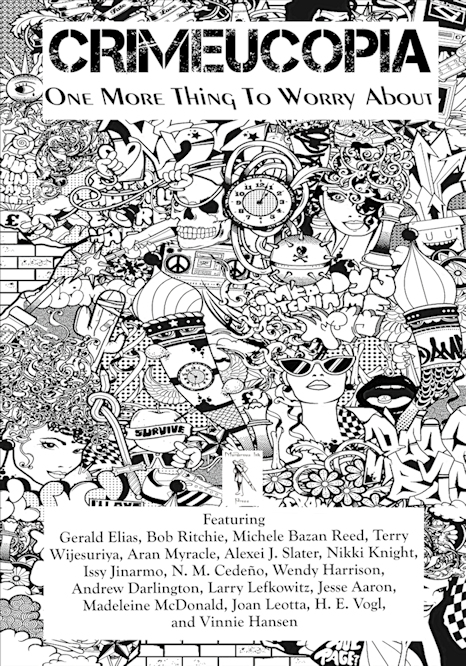
“Danger at Death’s Door” is scheduled for publication in March 2023 in the mystery anthology Crimeucopia: One More Thing to Worry About, from editor John Connor at Murderous Ink Press.

***

N. M. Cedeño is a short story writer and novelist living in Texas. She is active in Sisters in Crime- Heart of Texas Chapter and is a member of the Short Mystery Fiction Society. Find out more at nmcedeno.com

Libraries and “Merry Library Murder”

By N. M. Cedeño

The fact that the victim in my upcoming story entitled “Merry Library Murder” is a librarian is not a sign of hidden hostility or wishful thinking. Rather, the opposite is true. I set the story in a library because I spend a lot of time in libraries. Most of my reading material comes from the library, and I am a long-term library volunteer.

Of the many volunteering opportunities available in my children’s schools, the one to which I always gravitate is the assisting in the library. At one point, when I had an elementary, middle, and high school student in the house, I volunteered in all three libraries on a rotating basis each month. I started volunteering in school libraries about fifteen years ago and am still volunteering at the local high school library.

While volunteering, I’ve labeled, weeded, discarded, scanned into inventory, removed from inventory, added genre stickers to, added series number stickers to, shelved, checked-in, checked-out, magnetized, and demagnetized books. The books I’ve inventoried probably number well over 100,000. I’ve unpacked boxes of new books, packed boxes of old books, and shifted books on shelves. I’ve helped rescue books from a termite invasion and assembled and mounted signage. I once went through almost every picture book in an elementary school library to place red stickers on the spines of the ones with reading tests available for them. That meant looking up every single book on the computer to see if it had an associated test before placing or not placing a sticker on it. In order to raise funds for libraries, I’ve operated registers at more Scholastic Book Fairs than I can remember.

Last year, I helped genre-fy the entire fiction section of a high school library. How does one genre-fy a library? One separates the books by genre and creates sections: adventure, horror, science fiction, mystery, suspense, supernatural, fantasy, realistic, romance, historical, sports, humor, and classics. Graphic novels get their own section and genres, as do the books in languages other than English. This process required me to shift all the non-fiction books to make space. Consequently, I may be the only one in the entire community who has held almost every single book in the local high school library in my hands. That’s over 30,000 books.  

By far the most painful library duty I’ve ever performed is weeding fiction books. Removing fiction books from the collection that have sat on a shelf for years, untouched and unread, is a sad thing to do. But it’s something that has to be done. Shelf space is limited and new books are coming out every day.

Weeding non-fiction books that haven’t been read in years is less painful. If the material in the book is obsolete, it deserves to be removed from the library to make room for more current material. Who wants to read “How to Build a Webpage” out of a manual written in 1996? Books on teen pregnancy resources from the 1980s aren’t likely to be helpful to anyone today either. The oldest books I pulled from the shelves were from the early 1950s. They may have been useful in an archive somewhere, but not a high school library. After a day of weeding books, my hands are usually black with grime from decades of accumulated dust.

So to reiterate: I love libraries. And librarians. And Library Assistants, too. Many thanks to all the library staff I’ve worked with over the years. Sara, Becky, Maureen, Sarah, Ronda, Charity, Christina, Carole, Alyson, and all the rest, you are the best!

However, the victim in my upcoming short story, entitled “Merry Library Murder,” is a librarian. And yes, she is murdered in her own library during her town’s holiday festival. But this story is a holiday who-dunnit. Which means that justice will be served. If you’re looking for a quick holiday mystery, watch for Black Cat Weekly #68, coming out in late December. Or subscribe to Black Cat Weekly and get great reading delivered to your inbox every Sunday.

*All pictures by Pixabay.

***

N. M. Cedeño is a short story writer and novelist living in Texas. She is active in Sisters in Crime- Heart of Texas Chapter and is a member of the Short Mystery Fiction Society. Find out more at nmcedeno.com