The Million Dollar Question and A Goodbye

If mystery/crime is still one of the top selling genres for books, why are so many mystery magazines and publishers having such a hard time surviving compared to speculative fiction markets? The demise of Down & Out Books this month, coming on the heels of other closures, sales, and consolidations, has me thinking about the continued shrinkage of the mystery market and about what really drives sales for a particular genre. (With Down & Out’s closure, two of my stories that were awaiting publication need new publishers.)

Every couple of months, someone in the short mystery community asks how to sell more crime fiction short stories to the reading public. Someone else always answers that short stories don’t sell well because they are considered literary fiction, a category which sells far less than any other form of fiction. Others say that it’s simply a well-known fact that people don’t read short stories because they prefer novels and series.

Why assume short fiction is considered “literary” when short science fiction and short fantasy don’t seem to have problems selling? Why assume few people read short fiction when the existence of so many successful short speculative fiction markets seems to belie that supposition?

Go to any writers’ submission information site, Submission Grinder, Chill Subs, etc., and you will find far more markets for short speculative fiction (science fiction / fantasy / some horror) than you will for short mystery / thriller / suspense. The markets for short speculative fiction pay their authors far better than the crime genres, too. Why do they pay more? Because they have the sales numbers to support the pay.

In the short mystery fiction community, authors are frequently exhorted to buy more anthologies and subscribe to more magazines to support our community so that it doesn’t vanish. But if authors are the only audience, something is seriously wrong. Are dancers or actors told to buy tickets to their own theatrical performances so the show doesn’t close? Are artists urged to purchase artwork to prevent galleries from failing? Are musicians told to buy as many songs and albums as possible to help keep the music industry afloat? No. In all those creative-arts-based industries, business leaders recognize that it takes more than just the creators to support the industry. It would be ludicrous to believe that the creators alone could support an industry. Ergo, no amount of chiding of short mystery authors is going to improve sales numbers. It takes fans to support a genre.

So why aren’t crime and mystery fans buying short fiction while sci-fi and fantasy readers are? Are we marketing in the wrong places? Are we failing to draw in younger readers who then grow up to be buyers and subscribers? Maybe. But I think the situation is more complex than that. The mystery genre had a heyday, a golden age when it was all the rage in the early to mid-1900s. Once upon a time, Ellery Queen was a television series. So was Alfred Hitchcock Presents.

Today, we have Michael Connelly’s many works on streaming services. Craig Johnson’s Longmire and Tony (and Anne) Hillerman’s Leaphorn and Chee did well on screen, too. Only Murders in the Building has made a splash. The Enola Holmes movies are popular. People love the Brit Box mystery offerings. But the mystery genre offerings for the last three or four decades have been a drop in the bucket compared to the speculative fiction options available in the larger world of entertainment.

Today’s science fiction and fantasy stories are features of computer games and blockbuster movies. A glance at market offerings confirms that some mystery computer games exist, but very few are pure mystery. Most computer games with mystery plots are set on other planets, in other galaxies, in the future, or have other speculative elements.

Is there a connection between the current abundance of speculative fiction entertainment in games and movies and the thriving speculative short fiction market? Probably. Speculative fiction has been central to the cultural zeitgeist for several decades now, the same decades in which the mystery genre markets have been slowly vanishing.

What short mystery fiction really needs is a new golden age of mystery with a strong resurgence in the crime genre on screens. Until then, short mystery fiction writers will have to find other ways to reach readers. Which means we have to try the smaller-scale techniques and the more personal methods to increase our fanbase.

Some authors are trying book trailers on TikTok, YouTube videos, and social media posts in the hope of going “viral.” This month, I tried an even more direct approach to spread the word about short mystery fiction to youth. I spoke to a class at the local high school about how to revise short stories. I brought with me a half a dozen crime fiction anthologies and a handful of magazines and displayed them for the students. I told them to read, read, read. I recommended that they seek the “best of” anthologies for their genres. I recommended that they subscribe to magazines and ezine.

Will any of those kids read a crime fiction anthology or buy a crime fiction magazine subscription? I have no idea. However, I do know that we need to stop blaming authors for not buying enough magazine subscriptions to keep a magazine afloat or enough books to keep a small publisher from going bankrupt.

And now, a farewell. The Ink-Stained Wretches blog is closing, too. I will be moving over to post on the Austin Mystery Writers blog. All of the other members of this blog, except me, are already there. Look for my next post over at Austin Mystery Writers.

Thanks for reading.

Noreen

New Ghost Stories

I started reading ghost stories as a child and enjoyed the chill that the best of them sent up my spine. I began writing ghost stories, with a sci-fi and mystery twist, almost ten years ago when I wrote my first Bad Vibes Removal Services story. The series features Lea, a young history graduate student, working in a new service industry. She sanitizes and neutralizes the lingering emotional history from buildings and homes using newly invented equipment. She was drawn to the job because she’s always been sensitive to emotional atmosphere in rooms and has always been able to see ghosts.

The technology she uses in her job was created by a private detective named Montgomery in his quest to create a device to read the subatomic changes in soft materials caused when sound waves pass through them. Montgomery wanted to be able to read the recordings of conversations held in rooms in order to solve crimes. He ended up being able to track the emotional energy left in walls along with the sounds. In order to put his new technology in the public eye, he started Bad Vibes Removal Services to serve as a sister company to his own Montgomery Investigations business.

Lea, with her team of coworkers, soon discovers that she can’t neutralize the lingering emotions in a house if the source, a ghost in distress, is still present. Many of the ghosts she encounters died under questionable circumstances, leading to murder investigations.

The series started with one story. But I liked the characters so much that I wrote more stories, which led me to write a novel, The Walls Can Talk, then more stories, and another novel, Degrees of Deceit, then, more stories. The series currently has 15 or so published short stories and two novels. The latest story in the series, called “Wedding Vibes,” was published in Black Cat Weekly #145 courtesy of editor Michael Bracken. The story features Lea’s wedding reception being crashed by both a ghost and thieves trying to steal gifts. Luckily, her boss, Montgomery, her coworker and Maid of Honor, Kamika, and the rest of her friends are on the case. The thieves chose the wrong reception to crash.

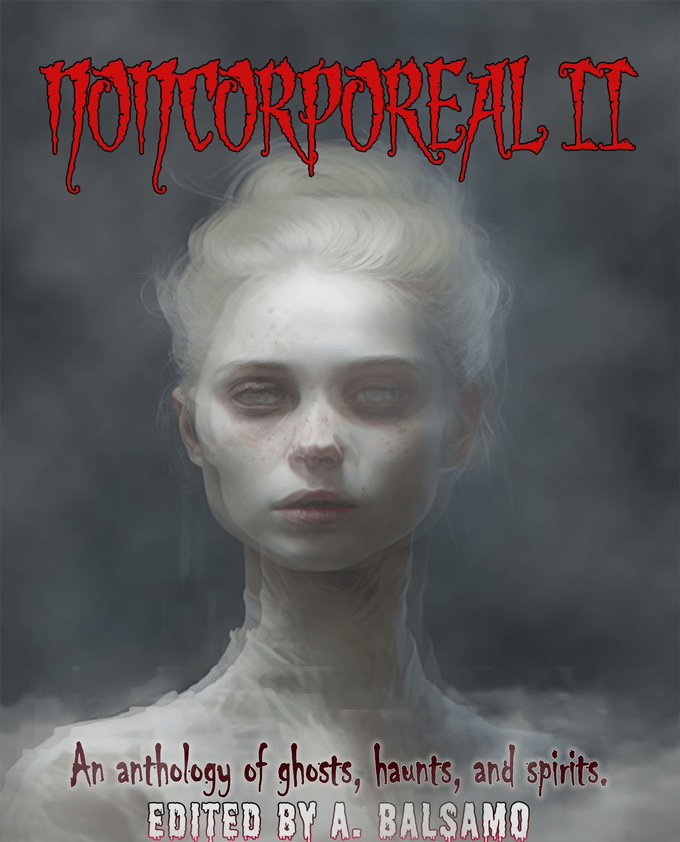
Another one of my ghost stories is rolling out right now, too. “A Lonely Death” is coming out in an anthology of spooky stories from Inkd Publishing called Noncorporeal II. Those who ordered the anthology from the Kickstarter should be receiving their copies shortly, and it will go on sale to the general public soon. The story begins with a cowboy digging a grave in the “middle of nowhere Texas” in the mid 1800s. Soon there after, a little boy whose home was built in what once was the “middle of nowhere Texas” meets a ghost. This story is told from the point of view of the ghost and from the point of view of the people in whose home the ghost appears.

This story was inspired by a three-year-old who was seen in his home talking to and looking up at an adult who the child’s mother couldn’t see. The family had several guests report either seeing a man who vanished or feeling “creeped out” in their guest room. The house was brand new, built on what had been farmland in Central Texas. My story answers the question of why a brand new house might have a ghost.

****

N. M. Cedeño is a short story writer and novelist living in Texas. She is active in Sisters in Crime- Heart of Texas Chapter and is a member of the Short Mystery Fiction Society. Find out more at nmcedeno.com

Do You Enjoy Speculative Fiction?

By N.M. Cedeño

Do you enjoy speculative fiction? Do you know what speculative fiction is?

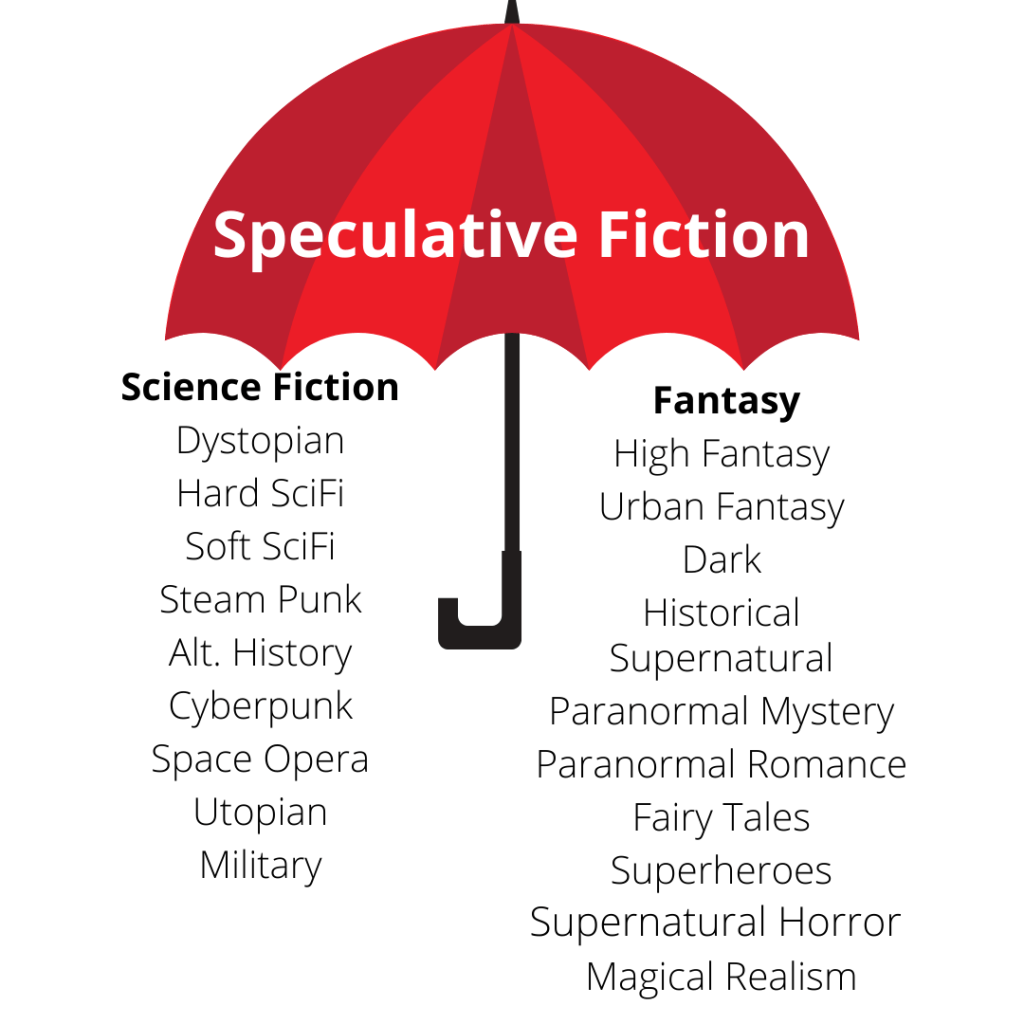
The dictionary defines speculative fiction as “a genre of fiction that encompasses works in which the setting is other than the real world, involving supernatural, futuristic, or other imagined elements.” The genre is an umbrella under which lies science fiction, fantasy, and even some kinds of horror. From fairy tales to space operas, from paranormal stories to alternative histories, any kind of fiction containing imagined elements that exist outside of known reality can be classified as speculative fiction. Many well-known books and series fall into this category.

Works of dystopian fiction like Brave New World by Huxley, 1984 by Orwell, and Ray Bradbury’s Fahrenheit 451 are speculative fiction. The Hunger Games dystopian series is speculative fiction.

Gabriel Garcia Marquez’s work of magical realism, One Hundred Years of Solitude, is speculative fiction.

Stephen King’s horror novel It and his time travel novel 11/22/63 are speculative fiction.

Star Wars, Buck Rogers, and other space operas are speculative fiction.

The Twilight romance series featuring werewolves and vampires is speculative fiction.

The Harry Potter fantasy series is speculative fiction.

The Martian, a work of hard science fiction by Andy Weir, is speculative fiction.

Janet Evanovich’s Lizzy and Diesel urban fantasy series is speculative fiction.

Dean Koontz’s Odd Thomas paranormal thriller series is speculative fiction.

Wonder Woman and other superhero stories are speculative fiction.

Irish folk tales about leprechauns or banshees are speculative fiction.

Given all the stories and genres that can be classified as speculative fiction, it might be easier to ask what isn’t speculative fiction than to go through all the examples of what it is. If a work of fiction is entirely realistic in its setting and involves no magical, supernatural, futuristic, or other elements that don’t yet or might never exist, then it isn’t speculative fiction. A mystery, police drama, or romance set in the present day with no imaginary elements added would be categorized as realistic fiction. Horror, thriller, and suspense novels that feature only human evil or terrors that are based in the real world are realistic fiction. A historical drama that accurately reflects life in a given time period would also be realistic fiction.

Speculative fiction allows for flights of imagination, presenting other worlds, dream worlds, and future worlds rather than depicting the world how it is or was. Realistic fiction stays within the bounds of known reality.

As an author, some of my writing falls under the mantle of speculative fiction. My Bad Vibes Removal Services paranormal mysteries featuring Lea, a woman who can see and talk to ghosts, definitely fits into the category. My romantic suspense / mystery novel All in Her Head also features paranormal elements.

My novel For the Children’s Sake is a murder mystery featuring an imaginary medical condition where some people’s skin oils cause other people to go into anaphylactic shock and die. That imaginary condition makes the book speculative fiction, even though the rest of the book is based in reality.

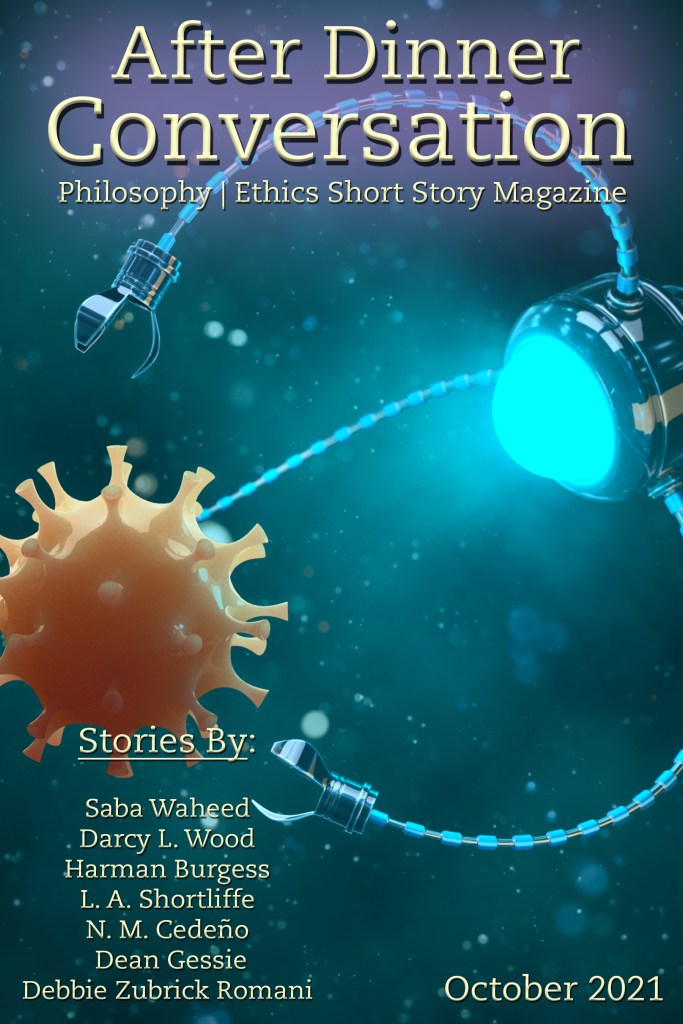
October 2021 issue

Several of my short stories are classified as social science fiction, set in possible future worlds. For example, my short story entitled A Reasonable Expectation of Privacy is a private detective story set in a world with no privacy rights.

My latest release is also a work of science fiction. The Wrong Side of History is currently available in the October 2021 issue of After Dinner Conversation: Philosophy and Ethics Short Story Magazine. The Wrong Side of History is a tale of blackmail set in a world recovering from a near-extinction event and featuring a 130-year-old politician trying to keep his legacy intact in a world with values that differ widely from those considered acceptable in his youth.

So back to the original question. Do you enjoy speculative fiction?

*****

N. M. Cedeño is a short story writer and novelist living in Texas. She is currently working on a paranormal mystery series called Bad Vibes Removal Services. Ms. Cedeño is active in Sisters in Crime- Heart of Texas Chapter. Find out more at nmcedeno.com.