
The Research Rabbit Hole: Jewel Theft 1950s-1960s

I’ve been researching background for another story featuring my character Jerry Milam, a World War II veteran and ex-cop turned PI. In looking for crimes for my detective to solve, I started digging into old newspapers for information on jewel thefts. I chose the topic because I’d read about the robbery of the American Museum of Natural History in New York in 1964. While the robbers were later caught, only ten of the twenty-four stolen gems were recovered. In researching that theft, I discovered that the Witte Museum in San Antonio was robbed in 1969, with a thief smashing a glass display case in order to snatch the forty-nine carat McFarlin Diamond, a canary yellow, emerald cut stone described as being the size of a hen’s egg, which was also never recovered.

Then, I fell down the rabbit hole.

Back in the days when J. Edgar Hoover was still in charge of the FBI, jewel thefts were all the rage in crime. Jewels, once removed from their settings, were impossible to identify because, unlike today, they had no microscopic serial numbers etched on them. Etching of jewels for identification purposes began in 1983. While watches had serial numbers, most people didn’t bother to make a note of theirs. Fences were happy to purchase stolen jewels and watches because they were so hard to link back to the original owners. Most gem stones were easily recut or reset and resold, vanishing forever.

Most jewel robberies in the 1950s and 1960s were committed by stealth, leading to the image of the lithe cat burglar crawling over rooftops firing the popular imagination. Alfred Hitchcock even made the movie To Catch a Thief, released in 1955, with Cary Grant playing a retired jewel thief known as the Cat.

Between 1959 and 1967, Lauren Bacall, Winston Churchill, Sophia Loren, Eva Gabor, and Yul Brenner, along with other famous and wealthy people, were relieved of their jewels by thieves. With the exception of Eva Gabor, none were present at the time of the theft. Thieves, likely the same ones who robbed the American Museum of Natural History’s gemological exhibit a few months later, waited for Eva Gabor and her husband to return to their hotel room in order to steal her twenty-five-thousand-dollar diamond ring, which they had been unable to locate while she was away from the room. They pistol whipped and bound Ms. Gabor and forced her husband to retrieve the ring from the hotel safe before making their getaway.

If you are wondering why one ring was enough for the thieves to risk adding armed robbery and kidnapping to the charges against them, consider that the average income in 1965 was less than seven thousand dollars a year. A twenty-five-thousand-dollar ring was worth several years income to most people.

My research led me to realize that even without serial numbers and etched identification codes, certain jewels would be easier to trace than others. Which jewels might be more traceable? Cabochon star rubies and sapphires. A rounded, polished shape, called a cabochon, was how all jewels were prepared before cutting was developed for gemstones. Opals are still prepared and set as cabochons.

Star rubies and star sapphires exhibit a phenomenon called asterism, a star pattern visible when light hits the stone. The star is created by long inclusions inside the stone. Stones with asterism are rounded and polished as cabochons, not cut, to preserve the star within them.

The Edith Haggin DeLong Star Ruby
By Vicpeters – Own work, CC BY 4.0, https://commons.wikimedia.org/w/index.php?curid=165353250

Star rubies and star sapphires are valued based on the clarity and size of their stars, the color saturation and transparency of the stone, by their shape, and by their inclusions and cloudy areas. These same features make the stones more easily traceable and identifiable. While other gems can be recut and reset to disguise them, star rubies and star sapphires can’t be cut because the rounded shape is what allows the star to be seen.

Is it any surprise that the most valuable stones recovered from the American Museum of Natural History robbery were the Star of India, one of the largest blue star sapphires in the world, and the DeLong Star Ruby, while the Eagle Diamond was never found?

That’s enough rantings from the rabbit hole.

*****

N. M. Cedeño is a short story writer and novelist living in Texas. She is active in Sisters in Crime- Heart of Texas Chapter and is a member of the Short Mystery Fiction Society. Find out more at nmcedeno.com.

Work-Arounds

By N.M. Cedeño

As I type this, I’m seeing double through my right eye. Well, not quite double. On the screen, it’s more like printed letters have their own ghostly echoes lingering directly above and behind. This has been an ongoing issue for over a month due to a dry patch on my cornea, making working on the computer and reading an exhausting slog. My left eye is compensating, allowing me to still have twenty/twenty vision with both eyes open, but I have to take frequent breaks from screens. The eye doctor added a new medicine this past week, so I’m hoping to “see” some improvement soon. If not, the next step is to see a specialist.

I had to come up with a work-around for my current writing project because of the eye-strain. What do you do when reading long articles looking for details that you need for a story makes you tired too quickly? The answer I came up with is “watch videos containing the needed information.”

 Because of eye strain, I’ve found watching videos to be easier than reading long articles. With the help of the Sisters in Crime Webinar Archive of videos, I’ve dug into the structure of the FBI, which crimes are under their jurisdiction, and which aren’t, and how cases are assigned and handled. I also watched a webinar on forensics, because why not. The archive contains a wide variety of videos on topics from writing craft to crime-solving. I’ll be watching more videos even when my eye issue is resolved because of the variety of topics and the amount of information available.

Thanks to YouTube videos, I’ve learned how to prevent the theft of a certain model of car, and I’ve learned about what features the car has to prevent the theft of a cargo trailer that the vehicle might be towing. Various videos helped me learn about the particular model of vehicle I need for a story, its security systems, and about the wide world of custom cargo trailers. Now I know how a thief might get around all of those security features to steal both the vehicle and the trailer, which moves the plot on my work-in-progress forward considerably.

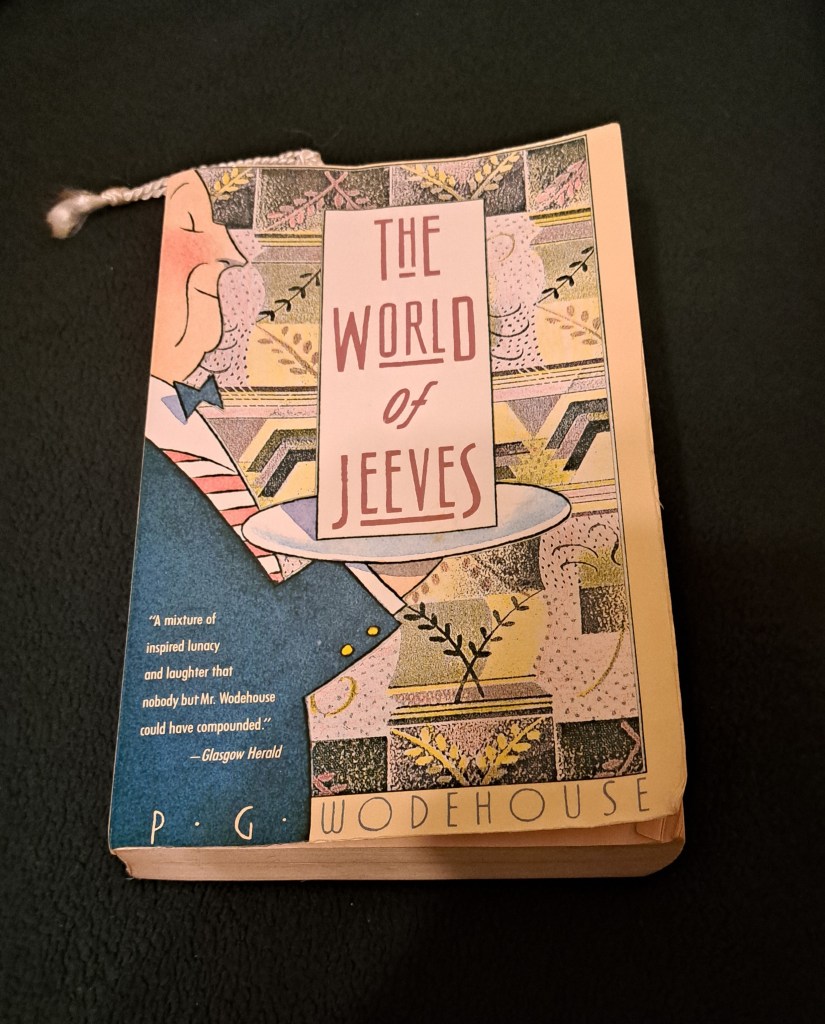
Of course, I’m still reading, but far more slowly than usual. I’ve read a couple books by Donna Leon this month and a lot of P.G. Wodehouse. I read the Wodehouse to lighten my mood. Jeeves and Bertie are wonderful if you need to laugh at something utterly ridiculous. I love Bertie’s confusion as Jeeves gets him out of an unwanted engagement by making him appear to be insane. The story where Jeeves and Bertie aid one of Bertie’s friends who has gone to jail for “biffing” a policeman while drunkenly trying to steal the policeman’s helmet left me in stitches.

On the non-writing front, my middle child starts college this month. He will have moved into dorms on campus by the time this blog posts. Thirteen years ago, a neuropsychologist walked me through the challenges he was facing. I realized he had a long road ahead of him and a lot of work to do. Being what’s now called neurodivergent, he would have to fight to learn many things that are innate to the majority of people: everything from proprioception and bilateral coordination to reading facial expressions. And he did ALL of that hard work. He went from being asked to leave a private school in kindergarten and being placed in special education for three years in elementary school to finishing high school in the top 6% of his class.

He is an incredibly talented, intelligent, outgoing young man with a “punny” sense of humor. Watching him leap into a world that has frequently been unkind to him because of his differences is an emotional challenge for a mom. But I believe he will find his way. He knows how to face obstacles, pick himself up and try again when he fails, and persist in chasing his dreams.

On top of that, my youngest earned her driver’s license this summer and has started going out into the world without me driving her. She is embarking on her senior year of high school and filling out college applications.

Watching my kids spread their wings is breathtaking and anxiety-inducing. An empty nest is on the horizon. My empty nest goals include attending a writing convention or two. I’ve only been to Bouchercon once and I’d like to attend again.

Speaking of Bouchercon, the Anthony Boucher World Mystery Convention is this coming weekend. I won’t be attending, so I hope everything goes well for everyone who is traveling to Nashville to attend. If you are there, stop by the book room and pick up a free copy of the anthology Private Dicks and Disco Balls: Private Eyes in the Dyn-O-Mite Seventies edited by Michael Bracken. I have a story in the anthology called “A Woman’s Place.”

*****

N. M. Cedeño is a short story writer and novelist living in Texas. She is active in Sisters in Crime- Heart of Texas Chapter and is a member of the Short Mystery Fiction Society. Find out more at nmcedeno.com.

Can I Trust AI Writing Apps?

By K.P. Gresham

I’ve been reading quite a few headlines about the new Artificial Intelligence writing apps that burst onto the scene in November of 2022. Reviews have been mercurial. Some say is the end of our ability to think. Others say it is the savior of our intellectual future.

I’m a curious person, so I decided to give it a go. I joined ChatGPT via chatopenAI.com, and put in the following prompt:

“Compare books by K.P. Gresham and J.D. Robb.”

(Of course, I chose J.D. Robb—she’s my favorite author. Just once I wanted to see my name and her name in the same sentence!)

Here are excerpts from ChatGPT’s response:

J.D. Robb and K.P. Gresham are both authors who write mystery novels, but their books differ in several ways.

J.D. Robb’s books are primarily crime and suspense novels, featuring a recurring cast of characters led by the protagonist, Eve Dallas, a New York City police detective…

K.P. Gresham’s books, on the other hand, are typically set in small towns in Texas and deal with more personal, often domestic, crimes…

Another difference between the two authors is their approach to character development. J.D. Robb’s books are centered around a recurring cast of characters, including Eve Dallas and her husband, Roarke, who are well-developed and have complex backstories that are gradually revealed throughout the series. K.P. Gresham’s books, on the other hand, feature a different set of characters in each novel, with some recurring characters that show up occasionally.

In summary… While both authors are skilled at creating engaging and suspenseful stories, their books differ in terms of genre, writing style, setting, and character development.

Okay! I’ll take that. But there was a hiccup in my info: I do not have a different set of characters in each novel. My mysteries feature Pastor Matt Hayden and his cronies in every book.

I responded to the post: “I thought K.P. Gresham’s books feature Pastor Matt Hayden and his friends and family.”

Excerpts from ChatGPT’s Response:

You are correct, and I apologize for my previous response. K.P. Gresham’s books do indeed feature Pastor Matt Hayden and his friends and family. I was mistaken in my previous response, and I appreciate you bringing this to my attention.

“K.P. Gresham’s mystery novels, including “Murder in the Second Pew,” “Dying for a Change,” and “Murder in the Choir Loft,” are set in the small Texas town of Shady Grove and feature Pastor Matt Hayden as the main character…

Similar to J.D. Robb’s books, K.P. Gresham’s writing style is character-driven and creates a strong sense of place… K.P. Gresham’s books are centered around Pastor Matt Hayden and his family and friends.

In summary, K.P. Gresham’s mystery novels do indeed feature Pastor Matt Hayden and his friends and family, and the books are characterized by a strong sense of place, character development, and personal crimes that occur in the small Texas town of Shady Grove.”

Actually, this is great stuff—for the most part. Except I didn’t write Dying for a Change or Murder in the Choir Loft.

My response? “K.P. Gresham did not write Dying for a Change nor did she write Murder in the Choir Loft. She did write The Preacher’s First Murder, Murder in the Second Pew, Murder on the Third Try and Four Reasons to Die. Her stories do not take place in Shady Grove, but in Wilks, Texas, and Austin, Texas.”

Excerpts from Chat GPT’s Response:

Thank you for bringing this to my attention, and I apologize for my previous mistakes. You are correct that K.P. Gresham did not write “Dying for a Change” or “Murder in the Choir Loft” and that her novels do not take place in Shady Grove, but in Wilks and Austin, Texas.

“K.P. Gresham’s mystery novels, including “The Preacher’s First Murder,” “Murder in the Second Pew,” “Murder on the Third Try,” and “Four Reasons to Die,” are set in small Texas towns and feature Pastor Matt Hayden as the main character. Her writing style is character-driven, with a focus on creating a strong sense of place and developing the personalities and relationships of her characters…

Once again, thank you for correcting my mistakes, and I hope this response provides a more accurate comparison between the books of K.P. Gresham and J.D. Robb.”

That’s my glimpse of Chat GPT. It got the big, important stuff right (i.e. all the J.D. Robb information). When it came to little ol’ me, it needed some important corrections. (Important to me, anyway.)

My takeaway? If you’re using a writing AI, don’t count on it for lesser known info. As a writer, I take my research VERY seriously. I don’t think this technology shows enough promise to depend on everything it says. Is the AI teachable? Yes. Reliable? Not so much.

Stay safe by doing your own research. (Hey—next time I’m going to write a blog on making the “perfect” Old Fashioned adult beverage. Talk about enjoying your research!).

And, as always, keep on writing!

K.P. Gresham, Author

Professional Character Assassin

K.P. Gresham is the award-winning author of the Pastor Matt Hayden Mystery Series as well as several stand-alone novels.  Active in Sisters in Crime and the Writers League of Texas, she has won Best Novel awards from the Bay Area Writers League as well as the Mystery Writers of America.

Click here to receive K.P.’s newsletter and a get a free short story!

Website: http://www.kpgresham.com/

Email: kp@kpgresham.com

Blogs: https://inkstainedwretches.home.blog/

https://austinmysterywriters.com/

Facebook: https://www.facebook.com/kpgresham

Books by

K.P. Gresham

Three Days at Wrigley Field

The Pastor Matt Hayden Mystery Series

The Preacher’s First Murder

Murder in the Second Pew

Murder on the Third Try

Four Reasons to Die