The Million Dollar Question and A Goodbye

If mystery/crime is still one of the top selling genres for books, why are so many mystery magazines and publishers having such a hard time surviving compared to speculative fiction markets? The demise of Down & Out Books this month, coming on the heels of other closures, sales, and consolidations, has me thinking about the continued shrinkage of the mystery market and about what really drives sales for a particular genre. (With Down & Out’s closure, two of my stories that were awaiting publication need new publishers.)

Every couple of months, someone in the short mystery community asks how to sell more crime fiction short stories to the reading public. Someone else always answers that short stories don’t sell well because they are considered literary fiction, a category which sells far less than any other form of fiction. Others say that it’s simply a well-known fact that people don’t read short stories because they prefer novels and series.

Why assume short fiction is considered “literary” when short science fiction and short fantasy don’t seem to have problems selling? Why assume few people read short fiction when the existence of so many successful short speculative fiction markets seems to belie that supposition?

Go to any writers’ submission information site, Submission Grinder, Chill Subs, etc., and you will find far more markets for short speculative fiction (science fiction / fantasy / some horror) than you will for short mystery / thriller / suspense. The markets for short speculative fiction pay their authors far better than the crime genres, too. Why do they pay more? Because they have the sales numbers to support the pay.

In the short mystery fiction community, authors are frequently exhorted to buy more anthologies and subscribe to more magazines to support our community so that it doesn’t vanish. But if authors are the only audience, something is seriously wrong. Are dancers or actors told to buy tickets to their own theatrical performances so the show doesn’t close? Are artists urged to purchase artwork to prevent galleries from failing? Are musicians told to buy as many songs and albums as possible to help keep the music industry afloat? No. In all those creative-arts-based industries, business leaders recognize that it takes more than just the creators to support the industry. It would be ludicrous to believe that the creators alone could support an industry. Ergo, no amount of chiding of short mystery authors is going to improve sales numbers. It takes fans to support a genre.

So why aren’t crime and mystery fans buying short fiction while sci-fi and fantasy readers are? Are we marketing in the wrong places? Are we failing to draw in younger readers who then grow up to be buyers and subscribers? Maybe. But I think the situation is more complex than that. The mystery genre had a heyday, a golden age when it was all the rage in the early to mid-1900s. Once upon a time, Ellery Queen was a television series. So was Alfred Hitchcock Presents.

Today, we have Michael Connelly’s many works on streaming services. Craig Johnson’s Longmire and Tony (and Anne) Hillerman’s Leaphorn and Chee did well on screen, too. Only Murders in the Building has made a splash. The Enola Holmes movies are popular. People love the Brit Box mystery offerings. But the mystery genre offerings for the last three or four decades have been a drop in the bucket compared to the speculative fiction options available in the larger world of entertainment.

Today’s science fiction and fantasy stories are features of computer games and blockbuster movies. A glance at market offerings confirms that some mystery computer games exist, but very few are pure mystery. Most computer games with mystery plots are set on other planets, in other galaxies, in the future, or have other speculative elements.

Is there a connection between the current abundance of speculative fiction entertainment in games and movies and the thriving speculative short fiction market? Probably. Speculative fiction has been central to the cultural zeitgeist for several decades now, the same decades in which the mystery genre markets have been slowly vanishing.

What short mystery fiction really needs is a new golden age of mystery with a strong resurgence in the crime genre on screens. Until then, short mystery fiction writers will have to find other ways to reach readers. Which means we have to try the smaller-scale techniques and the more personal methods to increase our fanbase.

Some authors are trying book trailers on TikTok, YouTube videos, and social media posts in the hope of going “viral.” This month, I tried an even more direct approach to spread the word about short mystery fiction to youth. I spoke to a class at the local high school about how to revise short stories. I brought with me a half a dozen crime fiction anthologies and a handful of magazines and displayed them for the students. I told them to read, read, read. I recommended that they seek the “best of” anthologies for their genres. I recommended that they subscribe to magazines and ezine.

Will any of those kids read a crime fiction anthology or buy a crime fiction magazine subscription? I have no idea. However, I do know that we need to stop blaming authors for not buying enough magazine subscriptions to keep a magazine afloat or enough books to keep a small publisher from going bankrupt.

And now, a farewell. The Ink-Stained Wretches blog is closing, too. I will be moving over to post on the Austin Mystery Writers blog. All of the other members of this blog, except me, are already there. Look for my next post over at Austin Mystery Writers.

Thanks for reading.

Noreen

Fall Comes to Paris


By Helen Currie Foster

Travel thoughts.

It’s fall in Paris. The rows of chestnuts flanking the Seine are turning golden-brown; gingko trees sport their distinctive yellow leaves, preparing to fling down, on one afternoon they keep secret, all their leaves at once.

Fall fashion? Long hair for women, slim tan trench coats at mid-calf, midi-length swishy skirts. Anyone can wear jeans and sneakers (male, female, old, young) with a blazer-cut jacket. In the markets, apples from the Garonne (Pixie Pommes!), quantities of mushrooms, cashmere scarves. Kids scurry to school at eight while their older siblings stride down Rue de l’Universite toward Science Po.

I’m forever grateful to Madame, our wondrous French teacher at McCallum High in Austin. On the first trip to Paris over fifty years ago, fresh off the early train, my husband and I stopped at a café where I opened my mouth in fear and trembling to order in French—deux cafes et deux croissants.

To my shock the proprietor didn’t blink. And the result was magic—our first taste of croissant.

Long past high school I still say “Merci, Madame!” A Parisienne, she had (I believe) a PhD. She maintained perfect class discipline—even with smarty seniors. When anyone asks, how did you learn French? I say, “Madame! She made us sing songs!” https://www.youtube.com/watch?v=96JRl7bER3g&list=RD96JRl7bER3g&start_radio=1

As to “à la Claire Fontaine” I suspect she omitted the first two verses—at least I don’t remember singing about bathing beneath a tree! But this song and the rest we still remember, decades later.

Sur le Pont d’AvignonFrère JacquesAlouette, gentille alouetteje te plumerai (le nez, le cou, et la tete, et le dos, etc.). At Christmas, Il est né, le divin enfant. Twisting your tongue around the pretty French words leaves you with life skills.

(She didn’t teach us La Marseillaise. But I still get chills when, in Casablanca, Victor Laszlo leads the crowd at Rick’s in singing it.)

And another beloved teacher taught both Latin and English. She could order grown seniors to race to the blackboard to diagram sentences, and insisted we use proper punctuation.

What was it about those favorite teachers? They made us learn. They brooked no foolishness. They could tell when we faked preparation. They thrust us into difficult novels, demanding paintings, complex unfamiliar music. Hitherto hidden histories. Concepts we hadn’t invented or come upon by ourselves.

Maybe we did learn. Maybe—that learning is worthwhile.

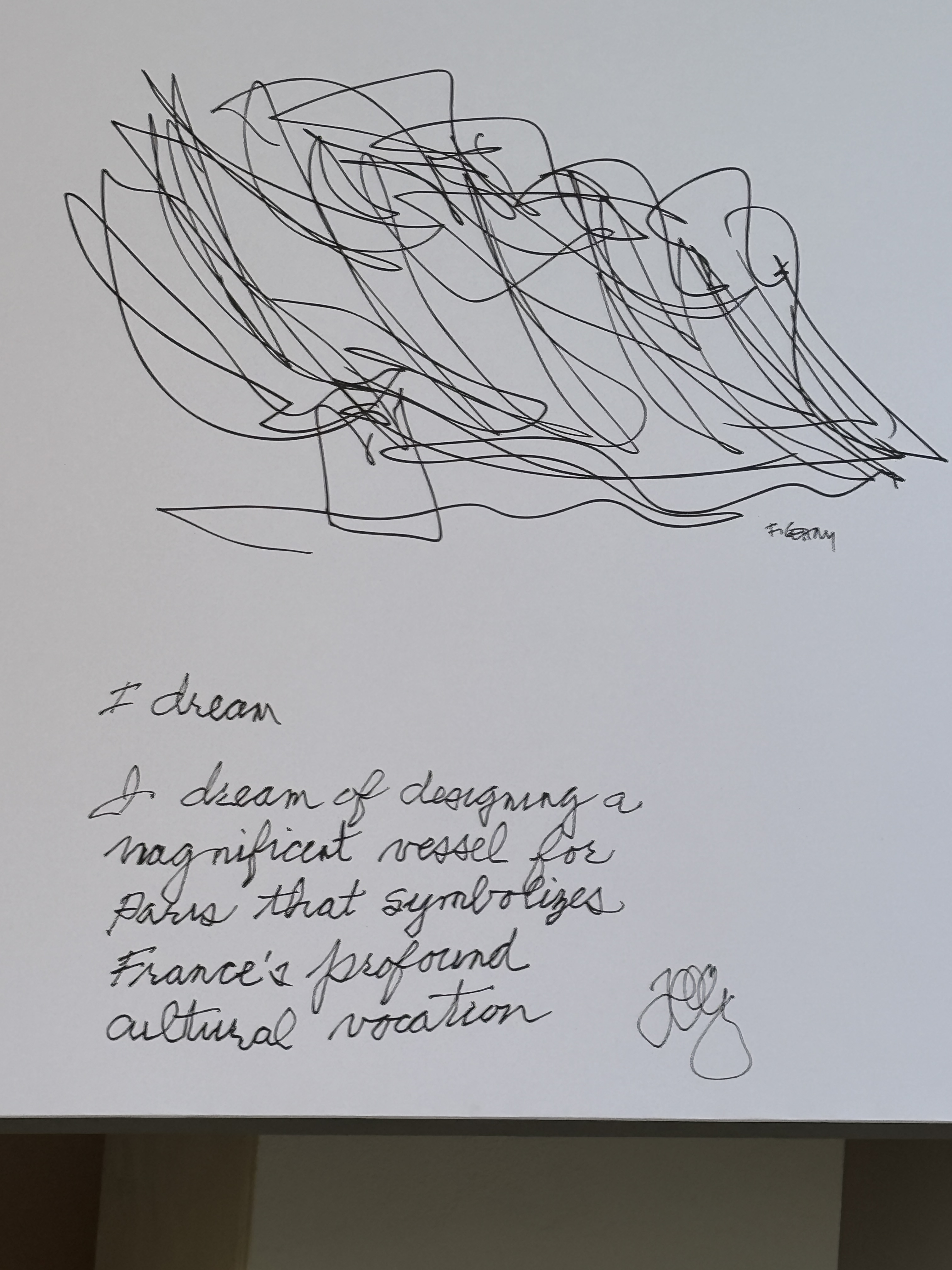
Yesterday we visited La Fondation Louis Vuitton to visit what architect Frank Gehry dreamed of as an iceberg with sails.

Curves, lines, water, wood… magical in their power.

The building invites you to wander and wonder. What imagination, what creativity, what a vision! I listened to the rippling water traveling down the slope—the sound took over. Couldn’t hear traffic, or talking. Just the water–in the middle of a vast city. Being there takes you back to Roman stonework (rectangles, arches, roads in straight lines), and then to the power of curved sails, moved by wind and water. People working there seemed quietly confident that visitors should and would be (but not literally) blown away.

READING: I’m very much enjoying Susan Wittig Albert’s Thyme, Place & Story website where she is now serializing the first China Bayles book–A Bitter Taste of Garlic. Many of us are fans of this series, and would be delighted to visit China’s herb shop in a town not far from Austin…!

I just finished Mick Herron’s Down Cemetery Road. I found it much scarier than the Slow Horses novels…but still wanted to know the ending. It was published over 20 years ago and apparently will be streaming in October.

On the flight over I was reading Graham Robb’s France, including some tales of Paris that were scarier than Down Cemetery Road. Like being the butt of your buddies’ jokes and winding up as a prisoner in Fenestrelle, a political prison during the Napoleonic era. https://fr.wikipedia.org/wiki/Forteresse_de_Fenestrelle

Meanwhile, at home, Ghost Justice is now out! Book 10 in my Alice MacDonald Greer Mystery Series set in the Hill Country. Available at BookPeople on Lamar Blvd. in Austin https://bookpeople.com/ and on Amazon. https://amzn.to/4pk8WQO

Hope you’ll enjoy it!

Helen Currie Foster lives and writes the Alice MacDonald Greer Mystery Series north of Dripping Springs, loosely supervised by three burros. She’s drawn to the compelling landscape and quirky characters of the Texas Hill Country. She’s also deeply curious about our human history and prehistory and how, uninvited, the past keeps crashing the party. Follow her at http://www.helencurriefoster.com.

HIDDEN GEMS OF HISTORY AND THE STORIES THEY INSPIRE

By F. Della Notte

Ideas for stories are often triggered by research into family members, alive or deceased, strangers and their stories and the histories of different cities, countries, and states. The information may never appear in a book, but it gives the writer a more profound sense of historical events that color the author’s senses. And of course, the older the city, town, or state, the deeper the hidden gems that may be found.

My short story, “The Runaway Pin Boy,” was inspired by my immigrant uncle, circa 1926, who ran away from home and worked as a pin boy in the New York City Bowery until his father (my grandfather) found him. What was life like for pin boys, often called pin monkeys? The research took me from the Bowery in New York City, where it began, to the development of the sport and bowling alleys across the nation.

Then, of course, there was the period of prohibition, another explosive, compelling time in history, giving birth to the private, secret clubs called speakeasies. Lest we think speakeasies were exclusively in big cities like New York, Austin, Texas, had its own. Some are still in operation, such as the well-known Prohibition ATX on Anderson Mill Road, which is jazzy and more modern-looking than its forerunner. The Midnight Cowboy, an old brothel masquerading as a massage parlor, is now one of the oldest speakeasies in Austin.

The unlikely combination of a ballet dancer, an old Victorian house in Austin, and the myth of Confederate gold inspired much of Two Wolves Dancing. None of the American Civil War’s hidden treasures, however, have been found or confirmed to exist, including the gold Jefferson Davis supposedly hid when fleeing the Union in 1863. There is still an ongoing dispute about what happened to gold bars that vanished near Dents Run, Pennsylvania, on their way to the U.S. Mint. There is one find that may keep treasure hunting for Confederate gold alive for generations to come: The Great Kentucky Hoard. In 2023, an anonymous person using a metal detector discovered 700 Civil War-era gold coins buried in a cornfield in Kentucky. The hoard was confirmed and the coins authenticated by numismatic authorities.

As a native New Yorker who used the New York City subway system extensively, it was the stories of the hidden subway tunnels that triggered my imagination once again. While a myth of an immense hidden treasure from the turn of the 20th century does not exist in the subways of New York, there is one gem: The Subway Garnet.

In 1885, while excavating for a sewer line beneath West 35th Street, a worker dug up a massive, red-brown garnet weighing almost 10 pounds. Initially, the rock was used as a doorstop by the Department of Public Works until its identity and its value were eventually recognized by a geologist. Now, it is housed at the American Museum of Natural History.

The secrets, legends, and urban myths of the subway system are old and many.  There’s the story of the pneumatic subway, constructed in the 1860s by inventor Alfred Ely Beach, beneath Broadway. Eventually, the project was abandoned and the entrance sealed. Decades later, when building the modern subway, excavators broke through and found the abandoned railcar.

The abandoned City Hall station, opened in 1904, was considered the crown jewel of the first subway line. It was closed in 1945 due to its sharp curve and low ridership, but myths of its secrets persist. Today, riders on the Number 6 train can sometimes catch a glimpse of the ornate station as the train turns around. Then there’s Track 61.

Now abandoned, Track 61 lies beneath Grand Central Terminal, running to the Waldorf Astoria Hotel. President Franklin D. Roosevelt’s custom five-car train platformed there, allowing him to enter and exit the hotel discreetly, keeping his paralysis out of public view.

And what would Urban legends and myths be without the Mole People: Dwellers who created shantytowns in abandoned tunnels. And ghost stories are a must, and so are ghost trains. Rumors persist of a phantom train that can sometimes be seen in the Astor Place station. One theory suggests the ghost train is the private car, called the Mineola, of August Belmont Jr., the financier of the first subway line, who used it to transport guests to his racetrack. Ghostly pets also have their place in the underground. Due to its connection with FDR and his dog, Fala, legends claim that the terrier’s ghost still haunts Track 61, where the dog used to accompany its master. 

And so with all of these histories, stories, and myths in a nation that hasn’t been in existence for quite 250 years, how much more can we imagine from ancient empires?

In book four of the Housekeeper Mystery Series, Mrs. B., and her boss, Father Melvyn decide to take a group to Rome Italy, to study the lives of the early Roman Christians, and find themselves in the middle of a theft and murder surrounding the discovery of an ancient cross that might have belonged to Miltiades, the first bishop of Rome, in the 4th century, when Christianity was illegal and punishable by death. The legend: a special cross, was made by Emperor Constantine, in 312 A.D. after his victory at the Milvian Bridge. He had a vision of the symbol of the cross, accompanied by the words, “In this sign you will conquer,” and he did. This was the turning point for Christianity, and the beginning of the myth that a gold cross studded with gems was gifted to Miltiades, to be passed down to each succeeding prelate. But the cross disappeared and didn’t resurface in Rome until Mrs. B. and Father Melvyn arrived. The question is, why, and who would kill for this cross?  

To find the answers, watch for Murder in the Cat’s Eye coming by the end of 2025.

Meanwhile, happy historical explorations and happy reading.