
THE FELINE WITCHING HOUR

by

Francine Paino, a.k.a. F. Della Notte

According to BondVet.com, cats are among the most intelligent creatures on the planet. Scientists believe that cats are uniquely smart when compared to dogs and other animals, which makes it understandable that, like their human counterparts, cats have witching hours. (PetMed.)  During those episodes, which generally take place at dusk or dawn, felines may suddenly have bursts of extra energy and display athletic and agile abilities.

In addition to watching my cat, Miss Millie, run, jump and stare at objects or minuscule insects that I either can’t see or don’t exist, I learned that she, to my amazement, could leap four feet up from one piece of furniture to a higher surface. (Now her middle-aged spread has reduced her airtime). And yes, I did measure the distance!

Millie has given us a few spooky behavior episodes of the midnight crazies too. She jumps on my bed at 3 a.m., stands on my chest, pokes her cold, wet nose against mine, and stares into my closed eyes, willing me to open them. On one occasion, she then ran repeatedly to the back door and shoved her head under the window covering to stare out at the back deck. Perhaps at real live prey beyond her reach. How frustrating for her, and no, I didn’t open the door and let her out!  Fortunately, those episodes are few and far between since she then settles down and takes intermittent naps during the day—a luxury I don’t have. To be clear, my Millie cares not a whit for what the experts say. Her most frequent witching hour occurs almost daily between three and four in the afternoon – my time to sit and read. It’s also her way of showing who’s the boss. Hey, human, forget the book. Look at me. She runs, jumps, pounces on invisible prey (invisible to me), and she will often roll onto her back at my feet and stare up at me with shiny eyes that challenge. Try and stop me. 

Suggested ways to manage these activities include creating climbing areas – but she already climbs on everything. Create hiding spots and exploration zones. Miss Millie knows every inch of this house. I think she knows spots I have not yet discovered, and she can squeeze herself into narrow spaces between furniture and the walls that amaze me. I know she has bones, but sometimes I wonder if they become cartilaginous. 

Especially fascinating is how she rules, or should I say communicates. If I’m at my computer in the late afternoon, we have a problem.  According to her time clock, I should be in the kitchen at that hour, taking out food groups to prepare for dinner. So, to move me, she jumps on my lap, proceeds to purr, and opens and closes her paws on my legs, kneading them as one kneads bread dough. And if I don’t acquiesce fast enough, she nips my forearms. I have even warned that I’d send her to the cat-sausage factory if she doesn’t stop, but Millie is immune to my empty threats.

“Maybe she just wants some attention and affection,” said my husband. Sounds reasonable, right? Wrong. Miss Millie will have none of that. She turns her head, stares into my eyes, gives a warning growl, nips my forearm, then jumps down and runs to the kitchen as if to say, Get out in that kitchen and rattle those pots and pans. (Weren’t they words to a song in the 1960s?)

And so, my cat is a fine example of the extraordinary intelligence, determination, and intuition and communication of a cat – and one who demonstrates clearly who’s the boss.

Miss Millie is the personality prototype for LaLa in the Housekeeper Mystery Series. At this time, LaLa is waiting for Father Melvyn’s and Mrs. B.’s return from Italy, but her active participation is minimal in Murder in the Cat’s Eye, A Roman Antiquities Mystery.

In the eternal city, there is a particular cat sanctuary worthy of mention. Torre Argentina (no relation to the South American country) is located in the ancient ruins where Julius Caesar’s assassination took place. The cat sanctuary was established in 1929 and provides shelter for stray and abandoned cats. It’s run by volunteers who provide care, spay and neuter services, and find homes for approximately 150 cats living within the ruins. Visitors may tour if in Rome, and through their remote adoption program, meet the cats and view their habitat. Makes one wonder what their witching hour looks like among the ghosts of ancient Rome.

In Murder in the Cat’s Eye, A Roman Antiquities Mystery, we meet two precious and precocious felines, Romo and Remo, named for the mythical founders of Rome, Romulus and Remus. Watch for them and Murder in the Cat’s Eye in the fall.

          Meanwhile, Happy Reading!!
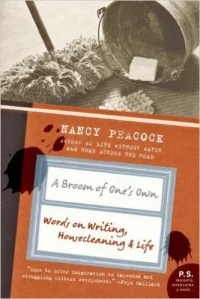
Review of a Very Very Very Very Very Good Book


I’m rereading novelist Nancy Peacock’s  memoir, A Broom of One’s Own: Words on Writing, Housecleaning & Life.  I liked the book when I read it the first time, sixteen years ago, and I like it even more now.

I posted the following review on my personal blog in 2009. The disclaimer preceding it is a reference to a recent FTC rule designed to “provide a robust framework that curbs unscrupulous practices in the book publishing industry. By prohibiting the creation, sale, or procurement of fictitious reviews, the FTC discourages the manipulation of the book review ecosystem.” Bloggers who occasionally posted reviews—”small-time” reviewers (like me), as it were—sometimes fulfilled their obligation by observing the letter of the law while frolicking with the spirit.

Where small-timers are concerned, the rule seems to have fallen by the wayside, and that’s a shame.  It stimulated creativity.

***

The backstory:

I wrote the following review to answer a “challenge.” I intended to post it at the end of September 2009. But in the process of writing, I got all tangled up in words and couldn’t finish even the first sentence.

I intended to post it at the end of October. I still couldn’t write it.

Finally, after telling myself I didn’t care, I managed to write it after the October deadline.*

In the middle of the “process,” I considered posting the following review: “I like Nancy Peacock’s A Broom of One’s Own very very very very very much.”

But the challenge specified a four-sentence review, and that was only one, and I didn’t want to repeat it three times.

So there’s the background.

I must also add this disclaimer: I bought my copy of A Broom of One’s Own myself, with my own money. No one told, asked, or paid me to write this review. No one told, asked, or paid me to say I like the book. No one told, asked, or paid me to like it. No one offered me tickets to Rio or a week’s lodging in Venice, more’s the pity. I decided to read the book, to like it, and to write this review all by myself, at the invitation of Story Circle Book Review Challenge. Nobody paid them either. Amen.

*********************************************

The review:

I like Nancy Peacock’s A Broom of One’s Own: Words About Writing, Housecleaning & Life so much that it’s taken me over two months and two missed deadlines to untangle my thoughts and write this four-sentence review, an irony Peacock, author of two critically acclaimed novels, would no doubt address were I in one of her writing classes.

She would probably tell me that there is no perfect writing life; that her job as a part-time house cleaner, begun when full-time writing wouldn’t pay the bills, afforded time, solitude, and the “foundation of regular work” she needed;  that engaging in physical labor allowed her unconscious mind to “kick into gear,” so she became not the writer but the “receiver” of her stories.

She’d probably say that writing is hard; that sitting at a desk doesn’t automatically bring brilliance; that writers have to work with what they have; that “if I don’t have the pages I hate I will never have the pages I love”; that there are a million “saner” things to do and a “million good reasons to quit” and that the only good reason to continue is, “This is what I want.”

So, having composed at least two dozen subordinated, coordinated, appositived, participial-phrase-stuffed first sentences and discarding them before completion; having practically memorized the text searching for the perfect quotation to end with; and having once again stayed awake into the night, racing another deadline well past the due date, I am completing this review—because I value Nancy Peacock’s advice; and because I love A Broom of One’s Own; and because I consider it the equal of Anne Lamott’s Bird by Bird; and because I want other readers to know about it; and because this is what I want.

*Not caring is often the key to cracking writer’s block. Nancy Peacock probably would say that, too.

The End of a Dream?

My first published story appeared in Analog: Science Fiction and Fact in 2012. Since about 2020, I’ve been making a concerted effort to land a story in that magazine’s sister mystery magazines, Ellery Queen Mystery Magazine (EQMM) and Alfred Hitchcock Mystery Magazine (AHMM). This has been my dream, my professional goal for years now. Thanks to changes in the industry, I may need to find a new goal.

Those who don’t follow the short fiction world may not be aware that a handful of the top paying professional mystery and science fiction magazines were sold to new owners in the last six months. Analog: Science Fiction and Fact, Asimov’s Science Fiction, EQMM, and AHMM were operated by Dell Magazines which was owned by Penny Press since 1996. The magazines were purchased earlier this year by Must Read Magazines, a division of Must Read Publishing, which is owned by Paragraph 1, Inc. Paragraph 1 also purchased The Magazine of Fantasy and Science Fiction which had been owned by Gordon Van Gelder since 2001.

What does that mean for readers?

So far, not much, other than a delay in the release of the latest magazine. My July/August issue of AHMM arrived this week, late under the previous publication timeline. The editors at the mystery magazines remain the same, which suggests that kinds of stories chosen for publication will remain the same.

What does this mean for authors?

Contract changes galore! UGLY ONES! The new owners have disposed of the old contracts, which were industry-standard short fiction contracts, and replaced them with new contracts that do not reflect the industry standard in any way.

The changes to the contracts are so extreme that authors are protesting loudly. Some, like Kristine Kathryn Rusch, have publicly announced that they will not be submitting to the magazines anymore and have pulled all pending stories because of failed contract negotiations. The Science Fiction and Fantasy Writers of America and Mystery Writers of America have both reviewed the contracts and entered negotiations on behalf of authors in hopes of improving the contract terms. Writer Beware has issued a warning statement on the contract terms, which included a waiver of moral rights and clauses covering production, merchandising, reprint, anthology, and other rights. The Submission Grinder formally delisted all of the magazines because of these “non-standard” contract terms.

In response, the owners of Must Read Magazines state that they are revising the contracts, supposedly replacing the moral rights waiver with other language. But even if that waiver is removed, the intellectual property rights grab involving production, merchandising, reprints, anthology, and other rights may remain.

This leaves me questioning what I should do. My last story in the queue at EQMM was recently rejected, but I have two stories submitted to AHMM right now. Do I leave them in the queue and see how negotiations play out? Do I pull them, as other authors have done, and submit them elsewhere?

If the top authors are pulling out, the quality of the magazines may decrease. Admittedly, my chances of getting a story published increase if others choose not to submit. But do I want to be in a magazine only because others decided the terms of the contract were too unfair? Does that make me a scab, willing to accept harmful terms out of desperation? Do authors stand a better chance of getting better terms if we all reject onerous contracts? We are all free-lancers with loose affiliations through memberships in writing organizations, not members of a union.

For now, this is all just a thought exercise about a dream, a goal I’d set for myself, a goal I may have to reset.

*****

N. M. Cedeño is a short story writer and novelist living in Texas. She is active in Sisters in Crime- Heart of Texas Chapter and is a member of the Short Mystery Fiction Society. Find out more at nmcedeno.com.