
JUST LOOK AROUND!

by HELEN CURRIE FOSTER

Not enough rain fell this year to allow the brilliant cerulean fields of Hill Country bluebonnets we usually expect, but the hardy lupines are busy making seedpods. “Maybe next year,” they say. Now instead we have the bright yellow coreopsis lanceolata, nodding their heads with any breeze,
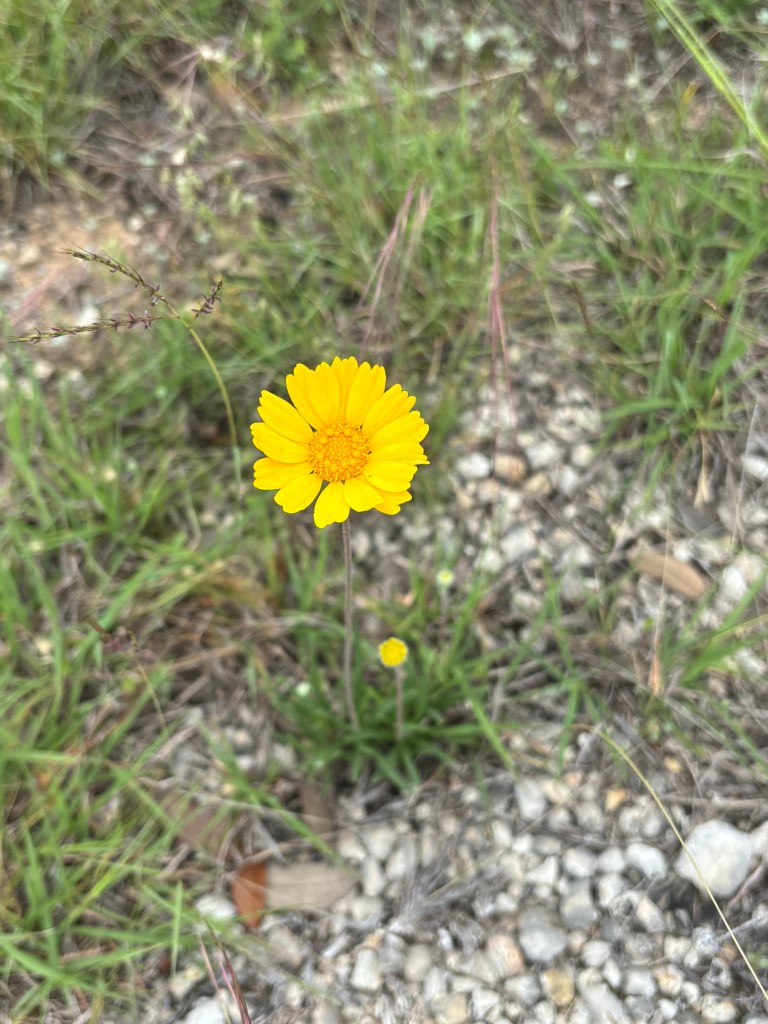
the wine-cups with their indescribable color—a member of the mallow family, not quite fuchsia, not maroon, just—heart-stopping,

the milkweed flower globes beloved of monarch butter-flies, and others. Heaven includes a few prairie celestials, magically opening in early in the afternoon, then vanishing by dusk.

Also, “Sweet Mademoiselle,” planted a couple of years ago, and who has never bloomed, produced her first rose!

Meanwhile, the ever-interloping cactus hope to assuage my fury at them (remember those secretly spreading roots and the huge basal “plates” that help the Cactus Conspiracy spread?) by popping open their yellow flowers. I am not fooled. I’ll continue to battle them with shovel and hoe. And a picker-upper.

Now for some Hill Country facts.

BIG CATS?  Just in case you thought the animal that appears in my mystery Ghost Cat was, perhaps, unrealistic? Over-the-top? Mere fantasy? Couldn’t have played a part at beginning and end? Not so! https://www.statesman.com/story/news/state/2025/04/21/mountain-lion-san-marcos-trail-texas-sightings/83194256007/

See? Perfectly possible. It’s still wild out here in the Hill Country, even as suburbs press upon us. At dusk I often find myself glancing at the edge of the drop-off behind the house, wondering if I’ll see a pair of ears. You can say mountain lion, puma, cougar…they’re secretive, strong, and active in the spring.

But the big cat I once saw on Bell Springs Road west of here was likely a large bobcat. I was alone, driving home from the post office. Up ahead a golden vision, spotted, walked slowly to the edge of the asphalt. I stopped. The cat stood, gazed at me, and after a breathless (for me) interval, gracefully turned and vanished through a fence into thick cedar. A magical moment. Every time I drive that road, I hold my breath, longing for one more sighting of something looking like this:

https://images.app.goo.gl/K9VMv8bW92CpoSacA

ANCIENT BONES? I wrote about old bones in my Ghost Bones (2024)—and now have learned that our Hays County police deal with ancient bones more often than you’d think. One resident recently called to report she’d found a skull in her firepit. The skull, with its lower jaw present, was obviously fairly old, but in an unexplained death Hays County is not permitted to send a body to the Travis County Medical Examiner without including the name of the person whose skull it is. (Hays County doesn’t have its own medical examiner.) So this skull traveled instead to Texas State anthropologists who reported, after testing, that the skull apparently belonged to a long, long-ago teenager who’d gone through hard times, as was evident from the “enamel lines” (a bit like tree rings) in the teeth.

But how it wound up in that firepit? So far as I know, that’s still a mystery. We forget—until reminded by a skull in a firepit—how long humans have roamed these hills, drawn by hunger and thirst to spring water and the hunt for food.

We also forget the age and history of this landscape. Some trees have sheltered native Americans, deer, and buffalo. The Columbus Live Oak near the Colorado River in Columbus is estimated to be over 500 years old. Others may be as old as 1,000 years.

https://tfsweb.tamu.edu/websites/FamousTreesOfTexas/TreeLayout.aspx?pageid=26882; https://goodcalculators.com/tree-age-calculator/

I revere the live oak in our front yard as if it were a beloved ancient relative and a symbol of stability and the power of trees. If anything were to happen to it—woe! I tried to estimate its age—using the calculator instruction to measure girth in inches at 4.5 feet, divide by pi, then multiply by a “growth factor” of 4, which gave me 127 years old. Perhaps this tree was a sapling in 1900, before either World War, before the Viet Nam war, before our current fraught politics. On a nearby hill there’s an ancient patch of even bigger live oaks. Perhaps those particular oaks depend on the odd little ribbon of wet white clay that lies about five feet underground and has been there—who knows how long. But the feeling of walking in beneath these old live oaks can confer a sense of being in the protection of one’s elders.  

So, welcome to the Hill Country in spring—southeasterly winds from the Gulf, blowing the flowers back and forth; reasonably moderate temperatures; fields and trees as green as green, as far as you can see. At the bird feeder, more color! Purple house finch, yellow-throated vireo, lesser goldfinch with brilliant gold breasts, vermilion cardinals, black-crested titmouse, white-winged dove—and the shy and tiny, but utterly gorgeous, painted bunting. (Reportedly it loves millet.) They provide not just color but music, from the titmouse, the tiny but high-volume Carolina wren, plaintive doves, whistling cardinals, and, at night, chuck-will’s-widow.

Not for long, of course. In winter ice can wreak havoc on trees and people. Summer sun? Scorching. Autumn? Nothing like the colors of New England, but hey—the sumac turns red. So welcome, Spring, with your bluebonnets and live oaks, with bird music and color, and with your reminder of the power and beauty of nature!

Progress report: madly working on Book 10 of the Alice MacDonald Greer Mystery series, set in the Hill Country. Have ordered “Forest Bathing” by Dr. Qing Li. Would enjoy hearing what you all are reading too, and any reports of “forest bathing”!

Helen Currie Foster lives and writes the Alice MacDonald Greer Mystery series north of Dripping Springs, Texas, loosely supervised by three burros. She’s drawn to the compelling landscape and quirky characters of the Texas Hill Country. She remains deeply curious about our human history and how, uninvited, the past keeps crashing the party.

Follow Helen at http://www.helencurriefoster.com.

CATHOLICISM, THE MUNDANE AND THE PROFOUND.

By Francine Paino, a.k.a. F. Della Notte

Monday, April 21, 2025. “Jorge Bergoglio,” the Camerlengo tapped Jorge’s forehead gently with a silver hammer and repeated his birth name three times. The Camerlengo received no response and declared Pope Francis, the 266th successor to Peter, dead.

Of course, in today’s world, medical devices inform the state of man’s being, but the Catholic Church retains many of its rituals, and this is one. After declaring Pope Francis deceased, his ring was taken and destroyed using a special hammer to ensure it could not be stolen and its seal reused—a practical as well as ceremonial action.

The world is aware that the leader of 1.4 billion Catholics is dead, and Peter’s seat is empty until a new Pope is elected by the College of Cardinals. The world will observe the beloved rituals and ceremonies of the highest levels of clergy in the Catholic Church, and perhaps at this time, it is fitting to observe the lives of those of us who live the everyday, less exalted existences. Enter author Jon Hassler.

Catholicism, love it or hate it, is filled with traditions. Even today, after so many of the rules, ceremonies, and rites have been watered down, Hassler shows how Catholics are still impacted by their faith and how the changes have been received or rejected. He infuses his characters with insights and the deeper longings of our souls, to be respected, needed, loved, and part of a community. Being Catholic, Hassler writes with great authority about the perspectives and outlooks of this group of fictitious Catholics in the fictitious town of Staggerford, Minnesota. And, of course, non-Catholics will recognize and relate to these people. But why do we read fiction?

We read fiction to escape. Great adventures, mysteries, romance, and Sci-fi. But why read a book about a cast of characters whose lives are nothing special? Lives like our own, possibly? One can read these books and identify with different characters, their likes, dislikes, and situations. The progressive, touchy-feely nun, Sister Judy Juba, her obnoxious but elderly father. He wants a wife, but not for companionship as much as someone to care for him. Janet, Randy, and their young children. Father Finn and French, the Vietnam veteran with lingering PTSD, Who are these people? They are us!

Like sleepwalkers, we often move through the repetitive routines of life with our eyes half open or sometimes closed, as do the characters in Hassler’s books. In A Green Journey, we are introduced to his small town and its residents as they work their way through days of routine, nothing-special tasks. They’re not Hollywood stars, singers, or men and women of great wealth or political power. What this core group has in common is they are all influenced by the rules and requirements of being Catholic, and they are influenced by a steadfast, and still devout Catholic heroine, Agatha McGee.

Agatha is a crusty, disciplined disciplinarian and an ‘old maid’ who wants the best for everyone. She’d taught most of them over decades in St. Isadore’s elementary school. Agatha is also an old-fashioned Catholic who voluntarily observes rules that had been relaxed by the Second Vatican Council, like not eating meat on Friday.

While she does her best not to become despondent over the changes in the church, the end of her teaching career, and her aloneness without a husband or children, she involves herself in the lives of other residents of Staggerford, including her dearest friend, Lillian Kite, Lillian’s daughter Imogene, Father Finn, the pastor at St. Isadore, and a host of others. They all slog through life’s ups and downs with Agatha’s advice and assistance – or interference, depending on the point of view. While doing her best to help her neighbors, Agatha begins an innocent long-distance pen-pal relationship with James O’Hannon, a kindred spirit, in Ireland. She pours out her heart and the troubles and opinions of the community to him. After five years and a mutual growing affection, she can travel to Ireland to meet him. That trip holds great surprises for our heroine and James O’Hannon.

In the second book, Dear James, Agatha is back in Staggerford after her trip to Ireland and continues to respond to James’s letters but doesn’t mail them. Instead, she saves his in her desk drawer, unsure if she will ever fully reestablish their communications. After Thanksgiving, Father Finn invites her to join a pilgrimage to Rome with him and his brother, a college professor. There, she reconnects with James. As they work through what their relationship can and cannot be, at home, in Staggerford, Lillian’s spiteful daughter, Imogene, invites herself into Agatha’s house, searches it and finds James’s letters. Imogine reads them and is furious by what Agatha wrote. She takes an evil delight in spreading the news that Agatha has been sharing unflattering gossip about the townspeople. Upon her return from Rome, Agatha is greeted by a chill worthy of the deepest Minnesota freeze. How will they rise above their hostilities? Can they come together again?

Hassler was a gifted writer whose ability to infuse what we’d consider the mundane with deep insights into the greater, profound life that each of us contains, is brilliant. As no two people on Earth have the same fingerprint, no two have identical soul prints. And therein, we find the truer meanings of the small, seemingly commonplace things in life.   

A New Woman is book three of the Staggerford Series. I look forward to reading about the later phases of Agatha’s 88-year life.

Until next time, Happy Reading.

Review: Ella Minnow Pea

by Kathy Waller

The quick brown fox jumps over the lazy dog.

Last week I re-posted about the difficulty I experienced trying to compose a blog post when my keyboard malfunctioned: I pressed a key, no letter appeared; I pressed another, no letter appeared. And so 0n. Communication broke down. But on a very minor scale. After an hour of teeth-grinding, I saw the humor. No harm done.

Resurrecting that post reminded me of a novel I read years ago: Ella Minnow PeA: a progressively lipogrammatic epistolary, by Mark Dunn. An epistolary novel, written as a series of letters and notes. In the society Dunn envisions, when  letters disappear, the events that ensue are funny. And not.

The book is set on the fictional island of Nollop, off the coast of South Carolina, and named for Nevin Nollop, author of the sentence, The quick brown fox jumped over the lazy dog. Islanders have honored Nollop with a cenotaph bearing his famous sentence. Leaders of Nollop, which declared its independence from the United States in 1870, have “sought to uplift its black and white citizens through almost monastic devotion to liberal arts education and scholarship, effectively elevating language to a national art form, while relegating modern technology to the status of avoidable nuisance.” Life is good.

Trouble begins when the tile displaying the letter Z falls from the cenotaph and shatters. Residents wonder why. Nineteen-year-old Ella Minnow Pea   thinks it’s only logical–after a hundred years, the glue gave way. She recounts the events that ensue in a letter to her Aunt Tissie.  The Council, suspicious of everything since a “predatory armada” of land speculators from the United Stated tried to buy real estate and turn the island paradise into a tourist trap,  rejects offers to repair and reattach the tile; instead, they meet long and often, seeking to “grasp sign and signal” from the loss. Their decision:

the fall of the tile bearing the letter “Z” constitutes the terrestrial manifestation of empyrean, Nollopian desire, that desire most surely being that the letter “Z” should be utterly excised–fully extirpated– absolutely heave-ho’ed from our communal vocabulary.

Nollop has spoken from beyond the grave. Z is forbidden.

Penalties for speaking or writing any word containing the letter, or for possessing written correspondence containing it, range from a public oral reprimand to death.

Nollop’s sentence now reads,

The quick brown fox jumps over the la*y dog.

Letters fly from niece to aunt to cousin and back, discussing preparations for the Day the law goes into effect. Children under the age of seven will receive special dispensation to use the letter. But Uncle Zachary will have to be called Isaac;  Zeke has applied to change his name to “Prince Valiant-the-Comely.” It could be worse. Maybe.

But islanders will no longer speak of “the topaz sea which laps our breeze-kissed sh0res” or of “azure-tinted horizons.” Nor will they order frozen pizza or booze, or waltz, or see Tarzan movies, or wheeze and sneeze, or recognize hazardous organizations of zealots . . .

Minutes before the midnight deadline, the clear-sighted Ella writes, “Immobilized we iz. Minimalized. Paralyzed.” And, “CRAZY.”

That’s just the beginning. Soon a second letter falls. Then a third.

Day by day, the alphabet shrinks, taking the vocabulary with it. Oddly enough, getting to the point now requires more words, and characters struggle to find synonyms. Under normal circumstanced, they would consult the thesaurus. But when Z was banned, so were all books.

Conditions deteriorate. Penalties are assessed; punishment is swift. The Council, certain it knows the will of Nollop, tolerates no opposition.

Before long, islanders wake up to the fact the Council has gone from banning one letter of the alphabet to banning the right to free expression.

After all, what can be said using only three consonants and one vowel? The islanders have no language. How can people forbidden to use language assert their rights? How can a government forbidden to use language deliberate or explain its actions? But since the government’s actions  have caused the island go descend into chaos, perhaps it prefers to do neither.

It does, h0wever, offer dissidents one hope: prove that Nollop is not omniscient and all twenty-six letters of the alphabet will be restored. There’s only one method of proof, and it’s an impossible task, but Ella Minnow Pea accepts the challenge.

The book starts as a comedy, a farce, a romp through the ridiculous, wordplay at its best. But beneath the surface, it’s dead serious. Wikipedia highlights three themes: totalitarianism, freedom of  speech, and good citizenship vs. freedom. I would add freedom of th0ught. Without words, how can you think?

Publisher’s Weekly calls Ella Minnow Pea “a novel bursting with creativity, neological mischief and clever manipulation of the English language.”

School Library Journal says it’s “perfect for teens fond of wicked wit, wordplay, and stories that use the absurd to get at the serious.”

I say, I have no more words, except these: Ella Minnow Pea is a funny book. A timely book. An important book. Read it.

*

Ella Minnow Pea  is sometimes subtitled  A  Novel without Letters.

  • *

Kathy Waller (aka M.K. Waller) writes crime/suspense fiction, literary fiction, humor, and whatever else comes to mind. Her stories appear in anthologies and online. She’s co-author of the novella STABBED, written with Manning Wolfe. Currently, she’s working on a who-dun-it set in small-town Texas. A native of such a town (minus murders, of course), she lives in Austin. She no longer has two cats but is happy to still have one husband.

***

Cover of Ella Minnow Pea via Amazon
Image of fox by Yvonne Huijbens from Pixabay
Image of bulldog by Pitsch from Pixabay
Image of keyboard by tookapic from Pixabay
Image of pizza by Mian Shahzad Raza from Pixabay

My Keys Won’ Work


by Kathy Waller


It’s been quite a while since I posted,* and I should wait until my turn rolls around again. But today a fellow Wretch shared something that had happened to her, and that reminded me of something that happened to me, and this is an Open week on ISW, so I decided to share what my friend’s remark reminded me of. Right now. Before I forget.

This is a repost of a repost of a post I wrote for Telling the Truth, Mainly in 2010, using my first laptop.  A monster Dell, it weighed at least fifty pounds, or seemed to at the time, but I loved it and lugged it everywhere. My introduction to coffee-shop writing, it was a sort of movable feast. But—there was one little problem. Two or three times. Read on.

*


INTRO, PART 2

While I was writing a post one evening, my laptop keys stopped working–one at a time, in no particular order. No matter how hard or in which direction I tapped, they didn’t depress, and nothing appeared on the screen. I considered giving up, then decided to keep a-goin’. The next day, I called technical service, was told I could replace the keyboard myself, visited Radio Shack for tools, used them, nearly stripped a screw, called tech service, received a visit from a tech, and got a quick fix.

An easily replaceable keyboard isn’t usually much to worry about, but in my keyboard’s case, there were extenuating circumstances. I was afraid something beneath the keyboard might be causing the malfunction, and that the tech might think so too. He might know how it got there and give me a look of reproof, possibly a mild reprimand. He might even sneer.

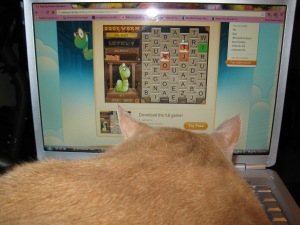
William Davis & Bookworm

I would have to stand there, blushing, and take it. My innate honesty would prevent me from saying my husband did it.

To learn why I would have blushed, you’ll have to read to the end.

Hint #1 : A single e might mean tech. But it might not. An a might mean a, or not.

Hint #2: The thing I was afraid was under the keyboard–it wasn’t cat hair. Cat hair wouldn’t have made me blush.

Hint #3: Don’t sweat the small stuff. Whatever you don’t get is small stuff. You’ll get the drift.

Hint #4: If you’re tempted to stop, please, at least skim to the end. I’ve added a translation of the last few lines. Last lines are usually important, and I’d like these to be understood. In addition, I managed to throw in a couple of words from Hamlet. 

Well, finally, here’s the post.

*****

THE POST

Wa do you do wen your keyboard malfunions?

Wen my spae bar sopped working, I aed online wi Dell e suppor.  e e old me I would reeie a new keyboard in e mail. I was supposed o insall i.

“Me?” I said. “Insall a keyboard?”

e e said i would be a snap. If I needed elp, e would walk me roug i.

I go e keyboard and looked up e insruions, wi said I ad o unsrew e bak. I jus knew I would be eleroued.

Bu I boug a se of srewdriers a RadioSak and flipped e lapop oer, remoed e baery, and aaked e srews.

e srews wouldn’ budge. I exanged a srewdrier for anoer srewdrier. I used all six. None of em worked.

I wen online again o a wi Dell. e e lisened, en old me o ry again.

I oug abou e definiion aribued o Einsein: Insaniy is doing e same ing oer and oer and expeing a differen resul.

“I wouldn’ urn,” I old e e.

He said e would send a e ou o e ouse o insall e keyboard for me. (I’m no dummy. Wen I boug e lapop, I boug a e o go wi i.)

Anyway, e nex day a e ame. He go ou is se of 3500 srewdriers, remoed e srews, ook off e old keyboard, and insalled e new one. He said I didn’ ave e rig size srewdrier. en e asked wa else I needed.

“I know you don’ ae an order for is, bu ould you wa me insall is exra memory a Dell e said I’m ompenen o insall myself?” He said e’d o i for me. I oug a was ery swee.

Anyway, i’s appened again, exep is ime i’s more an e spaebar. I’s e , , , and  keys.

I’e used anned air. So far all i’s done is make ings worse. Wen I began, only e  key was ou.

How an I wrie wiou a keyboard?

So tomorrow I’ll chat with my Dell tech and—

Well, mercy me. I took a half-hour break and now all the keys are working again. I wonder what that was all about.

Nevertheless, I shall report the anomaly. Call me an alarmist, but I don’t want this to happen a third time. I might be preparing a manuscript for submission. I’m being proactive.

But still—I’m torn. If I do need a another new keyboard, I want a tech to make a house call. I don’t have the proper screwdriver, I don’t know what size screwdriver to buy, and I don’t want to tamper with something that is still under warranty.

On the other hand, I have to consider the worst-case scenario: The tech takes out his screwdriver, loosens the screws, turns the laptop over, removes the keyboard, and sees lurking there beneath the metal and plastic plate the reason for my current technical distress: crumbs. 

And—sneer—”Been eating Oreos while you type, huh?”

e same, e earae, e disgrae a being found guily of su a soleism. e prospe is oo illing o spell ou.**

Bu for the sake of ar, I sall submi myself o e proud man’s onumely. omorrow I sall a wi Dell.***

[TRANSLATION OF ** and ***, ABOVE}

The shame, the heartache, the disgrace at being found guilty of such a solecism. The prospect is too chilling to spell out.

But for the sake of art, I shall submit myself to the proud man’s contumely. Tomorrow I shall chat with Dell.

***

I intended to wrap things up with a brief book review, but enough is enough.  I’ll save the review for next time. Anyway, the book is too good to be an add-on. It deserves to have a space all to itself.

***

Image of keyboard by Simon from Pixabay

Image by Michael Schwarzenberger from Pixabay

Image of William Davis playing Bookworm by MKW

*

Kathy Waller (aka M.K. Waller) writes crime/suspense fiction, literary fiction, humor, and whatever else comes to mind. Her stories appear in anthologies and online. She’s co-author of the novella STABBED, written with Manning Wolfe. Currently, she’s working on a who-dun-it set in small-town Texas. A native of such a town (minus murders, of course), she lives in Austin. She no longer has two cats but is happy to still have one husband.

*Kathy wishes she could say she’s been too busy doing Good Works to post,  but she hasn’t, and she doesn’t believe in telling fibs, and nobody who knows her would believe the Good Works story anyway. She’ll say only that she’s been on hiatus.