When Disinformation Leads to Death

N.M. Cedeño

Here in Texas over four hundred people have contracted measles in the past few months, resulting in the death of at least one child. Most of these cases were preventable with a vaccine. So why weren’t the victims immunized? Some are infants, too young to be vaccinated. A few may be people with compromised immune systems or other medical conditions that prevent them from receiving vaccines. However, the majority aren’t vaccinated because of conspiracy theories and false information being fed to parents, making them fear the vaccine.

Back in the 1990s, a British doctor, whose medical license was later revoked because of the medical hoax he perpetrated, falsified a study claiming to have identified a causal link between the vaccine for measles, mumps, and rubella, (the MMR vaccine) and autism. He published a massive lie that spread like wildfire and caused vaccination rates in Europe and the United States to plummet. By the time the fraud was revealed, the damage had been done.

As a parent of a child on the autism spectrum, I am absolutely certain the MMR vaccine did not contribute to the condition. I spotted variances in my child’s development by the time he was six months old. I knew something was different about the way he did and did not focus on motion months before he was given his first MMR vaccine. No vaccine caused his neurological differences. The most likely cause is a complex interaction of genetic factors.

Measles and rubella are not diseases that should ever be allowed to spread unchecked. Measles can kill, and when it doesn’t kill, it can obliterate the patient’s immune system, leaving them susceptible to a variety of infections. In countries where vaccination rates for measles are low, children who survive measles frequently die of other illnesses within a short time after having measles. Measles is also one of the most contagious diseases in the world, able to linger on surfaces and in the air for hours after an infected person has left the area.

William Morrow Paperback, reprint edition cover 2004

Rubella, depending on the stage of a woman’s pregnancy when she contracts the disease, can cause blindness, deafness, heart deformities, developmental abnormalities, and death for babies. Many infants only survive a short period after birth due to the damage caused in utero by rubella, also known as German measles. A well-known example of the harm caused by rubella was the case of actress Gene Tierney’s daughter, Daria, which inspired Agatha Christie’s novel The Mirror Crack’d from Side to Side.

Growing up, I heard the story of my uncle’s birth from my grandmother more than once. She contracted rubella while pregnant and decided not to go to the doctor for her check up that month because she knew that the doctor would push her to abort. In 1950s America, doctors saw so many deaths of newborns caused by rubella that they frequently advised a mother to abort if she contracted rubella while pregnant.

My grandmother made a choice, believing one should always give life a chance, knowing that her baby might not survive. My uncle was born at around three pounds, his growth and development stunted by the disease. He was deaf in one ear, had heart problems, had very poor vision, and only grew to about five feet tall. But he survived and lived to the age of 70, managing to get a driver’s license, go to community college, and work a variety of jobs.

As a parent, I have met other parents who chose not to vaccinate their kids. That decision, made by otherwise intelligent and educated people, still shocks and disheartens me. Reading that the parents of the child who died from measles still say that they wouldn’t have vaccinated their child scares me. How could they possibly think that the vaccine is somehow worse than the death of their child?

This current measles crisis is yet another example of conspiracy theories and false information being promoted over facts and truth to the detriment of society. Disinformation campaigns, conspiracy theories, and the current general distrust of any authority inspired me to write my latest story, entitled “Murder by Alternate Facts.” In the story a young woman named Arlene stumbles upon a wreck on a lonely country road and is forced to make a choice affecting who lives and who dies. The repercussions of Arlene’s choice inspire conspiracy theories, dividing her hometown and leading to murder.

“Murder by Alternate Facts” appears in the Murderous Ink Press anthology Crimeucopia: Chicka-Chicka Boomba! from editor John Connor.

*****

N. M. Cedeño is a short story writer and novelist living in Texas. She is active in Sisters in Crime- Heart of Texas Chapter and is a member of the Short Mystery Fiction Society. Find out more at nmcedeno.com.

Words, words, words . . .


By Dixie Evatt


Words, words, words . . .
~ Shakespeare

Before we had powerful computers in our pockets or on our laps, we had reference books. . . shelves and shelves of them.

One of my favorite possessions is a vintage Webster’s dictionary, published 1956 – when I was 10 years old. All 11-plus pounds of the five-inch-thick book teeter on a top shelf in my office. I can no longer safely lift it and the pages are laid out in three columns of typeface so tiny that my aging eyes strain to make out the words.

My book is a holdover from the days when library dictionaries were housed and opened on a specialized wooden lectern. I wonder, do libraries still have these throwbacks to that bygone day or have the enormous books all made their way to the shredder?

I never look at mine that I’m not reminded of the 1950s movie, Born Yesterday, starring Judy Holliday. She won an Oscar for her portrayal of the brassy girlfriend of an uncouth tycoon. Her character tries to overcome her limited education and rudimentary vocabulary by reading, among other texts, Alexis de Tocqueville’s Democracy in America. In one of the more humorous scenes, she struggles to make meaning of the archaic text and is advised to simply check the dictionary if she encounters any words she doesn’t understand. The increasingly frustrated Holliday would no more than read a sentence before she is up again, consulting a dictionary. Word by word. Trip by trip. Written today, the scene would surely lose its charm since she would likely be reading Tocqueville on a Kindle where all you must do is press and hold a finger on a word for the meaning to flash before you.

Like Holliday with a Kindle, writers don’t have the need for shelves full of reference books since language prompts are everywhere from the demons in autocorrect to the drop-down menus in word processing programs that produce synonyms.

The 19th Century French author Jules Renard is credited with saying, “What a vast amount of paper would be saved if there were a law forcing writers to use only the right word.

Yet, finding the right word isn’t always so easy even with all our modern assets. Luckily there are still some reference sources to help. Here are a few:

Evan Esar’s “20,000 Quips & Quotes: A Treasury of Witty Remarks, Comic Proverbs, Wisecracks and Epigrams.” If she’d thumbed through this one, Holliday would have learned that Tocqueville said, “The last thing a political party gives up is its vocabulary.”

“The Allyn & Bacon Handbook” by Leonard J. Rosen and Laurence Behrens. You must love any book that is willing to devote 22 pages to the uses and misuses of the comma alone.

Theodore M. Bernstein’s “Dos, Don’ts & Maybes of English Usage.” For instance, he explains why Mark Antony didn’t say “Friends, Romans, countrymen, loan me your ears.”

“Describer’s Dictionary: A Treasury of Terms & Literary Quotations,” by David Grambs and Ellen S. Levine. It indexes illustrative passages of more than 600 authors from travel writer Paul Theroux to contemporary British novelist Zadie Smith.

Eli Burnstein’s “Dictionary of Fine Distinction Book,” offering a humorous look at often misused words and phrases. For instance, couch vs. sofa.

Valerie Howard’s “1,000 Helpful Adjectives for Fiction Writers,” promises to spice up characteristics, qualities or attributes of a noun when a writer is having trouble capturing just the right word.”

Bill Bryson’s “Dictionary of Troublesome Words: A Writer’s Guide to Getting it Right” sets out to decipher the idiosyncrasies of the English language. Things such as 126 meanings of “set” when used as a verb and another 58 when used as a noun.

Brian Shawver’s “The Language of Fiction: A Writer’s Stylebook.” Need to be reminded when to use a comma or semicolon? Shawver’s there to help.

Kathy Steinemann’s “The Writer’s Lexicon: Descriptions, Overused Words, and Taboos.” Among other things, she offers writers cures for overused modifiers (I’m talking about you “very”).

John B. Bremner’s “The Columbia Dictionary for Writers: Words on Words.” Here you can learn the history of H. L. Mencken’s inspiration for coining the term “ecdysiast” to replace “striptease.”

Christine Lindberg’s “The Oxford American Writer’s Thesaurus.” Writing about bread? How about a baker’s dozen choices: dal, pita, rye, naan, tortilla, focaccia, ciabatta, challah, corn, sourdough, pumpernickel, baguette, etc.

“Associated Press Stylebook and Briefing on Media Law” has been found on the desk of every journalist for decades since it dictates uniform rules for grammar, punctuation, style for capitalization and numbers, preferred spelling, abbreviations, acronyms, and such.

“Words, words, words,” is the sarcastic response Hamlet gave when Polonius asked him what he was reading. Fortunately, authors still have no shortage of excellent reference books to help them find the right ones.

***

A former political reporter in Austin, Dixie also taught writing at Syracuse University. When she teamed up with Sue Cleveland to write fiction, they sold a screenplay to a Hollywood producer. Although the movie was never made, the seed money financed ThirtyNineStars, their publishing company. Through it they published two award-winning thrillers (Shrouded and Digging up the Dead) under the pen name, Meredith Lee. Dixie’s first solo mystery was Bloodlines & Fencelines, set in a tiny Texas town near Austin. Kirkus reviews described the book as, “A twisty whodunit that’s crafted with care and saturated with down-home Southern charm.” She is working on second mystery in the series. www.dlsevatt.com

***

Image of dictionary by PublicDomainPictures from Pixabay

Publicity photo of William Holden and Judy Holliday for Born Yesterday via Wikipedia

Image of tablet  by Gerd Altmann from Pixabay

EQUINOX!

by Helen Currie Foster

March 14, 2025

“An excess of animal spirits”–springtime! Really? Molly Ivins was right as usual when she wrote, “Texas–land of wretched excess!” We’ve had ridiculous lows, unseen for decades. Early daffodils and hyacinths came, shivered, and shriveled in the unholy cold winds roaring across the plains. But we’ve also had the earliest 90 degrees in decades! Wretched excess indeed!

Just two days until the vernal equinox on March 19, and spring. What makes us wander outside, searching for the first bluebonnet, the first violet? What makes us huddle outside the garden store, searching through the little plants shivering in the breeze, fingering seed packets, carrying home small pots of basil and blue salvia even though the weather’s far too untrustworthy for planting? What is this proto-agricultural spirit that makes us lug home the potting soil, hoe the garden bed? More sunlight? Cabin fever? Some early human gene? We, the Animal Kingdom, working with the Plant Kingdom?

I’m rereading Barry Cunliffe’s Europe Between the Oceans: 9000 BC-AD 1000 (https://amzn.to/3RfJzj6), a book I value not just for the stunning photographs of prehistoric sites and art, but for describing a history of human inventiveness. Cunliffe, Oxford Professor Emeritus of Archeology since 2007 (many books–– https://bit.ly/3XZkmNA), says “massive transformation” occurred in Europe between 1300-800 BC. Population growth required developing more crops than wheat and barley, including lentils, peas and—“the celtic bean (Vicia faba).”

Immediately I ordered a giant pack of fava bean seeds.

This image has an empty alt attribute; its file name is img_0981.jpg

Then I read the label: they’re mostly a winter crop–but this year I’m desperate. With last year’s blistering hot drought, I wound up with only one pot of cherry tomatoes on the porch and a dozen wilting jalapeno plants in the garden. Cunliffe’s reference to Vicia faba fired my imagination—envisioning myself harvesting large fuzzy green pods, containing delectable beans, and adding a little vinaigrette…olive oil (since 4000 BC) and vinegar (3000 BC). Using an ancient bean and ancient vinaigrette recipe! Possibly those beans were harvested, and the vinaigrette shaken, by some long-ago ancestor 3000 years ago, making me wonder if we have genetic preferences, genetic recipe roots? After all, we of the Animal Kingdom depend on the Plant Kingdom (oxygen, vinaigrette, and wine!).

Mysteries offer escape—a protagonist we like, an intriguing plot, a vivid setting. Like plants, favorite old mysteries offer much when we revisit. Mystery writers? They’re good to “talk to.” This morning I discovered on the shelf my dad’s 1934 Modern Library edition of Dashiell Hammett’s The Maltese Falcon, with a brief bio and the “new introduction” by Hammett.

This image has an empty alt attribute; its file name is img_0980.jpg

I didn’t know Hammett had worked as an operative for Pinkerton’s Detective Agency before he started writing! “Drifting through a miscellany of ill-paid jobs, he found a temporary solution to his economic problem by shadowing real malefactors with what might be called conspicuous success.” Then came the World War: “He won a sergeantcy and lost his health.”

Hammett can remember where he got his characters. Here’s a snippet of what he says about The Maltese Falcon:

“Dundy’s prototype I worked with in a North Carolina railroad yard; Cairo’s I picked up on a forgery charge in Pasco, Washington, in 1920; Polhous’s was a former captain of detectives…Effie’s once asked me to go into the narcotic smuggling business with her in San Diego…”

Hammett then muses about his own protagonist. “Spade had no original. He is a dream man in the sense that he is what most of the private detectives I worked with would like to have been and what quite a few of them in their cockier moments thought they approached. For your private detective does not—or did not ten years ago when he was my colleague—want to be an erudite solver of riddles in the Sherlock Holmes manner; he wants to be a hard and shifty fellow, able to take care of himself in any situation, able to get the best of anybody he comes in contact with, whether criminal, innocent by-stander or client.”

What a great description, and didn’t Humphrey Bogart nail it?

It strikes me that this new character of his upended the vision of the members of the London 1930 Detectives Club—Hammett gave the wide-eyed mystery audience a protagonist who is not a secret member of the aristocracy (Albert Campion) or a perfect gentleman (Roderick Alleyn) or a hyper-particular French veteran drinking tea and waxing his moustache (Hercule Poirot)…but a “hard and shifty fellow…able to get the best of anybody.” Welcome to the New World’s new-style mystery protagonists, the children of Hammett, Raymond Chandler, Sara Paretzky and others…including that hybrid protagonist, Mary Russell, in Laurie King’s Mary Russell and Sherlock Holmes series.

For Mary Russell and Sherlock Holmes, the scent of honey is a repeat theme (her Holmes is a beekeeper). I like her Holmes, I like her Russell, and just finished her Garment of Shadows (2012). https://bit.ly/4iTwmYZ King has chosen a fascinating and ambitious setting: the 1920’s, with Spain and France fighting for control of Morocco, each coveting its crucial strategic location at Gibraltar, while various Moroccan groups—Berber and otherwise—fight for independence. King uses first person point of view for Mary Russell, who’s suffering from acute amnesia—forgetting her childhood and even her marriage––but uses third person POV for Holmes’s chapters. Those shifts sometimes confused me. But her depth of history and geography, and her vivid descriptions of the magical city of Fez with its souk, bring the setting alive. Mary Russell herself has become quite a protagonist, with linguistic skills—including Arabic––and the imagination and drive to devise a daring escape from a horrible prison. I’d like to learn knife-throwing like Mary Russell (she keeps one in her boot) but the likelihood seems dim.

Writer/theologian Bruce Reyes-Chow mentioned how, when stuck, he’d “talk through ideas with myself, my plants…” I intend to follow his lead. On our deck sit five jasmine plants we’ve toted around since the seventies. I think they sometimes do communicate with me—“I’m dry-y-y-y!” But from now on, when I’m stuck on a plot, I’ll go consult them. Every spring, those jasmine produce tiny white flowers with an unmatchable scent. In search of even more scent, this year I’ve planted another mix of old and new. Rose de Recht is a fragrant pink heirloom damask, Fragrant Blush promises pink perfume, and Star of the Republic is tough, like her name, but delicate pink with exquisite fragrance.

This image has an empty alt attribute; its file name is img_0978.jpg

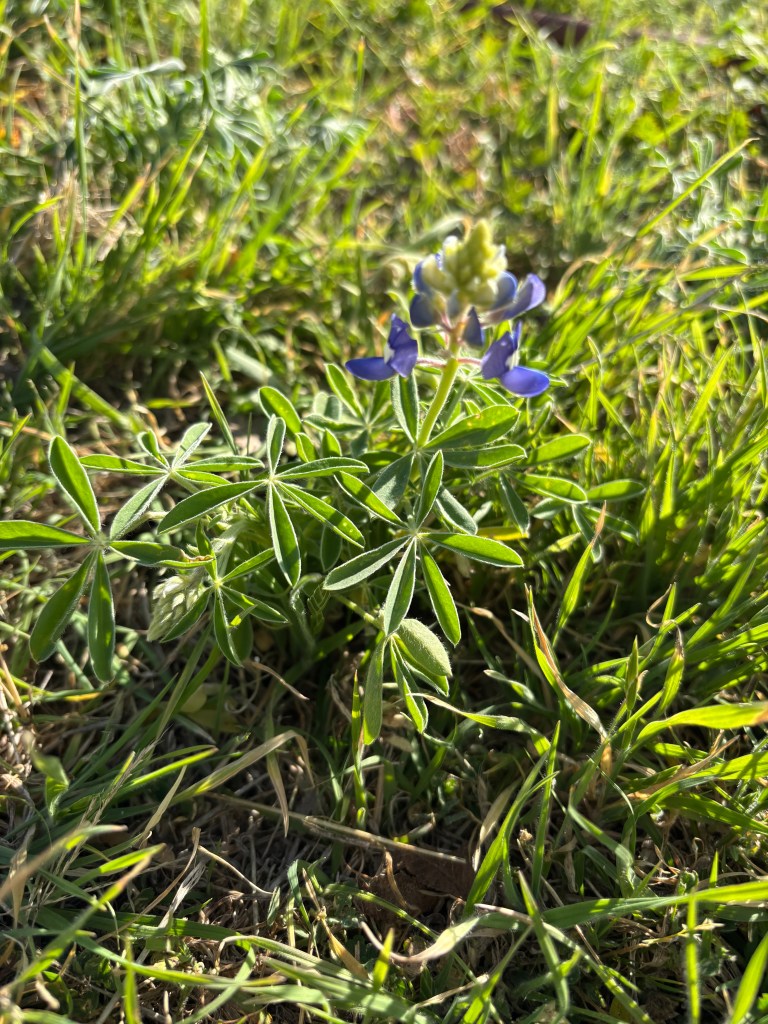
And now suddenly the redbuds, with their irresistible yet evanescent fuchsia buds, are blooming. I’ve seen our first bluebonnet,

This image has an empty alt attribute; its file name is img_0974.jpg

and the first purple prairie verbena. The live oaks know it’s almost the equinox—they’ve flung down their old leaves (aided by the fierce winds) and are preparing their catkins and baby leaves. The cedar elms have put out tiny chartreuse leaves just in the last two days.

This image has an empty alt attribute; its file name is img_0973.jpg

So it’s spring! Grab that trowel! And after all your work, you deserve to loll on the couch at night with a good mystery. I’m halfway through the tenth book in my Hill Country murder mystery series. This one raises a question I find intriguing and difficult. Can justice be served when, unauthorized to pronounce justice, we take justice into our own hands? Is that still justice? I’m discussing it with the plants. More to come….

This image has an empty alt attribute; its file name is img_1776.jpg

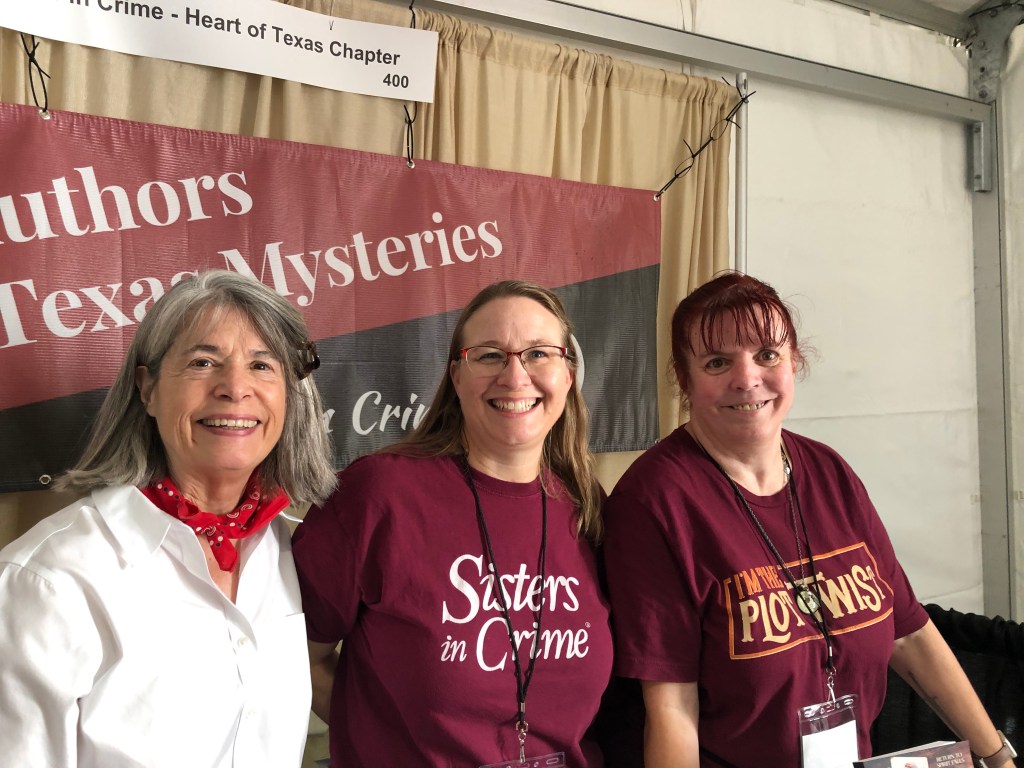
Here are Helen, Noreen Cedeno, and Juanita Houston at the Texas Book Festival!–Heart of Texas Sisters in Crime

Award-winning Helen Currie Foster lives and writes the Alice MacDonald Greer Mystery series (9 volumes so far) north of Dripping Springs, Texas, loosely supervised by three burros. She’s working on Book 10. She’s drawn to the compelling landscape and quirky characters of the Texas Hill Country. She’s also deeply curious about our human history and how, uninvited, the past keeps crashing the party.

Follow her at http://www.helencurriefoster.com and at https://www.amazon.com/stores/Helen-Currie-Foster/author/B00R1X9RXK?https://www.facebook.com/helencurriefoster

WRITING CHARACTERS’ EMOTIONS

BY

Francine Paino, a.k.a. F. Della Notte

People don’t stand or sit like stone statues, unless there’s a reason. They move, breathe, and respond to situations with emotions, internally and externally, and so they should in stories. Thus, the author must find words to bring the reader into the character’s heart and mind. Writers spend hours thinking about what their characters are feeling. How do we show the reader those emotions?  Eyes are one of the most popular tools to convey feelings.

Yes, those spherical bodies of different shapes, colors, and densities are called the windows of the soul. Thousands of pages have been dedicated to the power of the eyes.  There are hundreds, of eye expressions, including wild, frightened, gooey, flinty, evil and the list goes on. Each one of those words or phrases evokes a sense of the person’s feelings. For a writer, those eyes may be a windows of the story. But wait— Are they enough? How else may we show a character’s emotions?

Body language is one. He slouched, lowering his eyes. That may indicate disappointment to the reader. She flung her long blond hair back over her shoulder and lifted her chin. Conceit? Defiance? It could be either, depending on the scene. However, there is another often overlooked part of the body that exhibits emotions: hand gestures.

Hand gestures may emphasize words, or be used in place of words. Communication experts have recently added hand gestures to the lexicon of terms revealing emotions and thoughts.

An NIH, National Library of Medicine, 2014 article on gestures’ roles in speaking, learning, and creating language concludes, “gestures provide both researchers and learners with an ever-present tool for understanding how we talk and think,” and hand gestures are used in many cultures and societies.

In Around the World in 42 Gestures, we travel with examples of hand motions and their meanings and learn reasons to familiarize ourselves with them when visiting foreign lands. While polyglots speak many languages, for the majority, some prep time learning a few regional hand gestures would be easier and more effective than trying to master language skills. With hand gestures, one can say a lot with one move instead of struggling through vocabulary, grammar, and pronunciation combinations, and it would be wise to understand if a positive Western gesture isn’t welcome in a foreign land. For example, the gesture we use—crossed fingers to wish good luck, in Vietnam is an anatomically-themed insult.

Tapping your forehead with bunched fingers in Peru means, “I don’t get it. I’m not smart enough, and in France, touching your index finger below the eye indicates, “I don’t believe you.” Moving on to Spain, passing your forefinger and middle finger (V formation)  down your face from your eyes indicates, “I’m broke.” Moving east to Russia, pulling your left hand behind your head and scratching your right ear, says, “This is getting too complicated.” Indeed, that is the right gesture for such a sentiment.

Coming back west, we end our short tour in Italy, a country one cannot visit, in reality or in fiction, without understanding the loaded meanings of at least some of the gestures so common in Italian culture.

Italians are universally known to incorporate hand movements with words and often in place of them. The Italian Language Center identifies roughly 250 hand gestures that are part of Italian conversations. Why so many?

Theories suggest that the iconic hand gestures result from a long history of Italy being invaded by many nations that imposed their languages, cultures, and mannerisms. From the Ancient Greek colonization along the Mediterranean coast to subsequent invasions by the Carolingians, Normans, Visigoths, Arabs, and Germans, these hand gestures developed as a means of communication among people with no common language – and have stuck around ever since. The hand gestures may have sprung up to ease communication.”

Although many of these motions vary by region, among the most common and generally understood by all are bunching all five fingers on one hand and bringing them to the lips in a symbolic kiss, which expresses appreciation for any masterpiece, even in cooking.

There is one Italian gesture, however, one should use sparingly, if at all. Holding four fingers together and swiping them outward from under the chin can mean, “I don’t give a damn,” but it also has a ruder meaning. As a visitor to Italy, I think it’s best not to test that one.

In book four of the Housekeeper Mystery Series, Murder in the Cat’s Eye, Father Melvyn and Mrs. B. take a group of eccentric parishioners to Rome to learn about the lives of the earliest Christians. In this adventure, the reader will encounter the quirks of the travel group that could land them in the hoosegow, a series of crimes that engulf the unsuspecting travelers from Austin, Texas, an Italian detective, and several characters who are not what they seem. It will serve the reader well to understand the hand motions that are part of Italian communications. Perhaps this book will require a glossary of gestures.

Buon viaggio e buona lettura.

 (Have a good trip and happy reading.)

https://www.worktheworld.com/infographics/around-world-42-hand-gestures,

https://pubmed.ncbi.nlm.nih.gov/22830562/