THE POWER OF THE UNKNOWN

by Francine Paino, a.k.a. F. Della Notte

Readers, what’s your pleasure? Do you prefer romance, adventure, family sagas, historical fiction, or fantasy? The list goes on and on, but in most cases, the mystery of not knowing what will happen is a strong underlying driver of any story.  

Revelations in any genre can be uplifting or not. It may be frightening, too, but the power of the unknown draws us. In the words of Albert Einstein, in his essay The World as I see it, “The most beautiful experience we can have is the mysterious. It is the fundamental emotion that stands at the cradle of true art and true science.”  Read the full quote of Einstein’s essay, The World as I See It. https://history.aip.org/exhibits/einstein/essay_text.htm#:~:text=%22The%20most%20bbeautiful%20experience%20we,and%20his%20eyes%20are%20dimmed

Even simple, everyday decisions contain elements of the unknown.  Before we contemplate the mysteries of the universe, or at least of the day, we wonder what should we eat for breakfast? What outfits should we wear?  And even those close-in unknowns can sometimes create a sense of wonder when we decide.  A new recipe that tastes surprisingly good. An outfit that is more flattering than expected. We can wonder if something out of the ordinary will happen to us today? Will we meet someone new? What new experiences will we encounter? Will we learn anything new and valuable before we lay our heads down at the end of this day? 

Each of us has our own never-ending list of conscious and unconscious questions. And our wonderment is not limited to the higher questions of life. A little gossip goes a long way. We often enjoy the delicious anticipation of learning the answers to other people’s secrets. That’s why exposés of celebrity lives are so popular. And that’s the stuff novels are made of. 

Bestselling author Nikki Erlick takes a unique approach to creating suspense in her book, The Measure, which is not a mystery.   She presents the lives of eight individuals in a world of 7.9 billion people. Their days begin like any other, except that all over the world, everyone over the age of twenty-two wakes one morning to find a mysterious, little wooden box at their front doors, addressed and waiting for them whether they live in a tent, an apartment, or a house.  Inside these boxes are strings of varied lengths, representing the time left for each recipient to live.  The first response is, is this a joke?  Once it’s established that it’s not some universal joke, shock and disbelief come. And then the questions. Where did these boxes come from? Who sent them?

When it’s learned that the strings accurately correspond to the length of life, how many will choose not to look inside the boxes?   How do those who chose to look and find short strings cope with impending death? What impact does this knowledge have on societies worldwide, and specifically on these eight lives? 

The publisher’s synopsis calls The Measure an “ambitious and invigorating story about family, friendship, hope, and destiny.” Such tales can be found in many other books and in more depth. It wasn’t the philosophical questions these characters faced that held me. It was the enigmatic circumstances created by Ms. Erlick.  

If you haven’t read the book, by now you’ve developed your own questions about where the boxes came from, what it all meant, and the mystery of the denouement.  The questions of life are intriguing and found everywhere in fiction, regardless of genre. I love to read stories that may not be mysteries in the traditional sense,because there will always be elements of the unknown and questions to be answered.   Will you read this one? That’s the new unknown for me.

In my Housekeeper Mystery Series, the characters must face all the usual questions and problems of life, including health issues and the loss of friends and family. Still, they must find answers to the who, what, where, when, how of criminal situations. Any the why – which means delving into the darker side of human nature. 

In book one of the Housekeeper Mystery Series, I’m Going to Kill that Cat, protagonists Father Melvyn and Mrs. B. are drawn into solving the murder of a parishioner and finding her missing cat. Their discoveries threaten to unleash a major scandal for the parish, and they find their own lives on the line.

In book two, Catwalk Dead, Murder in the Rue de L’Histoire Theatre, Father Melvyn and Mrs. B. must use all their powers of logical deduction to unravel the case and prove it’s not the Macbeth theater curse at work before anyone else dies and her son’s ballet company is destroyed. 

  The Church Murders and the Cat’s Prey is book three. It begins on Easter Sunday when a sinister and deadly plot to destroy Austin’s religious communities begins with Father Melvyn being shot as he celebrates Mass.  Panic grips the city. Will evil prevail, and will Mrs. B. and Father Melvyn help find the answers? Will they survive?

I’ve Been Waterin’ the Yahd

By M. K. Waller

The following post appeared on my personal blog, Telling the Truth, Mainly, in April 2022. But the story of my writing process is always worth a retelling. Please read on.
*************

Sometime back in the 1930s, my grandmother picked up the telephone receiver just in time to hear the Methodist minister’s wife, on the party line, drawl, “I am just wo-ahn out. I’ve been waterin’ the yahd.”

To those not in the know, the statement might not seem funny, but my family has its own criteria for funny.  And so those two sentences entered our vernacular.

They were used under a variety of circumstances: after stretching barbed wire, frying chicken, mowing the lawn, doing nothing in particular.

My father would fold the newspaper, set it on the table, and announce, “I am just wo-ahn out. I’ve been waterin’ the yahd.”

I am wo-ahn out now but not from waterin’ the yahd.

Putative novel 2022

Last night David, the family’s official printer, printed the manuscript of what I’ve been calling my putative novel. It runs to over two hundred pages, 51,000 words. It isn’t finished—far from it. There’s more to write, scenes to put in order, clues and red herrings to insert, darlings to kill. All that stuff. And more.

However, for the first time it feels like I can stop calling it putative. No longer supposed, alleged, or hypothetical. It’s looking more like a potential novel. Possible, Even probable.

Now, about being wo-ahn out.

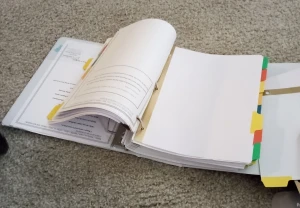
Last night I started putting the manuscript, scene by scene, into a three-ring binder. That required using a three-hole punch.

I hate using three-hole punches. I hate fitting the holes in the paper onto the binder rings. They never fit properly. Getting them on the rings requires effort. It’s tiring.

When I went to bed, I was all the way up to page 37.

Then I woke at 5:30 this morning. Instead of turning over and going back to sleep, I got up. I just couldn’t wait to get back to organizing my manuscript.

But I didn’t organize. I managed to drop the whole thing onto the floor and then couldn’t pick it up. (I’d had knee surgery and wasn’t quite up to bending over that far.) I had to wait for David.

Putative novel 2022-2024

By the time the notebook and manuscript were back in my possession, I was sick and tired of the whole thing. I played Candy Crush.

If I’d had any sense at all, I’d have gone back to bed. I was sleepy. I felt awful. I needed to sleep.

But did I go back to bed? Noooooooooooooooooooooo. That would have been the act of a rational person.

I stayed up added to my sleep deprivation.

I could go to bed right now. I could conk out and tomorrow feel ever so much better.

But will I? No. Because I’m too tired to stand up, too tired to put on my pajamas, too tired to pull down the sheets.

I am just wo-ahn out. I’ve been waterin’ the yahd.

***

Things have changed since 2022. Some days, the novel has reverted to putative, but on most days, it’s still possible. Thanks to extensive revision, the current draft bears little resemblance to the one in the notebook. I have given up three-ring binders and three-hold punches.

***

M. K. Waller’s latest story, “Mine Eyes Dazzle,” appears in the eclipse-themed anthology Dark of the Day, edited by Kaye George (Down and Out Books, 2024). Other stories appear in Day of the Dark (Wildside, 2017), Lone Star Lawless (Wildside, 2017),  Murder on Wheels (Wildside, 2015), and online on Mysterical-E. She is co-author of the novella Stabbed (Starpath, 2019), written with Manning Wolfe. She also writes as Kathy Waller. She lives in Austin and blogs at Telling the Truth, Mainly.

The Derringer Awards and Reading for Writing

By N.M. Cedeño

They say to be a writer you must first be a reader. And it’s true. So reading is both necessary for my work and my favorite form of leisure activity. I’m lucky that I get to do something I enjoy and would do anyway in support of my work.

I’ve never kept lists or used programs to track what I read. It never felt necessary. As a result, I can’t cite definitive numbers about how much I read or analyze by category what I read. In general, I enjoy mystery novels, mainly historical and traditional, some cozy, very rarely thrillers. I read the occasional historical romance novel and frequently read nonfiction histories. When I see a topic that piques my interest, I’ll even read books on bioethics, philosophy, medical matters, and even economics. And, of course, I read tons of short stories in magazines, e-zines, anthologies, and collections. Most of the short stories are crime fiction, but science fiction short stories creep in here and there, too.

In the last few years, I’ve been writing short stories exclusively. Reading the short stories that are being published helps me learn which markets print what kind of stories. In this past week alone, I read twenty-three short stories and two novels. Setting the novels aside, let’s focus on those twenty-three short stories. You might have noticed that’s an oddly specific number for someone who doesn’t write down or track what she reads.

I have an excellent reason for knowing that number.

We are in the midst of Derringer Award season, during which Short Mystery Fiction Society members vote on which stories receive the Derringer Award for Short Mystery Fiction. The stories are nominated in four categories: flash fiction, short story, long story, and novelette. On April 1, the nominees for each category were announced on the Short Mystery Fiction Society blog page. As a member of the Short Mystery Fiction Society it is my duty and privilege to read all of the nominated short stories and vote on which stories I believe should win an award. Once the nominees were posted, I read them, all twenty-three nominees, which is how I know exactly how many short stories I read this past week. The stories were phenomenal, the best of the best in short crime fiction.

Many of these stories are what I aspire to write: powerful, thought-provoking, well-plotted, well-written short crime fiction. These stories are examples of the best work being done in the short mystery genre in various lengths, from under 1000 words to under 20,000 words. I encourage anyone who wants to write short mystery fiction to seek out the stories, and past winners, and read them. They are more than worth your time, and you will learn a lot about great writing from them.

And about those novels I read this week? They were from the Holmes on the Range series by Steve Hockensmith. I discovered the series by reading the related short stories in Ellery Queen Mystery Magazine. The most recent story was in the January/February 2024 issue, and the blurb with the story helpfully informed me that earlier stories I may have missed had been rereleased recently. Thanks to that helpful blurb, I went looking for the novels and found them. Next, I’ll be hunting down the short stories that I missed.

****

N. M. Cedeño is a short story writer and novelist living in Texas. She is active in Sisters in Crime- Heart of Texas Chapter and is a member of the Short Mystery Fiction Society. Find out more at nmcedeno.com

THE NAME OF THE ROSE IS—wait, how do you pronounce that?

BY HELEN CURRIE FOSTER

April 1! It’s spring, with a riot of bluebonnets this year.

Plus paintbrush! Winecup! Verbena! Prairie celestials (so lovely)!

And within the fence, safe from our marauding burros, the roses are opening their petals and sharing their beauty.  Humans have been growing and hybridizing roses for millenia. I favor those with deep rose fragrance. This year the sniff prize goes to Madame Isaac Pereire,

but Zephirine Drouhine is a strong contender as well—sweet perfume, but no thorns!

Blooming with pride are Cramoisi Superieur, fun to pronounce, and dainty little Perle d’or, below.

Yes, the French have been busy.  But I’m waiting on the spectacular Star of the Republic, which is covered with buds that will become exquisite cream and pink roses,  and is almost as tall as Texas.

Thanks for human ingenuity and the deep love of beauty and fragrance that resulted in these roses. We humans are so able to produce beauty—and yet we mystery readers and writers know how gripped we are by the companion question: why do humans commit the primal sin of murder?

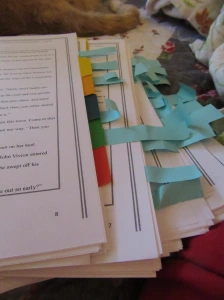
I’ve been reading a riveting book called How the Mind Changed, A Human History of Our Evolving Brain (2022), by neuroscientist Joseph Jebelli, who studies the genetic history of the human brain. I’ve had to put stickers and checks on so many pages!

Jebelli says that, starting about 7 million years (or 230,000 generations) ago, when humans split from chimps, our brains were only 350 cm3 big. Then 3.5 million years ago, when our ancestor Lucy came along, we got a new uniquely human gene that gave us a folding neocortex and nearly doubled our brain size to 650 cm3.

Later, he says, our brains bloomed to 900 cm3, when we began cooking (maybe 2.7 million years ago), then to 1000 cm3, about 2.5 million years ago, then to 1500 cm3 500,000 years ago, and then grew another 25% by the time, 300,000-400,000 years ago, when Homo sapiens appeared.

Later research shows—the bigger the brain, the bigger the social group. Id., 69.

And lucky Homo sapiens came along when our planet was in extreme ecological instability: “African megadroughts depleted the land’s fresh water; vanishing grasslands diminished the number of animals available…” Homo sapiens spread across the planet, interbreeding along the way with the Neanderthals (who went extinct around 40,000 years ago), and the Denisovans, Neanderthal cousins from Asia. Most humans outside Africa carry around 2 percent Neanderthal-derived DNA while today humans in Papua New Guinea and Australia possess up to 6% Denisovan DNA.

Now we have tools of advanced microscopy and molecular genetics to use “the mosaic of neurons, the constellation of synapses and the tributaries of molecules to learn the age of the brain and the transformations it has seen.” Îd., 21.

But it’s Jebelli’s discussion of brain research on “fair play” that I find most fascinating – whether the experiment uses rats, vampire bats, or humans. “Our minds intuitively draw a distinction between unfair equality (all students receiving the same…grades regardless of merit) and fair inequality (the doctor earning more than the cleaner). When push comes to shove, humans nearly always prefer fair inequality to unfair equality.” Jebelli goes on to explain that when we humans engage in fair play, we experience a surge of neural activity in our brain’s reward centers, releasing dopamine, oxytocin, serotonin and endorphins. Id., 68.

Watch out: scientists are identifying gene mutations that explain amazing things. “Non-monogamous brains tend to have a special kind of dopamine receptor gene called DRD4, which is linked to promiscuity and infidelity.” Id., 78. Use that in a plot, mystery-writers!

But I was thrilled by the focus on the link between strong imagination and intelligence in our “default network, a brain system that participates in daydreaming, mind wandering, reflective thinking and imagining the future….People who engage in these cognitive practices…have greater access to the states of mind necessary to solve complex problems.” Id., 115. Jebelli says our default networks are only active when we’re not focused on a task, “when the brain is cycling through thoughts not associated with the immediate environment.”  In other words, the default network contrasts with our executive control network.  Jebelli makes another leap: compassion also stimulates the default network. “Compassion requires imagination. ‘Climb into his skin and walk around in it,’ Atticus tells Scout.” But imagination also requires compassion.  Id., 119.

Why has this book grabbed me? As a mystery writer I wrestle with why some humans will run into the street to save a child from a bus, and some will just watch; and why and how some humans invent gripping new imaginative worlds (Lord of the Rings, Harry Potter, Slough House, Yoknapatawpha County, the Forest of Arden, Hat Creek and the saga of Lonesome Dove) that tell of human struggles and victories, tragedies and comedies. Yes, writers who stimulate our “default networks”!

So you might like to take a peek at How the Mind Changed—check out the chapter on that age-old conundrum––what is consciousness? And the chapter on different minds, or neurodiversity, including genetic components. And the chapter on the new field of neurocriminology: what makes humans commit crimes? Which brain regions are responsible for violence? One possibility—it’s an area of the hypothalamus called the ventromedial hypothalamus, “an ancient brain region that has been conserved throughout mammalian evolution.” Yikes!

As Jebelli notes, plots will abound from this inquiry, this research. As always, inquiring minds want to know.

Meanwhile, it’s April! So let us now praise Geoffrey Chaucer – whose compassion and imagination gave us “Whan that April with his showres soote The droughte of March hath perced to the roote, And bathed every veine in swich licour, Of which vertu engendred is the flowr…”

And further to celebrate—Book 9 of my Alice MacDonald Greer legal thriller series has gone off for copy-edit. Yes, again the primal crime has been committed…!