THE WITCHING HOURS OF HALLOWEEN

It’s time…for ghosts, goblins, witches, warlocks, and, of course, the dead. It’s Halloween.But what was it about in ancient times, and where did it begin?

The customs of Halloween can be traced back to the Druid priests of the Celtics. It was the second most significant holiday of their year. The first was Beltane – the growing season celebrated from April 30– May 1. The second, October 31, was Samhain when the crops were reaped. It was believed that by harvesting all the crops by October 31, there would be no damage to them by ‘evil or mischievous spirits’ who’d return on the first evening of the dark half of the year. 

Druid rituals, deeply ingrained in the Celtic belief system, consisted of lighting huge bonfires, animal sacrifice, and burnt offerings of foods. The priests disguised themselves with animal masks to confuse the spirits.

When Christian missionaries set out to convert England, Pope Gregory, the head of the Church from 590 to 604 A.D., advised them not to force the conversion to end their culture but to incorporate as much of it as possible. It wasn’t a far stretch to succeed since saints in Christianity were credited with miraculous events that were supernatural in nature. Thus, the name Samhain, on October 31, morphed into All Hallows Eve – the night before the saints were revered. 

All Hallows Eve, over time, became Halloween, and the old beliefs did not completely disappear. The concept of spirits returning survived, and Christianized customs grew out of the old ways, with each country developing its own practices.    

In France, Halloween holds little attraction or fanfare. It is considered a very American tradition, and the French are never anxious to adopt American ways. Halloween in France is overshadowed by All Saints Day, on November 1, a national public holiday. The French attend specific religious services and visit cemeteries to lay flowers on deceased relatives’ graves.

The same may be said for the Netherlands. They, too, consider Halloween an American and commercial endeavor rather than a cultural institution. On November 11, the Dutch observe Sint-Marten, a children’s feast that resembles the American celebration of Halloween and is more widely practiced.

In Asia, Halloween has become popular. Hong Kong, the American festival has caught on, and in Japan, where it was first celebrated at the 2000 Tokyo Disneyland, it has taken on a life of its own. 

In Haiti, Fet Gede, or the Festival of the Dead, has an entirely different cultural backdrop. On November 1, All Saints, and on November 2, All Souls, those who practice Voodoo, the Vodouisants, pay their respects to Baron Samedi, the father of deceased spirits. Vodouisants dance in the streets, commune with the dead, and walk through graveyards, leaving food for their ancestors from their own tables. It more resembles Mardi Gras than Halloween.

In Italy, La Festa di Ognissanti (the feast of All Saints) or Hallowmas – short for All Hallows Mass, on November 1, is celebrated by spending time with family. On all Souls, Italians leave chrysanthemums on loved ones’ graves and bake cookies called fave dei morti. They are made with almond, butter, and flour and represent the beans of the dead, a tradition that has survived from ancient Roman times, when beans were used in funerary rites. 

Perhaps my favorite Halloween ritual is from Mexico: Dia de Los Muertos – the Day of the Dead. Mexicans wear bright makeup and dazzling costumes to parade, sing, and dance. A unique aspect of Dia de Los Muertos is the building of altars in tribute to deceased ancestors. Upon these altars are sugar skull-shaped confections and bottles of tequila, along with flowers and pictures of the dead. These offerings are believed to attract the spirits and reunite them with their living families. Other traditions include gathering at the cemeteries dressed in eye-catching costumes with colorful floral decorations, including symbolic marigolds. There, they enjoy traditional foods like pan de muerto (bread of the dead) and Calaveras (sugar skulls). From Mexico, we come to the United States, where all of our American Halloween traditions evolved from other countries.

Carved Jack-o-Lanterns began with a legend about a man named Stingy Jack who trapped the Devil and only let him go on condition that Jack would never go to Hell. When Jack died, Heaven didn’t want him, so he wandered the earth as a ghost for eternity, with a burning lump of coal in a carved-out turnip (now a pumpkin) to light his way. Eventually, people began carving frightening faces on their pumpkins to scare away evil spirits.

The custom of wearing creepy costumes began with Samhain. The Celts believed that in costume, they would be mistaken for ghosts and left alone by actual spirits. And then, there is Trick-or-Treat. 

One theory is that during the Middle Ages, on All Souls Day, children and some adults collected food and money from neighbors in return for their prayers for the dead. Eventually, that was replaced with non-religious practices, including songs, jokes, and other tricks if the treat wasn’t forthcoming. The ritual of door-to-door seeking handouts has long been part of Halloween, but we are long past the days of giving fruits, nuts, coins, and toys. We now are every dentist’s dream, devouring $3 billion-plus dollars of candy.

Bobbing for Apples is not as American as Apple Pie. It stems back to a courtship ritual of the Roman festival honoring Pomona, the goddess of agriculture and abundance. Young men and women could “predict their future relationships based on the game. When the Romans conquered the British Isles in 43 A.D,” the Pomona festival melded with Samhain. 

No discussion would be complete without Pranking. Playing pranks varied by region, but the pre-Halloween tradition known as “Devil’s Night” included good-natured mischief. When Irish and Scottish immigrants came to the U.S., they brought the practice of celebrating Mischief Night as part of Halloween.

Igniting huge bonfires also began with the Druids, and over time, believed to light the way for souls seeking the afterlife. Bonfires are no longer common, at least not in big cities. In today’s world, souls need good eyesight because the most they get is candlelight.

  So, my witches, warlocks, ghosts, goblins, and mischief makers, you now have some customs, traditions, and history. Enjoy it with the candy and treats. 

Happy Halloween!

Francine Paino a.k.a. F. Della Notte

THE PULL OF EMPTY SPACES

by Helen Currie Foster~October 17,2023

Last week, trudging up a rocky trail to an abandoned abbey high above an Italian valley in the Sabine Hills, I heard another walker ask this: after the Romans defeated the Sabines, were any Sabine ruins left?

“Yes,” said the guide. “A temple to the goddess of empty spaces.”

The goddess of empty spaces? Her name?

“Vacuna.”

Even in fourth year Latin at McCallum High, our beloved teacher, Miss Bertha Casey, never mentioned Vacuna.

The walker’s question—any Sabine ruins?—had never occurred to me.

Questions by others can open empty pages in our own minds.

Vacuna’s authority remains a mystery—appropriate, if she was, among other powers, in charge of empty spaces. Or moments of rest, of vacancy, of relaxation. One writer says, “Vacuna was the Sabine goddess of water, nature, forests and fertility, but she was also the goddess of rest.” https://worldhistory.us/ancient-history/vacuna-the-hidden-goddess-veiled-in-the-mist-of-history.php; https://www.romeandart.eu/en/art-nimphs-floating-island.html; https://en.wikipedia.org/wiki/Vacuna

From this hill to the next hill stretched a vast empty space.

Well, not exactly empty––the air seemed visible, with sunlight glinting on bits of dust and mist. But the enormous not-exactly-empty openness fired imagination. The land below contains houses, farms, fences, vineyards—all presumably considered to belong to someone. But watching the air shimmer above the valley I wondered—does that openness belong to Vacuna? To anyone looking out across the valley?

Wait—it didn’t belong to anyone. Not to a hang-glider, nor a kite-flier, nor a drone.  Long after they’d folded their toys and gone home, empty space would still be there, stirring imagination, raising questions, dreams, ideas.

How do you respond to the words “blank page”? To a new notebook? To a waiting empty screen—a “new document” in Word? Your pencil is sharp. Your fingers are poised. What will you write, draw, scribble on that blank page? The very sight of the words “blank page” makes you pause, doesn’t it, making you wonder what you might write? Blank pages prick the imagination.

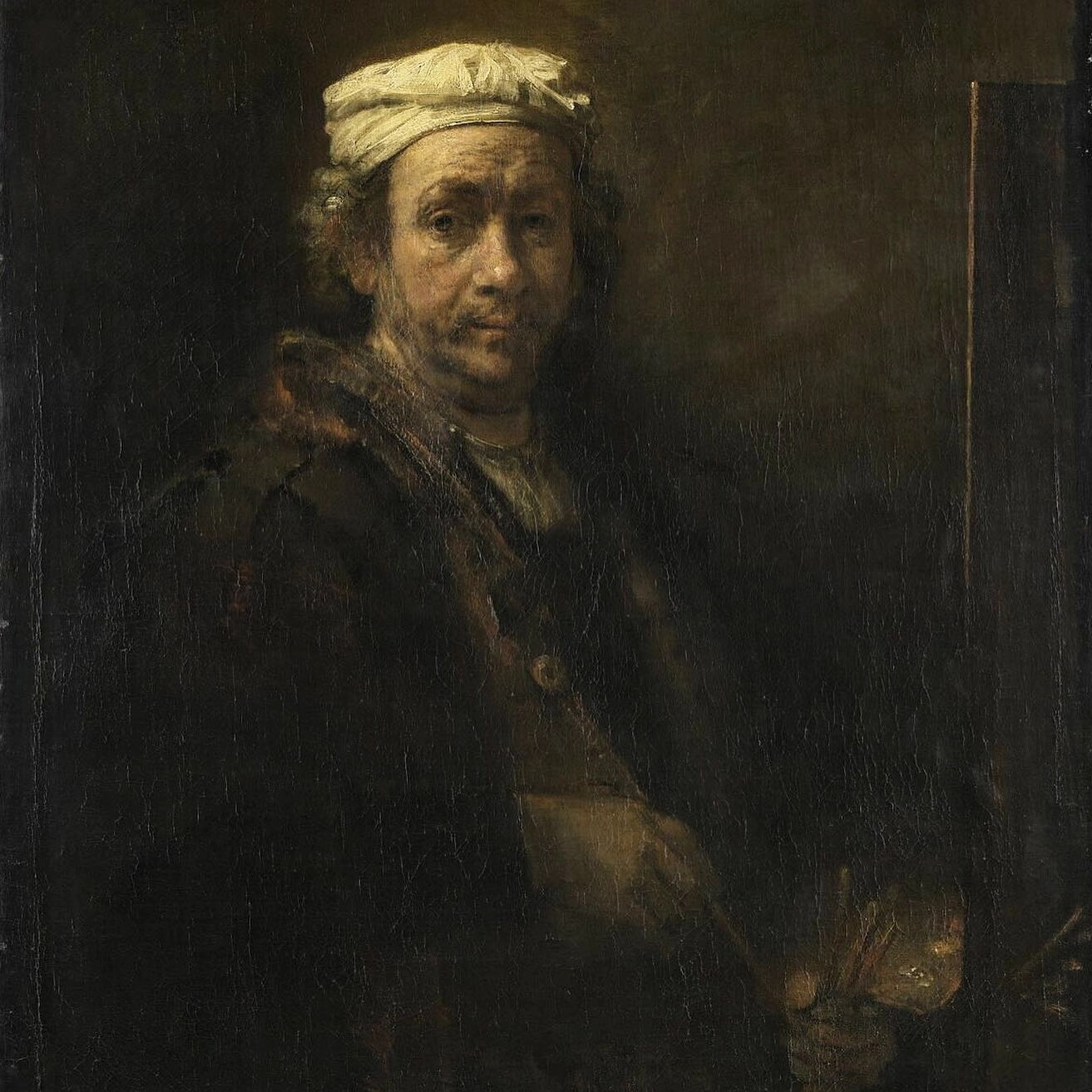
Or you’re an artist, brush in one hand, a vivid palette of colors in the other, confronting a blank canvas. The choices! Red? Violet? Ochre? Viridian? Think of Rembrandt’s self-portrait, as the artist lifts his brush, staring directly at us while coyly hiding the canvas. For us, his canvas is blank. What’s the artist thinking? What do we imagine he’s painting? Of course the tricky master has already painted the canvas we’re looking at, and he included his staring eyes, his ruthless assessment of himself, every wrinkle, every wart.

https://www.louvre.fr/en/what-s-on/life-at-the-museum/a-masterpiece-of-the-louvre And you? What would you paint?

I think of Lily Briscoe in Virginia Woolf’s To the Lighthouse, fiercely concentrating on finishing the portrait she began years ago. We can’t see her painting, but we feel the intensity of her decision-making as to precisely why, where, and how she’ll move her brush for the last stroke.

“Blank canvas”? Emptiness…better, openness; availability; possibility. Imagination calls.

I spend hours revisiting mysteries, reveling in the craftsmanship of the greats, and the enormous creativity that blossoms from the first page, where the canvas is empty before the reader. This week I’ve revisited “Fred Vargas” (writing name) – the French archeologist whose mysteries about her Pyrennean police commissaire, Jean Baptiste Adamsberg, lead the unsuspecting reader into wild leaps of imaginative plotting. https://fr.wikipedia.org/wiki/Fred_Vargas In An Uncertain Place, for instance, when Adamsberg goes to London for an international police conference, his English counterpart, Inspector Radstock, drags him to Highgate Cemetery where someone has left at the entrance 18 pairs of shoes with human feet in them. https://highgatecemetery.org/ The feet have been chopped off dead bodies awaiting burial in funeral parlors. Oh, wait—that’s 17 pairs plus one solo shoe with a solo foot. Adamsberg returns to France, still mulling this weirdness, and confronts a grisly murder where the corpse has been chopped into confetti, with special attention to the big toes and hands and feet. Why? And is the wild-eyed twenty-something who invaded Adamsberg’s Paris house really his undreamed-of son? The plot turns on Serbian vampire stories and the rumor that when Victorian artist/poet Dante Gabriel Rossetti exhumed his dead wife Elizabeth Siddal seven years after her death—ostensibly to retrieve his manuscript volume Poems—she was still rosy and pink. https://nonfictioness.com/victorian/the-exhumation-of-elizabeth-siddal/

From a blank page, to dead poets, to vampires and tombs in Serbia, to…well, check it out! Let me know if you actually identify the murderer before the end. Adamsberg’s one of my favorite characters. Still don’t know why he wears two watches and can’t tell time.

How do fiction writers fill the blank page? By that mysterious process—imagination. In the October 16, 2023 New York Times, Italian physicist Carlo Rovelli asks how we can learn about black holes—places we can neither travel to nor see. His answer? “To travel to places that we cannot reach physically, we need more than technology, logic or mathematics. We need imagination.”

Per Merriam Webster, “The meaning of IMAGINATION is the act or power of forming a mental image of something not present to the senses or never before wholly perceived in reality.” J.K. Rowling: “Though I personally will defend the value of bedtime stories to my last gasp, I have learned to value imagination in a much broader sense. Imagination is not only the uniquely human capacity to envision that which is not, and therefore the fount of all invention and innovation. In its arguably most transformative and revelatory capacity, it is the power that enables us to empathise with humans whose experiences we have never shared.” https://news.harvard.edu/gazette/story/2008/06/text-of-j-k-rowling-speech/

Our genre requires imagination. Mystery writers need a vivid, tangible setting, especially for the murder. My mind has taken me to a rock-art painted cave atop a bluff high above an old ranch, to a music recording studio, to a dining room where a horse rears. We need characters. Protagonist! Murder victim! Suspects! Subsidiary characters who adds color, flavor, depth—like Eddie LaFarge, the retired pro football center who limped into the Central Garage in my imaginary town of Coffee Creek.

And I find something unexpected has happened to me, writing the Alice MacDonald Greer murder mystery series. In the middle of the night, my characters now feel as real as relatives. I watch them driving, kissing, feeding the burros, worrying. Sometimes they pause for a moment, imagining what they’ll do next.

Thank you, Vacuna, goddess of empty spaces.

Those croissants? We’re recovering in Paris from hiking, where these, from the Maison Julien patisserie on Rue Cler, may be the best ever. Letting melting butter create those empty spaces between the layers? Genius.

Helen Currie Foster writes the Alice MacDonald Greer Mystery series (now working on the 9th) north of Dripping Springs, Texas, in the Hill Countrloosely supervised by three burros. She’s active in Austin Shakespeare and the Hays County Master Naturalists and very much enjoys talking to book groups. The 7th mystery, Ghost Daughter, published June 15, 2021, was named The Eric Hoffer Award 2022 Mystery/Crime Category First Runner-up, and also 2022 National Indie Excellence Award Finalist, Mystery.

The Good, the Bad, the Cleanup

by N.M. Cedeño

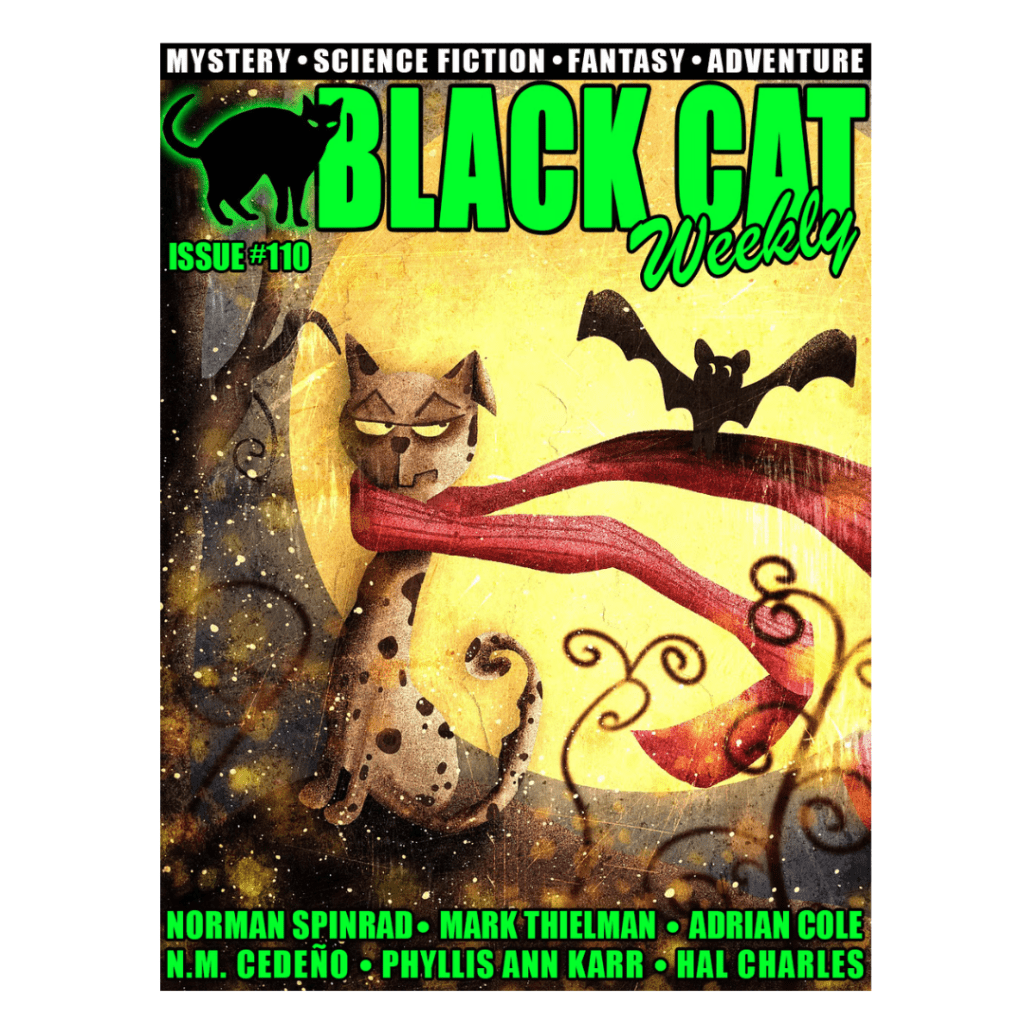
First, some good news! My story entitled “A Matter of Trust” was published in Black Cat Weekly #110 on October 8 via editor Michael Bracken. The story features genetic genealogy private investigator Maya Laster who first appeared in “Disappearance of a Serial Spouse” in Black Cat Weekly #79 in March 2023. In this, her second published case, Maya is working to help her client, Bob Rolland, prove that he’s an heir to a forgotten trust fund, when violence ensues. With Bob’s life hanging in the balance, Maya races to discover who might want to stop him from claiming his inheritance.

“A Matter of Trust” is my first story inspired by a click-bait title that I didn’t click. The article was something about a dead billionaire leaving everything in trust for his reincarnated self to inherit. I imagined a vast fortune sitting forever, waiting for an heir to step forward. I thought, what if someone left everything in trust for possible future grandchildren? And what if the only link to the information about the trust died without telling anyone? From those seeds grew a story of lost family relationships requiring a genetic genealogist to reconnect the missing pieces.

So, for those who always ask: yes, story ideas really do come from everywhere.

Next, the bad news. Two events within five days gave me ample material to consider for use in future stories, and I would not wish either of them on anyone.

First, The Hail.

Photo taken by a neighbor.

One Sunday evening, my neighborhood was hit by baseball-sized hail. If you’ve never experienced a storm like that, it’s hard to imagine the sheer power behind that kind of precipitation. Windshields and car rear windows exploded when hit by enormous hail falling at terminal velocity. Coming down in sheets like rain, pummeling everything in its path, it left its mark everywhere, from the soil, the concrete, and the asphalt to cars, roofs, light fixtures, patio furniture, and trees. It even killed birds.

My family hid in a closet, listening to what sounded like a bombardment. The weather notification that baseball-sized hail was coming arrived on our phones five minutes after we had already retreated to the closet with the dog because of the fury of the storm. The warning came far too late to try to protect anything outside, but did confirm our instinct to take cover away from windows.

Next, The SWATTING.

Four days after the storm, someone decided to commit a crime against the community by calling in a false attack at my children’s high school. For those who don’t know, per the Oxford dictionary, “swatting” is defined as “the action or practice of making a prank call to emergency services in an attempt to bring about the dispatch of a large number of armed police officers to a particular address.” Seven different agencies responded to the high school in full gear, expecting to find an active shooter.

Someone intentionally terrorized hundreds of teachers and almost four thousand students at one school. It’s an enormous high school with a dozen buildings spread over a quarter mile wide. People in one building have no idea what may be happening in another building. So when the school locked down, many kids assumed the worst was happening somewhere and texted their parents from hiding places in darkened rooms and storage areas.

The number of swatting incidents in the US rose so quickly in the past few years that the FBI has created a database to aid in tracking and investigating them. Three high schools in two districts in my area were “swatted” in one day. In my youth such incidents could be ascribed to individual teenagers playing pranks or trying to avoid a test. While that may explain a few isolated cases, evidence suggests that many of the recent swatting incidents are linked to common perpetrators, many of whom may not be in the US. Terrorists have realized that they can sow fear with a spoofed phone call.

Once I have some distance from these events and can put them in perspective, details from one or both incidents may appear in a story. For the moment, I’m still cleaning up the mess.

*****

N. M. Cedeño is a short story writer and novelist living in Texas. She is active in Sisters in Crime- Heart of Texas Chapter and is a member of the Short Mystery Fiction Society. Find out more at nmcedeno.com