Look out, there, you young whipper-snappers – (anyone under the age of 60.) Pursuing exciting and noteworthy activities like crime-solving isn’t limited to those more youthful people. Your elders are still learning and finding new avenues and adventures too. Here’s a surprise for you. You grow in wisdom exponentially when you pass the half-century mark, as we see in so many of the senior sleuths in today’s fiction.
There is a surging interest in books with senior sleuths that may be generated by those who have raised their children to adulthood, retired or are semi-retired from their vocations, professions, and jobs, and still have active minds and bodies. They enjoy reading about contemporaries in fiction with the same attributes of time, curious minds, and the inclination to fit puzzles together, and not just on a tabletop.
Or perhaps this new appreciation for exciting possibilities after Social Security and Medicare kick in is on the rise among the youngster (under age fifty) who want something to look forward to beyond the antiquated concept that life slows down after sixty. Then it’s all dreary golf, bingo, and blue plate specials – while you wait to die. The authors of the older sleuth mysteries squash that concept with humor and wisdom.
Our elderly protagonists may stumble in their quests to solve crimes, but it doesn’t faze them because they know making mistakes is part of growing older gracefully. They’re stronger for having experienced the fullness of life with pain, sorrow, joy, failure, accomplishment, and everything else that goes with it.
Unlike many Asian, Native American Indian, and African cultures where elders are considered people of greater wisdom to be respected and consulted, Americans, obsessed with the youth and beauty fetish, fear aging and often shun aging.
In Greece, ‘old man’ is not a derogatory term. In Greek-American cultures, old age is honored and celebrated, and respect for elders is central to the family.” The African proverb, ‘A village without the elderly is like a well without water, ‘expresses their cultural approach to old age.
The importance of older generations is emerging in our society as Americans continue living longer. As noted by Alison Bryant, Ph.D., senior vice president of research at AARP (a nonprofit organization focused on civic engagement for people 50 years and over), “As Americans continue living longer, society must redefine what it means to get older. It’s encouraging that most older adults feel positive about their lives…. But we have work to do to disrupt damaging negative associations around aging.”
We hope that America’s cultural view of the beauties and blessings of growing older is improving, and it’s feasible that the surge of interest in the senior sleuths of fiction will help. Life often does imitate art, and the adventures and lives of fictitious characters will help turn younger Western attitudes into a more positive recognition of all seniors have to offer.
In the Housekeeper Mystery Series, Mrs. B., the protagonist, is a feisty, energetic, strong-willed, and outspoken senior citizen who has raised her children to adulthood, battled and beaten breast cancer, then lost her beloved husband.
In book one, I’m Going to Kill that Cat, on a lark, Mrs. B. answers an ad for a new housekeeper needed at St. Francis de Sales. She is invited to interview for the position and is hired by the pastor, Father Melvyn Kronkey. Thinking her new vocation was just the care and upkeep of the priests and the rectory, she could never have imagined the new life of solving crimes she’d be thrust into when she rang the doorbell of the rectory.
Below, I have included several links to a wide range of mysteries featuring senior sleuths, the motivations of the authors who wrote them, and information on cultures that deeply respect age.
And remember: We are older, but we are not dead. Not by a long shot! Who knew getting old was so much fun?
I admit that the ending of my story “Short-Term Murder” in issue #88 of Black Cat Weekly may include wishful thinking. The plot of the story revolves around a murder in a short-term vacation rental in a neighborhood. Two of the neighbors work together to solve the murder after one of them, Mariah Grant, the woman who lives next to the vacation rental, becomes a suspect because of her documented dislike of the house.
The inspiration for the story:
My neighborhood has fewer than one hundred houses. I know and communicate with all of my immediate neighbors and even a few neighbors in the houses that back up to mine. The neighborhood is secluded, bounded on three sides by a dry branch of Onion Creek that only fills when it rains. The area is quiet and peaceful. Or it was until last summer.
Before last summer, the house next door to me was owned and occupied by a family of five: two parents and three boys who attended the elementary school. Children that age go to bed early. They were quiet neighbors in the evenings.
Then, the family moved and sold the property to a business. The business set to work turning what had been a single family home into a mini-hotel and party venue. The mature oaks and crape myrtles in the back yard were chopped down and equipment rolled in to dig a massive swimming pool with an outdoor sound system and party space. Around Thanksgiving, the construction noise finally stopped, and the place opened for business.
My neighbors and I quickly discovered the rental listing online. From the pictures, we could see that the company stuffed bunk beds into what had been living spaces and listed the house as “sleeps twenty.” The online ad invited (and still invites) parties and weddings of up to thirty people.
In a blink of an eye, my formerly quiet street became party central.
Petra: Protector of the house
Over the holidays, a line of cars parked in front of my house with people coming and going at all hours. My German Shepherd mix, who believes it is her duty to warn me of all dangers to my property, barked at the people milling on the sidewalk in front of my house at 1:30 in the morning. I stepped outside and asked them to move. (The local police told me later that standing in front of someone’s house at all hours isn’t allowed, and I should call them to ask the people to move. I was new to the problem then and didn’t know better.)
Group after group produced bags and bags of trash. It didn’t all fit into the bin the city provides to each house. So the guests piled trash into the recycling bins, too. When the lids wouldn’t close, the trash blew all over the neighborhood. (Yes, this is a city code violation.)
This month, a mini-bus pulled up in front of the house and disgorged fifteen or twenty women in cute, short dresses and matched cowboy hats. Bachelorette party? Sorority reunion? Who knows? They threw a rollicking, screaming pool party in the backyard. It sounded like teenage girls screaming at the top of their lungs at their favorite boy-band concert.
We have many children in the neighborhood. Do the vacationers speeding around the curved street to get to their party care about our children? Not remotely. Do they care about the house, the neighborhood, the community? Not in the slightest. Do they throw outdoor parties on Tuesday nights when everyone around them has school and work the next day? Yep. That happened this past week.
My city council member, who lives a few houses down from me, informed everyone that under city law the owners are entitled to use their property as they see fit. It’s legal to be a horrible neighbor. I’ve seen in the news that some cities are moving to classify short-term rentals as commercial lodgings, like hotels. That classification would make them illegal in neighborhoods. I’ll be watching with interest to see if the regulations pass legal hurdles.
In the meantime, if you read “Short-Term Murder” in Black Cat Weekly #88, you’ll see how I channeled my frustration into the creation of a short mystery.
****
N. M. Cedeño is a short story writer and novelist living in Texas. She is active in Sisters in Crime- Heart of Texas Chapter and is a member of the Short Mystery Fiction Society. Find out more at nmcedeno.com
What’s your favorite place to read? A certain chair? The one with a lamp that shines on your book, not in your eyes? Perhaps a ferryboat seat, where you glance up at the horizon, then down at your book? On a plane, or train?
When I was young our house had an elm tree in the back yard which was not only climbable, but offered two branches that stuck out at the perfect angle for a lounging pre-adolescent. Even better—the lounger was invisible from the house. I could scramble up, arrange myself, open my book—and be left unfound, undisturbed, for some time.
A later joy was climbing on the New Haven RR in Boston after final exams (Chaucer, Shakespeare), armed with the latest James Bond and the very biggest Hershey bar with almonds, and being rocked south for miles along the coastline. Uninterrupted.
And I confess to rereading books. I further confess to rereading children’s books. Maybe a more accurate word is: revisiting. At least every two years, I pick up Kipling’s Kim, finding my way to the part where Kim guides his Tibetan lama, who seeks a sacred river, on a pilgrimage into the high deodar forests of the Himalayas. I can almost smell the trees. There Kim steals the Russian spies’ notes––his own initiation into the Great Game. Even more satisfying? The long afternoon where, exhausted, he is “taken apart” by Eastern massage and finally stumbles out, recovered, to find his lama at the brink of—well, no spoilers.
Why this gravitational pull of favorite children’s books?
Maybe because the best children’s books feature enterprise, surprise, disguise. And—most important––the discovery of identity.
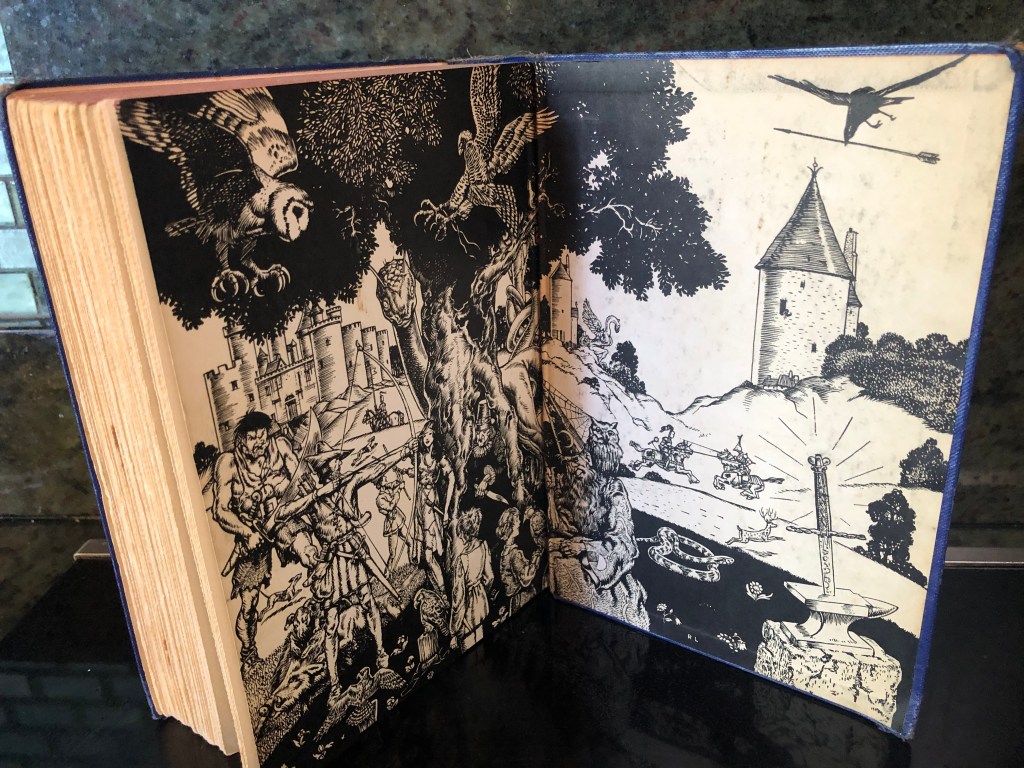
Consider The Sword in the Stone, where Merlin transforms Wart into various animals (badger, owl, fish) who teach him survival techniques (“put your back into it!”). And magic! Giants! Griffins! The Queen of Air and Darkness! (See volume below–griffin looming behind tree.) One favorite moment? When Merlin transforms Wart to a raptor—a small merlin––who must sit for desperate minutes during his formal initiation, near the maddened and perilous Peregrine. Why does Wart need Merlin’s special tutelage? Because of his identity, which he and we will finally discover.
Others I still pull off the shelf: The Wind in the Willows, especially Mole’s tearful return home, where he recognizes his true self.
Also Susan Cooper’s The Dark Is Rising. Maurice Sendak’s Nutshell Library – memorizing all the poems. I sneak back to Harry Potter—a feast of enterprise, surprise, disguise, and Harry’s search for his own identity. Occasionally I return to Lord of the Rings––especially the battle for Gondor. You’ll note I missed out on Jack London and many others. But there’s always The Lion, the Witch and the Wardrobe—remember that wondrous moment when Lucy slips through the back of the wardrobe, past all the mothballed coats…into magic? Into the snowy landscape where she meets Mr. Tumnus the faun? Into the realm where––as Lucy later discovers––she is Queen Lucy?
You have your favorites. So do our collective children and grandchildren. Bookstore shelves still offer children tales of enterprise, surprise, disguise—and characters discovering their own identities.
And fortunately, children’s books needn’t follow the 1930 Detection Club’s 10 Rules for Writing a Mystery. Rule #2: “All supernatural or preternatural agencies are ruled out as a matter of course.” Following Rule #2 would let out magic, of course, and its enormous space for imagination. (If you, like me, crave an occasional touch of magic for grown-ups, try Remarkably Bright Creatures by Shelby Van Pelt. amzn.to/44iIoVj)
As a mystery writer/reader I usually write about mystery. But thinking lately about the bibliophile’s favorites—favorite reading spots, favorite chairs, favorite characters––has sent me down a different path. Why reread? Wait––why revisit?
What is it about the end of Kim, or the plight of Frodo and Samwise in Shelob’s lair, or Harry Potter’s first moment on his broom, learning how good he is at Quidditch––that whispers, “read it again!”
I reread mysteries too. Have you reread a Dorothy Sayers, a Ngaio Marsh, a Sherlock Holmes? Or John le Carré? How many times have you read Tinker, Tailer, Soldier, Spy, or Smiley’s People? (Come on, spy thrillers are part of the mystery-thriller-spy novel genre.) And why do we reread le Carré? One character in particular: George Smiley.
Smiley first appears on page 1 of chapter 1, titled “A Brief History of George Smiley,” in Call for the Dead, le Carré’s first book, published in 1961. Smiley’s marriage to the aristocratic Lady Ann Sercomb has ended when she abandoned him, and he’s described as follows: “Short, fat and of a quiet disposition, he appeared to spend a lot of money on really bad clothes, which hung about his squat frame like skin on a shrunken toad.”
We learn of his deep love of 17th century German literature, his success at Oxford, his recruitment by MI-6, his dangerous service abroad as a spy in WWII. Not a commanding figure, no. But le Carré allows us to glimpse his sharp mind, his penetration, his ability to absorb all he hears. Smiley’s work as an intelligence officer provides him “with what he had once loved best in life: academic excursions into the mystery of human behaviour, disciplined by the practical application of his own deductions.”
Smiley appears next in A Murder of Quality (1962), where Smiley’s solution to the murder rests on a scathing critique of the snobbishness of British public schools (le Carré despised his own experience at such a school).
By the time we reach Tinker, Tailor, Soldier, Spy (1974), Smiley has been put out to grass at MI-6 under the new regime headed by Bill Haydon, who has seduced Smiley’s wife Ann and taken over London Station after causing the bitter dismissal of Control as its head.
In Tinker, Tailor, Smiley is plucked out of retirement to interview a somewhat dubious British agent who claims the Russians may have placed a mole inside MI-6. Here’s Smiley, listening to the agent’s tale:
“He sat leaning back with his short legs bent, head forward, and plump hands linked across his generous stomach. His hooded eyes had closed behind the thick lenses. His only fidget was to polish his glasses on the silk lining of his tie, and when he did this, his eyes had a soaked, naked look that was embarrassing to those who caught him at it.”
Le Carré’s letter to Sir Alec Guinness (3 March 1978) appears in A Private Spy / The Letters of John le Carré, at 213. He tells Sir Alec:
“Apart from plumpness, you have all the other physical qualities: a mildness of manner, stretched taut, when you wish it, by an unearthly stillness and an electrifying watchfulness. In the best sense, you are uncomfortable company, as I suspect Smiley is. An audience wishes––when you wish it––to take you into its protection. It feels responsible for you, it worries about you. I don’t know what you call that kind of empathy, but it is very rare, & Smiley and Guinness have it: when either of you gets his feet wet, I can’t help shivering.”
I love that “as I suspect Smiley is.” Does the author’s own speculation about George Smiley explain, in part, why we readers become so attached to this character? What drives us to Smiley’s side? Is it his apparent ineffectualness, his vulnerability, his stillness, his watchfulness, entwined with our certainty that he will somehow keep going?
Not until 1979 in Smiley’s People does Smiley achieve final vindication, catching the Russian master-spy who conceived the long set of steps that led to Haydon’s seduction and Control’s fall. At the climax, we (along with Smiley and his fellow spy Peter Guillam) await the possible arrival of the Russian in cold war Berlin, at the crossing point from East Germany. Will the spy make it across the bridge? Guillam asks what cover the Russian will use:
Smiley sat opposite him across the little plastic table, a cup of cold coffee at his elbow. He looked somehow very small inside his overcoat.
“’Something humble,” Smiley said. “Something that fits in. Those who cross here are mostly old-age pensioners, I gather.’ He was smoking one of Guillam’s cigarettes and it seemed to take all his attention.”
At book’s end, we are waiting with Smiley. It’s cold there by the Berlin bridge. I expect Smiley’s feet are wet. Like the author, “I can’t help shivering.” When we know a character’s vulnerabilities, we begin to perceive true identity.
For Smiley, for all the characters created by their authors with such vividness and such vulnerability that we seem to feel what they feel, for such characters–I reread. Yes, the better word is revisit: I go back just to be sure the characters are still there, still available, still waiting quietly on the shelf. And, yes, just as good as I thought they were.
I’d love to hear your favorites (reading spots, children’s books) and the favorite characters you…revisit.





 Ink-Stained Wretches