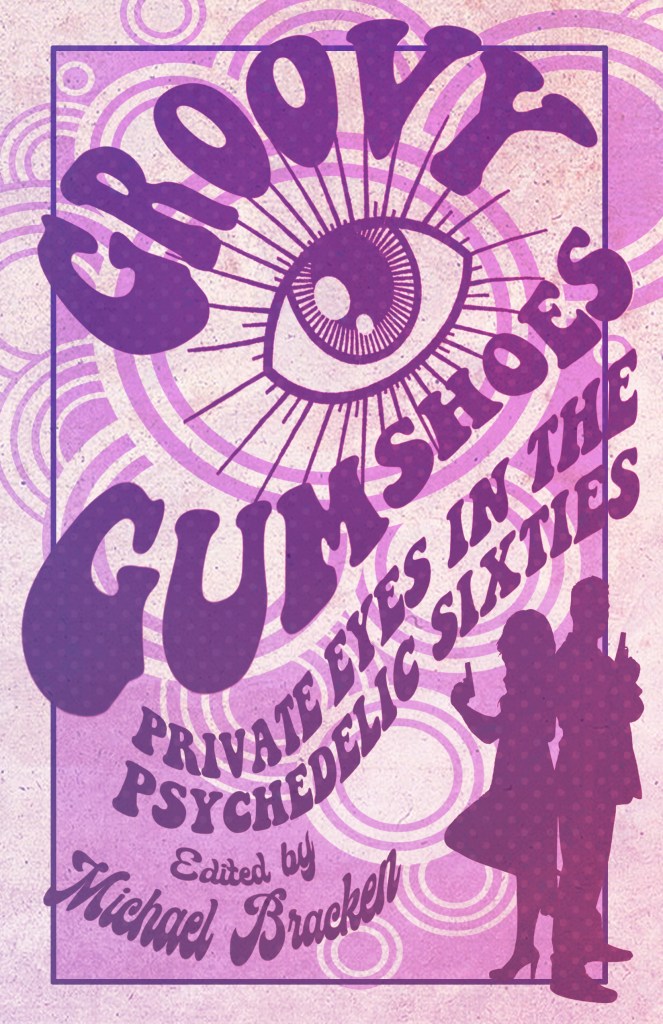
Writing “Nice Girls Don’t” for Groovy Gumshoes

So what if I wasn’t born in the 1960s? I can do research!

In 2020, I came across a call for submissions for mystery short stories to be included in an anthology. The anthology was to be called Groovy Gumshoes: Private Eyes in the Psychedelic Sixties. The editor, Michael Bracken, wanted stories set in the 1960s featuring private detectives, with bonus points given if the story included a major historical event.

The call caught my attention, but not having been born in the 1960s, I searched my brain for any specific event that I might use as starting point for a story. Two events for which I had a wealth of knowledge at my fingertips came to mind. One was the Assassination of President John F. Kennedy. When you grow up in Dallas, this one comes to mind quickly. But I thought that event, given its extreme historical prominence, might be covered by too many other authors submitting stories.

So I selected the second event: the UT Tower Shooting.

The University of Texas Tower Shooting on August 1, 1966, is a dark shadow on Austin’s history. It was a mass shooting at a school that happened decades before such events became regular occurrences. The Tower Shooting, like the JFK assassination, is reviewed regularly by the local media on anniversaries of the event. And I am intimately familiar with the locale where the shooting occurred since I attended the University of Texas at Austin and walked in the shadow of the Tower daily for four years. Additionally, the shooting is well-documented. Video taken that day is even available online. I knew that finding background details for a short story set around the time of the shooting wouldn’t be hard.

However, none of that is why the Tower Shooting came immediately to mind.

It came to mind because I knew someone I could question about life in the 1960s in Austin, Texas, and about the Tower shooting in particular: my father.

My father, whose grandparents were all Czech immigrants who arrived in Texas after the Civil War, graduated from tiny Rogers High School in rural central Texas and set out be the first in his immediate family to graduate from college. He worked his way up: first attending a junior college, then transferring to a small private college, then transferring, finally, to the University of Texas at Austin. On the fateful morning of August 1, 1966, my father turned in the final paper for the final class he needed to graduate. He arrived on campus early in the morning and left to report to his job at an Austin grocery store.

My father- Dec. 1966

He had a lot on his mind that day. With his upcoming graduation at the end of the summer term, my father should have been considering his improved employment prospects. But he wasn’t looking for jobs. He knew that his draft number was coming up in October. He had to make a decision: volunteer for the draft or wait to be drafted into the military in the midst of the Vietnam War. He volunteered for the draft in September 1966.

Twenty-seven years later, on my first day living in the dorms at UT, my father showed me where people had died near the balustrade on the South Mall. He pointed out the bullet holes marking the stone. He recounted his memory of leaving campus and listening to the shooting on the radio while at work. His story of that day, woven into the story of his life, became a piece of family lore, embedded in my memory.

And so, after picking my father’s brain and doing a ton of research, my short story “Nice Girls Don’t” came into being. The story features a private detective hired in September 1966 to investigate the death of a young woman, a UT student who died the day of the Tower Shooting. The girl’s parents believe their daughter’s case was ignored because the police were too busy dealing with the Tower Shooting to give her death the attention it deserved. The parents want the detective to find out what really happened.

After completing my story, I submitted it to the editor, hoping it might be selected for inclusion in the anthology… And the editor, Michael Bracken, chose my story to be included in Groovy Gumshoes: Private Eyes in the Psychedelic Sixties, coming from Down & Out Books in April 2022!

~~~~~~

N. M. Cedeño is a short story writer and novelist living in Texas. She is active in Sisters in Crime- Heart of Texas Chapter and is a member of the Short Mystery Fiction Society. Find out more at nmcedeno.com.

Book Review: The Secret Library: A Book-Lovers’ Journey Through Curiosities of History by Oliver Tearle

by Renee Kimball

Sometimes you stumble unawares into a book and then, in total surprise, you are rewarded.  That was my experience when I happened to find The Secret Library: A Book-Lovers’ Journey Through Curiosities of History by Dr. Oliver Tearle.  This is a book a bookish reader can gobble up, each chapter one more rich tidbit that goes on and on – an entertaining, multi-layered literary feast.

Tearle begins with an old question: “What book would you like to take with you if you are left on a desert island?”  (We all know that question, and we also know the answer varies widely in response both to what you have read, as well as, your age).  And having asked this question, Tearle provides G.K. Chesterton’s still witty reply: “Thomas’ Guide to Practical Shipbuilding.”  A response Tearle says is guaranteed to produce a smile. 

But you ask, who is Oliver Tearle?  

Dr. Oliver Tearle is a professor of English at Loughborough University, United Kingdom, and the author of The Secret Library: A Book Lovers’ Journey through Curiosities of History.  Tearle is also the creator of the highly popular literature blog, Interesting Literature: A Library of Literary Interestingness, touting 25,000 followers, along with an enviable presence on Twitter and Facebook. 
If numbers are proof of success, those that follow Tearle appear much more than just a little bit interested in literature’s long and quirky history. 

In the “About,” section of Tearle’s website, he offers the intent behind his blog:“. . . The aim is simple: to uncover the little-known interesting facts about the world of books, and to shine a light on some of the more curious aspects of literature.” 

Backtracking to Chesteron as to what might prompt a choice of books on that desert island, Tearle argues that for a book to be important enough, “the . . . book needn’t mean ‘great work of literature’ or ‘novel you’ve always wanted to read but have never had the time or courage to take on. . .”

An important book can be relatively unknown except to a few, but its impact upon ‘Western society’, is immense, citing to Euclid’s Elements, or Dr. Johnson’s Dictionary.

Writing The Secret Library, Tearle’s goal was to simply answer some questions he had had about literature; even though these may have been previously addressed, he wanted to go further and include “non-literary texts” as well.

Tearle stated he had . . . “two related aims: to bring to light the lesser-known aspects of well-known books, and to show how obscure and little-known books have surprising links with the familiar world around us. . . In short, it attempts to bring to light some hidden facts about both the best-known and the least-known books ever written, typed, inscribed, dictated, or indeed fabricated.”.

Beginning with what we have inherited from the Classical era that created the basis for all the arts, we are linked back to Ancient Greece (in gratitude).  With Tearle, we are led even further forward into a bibliophile’s wonderland . . .” its a medley of curiosities, a whistle-stop tour around an imaginary library stuffed full of titles both familiar and forgotten. . .”  If you are a curious book lover seeking unknown facts and authors, this is the reading adventure for you. 

Throughout nine chapters, Tearle explores literature (gone but not forgotten) chronologically, from the Classical time forward.  Each chapter ends with a clue tying it to the next chapter – it is up to the reader to puzzle it out and connect the clues.  Without spoiling the book for would-be-readers, below are just a few of the interesting answers found within The Secret Library. . .

What is the oldest book known to man?  . . .The Etruscan Gold Book, which was produced around 2,500 years ago. It comprises six large sheets of 24-carat gold which have been bound together with rings, thus forming a unified object that might be labelled a ‘book.”  It was discovered in the mid-twentieth century; unfortunately, as it was written in Etruscan language, which we know very little about, deciphering it proved tricky, to say the least. (Note, Wikimedia Commons does not have a photo of this book; however, there are images of it on the web at various sites).

Is the Iliad the first great work of Western literature?  “The Iliad is the first great work of Western literature probably composed in around the eighth century B.C. . . who Homer was remains a mystery. . .and after nearly three millennia unknowable.  The story of the Greeks . . disguised in a big wooden horse inspired the Trojan horse (in computing, a piece of malware that infiltrates your computer by disguising itself as something benign).”

Who was Euclid? “. . .The greatest mathematician of ancient Greece was Euclid.  But which Euclid? There were, it would appear, several. . .The attribution of the work to Euclid is the result of one passing reference made by a later writer, Proclus, naming Euclid as the author of, the book . . .most historians accept the attribution as fact.

Who was the first science fiction writer? “Pinpointing the starting-point of science fiction is a tricky undertaking. Did it begin with Jules Verne’s Journey to the Centre of the Earth in 1864? Or Mary Shellye’s Frankenstein in 1818?  . . .Asimov and Carl Sagan give the mantle to . . . astronomer Johannes Kepler, whose Somnium written in Latin in 1608, speculated on what the Earth might look like from the Moon. . .but the origins of science fiction can be traced back far earlier even than Kepler. . .to the second century. . . to a Syrian writer named Lucian, whose short work A True History has claim to being the first-ever work of science fiction. . .

Who owned the largest library in medieval England?  “. . . Richard de Bury would have to be a contender. . .a fourteenth-century bishop of Durham, de Bury appears to have been something of an incurable bibliophile whose library dwarfed those of his fellow bishops. . .he has been described by his biographer Samuel Lane Boardman as the patron saint of book lovers. . .De Bury even wrote a book about his book obsession, Philobiblon (literally, ‘love of books’), which has been described as the first-ever book about library management. . .he completed it shorty before his death in 1345.”

Flatulent Demons? “Dante Alighieri. . .is best remembered for the epic poem about heaven, hell, damnation, purgatory and salvation called The Divine Comedy. . .It is not a comedy, because it is not funny. . .it might be viewed as the original fantasy trilogy, charting the poet’s journey from hell to purgatory before arriving in heaven.  T. S. Eliot, to whom Dante meant a great deal, said of Dante’s work that genuine poetry is able to communicate before it is understood.  Rumour has it that Dante taught his cat to hold a candle up for him in its paw while he was eating or reading.”

And . . .there is so much more: The First Autobiography (a manuscript found by “William Erdeswick, a lieutenant-colonel, found in a cupboard in his house in Chesterfield. . .a book first transcribed in the 1430s written by Margery Kempe;” “The discovery by an Italian librarian during the fifteenth century of Lucretius’ epic poem De Rerum Natura” was the spark that began the Italian Renaissance (according to literary historian Stephen Greenblatt); “Rabeliais, who wrote Gargantua and Pantagruel gave us two popular adjectives. . .gargantuan. . .and panurgic. . .”

There are more tales, more improbable but true connections, that Tearle deftly reveals and magically weaves into a cohesive whole.  This is the book you keep in your carryall, in the car, by your beside table; pick it up at any point and you will be amazed at just what you can learn.

References

The Secret Library: A Book-Lovers’ Journey Through Curiosities of History by Oliver Tearle. Photo Courtesy of Amazon.

The Iliad. Wikimedia Commons, attribution:  Pete unseth, CC BY-SA 4.0 <https://creativecommons.org/licenses/by-sa/4.0&gt;, via Wikimedia Commons

Johannes Kepler, Somnium. Courtesy Amazon.com.

The first page of Richard De Bury’s Philobiblon. Wikimedia Commons, attribution. Richard de Bury (Life time: 1287-1345), Public domain, via Wikimedia Commons.

The Portable Dante. Photo courtesy of Amazon.

***

A former paralegal, Renee Kimball has a master’s degree in criminal justice. Among her interests are reading and writing. She is an active Animal Advocate and fosters and rescues both dogs and cats and works with various organizations to find them forever homes.

How to Paint a Horse?

by Helen Currie Foster

Like many of you I’m fascinated by prehistory, always hoping for a chance to clamber up (or down) to visit incredible cave paintings. My first mystery, Ghost Cave, was inspired by climbing to cave shelters where the Devil’s River meets the Rio Grande. Ghost Cave’s cover? The famous White Shaman images. https://www.amazon.com/s?k=Helen+Currie+Foster+ghost+cave&crid=24J6S4P7832FF&sprefix=helen+currie+foster+ghost+cave%2Caps%2C129&ref=nb_sb_noss

In the Dordogne, in southern France, I heard the echo of the iron cover banging into place to close the entrance to the Pech Merle cave to prevent damage from outside air. Down the clanging iron stairs we went, along chilly stone tunnels, and then—the horses! Oh, the spotted horses, so real you could almost hear them breathe. They’ve been carbon-dated to 25,000 BCE. I’ve waited in line to see the famous Font de Gaume at Les Eyzies, also in the Dordogne, and hiked, shivering, to see the pictures deep in the Pyrenees cave at Niaux. I long to visit them all. Sometimes my companions balk.

Confronted by such artistry, such deft depictions, simultaneously spare and rich, like Chinese scroll landscapes or Picasso’s early drawings, haven’t you wondered about the artists? Why were they so deep in these dark, perilous caves? What was their life—or death—outside?

Today, with climatic violence the new normal, and new discoveries daily about human prehistory (including 23 and Me’s calculation of our personal percentages of Neanderthal ancestry), I’m more and more curious every day about our long-ago ancestors. The real question, of course: what is it to be human?

Welcome to  “The Dawn of Everything: A New History of Humanity,” a tome by two Brits—David Graeber, the late professor of anthropology at London School of Economics, and David Wengrow, professor at the Institute of Archaeology, University College London. “The Dawn of Everything”? Sounds ferociously ambitious—overarching, maybe overreaching. But my best friend from high school—Dr. Megan Biesele, distinguished anthropologist—said “let’s read and discuss.” Easy for her to say: the tome is 526 pages long, with 83 pages of notes and a 62-page bibliography. https://www.amazon.com/Dawn-Everything-New-History-Humanity/dp/0374157359

Graeber and Wengrow boldly challenge our “received understanding” of an original state of innocence and equality, followed by the invention of agriculture and higher population levels and creation of cities leading inevitably to the rise of hierarchy and inequality. They employ often hilarious section headings. Example: “How the conventional narrative of human history is not only wrong, but quite needlessly dull.” (At 21.) (For a shorter version, see their Fall 202 article: https://www.laphamsquarterly.org/democracy/hiding-plain-sight.)

“The Dawn” asserts that the ideas of individual liberty and political equality we cherish today weren’t an outgrowth of the European enlightenment, but inspired by Native American critiques of their European invaders. The relevant heading: “In which we consider what the inhabitants of New France made of their European invaders, especially in matters of generosity, sociability, material wealth, crime, punishment and liberty.” (At 37.) One French evangelist sent to the Algonkian Mi’kmaq wrote, “They consider themselves better than the French: ‘For,’ they say, ‘you are always fighting and quarrelling among yourselves; we live peaceably. You are envious and are all the time slandering each other; you are thieves and deceivers; you are covetous, and are neither generous nor kind; as for us, if we have a morsel of bread we share it with our neighbour.” This missionary was irritated that the Mi’kmaq would constantly assert they were richer than the French, who had more possessions, because they themselves had “ease, comfort and time.” Such records by missionary priests were compiled in 71 volumes of Jesuit Relations (1633-1673). 

I’d never heard of the Wendat tribe’s philosopher statesman Kandiaronk, reportedly a highly skillful debater, who during the 1690’s was invited to participate in a sort of salon, where he shared his devastating moral and intellectual critique of European society. Kandiaronk sounds amazing: one priest described him as “always animated, full of wit, and generally unanswerable.” His arguments were included in Dialogues (1703), published by an impoverished French aristocrat named Louis-Armand de Lom d’Arce. Kandiaronk held that European-style punitive law, like the religious doctrine of eternal damnation, wasn’t required by innate human corruption but by a society that encouraged selfish and acquisitive behavior. Nor had I heard that Kandiaronk’s critiques were adopted by French Enlightenment figures during the 1700’s. I hadn’t realized that substantial origins of the French “enlightenment” were…North American. 

 “The Dawn” discusses the Huron concept called Ondinnonk, a secret desire of the soul manifested by a dream: “Hurons believe that our souls have other desires, which are, as it were, inborn and concealed…They believe that our soul makes these natural desires known by means of dreams…Accordingly when these desires are accomplished, it is satisfied; but, on the contrary, if it be not granted what it desires, it becomes angry, and not only does not give its body the good and the happiness that it wished to procure for it, but often it also revolts against the body, causing various diseases, and even death…” Apparently tribe members spent time communally trying to decipher the meaning of others’ dreams and, sometimes, trying to help each other realize their dreams. (At 23-4, 454-5, 486, 608 n74.) 

After this startling introduction to an unknown genius (I mean, I’d have loved to learn about Kandiaronk back in 10th grade…or any grade, really—and apparently his ideas can be found: https://books.google.com/books/about/Native_American_Speakers_of_the_Eastern.html?id=Fu1yAAAAMAAJ), Graeber and Wengrow provide extensive examples of our incorrect assumptions. They argue that the notion that humans inevitably moved from hunting and foraging to static agricultural lives (with inevitable hierarchy and inequality) isn’t borne out by current archeology. They point to many cultures which rejected “big ag,” opting instead to keep hunting and foraging, making occasional gardens, and spending winters in river lowlands, moving to highlands in the summer with their flocks. (This made me think of the French Pyrenees, where the “transhumance” –taking livestock to the hills—still happens.) They argue that cities weren’t inevitably hierarchical, and that many arose with populations that—even if they had kings—made their decisions collectively, not hierarchically.

“The Dawn” is unsettling. Are we “stuck” today in ideas that are not in fact “inevitable” aspects of human social organizations? Are we less creative, socially speaking, than our forebears? Well, I’ve only made it to page 486. I’ll let you know how this turns out. If I’m intellectually “stuck,” I hope not to stay that way.

But back to the caves and the art on those seeping limestone walls. My strong impression is that we frequently underestimate those who traveled before us. We assume that the ways of today’s world manifests “progress” over our past. Surely that’s true: we did manage at least temporarily to get rid of smallpox…one small victory. But apparently there’s a great deal we’ve lost, forgotten, or never known…I mean, what is the meaning of the White Shaman picture? Did the artists ride the spotted horses painted in Pech Merle? Or just admire the herds from a distance?

“The Dawn of Everything” offers fodder for that most delightful and enduring attribute of our species: curiosity. I’m still chewing on these ideas. One topic is the surprising variety of ways that societies treat—or eschew—wealth. Another that nags at me is the Wendat condemnation of our punitive habits. Dialogues reported that rather than punish culprits, “the Wendat insisted the culprit’s entire lineage or clan pay compensation. This made it everyone’s responsibility to keep their kindred under control.” Wow. Just one of the things I’ll be thinking about…

Meanwhile, a delightful book, beautifully written, which offers windows onto the 21st century culture of Kandiaronk’s relatives is the best-selling Braiding Sweetgrass by botanist Robin Wall Kimmerer, a member of the Citizen Potawatomi Nation. https://www.amazon.com/s?k=kimmerer+braiding+sweetgrass&crid=J2LA9POFHIJK&sprefix=kimmerer%2Caps%2C244&ref=nb_sb_ss_ts-doa-p_1_8

I found Braiding Sweetgrass so touching, especially the chapter called Allegiance to Gratitude, describing the children in the Onondaga Nation school reciting the traditional Haudenosaunee “Thanksgiving Address,” the Words That Come Before All Else. Most sections of this Address end, “Now our minds are one.” Maybe this is a living example of a communal tradition that molds a society. I recommend this book.

Helen Currie Foster lives and writes the Alice MacDonald Greer Mystery series north of Dripping Springs, supervised by three burros. She remains fascinated by human prehistory and how, uninvited, our pasts keep crashing the party. Her latest is Book 7, Ghost Daughter. “An appealing sleuth headlines a solid thriller with panache” —Kirkus Reviews

Book Review: Benjamin Capps’ The Heirs of Franklin Woodstock

by Kathy Waller

George Woodstock received the peculiar phone call on his sixty-sixth birthday. . . He let the phone ring twice, then answered, “Woodstock Machine Shop.”

It was Helen’s voice. “Clara called, George.”

“Where is she?” 

“Your sister. She’s out at Woodstock where she always is. Your papa has escaped from the nursing home.” . . . 

“What in the hell does escaped mean? Did you ask any questions? . . .  Have they put up a fence for patients to climb over? Or did he tunnel out? Did he wound any guards? I thought Papa was in a nursing facility.”

“Please don’t be snotty, George. I’m only telling you what Clara said. I said you’d call back.”

According to Best Mystery Novels, mysteries must meet certain criteria: there must be a puzzle; a detective or protagonist who sets out to solve the puzzle; suspects; clues; red herrings; hidden evidence; gaps in information; and suspense.

The Heirs of Franklin Woodstock  isn’t classed as a mystery.  It’s “general fiction.” Literary fiction. It isn’t shelved  in  bookstores and libraries amongst the Christies and the Hammetts and the Chandlers.

Author Benjamin Capps is famous for his award-winning historical fiction, realistic novels set in an Old West lacking the romance of pulp fiction. He didn’t write mysteries.

But based on the criteria laid out above, The Heirs of Franklin Woodstock is a mystery. On page one, the puzzle is laid out: ninety-one-year-old rancher Franklin Woodstock has “escaped” from the nursing home and is missing. And protagonist George Woodstock sets out on the three-hour drive from Fort Worth, northwest to the town of Woodstock, near his father’s seven-thousand-acre ranch, to find out what’s going on. (Clara, the sister who called, is known in the family as “a dingbat.”)

George’s investigation begins in chaos. The sheriff says they don’t usually find missing persons, just bodies they then identify by going through the files. He has two deputies out looking and will call in more searchers–George offers to help with expenses if necessary–but that’s about all his office can do.

At the Goodhaven Nursing Home, George asks the nurse at the front desk if she has a clue as to what his father might have been thinking in the days before he disappeared. She has a ready, and vehement, non-answer:

“I’m trying to bring the charts up for the next shift,” she said. ” . . . Now, sir, I would like to tell you what is charted again and again about Mr. Franklin Woodstock: Stubborn! Will not eat boiled and mashed carrots. Stubborn! Will not accept bath. Stubborn! Will not let aides assist in toilet. Stubborn! Tries to pinch aide or nurse. Stubborn! Will not lay as asked in bed. Stubborn! Pulls out feeding tube. Stubborn! Broke injection needle. Stubborn! Will not swallow boiled and mashed vegetables. Stubborn! Spits out pills.”

Asked the same question, the ward nurse sticks out a hand: “See that thumb? That knuckle! That’s  where a patient bit me. Just bit me on purpose.  . . .  She’s only got about seven teeth and she sunk every of them into my thumb.”

The Director of Nursing speaks more formally, but her only specific reference to George’s father is that a nurse was fired because she was discovered  bringing him food from home–ground broiled steak mixed with mushroom soup and thermoses of cold beer.

At the Woodstock ranch, George finds a haven in the person of Izzy, housekeeper, cook, compulsive gardener, canner, egg gatherer and churner of butter, and mother to everyone, although she’s probably no older than George. Izzy’s son Juan, who’s always gone by the name of Johnny Woodstock, is, as always, doing the practical–heading out on horseback with tenant-cowhands Buck and Slim to search for their employer. Johnny knows the ranch nearly as well as Franklin does.

Then the phone calls begin, and the six-hour round-trips to the airport in Fort Worth to pick up siblings and to try to keep his small machine shop afloat.

So the suspects gather. With plans. And motives.

Walter, a New York businessman with a degree from Harvard Business School, sees an opportunity to subdivide five thousand acres for an exclusive community, “no low-class people.” With his experience, of course, he’ll head up the project. That Chicano Johnny is good enough for punching cows but using a computer and managing a huge enterprise? Maybe he graduated from high school. Walter has also hired a private detective to find Papa, no matter how far he has to go or how much it costs.

Irma and her evangelist son Wilbur propose a different idea: The ranch will become Noah’s Ark, a combination religious retreat that will attract famous preachers, and a place of safety where every resident will be armed, a thousand rounds of ammo for each rifle, seeds, chainsaws, experts who can fix windmills and water pumps, animals two by two . . . because Russia, or somebody, is preparing to drop the Bomb. They’ve thought it out to the nth degree. Papa was a Born Again Christian and would have approved. Wilbur will probably be the first president, receiving a modest salary of $60,000. Irma had suggested $100,000.

Clara seems to want only to spoil her grandchildren, and Clarence, with a Ph.D. in literature and teaching in California, seems only to want to sit up all night with George, sharing several six-packs and talking old times. But Frank, his geologist son, believes the ranch sits on deep oil wells that could be profitable.

During George’s long drives between Fort Worth and the ranch, we learn a lot about Franklin Woodstock. He hasn’t always been “stubborn” or “Born Again.” He’s been a hard worker and a shrewd manager, starting with nothing and acquiring land and cattle, building “the Old Place” and later a large house, adding stock tanks and windmills, working alongside his hands in every endeavor. He has raised a family and sent his children to any school they wanted. When Clara’s grandson, Homer, who is “different,” is expelled from third grade for arguing unintelligibly with the teacher because he doesn’t want to sit down, and then (it is assumed) keeps breaking into the school library and stealing books (which are always returned), Franklin somehow smooths things over and starts building a library in his own home; the break-ins cease. Homer can’t read but seems to think if he could , he would understand what everyone else does.

Franklin Woodstock is the best man George has ever known.

We learn a lot about George, too: a surveyor with the CCC, a navigator who flew forty missions over the Pacific in World War II, an assistant engineer with the U. S. Army Corps of Engineers, a machinist and tool-and-die maker. He’s a man  with a high school education who wants to work with his hands, and he’s good at it. His father respects that and has promised him $100,000 to expand his business–a loan, not a gift. But with nothing on paper, and no witnesses to the promise, George doesn’t know whether he’ll get the money. And he feels guilty for even thinking about it.

He’s also worried that his siblings are behaving as if Papa is already dead. Walter says they can have him declared so. Walter is determined. Who knows what the others will agree to?

Although the active characters are the heirs of Franklin Woodstock, the old man holds the novel together. He’s missing. Is he dead or alive? Will they ever know?

What happened to Franklin Woodstock? There’s the mystery.

There are, of course, clues, red herrings, hidden evidence, gaps in information, suspense–all of the other basic criteria. But it would be a shame to share too much here.

As they say in fourth-grade book reports, if you want to know what happens, you’ll have to read the book.

***

A word about the author:

Benjamin Capps was born in 1922 in Dundee, Archer County, Texas.

At fifteen, he entered Texas Technological College in Lubbock but left after a year to work in the Civilian Conservation Corps and then as a surveyor in the U. S. Department of Engineering. As a navigator, he flew forty missions over the Pacific in World War II. He received two degrees in English and journalism from the University of Texas and taught at Northeastern State College in Oklahoma. But teaching didn’t allow him time to write and drained his creativity. He became a machinist and tool-and-die maker before becoming a full-time writer. He lived in Grand Prairie, Texas.

In “Benjamin Capps Papers: A Guide,” (University of Texas Arlington Special Collections), it notes that,

According to Capps, his writing’s aim is to be authentic and “to probe the human nature and human motives” involved in his stories. His works are painstakingly researched for historical accuracy and generally explore lesser known facets of the American frontier. 

Three of his books won Spur Awards from the Western Writers of America. One novel and one work of nonfiction received a Wrangler Award from the Cowboy Hall of Fame and Western Heritage Center. He was the recipient of numerous other awards.

Dundee, Capps’ birthplace, is nineteen miles from Archer City, where Larry McMurtry was born eleven years later. Capps never achieved McMurtry’s fame (or notoriety).

But he’s been counted among writers such as Walter Van Tilburg Clark and Conrad Richter for writing about the Old West with “compelling authenticity.”

James W. Lee, Director, Center for Texas Studies, University of North Texas, calls his Woman of the People “the finest novel ever to come out of Texas.” (Note: Lee is right.)

He also says “Ben Capps is the Texas author whose work will still be read a hundred years from now.”

***

Kathy Waller has published short stories and one novella, Stabbed, written with Manning Wolfe. She blogs at Telling the Truth, Mainly.

*

Sources:

Benjamin Capps. The Heirs of Franklin Woodstock. Lubbock: TCU Press, 1989.

Spur Award for the Best Western Novel

Texas Archival Resources Online

Encyclopedia.com

Texas Escapes

Within Hours

Book flap and blurbs

Master’s class, “Literature and Lore of the Southwest,” Southwest Texas State University, taught by Dr. Dickie Heaberlin, 1984. Memory and informed opinions of Kathy Waller, student.

Cover image: Amazon.com