Bouchercon and Imposter Syndrome

Bouchercon is what the mystery community calls the World Mystery Convention. When I registered to attend my first Bouchercon in 2019, I didn’t place myself on the list of authors willing to be on a panel to discuss writing in front of attendees. I felt like I was a rank beginner who needed to attend the conference to learn, not to teach anybody anything. In spite of receiving encouragement to sign up for a panel from a regular conference attendee, I didn’t feel qualified.

At that time, I’d had one short story traditionally published and had self-published four novels and a bunch of short stories. That one traditionally published story, entitled “A Reasonable Expectation of Privacy,” had appeared in Analog: Science Fiction and Fact in 2012 and came in third in the 2013 Analog Readers Poll. In 2019, I was also the chapter president for Sisters in Crime: Heart of Texas Chapter after previously serving two years as vice-president. While I volunteered at the 2019 Bouchercon to sit and greet people at the Sisters in Crime table and organized meetups for my chapter members, I felt discussion panels were for distinguished writers with long lists of publications, not me. Who was I to sit on a panel?

I arrived at Bouchercon in Dallas and eagerly set out to attend discussion panels, and quickly realized that I’d under-rated myself. In several of the panels I attended, men were up on the dais, discussing their one and only short story publication. Those men felt confident enough with a single publication to place themselves on the list for a panel assignment. And that one story had indeed qualified them to discuss their writing.

“Imposter Phenomenon” was first described in high-achieving women by two female psychologists in 1978. They discovered that despite receiving recognition, accolades, or achieving success in their fields, many high-achieving women suffered from severe self-doubt, feeling that they didn’t deserve their success. Later studies found the phenomenon doesn’t discriminate, striking both men and women.
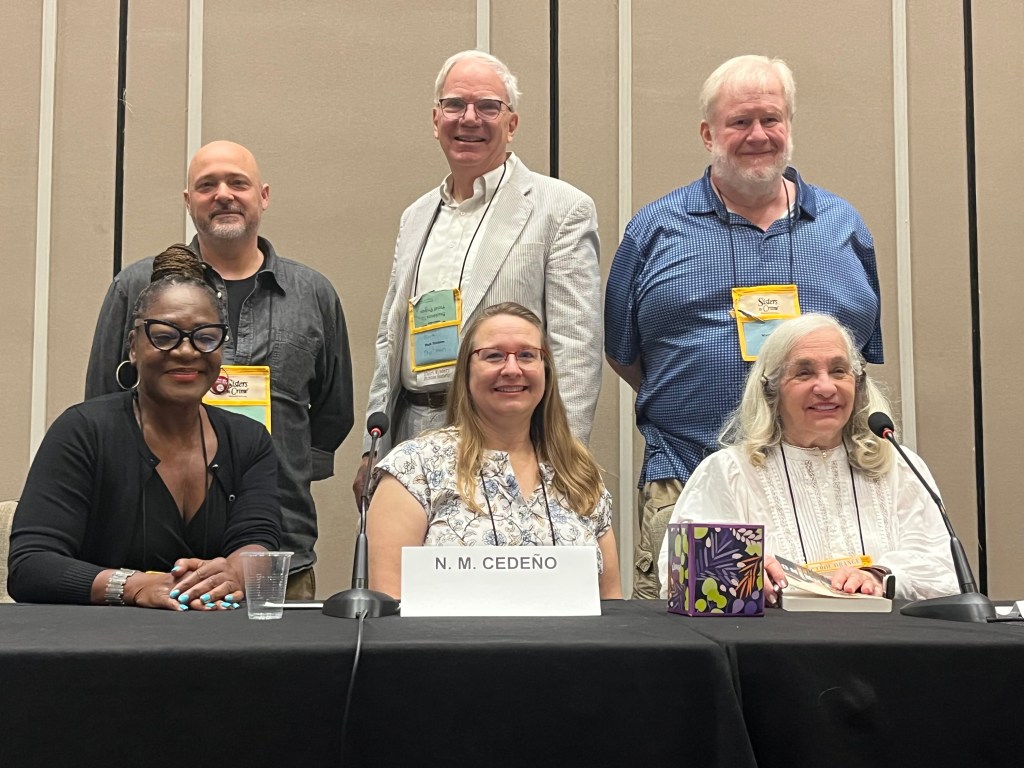
photo by KT Bartlett 2025

Last week, I attended Bouchercon 2025 in New Orleans, my second time to attend the world mystery conference. I learned my lesson in 2019 and placed myself on the list to be on a panel when I registered. And I was assigned to a panel discussing how authors create their authorial voices. I arrived in the assigned room to discover that I’d been placed on a panel with two English professors, a magistrate judge, and an art expert who were all mystery writers, with another mystery writer as the moderator. The line-up could have been intimidating. But I held my own and had as much intelligent information to offer about the topic as everyone else.

During the conference, I witnessed someone else suffering from “Imposter Syndrome.” I attended the Anthony Awards Ceremony and found myself seated at a banquet table with another author and her husband. The author was nominated for the Anthony Award. When an organizer of the event announced that each nominee and a guest or two of their choice should come to the front of the room to sit at tables reserved especially for them, the nominee at my table told her husband that she didn’t feel like she should go. I told her that she was nominated and deserved to be at the front. She refused to move, too self-effacing to feel that she belonged, even though she’d been nominated. The look on her face said that she doubted she would win, so she didn’t belong with those at the front closest to the stage.

When the ceremony reached my table-mate’s category, her husband began to record video on his phone. He had more faith in his wife than she had in herself. The look on her face when her name was called as the winner of the Anthony in her category was sheer surprise. She rose and went to accept her reward, no speech in hand, because she never expected to win. She managed to say a few words, thanking people while trembling slightly, and returned to our table, still in shock.

I congratulated her and told her that she deserved the award. She gave me a doubtful smile. I hope after she processes her win, she will realize that she did belong at the front of the room. I hope that she learns to accept that she is worthy of her own success.

I’ve met and heard of writers who do beautiful work, but are too filled with self-doubt to submit the work for publication or to publish it themselves. Their stories remain hidden in drawers and on hard drives. I’ve read novels that barely rose above average, but still were published. The difference in an average story that was published and a great story that was hidden away is frequently found in the confidence of the author in their own work.

What many of those self-doubting writers don’t know is how welcoming the mystery community is. The mystery community welcomes everyone at Bouchercon. By virtue of your attendance, you belong. Strangers will walk up and start conversations with you. Year round, organizations such as the Crime Writers of Color, Sisters in Crime, and the Short Mystery Fiction Society welcome aspiring writers and writers at every level of their careers, providing support and information to help them succeed.

If you are a writer, aspiring or published, of any genre, join a group and meet other writers. You belong!

*****

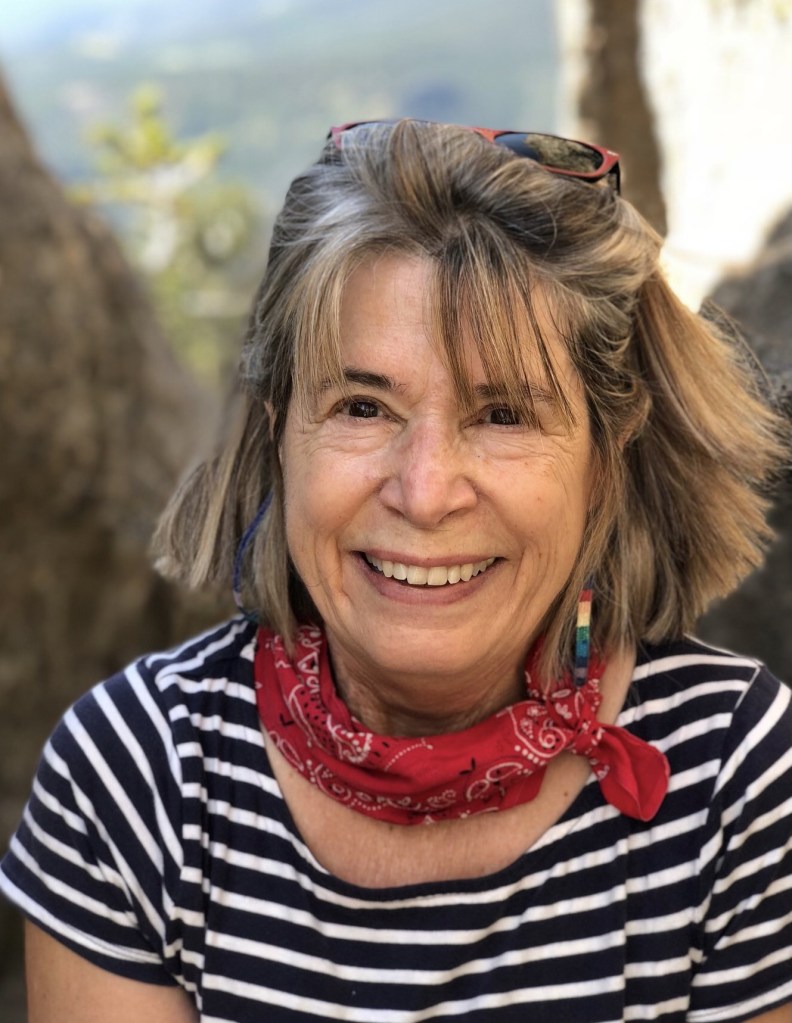
N. M. Cedeño is a short story writer and novelist living in Texas. She is active in Sisters in Crime- Heart of Texas Chapter and is a member of the Short Mystery Fiction Society. Find out more at nmcedeno.com.
See You…in September!

by Helen Currie Foster

It’s September 1. New school year! New shoes, after a hot barefoot summer! New outfit, for the first day of school! And then––new classes! New subjects, new teachers, new tools! New friends! New lockers, new classrooms, new hallways…. New season—new teammates, new coach, new plays.

Remember your first day back at school? Back to college, back to university? Do you remember the excitement, the nervousness, the anticipation?

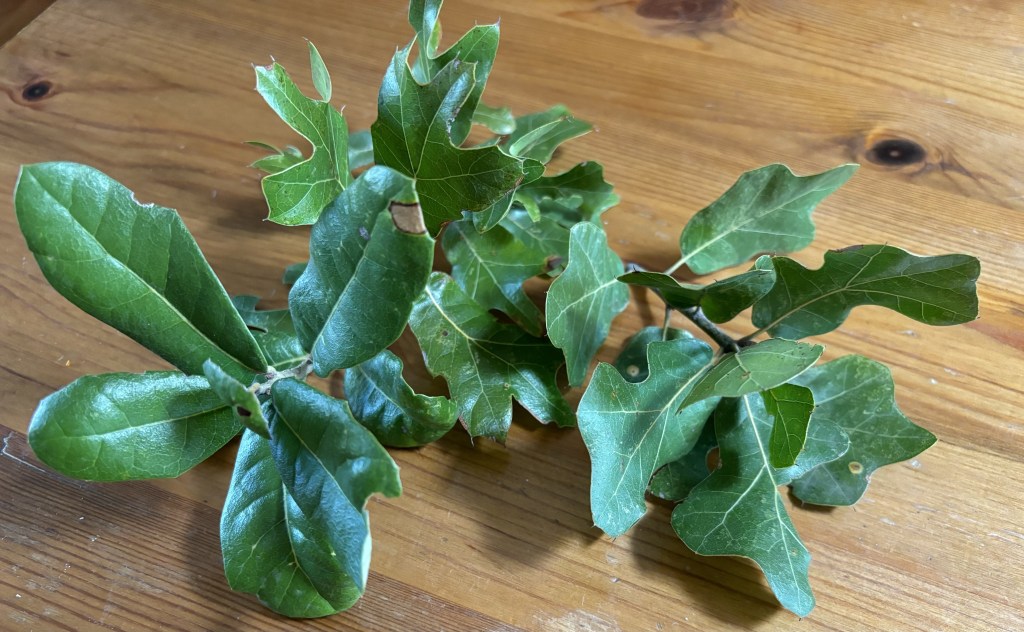
Today is Labor Day. And now there will be apples, apple pie and apple crisp. There will be chrysanthemums, spilling out of baskets. Even in central Texas, leaves will change color—as Maxwell Anderson’s lyrics have it, “When the autumn weather turns the leaves to flame.” Here in the Hill Country, sumac and Spanish oak turn red, sweet gum turns yellow. No, not the glory of the maples, but a change in the landscape. Because finally, after the dog days of summer, that’s what September brings: something new.

It’s time to pull up the tired summer flowers and thank them for their service. Time to dig some holes and plant new trees, and order some bulbs. I’ll be planting the Mexican plum seedlings a friend gave me, and ordering narcissus bulbs for indoor blooming.

Then the Hill Country brings its own fall excitement. Dove season began today and a down-the-road neighbor, disturbed by shotgun pellets falling on her roof, had to call the sheriff, and have officers explain to a clueless (thoughtless? lawless?) neighbor that it’s contrary to law to allow your ammunition to cross your own fence line. Also unneighborly. But hmm, that could find its way into a future book plot….

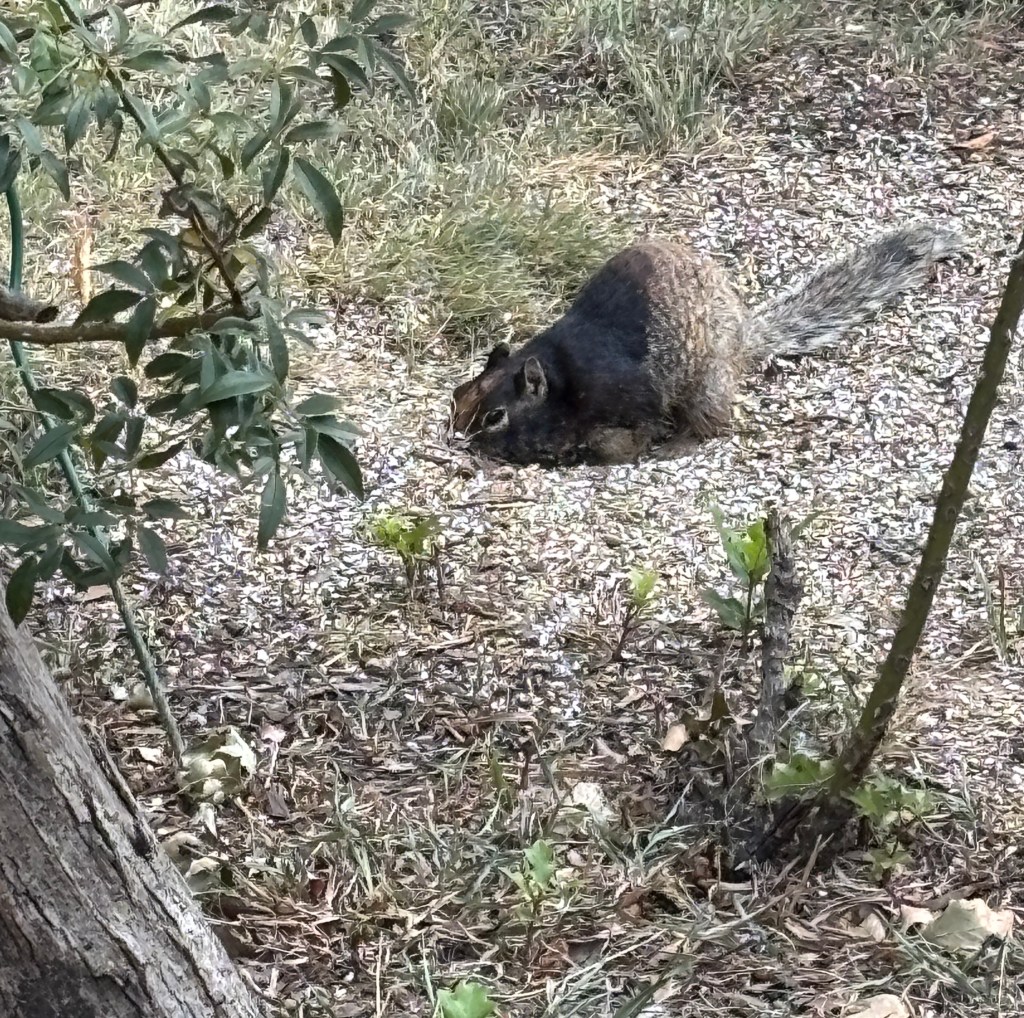
Our Hill Country holds surprises. One is the way water hides in the Hill Country—down in secret seeps and creeks, around curves and hollows. And what odd creatures live out here! For example, this fall we’ve seen again the rare and secretive rock squirrel.

(We’ve seen a solitary rock squirrel only once every few years.) We’ve heard the great horned owls that call at night, up and down the creek, and the herons who call, flying down the valley. The buzzards drone, annoyingly, from the tops of telephone poles. We treasure glimpses of the shy, gorgeous painted buntings who appear briefly at the bird feeder, then flit away. Porcupines visit. Roadrunners dart across the road.

And finally the dog days are over. (This year they were July 3-August 11, and these hot sultry days have borne their name from ancient times supposedly because it’s when Sirius, the Dog Star that accompanies Orion, rises with the sun.) https://www.almanac.com/content/what-are-dog-days-summer  But during the dog days I took refuge at night reading two mystery series that were new to me, by British author Peter Grainger: the DC Smith Investigation series and the Kings Lake Investigation. http://bit.ly/4gmPsad

These wry British procedurals are set on the coast of Norfolk, providing a cool and rainy ocean-side backdrop for the appealing characters. At least I could read about rain and cool breezes. But the books offered not only a respite from ridiculous heat, but a welcome respite from writing. For the last few weeks I’ve been finishing Ghost Justice—Book 10 in my Alice MacDonald Mystery Series, set here in the Texas Hill Country. For me that process inescapably includes waking in the wee hours with my mind on plot additions and subtractions, dialogue, characters. For just such moments—when the characters wake me up at night voicing their further demands (yes, they come alive!)—I find mysteries provide absorbing distraction.

Watch for Ghost Justice this week!

Helen Currie Foster lives and writes the Alice MacDonald Greer Mystery series north of Dripping Springs, Texas, loosely supervised by three burros. She’s drawn to the compelling landscape and quirky characters of the Texas Hill Country. She’s also deeply curious about our human history and how, uninvited the past keeps crashing the party. Follow her at http://www.helencurriefoster.com.

JUST LOOK AROUND!

by HELEN CURRIE FOSTER

Not enough rain fell this year to allow the brilliant cerulean fields of Hill Country bluebonnets we usually expect, but the hardy lupines are busy making seedpods. “Maybe next year,” they say. Now instead we have the bright yellow coreopsis lanceolata, nodding their heads with any breeze,

the wine-cups with their indescribable color—a member of the mallow family, not quite fuchsia, not maroon, just—heart-stopping,

the milkweed flower globes beloved of monarch butter-flies, and others. Heaven includes a few prairie celestials, magically opening in early in the afternoon, then vanishing by dusk.

Also, “Sweet Mademoiselle,” planted a couple of years ago, and who has never bloomed, produced her first rose!

Meanwhile, the ever-interloping cactus hope to assuage my fury at them (remember those secretly spreading roots and the huge basal “plates” that help the Cactus Conspiracy spread?) by popping open their yellow flowers. I am not fooled. I’ll continue to battle them with shovel and hoe. And a picker-upper.

Now for some Hill Country facts.

BIG CATS?  Just in case you thought the animal that appears in my mystery Ghost Cat was, perhaps, unrealistic? Over-the-top? Mere fantasy? Couldn’t have played a part at beginning and end? Not so! https://www.statesman.com/story/news/state/2025/04/21/mountain-lion-san-marcos-trail-texas-sightings/83194256007/

See? Perfectly possible. It’s still wild out here in the Hill Country, even as suburbs press upon us. At dusk I often find myself glancing at the edge of the drop-off behind the house, wondering if I’ll see a pair of ears. You can say mountain lion, puma, cougar…they’re secretive, strong, and active in the spring.

But the big cat I once saw on Bell Springs Road west of here was likely a large bobcat. I was alone, driving home from the post office. Up ahead a golden vision, spotted, walked slowly to the edge of the asphalt. I stopped. The cat stood, gazed at me, and after a breathless (for me) interval, gracefully turned and vanished through a fence into thick cedar. A magical moment. Every time I drive that road, I hold my breath, longing for one more sighting of something looking like this:

https://images.app.goo.gl/K9VMv8bW92CpoSacA

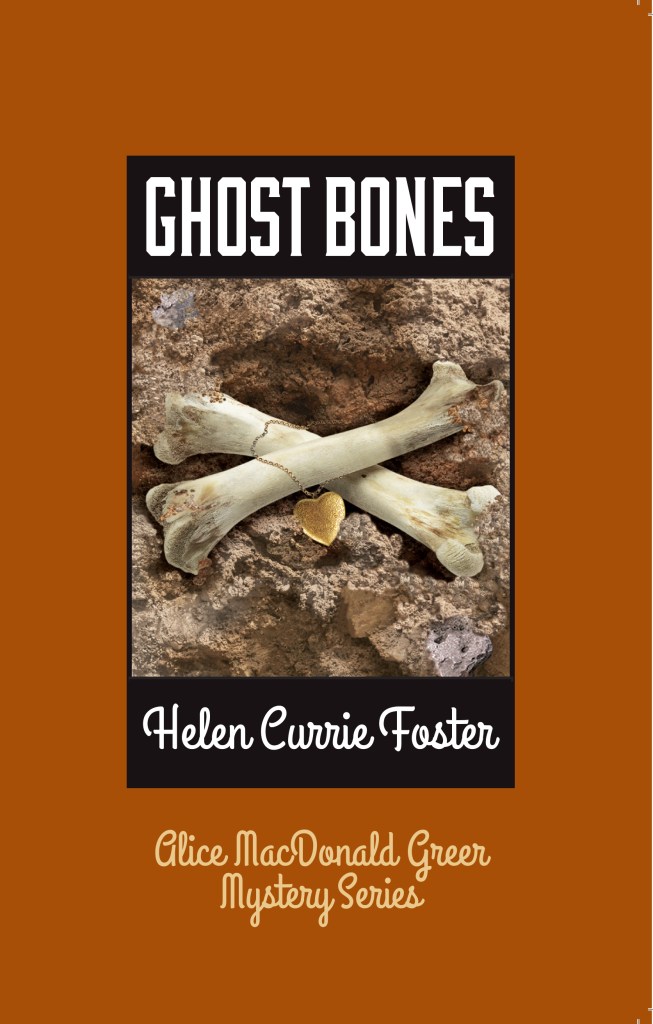
ANCIENT BONES? I wrote about old bones in my Ghost Bones (2024)—and now have learned that our Hays County police deal with ancient bones more often than you’d think. One resident recently called to report she’d found a skull in her firepit. The skull, with its lower jaw present, was obviously fairly old, but in an unexplained death Hays County is not permitted to send a body to the Travis County Medical Examiner without including the name of the person whose skull it is. (Hays County doesn’t have its own medical examiner.) So this skull traveled instead to Texas State anthropologists who reported, after testing, that the skull apparently belonged to a long, long-ago teenager who’d gone through hard times, as was evident from the “enamel lines” (a bit like tree rings) in the teeth.

But how it wound up in that firepit? So far as I know, that’s still a mystery. We forget—until reminded by a skull in a firepit—how long humans have roamed these hills, drawn by hunger and thirst to spring water and the hunt for food.

We also forget the age and history of this landscape. Some trees have sheltered native Americans, deer, and buffalo. The Columbus Live Oak near the Colorado River in Columbus is estimated to be over 500 years old. Others may be as old as 1,000 years.

https://tfsweb.tamu.edu/websites/FamousTreesOfTexas/TreeLayout.aspx?pageid=26882; https://goodcalculators.com/tree-age-calculator/

I revere the live oak in our front yard as if it were a beloved ancient relative and a symbol of stability and the power of trees. If anything were to happen to it—woe! I tried to estimate its age—using the calculator instruction to measure girth in inches at 4.5 feet, divide by pi, then multiply by a “growth factor” of 4, which gave me 127 years old. Perhaps this tree was a sapling in 1900, before either World War, before the Viet Nam war, before our current fraught politics. On a nearby hill there’s an ancient patch of even bigger live oaks. Perhaps those particular oaks depend on the odd little ribbon of wet white clay that lies about five feet underground and has been there—who knows how long. But the feeling of walking in beneath these old live oaks can confer a sense of being in the protection of one’s elders.  

So, welcome to the Hill Country in spring—southeasterly winds from the Gulf, blowing the flowers back and forth; reasonably moderate temperatures; fields and trees as green as green, as far as you can see. At the bird feeder, more color! Purple house finch, yellow-throated vireo, lesser goldfinch with brilliant gold breasts, vermilion cardinals, black-crested titmouse, white-winged dove—and the shy and tiny, but utterly gorgeous, painted bunting. (Reportedly it loves millet.) They provide not just color but music, from the titmouse, the tiny but high-volume Carolina wren, plaintive doves, whistling cardinals, and, at night, chuck-will’s-widow.

Not for long, of course. In winter ice can wreak havoc on trees and people. Summer sun? Scorching. Autumn? Nothing like the colors of New England, but hey—the sumac turns red. So welcome, Spring, with your bluebonnets and live oaks, with bird music and color, and with your reminder of the power and beauty of nature!

Progress report: madly working on Book 10 of the Alice MacDonald Greer Mystery series, set in the Hill Country. Have ordered “Forest Bathing” by Dr. Qing Li. Would enjoy hearing what you all are reading too, and any reports of “forest bathing”!

Helen Currie Foster lives and writes the Alice MacDonald Greer Mystery series north of Dripping Springs, Texas, loosely supervised by three burros. She’s drawn to the compelling landscape and quirky characters of the Texas Hill Country. She remains deeply curious about our human history and how, uninvited, the past keeps crashing the party.

Follow Helen at http://www.helencurriefoster.com.

EQUINOX!

by Helen Currie Foster

March 14, 2025

“An excess of animal spirits”–springtime! Really? Molly Ivins was right as usual when she wrote, “Texas–land of wretched excess!” We’ve had ridiculous lows, unseen for decades. Early daffodils and hyacinths came, shivered, and shriveled in the unholy cold winds roaring across the plains. But we’ve also had the earliest 90 degrees in decades! Wretched excess indeed!

Just two days until the vernal equinox on March 19, and spring. What makes us wander outside, searching for the first bluebonnet, the first violet? What makes us huddle outside the garden store, searching through the little plants shivering in the breeze, fingering seed packets, carrying home small pots of basil and blue salvia even though the weather’s far too untrustworthy for planting? What is this proto-agricultural spirit that makes us lug home the potting soil, hoe the garden bed? More sunlight? Cabin fever? Some early human gene? We, the Animal Kingdom, working with the Plant Kingdom?

I’m rereading Barry Cunliffe’s Europe Between the Oceans: 9000 BC-AD 1000 (https://amzn.to/3RfJzj6), a book I value not just for the stunning photographs of prehistoric sites and art, but for describing a history of human inventiveness. Cunliffe, Oxford Professor Emeritus of Archeology since 2007 (many books–– https://bit.ly/3XZkmNA), says “massive transformation” occurred in Europe between 1300-800 BC. Population growth required developing more crops than wheat and barley, including lentils, peas and—“the celtic bean (Vicia faba).”

Immediately I ordered a giant pack of fava bean seeds.

This image has an empty alt attribute; its file name is img_0981.jpg

Then I read the label: they’re mostly a winter crop–but this year I’m desperate. With last year’s blistering hot drought, I wound up with only one pot of cherry tomatoes on the porch and a dozen wilting jalapeno plants in the garden. Cunliffe’s reference to Vicia faba fired my imagination—envisioning myself harvesting large fuzzy green pods, containing delectable beans, and adding a little vinaigrette…olive oil (since 4000 BC) and vinegar (3000 BC). Using an ancient bean and ancient vinaigrette recipe! Possibly those beans were harvested, and the vinaigrette shaken, by some long-ago ancestor 3000 years ago, making me wonder if we have genetic preferences, genetic recipe roots? After all, we of the Animal Kingdom depend on the Plant Kingdom (oxygen, vinaigrette, and wine!).

Mysteries offer escape—a protagonist we like, an intriguing plot, a vivid setting. Like plants, favorite old mysteries offer much when we revisit. Mystery writers? They’re good to “talk to.” This morning I discovered on the shelf my dad’s 1934 Modern Library edition of Dashiell Hammett’s The Maltese Falcon, with a brief bio and the “new introduction” by Hammett.

This image has an empty alt attribute; its file name is img_0980.jpg

I didn’t know Hammett had worked as an operative for Pinkerton’s Detective Agency before he started writing! “Drifting through a miscellany of ill-paid jobs, he found a temporary solution to his economic problem by shadowing real malefactors with what might be called conspicuous success.” Then came the World War: “He won a sergeantcy and lost his health.”

Hammett can remember where he got his characters. Here’s a snippet of what he says about The Maltese Falcon:

“Dundy’s prototype I worked with in a North Carolina railroad yard; Cairo’s I picked up on a forgery charge in Pasco, Washington, in 1920; Polhous’s was a former captain of detectives…Effie’s once asked me to go into the narcotic smuggling business with her in San Diego…”

Hammett then muses about his own protagonist. “Spade had no original. He is a dream man in the sense that he is what most of the private detectives I worked with would like to have been and what quite a few of them in their cockier moments thought they approached. For your private detective does not—or did not ten years ago when he was my colleague—want to be an erudite solver of riddles in the Sherlock Holmes manner; he wants to be a hard and shifty fellow, able to take care of himself in any situation, able to get the best of anybody he comes in contact with, whether criminal, innocent by-stander or client.”

What a great description, and didn’t Humphrey Bogart nail it?

It strikes me that this new character of his upended the vision of the members of the London 1930 Detectives Club—Hammett gave the wide-eyed mystery audience a protagonist who is not a secret member of the aristocracy (Albert Campion) or a perfect gentleman (Roderick Alleyn) or a hyper-particular French veteran drinking tea and waxing his moustache (Hercule Poirot)…but a “hard and shifty fellow…able to get the best of anybody.” Welcome to the New World’s new-style mystery protagonists, the children of Hammett, Raymond Chandler, Sara Paretzky and others…including that hybrid protagonist, Mary Russell, in Laurie King’s Mary Russell and Sherlock Holmes series.

For Mary Russell and Sherlock Holmes, the scent of honey is a repeat theme (her Holmes is a beekeeper). I like her Holmes, I like her Russell, and just finished her Garment of Shadows (2012). https://bit.ly/4iTwmYZ King has chosen a fascinating and ambitious setting: the 1920’s, with Spain and France fighting for control of Morocco, each coveting its crucial strategic location at Gibraltar, while various Moroccan groups—Berber and otherwise—fight for independence. King uses first person point of view for Mary Russell, who’s suffering from acute amnesia—forgetting her childhood and even her marriage––but uses third person POV for Holmes’s chapters. Those shifts sometimes confused me. But her depth of history and geography, and her vivid descriptions of the magical city of Fez with its souk, bring the setting alive. Mary Russell herself has become quite a protagonist, with linguistic skills—including Arabic––and the imagination and drive to devise a daring escape from a horrible prison. I’d like to learn knife-throwing like Mary Russell (she keeps one in her boot) but the likelihood seems dim.

Writer/theologian Bruce Reyes-Chow mentioned how, when stuck, he’d “talk through ideas with myself, my plants…” I intend to follow his lead. On our deck sit five jasmine plants we’ve toted around since the seventies. I think they sometimes do communicate with me—“I’m dry-y-y-y!” But from now on, when I’m stuck on a plot, I’ll go consult them. Every spring, those jasmine produce tiny white flowers with an unmatchable scent. In search of even more scent, this year I’ve planted another mix of old and new. Rose de Recht is a fragrant pink heirloom damask, Fragrant Blush promises pink perfume, and Star of the Republic is tough, like her name, but delicate pink with exquisite fragrance.

This image has an empty alt attribute; its file name is img_0978.jpg

And now suddenly the redbuds, with their irresistible yet evanescent fuchsia buds, are blooming. I’ve seen our first bluebonnet,

This image has an empty alt attribute; its file name is img_0974.jpg

and the first purple prairie verbena. The live oaks know it’s almost the equinox—they’ve flung down their old leaves (aided by the fierce winds) and are preparing their catkins and baby leaves. The cedar elms have put out tiny chartreuse leaves just in the last two days.

This image has an empty alt attribute; its file name is img_0973.jpg

So it’s spring! Grab that trowel! And after all your work, you deserve to loll on the couch at night with a good mystery. I’m halfway through the tenth book in my Hill Country murder mystery series. This one raises a question I find intriguing and difficult. Can justice be served when, unauthorized to pronounce justice, we take justice into our own hands? Is that still justice? I’m discussing it with the plants. More to come….

This image has an empty alt attribute; its file name is img_1776.jpg

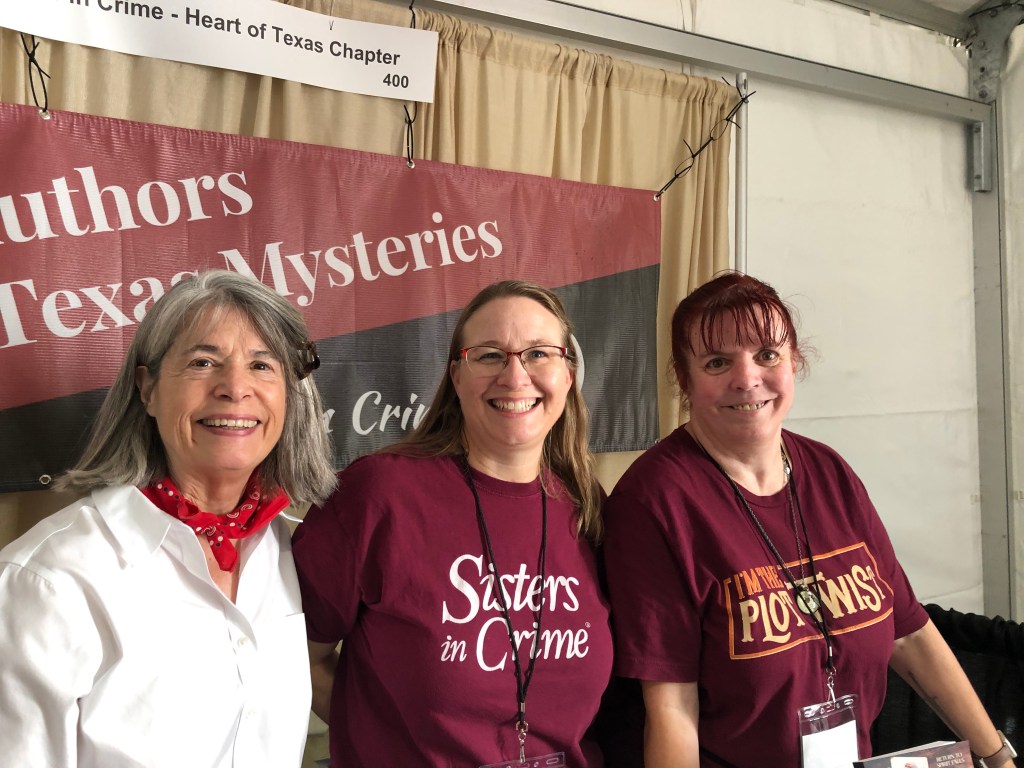
Here are Helen, Noreen Cedeno, and Juanita Houston at the Texas Book Festival!–Heart of Texas Sisters in Crime

Award-winning Helen Currie Foster lives and writes the Alice MacDonald Greer Mystery series (9 volumes so far) north of Dripping Springs, Texas, loosely supervised by three burros. She’s working on Book 10. She’s drawn to the compelling landscape and quirky characters of the Texas Hill Country. She’s also deeply curious about our human history and how, uninvited, the past keeps crashing the party.

Follow her at http://www.helencurriefoster.com and at https://www.amazon.com/stores/Helen-Currie-Foster/author/B00R1X9RXK?https://www.facebook.com/helencurriefoster

Frosty Weather!

by Helen Currie Foster

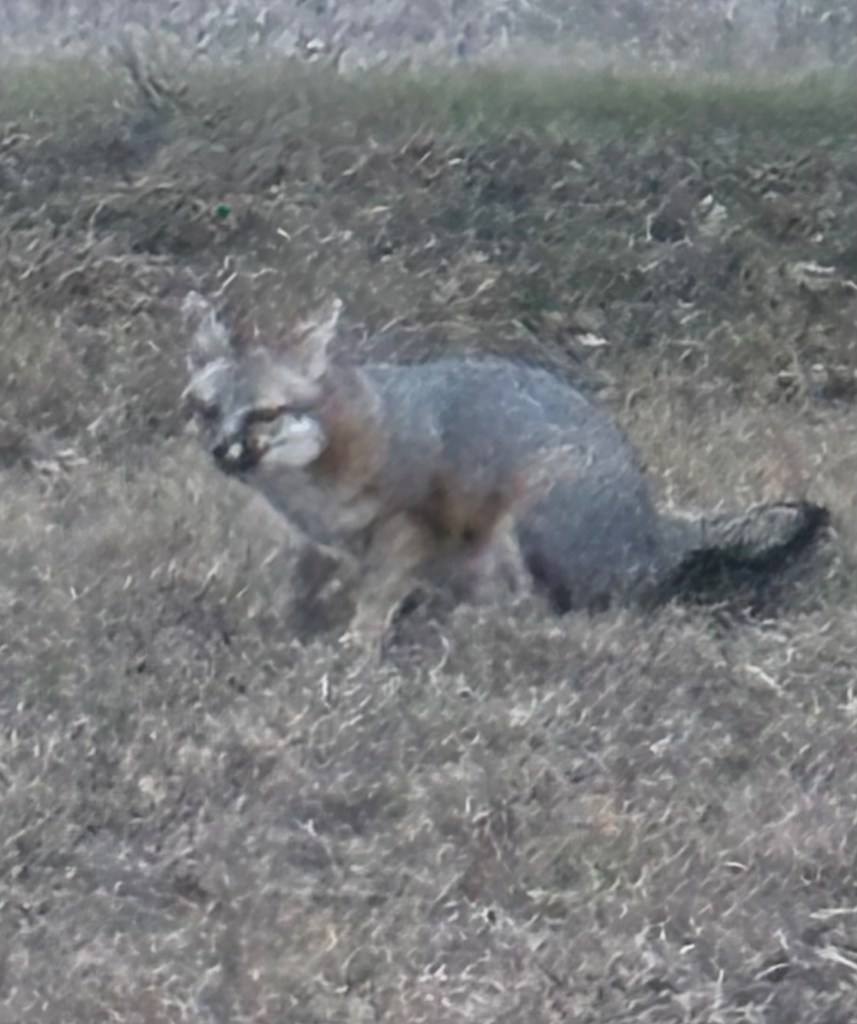
Brr!! It’s so cold the foxes are prowling the front yard looking for snacks and the birds are up at dawn waiting for their humans to show up with the bird feeders.

Dawn and twilight, twilight and dawn: Out here in the Hill Country, planets and stars still visit regularly. Lately Mars (on Jan. 12 it came as close to us as it gets, every couple of years) has been showing off after dark in the eastern sky, glowing orange-red like a war god’s shield. Jupiter rises high above, competing on brightness with Venus off in the west. Last week Venus revealed itself above the sunset, above rows of pink clouds like swishing skirts below. Close to Venus but a bit “left” or south you can spot Saturn (admittedly I get help from the Skyview app)—small and far away but Saturn still hopes we’ll at least leave a comment in the planetary visitor’s book. I find it both exciting and comforting that out here we still can see planets, unbothered by earthly chaos, spinning through space, away from us, then back again. (If lights are encroaching on your nights, consider joining Dark Sky!)

Which takes me back to our earlier sky-watching ancestors. Housebound this icy weekend, I found myself checked 23andMe and discovered I have the first in a list of Neanderthal gene variants, tactfully (really beautifully) described as: “…one variant associated with having difficulty discarding rarely-used possessions.”

Spang on! So true! I know some of you readers are fully capable of blithely opening a dusty box of someone’s old t-shirts and thinking—does he really want to keep his t-shirt from basketball camp thirty years ago? Surely not. Off to Goodwill!

But because that shirt unearthed memories of stories of basketball camp, my Neanderthal variant ordered, “put that box back on the shelf!”

And “rarely-used possessions” can still be extremely valuable. The perfect rock for chipping a new axe? The best cave for winter living? The skin bag of crushed ochre? It’s important to remember where these things are! https://www.durham.ac.uk/departments/academic/archaeology/archaeology-news/neanderthals-the-oldest-art-in-the-world-wasnt-made-by-homo-sapiens/

Still, in our “too much stuff” world, while 23andMe offered a tactful way to describe this Neanderthal variant, perhaps a more useful term is—“difficulty discarding memory-stirring possessions.”

Maybe your home (like mine) also holds a number of “rarely-used possessions.” For Marie Kondo the operative question was “does it evoke joy?” My new question for the “rarely-used possession” is, does this actually stir memories? What “memory containers” do we really, truly, keep going back to? Not just keep, but go back to? Pick up and look at again? And remember?

For me? Not old diaries. Certainly not yearbooks. Nor even boxes of pictures. But certain old clothes do remind me of memories and milestones: the suit bought for interviewing during law school. A treasured fleece from a rowing competition. Even childhood clothes that are long-gone live in memory—the sweater a grandmother knitted (second grade), the scratchy little swimsuit for swimming in a mountain lake (third grade), the blouse saved for with baby-sitting money.

Other sources of memories, similarly intangible? Music, of course, especially if dancing was involved! First time slow-dancing in seventh grade! First time at the Broken Spoke, trying the Cotton-Eye Joe! Sam’s Town Point on a perfect night–– https://www.samstownpointatx.com/––with Floyd Domino and the All-Stars and everyone dancing! http://www.floyddomino.com/dates-news.html Do dance memories stick in your head too?

One cache of memories I desperately wish I had––and you might too––involves the night-time communal dances of the San people of the Kalahari, in southern Africa. These memories are vividly described in Once Upon a Time Is Now, A Kalahari Memoir,

by the extraordinarily distinguished anthropologist Dr. Megan Biesele, a treasured friend. https://amzn.to/4at9o8o  Megan lived with the San people and on many, many nights watched them engaged for hours of singing, dancing, retelling traditional stories—and healing. She describes the synchrony of the dance around the fire:

“Anything…could happen as the people took up the tools…of their voices and their hands, their legs and their feet, their knowledge of each other, and of their reliable power to create, with each other, a force for heath and peace. As the voices blended in a polyphony of endless incremental variation, as the powerful stamping of the men’s feet took them in measured, inexorable progress around and around the dance circle, I felt the waves of energy…it was impossible not to become linked to the process myself.  [P]eople seemed with each movement, each note of singing, to call out to each other and to receive instantaneous response…. Every dark night could become a bright night of the soul.” (Id. at 173-4)

I still haven’t figured out how to get Alice, my protagonist in the Ghost mystery series set in the Texas Hill Country, to the Kalahari. She and her beau, Ben Kinsear, would really like to go. Meanwhile they will keep dancing at the Beer Barn, in Coffee Creek. Also, Alice still keeps her kids’ baby clothes, and one of her mother’s hand-made dresses, and the white Gibson-girl dress her great-grandmother wore back before WWI.

But maybe I’ll take a spring-cleaning-vow for a box or two. Watch this space.

Meanwhile, remember the birds can lose 10% of their weight just keeping warm on a frigid night. Keep your feeders filled! And stay warm!

Helen Currie Foster lives and writes the award-winning Alice MacDonald Greer mystery series in the Texas Hill Country, north of Dripping Springs, loosely supervised by three burros. Coming soon–Book 10 in the series!

Curious Animals and Recent Reads

by Helen Currie Foster

New reads! If, like me, you desperately miss John le Carré, consider A Spy Alone, the 2023 debut spy thriller by Charles Beaumont, a field operative veteran of Britain’s MI-6. https://bit.ly/3ZzHjHs His premise is fascinating: we know of the “Cambridge Five” who spied for Russia from the 1930’s to 1950’s—Kim Philby, Guy Burgess, Donald Maclean, Anthony Blunt and John Cairncross. https://en.wikipedia.org/wiki/Cambridge_Five But has there ever been, or could there be, a spy ring linked to Oxford? Beaumont’s protagonist Simon Sharman feels real, right from the first page:

“It is their shoes that give them away. As a lifelong fieldman, Simon Sharman hasn’t forgotten the lesson: walkers might change their jackets, pull on a pair of glasses, even a wig. But nobody changes their shoes on a job. Look at their shoes. 

I was hooked. Warning: Beaumont’s book is contemporary, well-written, tense, and may interfere with sleep. 

Two other recent reads: old adventure and a new “adult fantasy.” I’d never heard of The Long Ships by Frans G. Bengtsson (1954). Set from 980 to 1010 A.D., the book recounts the wide-ranging adventures of Norseman Red Orm Tostesson, and the collision between Christian priests (the “shaven men”) and the Norse culture of Skania at the south tip of Sweden. Now I know what it meant to go “a-viking”—to go sea-raiding! 500 pages, with Red, a very engaging Norseman. Great maps, too.

The Lost Bookshop, by Evie Woods (2024), offers time travel between the 1920’s and 30’s in Britain, and the present; a search for a lost Brontë manuscript; a disappearing attic; and disappearing and reappearing characters.

I confess I flipped through big chunks, relieved when true love finally won out after two women, generations apart, survive appalling treatment. The disappearing attic reminded me of Susan Cooper’s Over Sea, Under Stone,

and of course the wardrobe into Narnia in The Lion, the Witch and the Wardrobe. I’m always up for secret doors. 

I’m rereading a fascinating and fairly demanding study by Graham Robb, who has probably bicycled and walked further in Britain and France than most humans.

In The Search for Middle Earth: Mapping the Lost World of the Celts (2013)he describes how the Keltoi, or Celts, developed a system of surveying based on a midline transected by the lines of the summer and winter solstice to estimate travel distances and times—a feat not replicated for centuries. He maps the Heraklean Way, the path from southwestern Iberia that runs northeast across the Pyrenees to the Alps along the diagonal of the solstice sun, which Hannibal took when he invaded Italia. He describes Druid schooling (20 years to learn) and maps out protohistoric forts which turn out to lie along survey lines. He provides amazing maps. Two ongoing lessons from Robb’s devoted research: the winners write history; and humans tend to underestimate the accomplishments of earlier civilizations. 

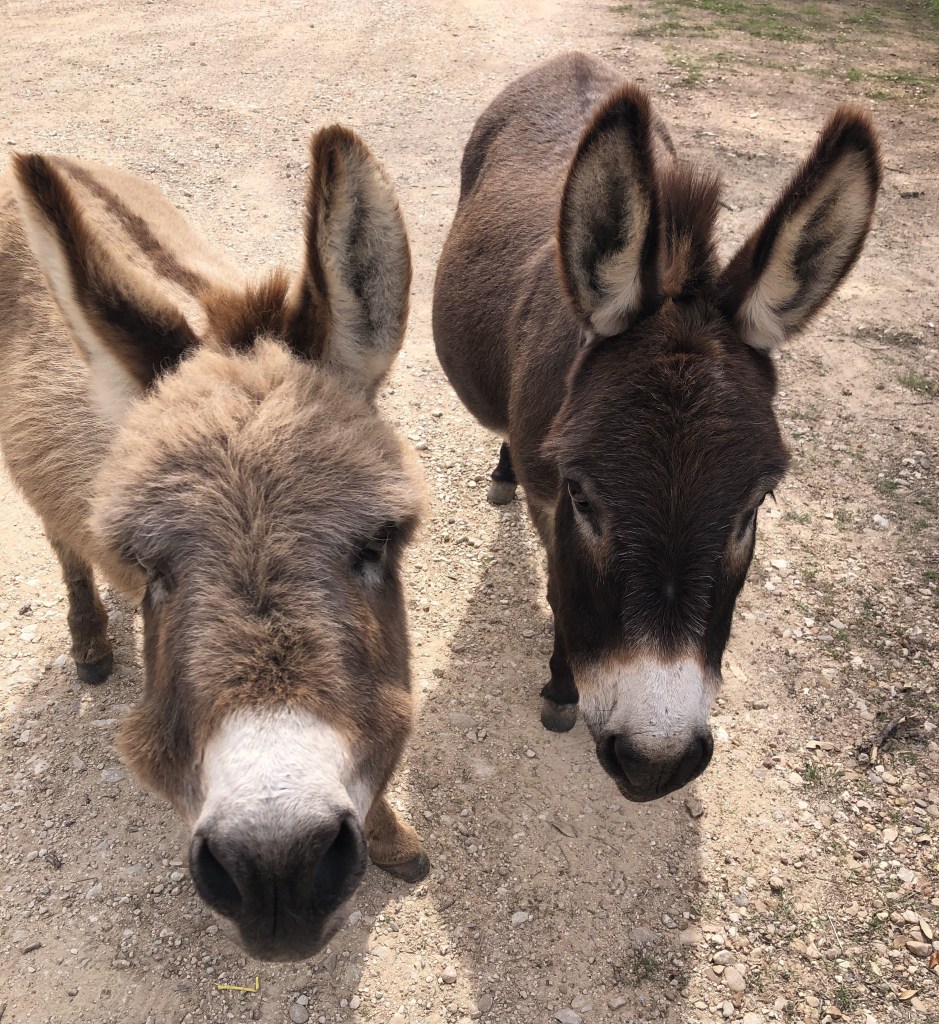
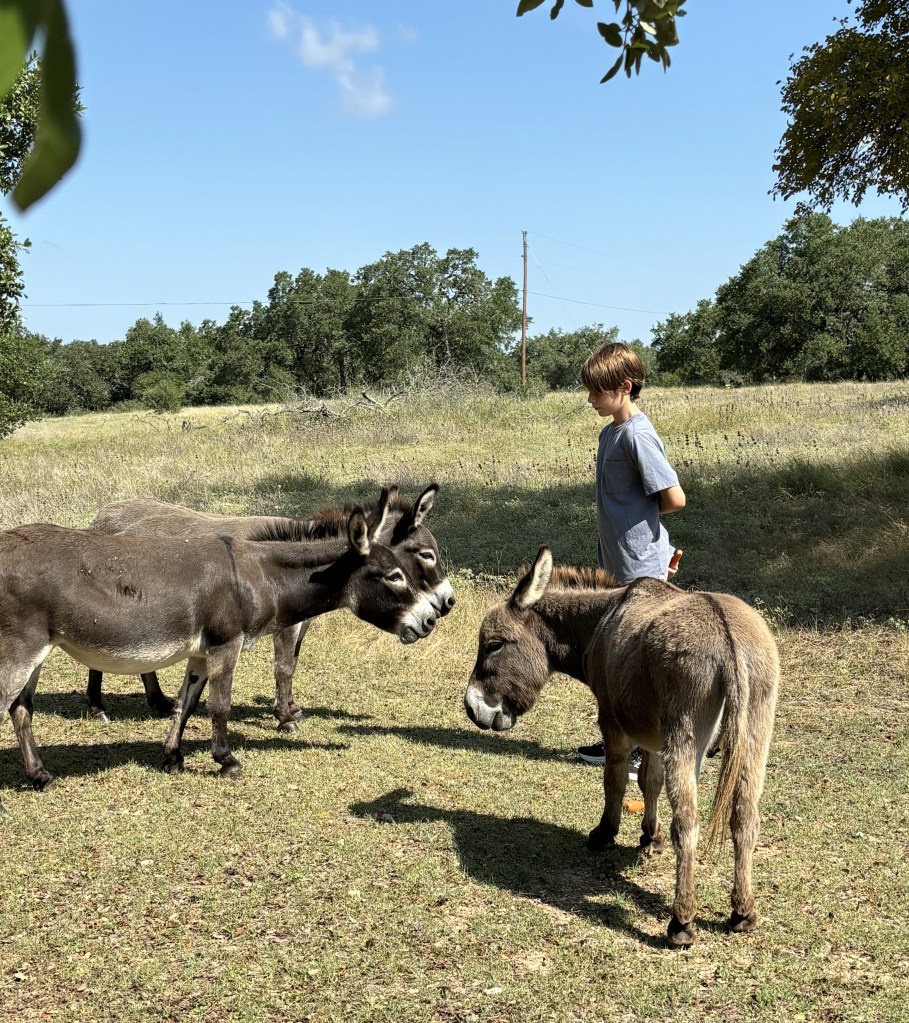
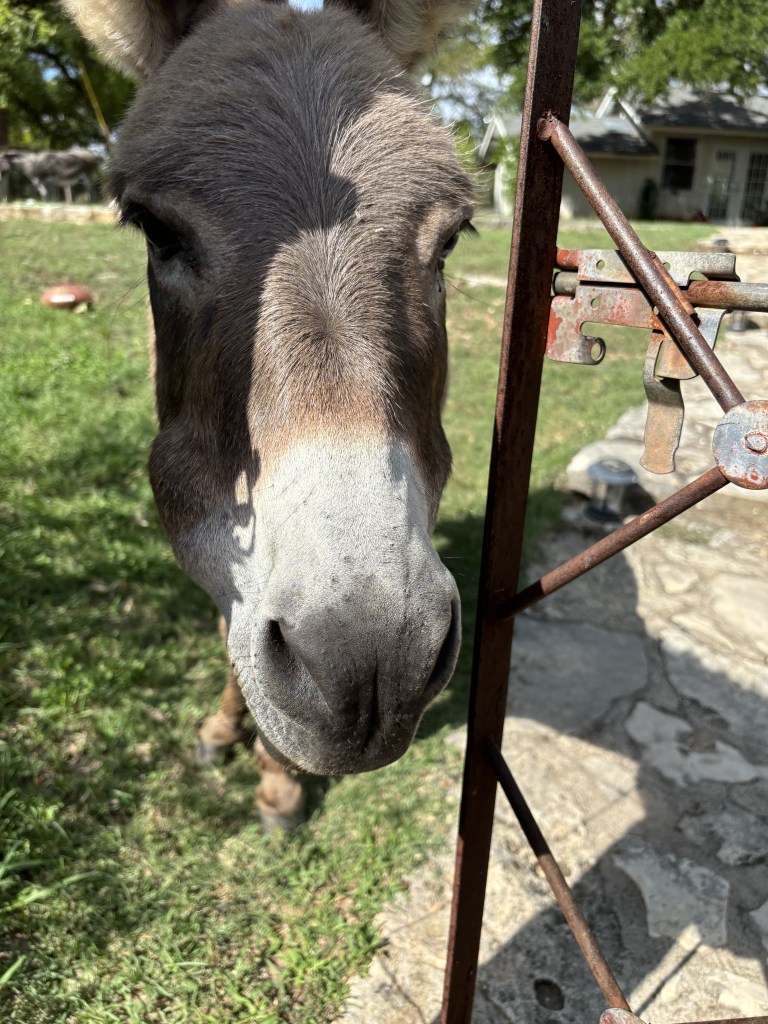
Several of you asked about the three burros, given the recent cold snap. Thank you, they’re well. Their hair’s not waterproof so in cold rain they gather on the south side of the stable, under the roof, safe from rain and the north wind. They were relieved to see green grass again after the drought broke, but they’re also eating—and rolling in––green hay. And mud!

Yet despite hay, they gather outside the gate every morning and afternoon for carrots. They consider this part of their deal.

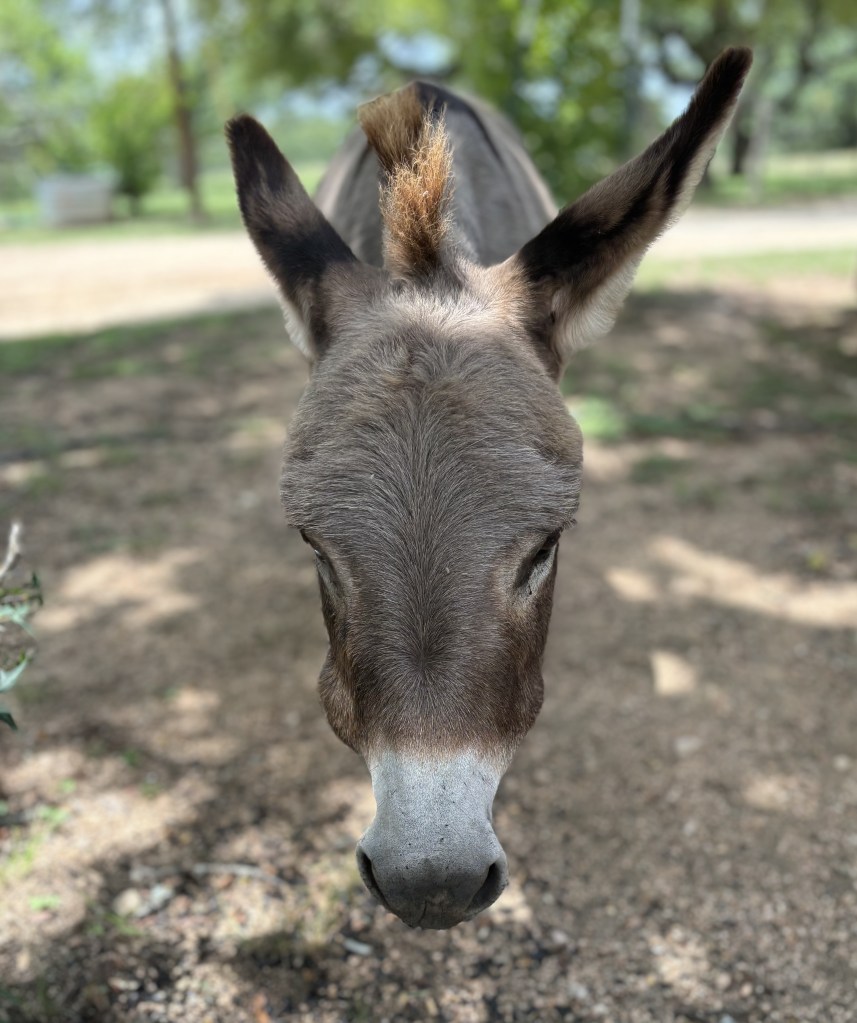
Burros are curious. They amble over to watch us garden and hang up laundry. They need company. They graze near each other. They may live into their 40’s. Sebastian, the short stubby knock-kneed male who invited himself to live here, may be 35 or more. Amanda (who insists I tell you she’s registered, with papers) may be 20. Her daughter Caroline is 12. Sebastian deems it his duty to bray loudly when any person or car appears at the end of the driveway, and to welcome the sun every morning with a stunningly loud bray. Now both Amanda and Caroline have begun to bray occasionally. 

Only donkeys can bray. Unlike horses or zebras, donkeys begin a bray on the inhale and continue braying on the exhale. They have great hearing—supposedly they can hear another donkey bray 60 miles away. 

They especially detest canids and will attack, dance on and kick dogs, coyotes, bobcats, foxes. A spooked horse will run away: donkeys stand together until they decide what they’re going to do. This morning, leaving for the post office, I saw the three donkeys standing together, knees locked, ears cocked, eyes fixed on two trespassing dogs who’d strayed across the cattleguard and into the donkeys’ domain. 

The dogs immediately acknowledged their gross error of judgment, raced frantically away and never returned.

If donkeys could read (wait—maybe they can, but have trouble turning the pages), I predict they’d prefer mysteries. They enjoy puzzles (like how to lift the chain and invade the fenced garden). 

Humans and donkeys. We are both curious animals.

Helen Currie Foster lives and writes the Alice MacDonald Greer Mystery Series north of Dripping Springs, Texas, loosely supervised by three burros. She’s drawn to the compelling landscape and quirky characters of the Texas Hill Country. She’s also deeply curious about our human history and how, uninvited, the past keeps crashing the party! Currently she’s working on Book 10. Her protagonist, Alice, gets into legal drama, and matters of the heart. Alice does have a treehouse…

Follow Helen at http://www.helencurriefoster.com and on Amazon and Facebook, https://www.facebook.com/helencurriefoster

The Woods Are Lovely: A Passion for Trees

Helen Currie Foster

October 29, 2024

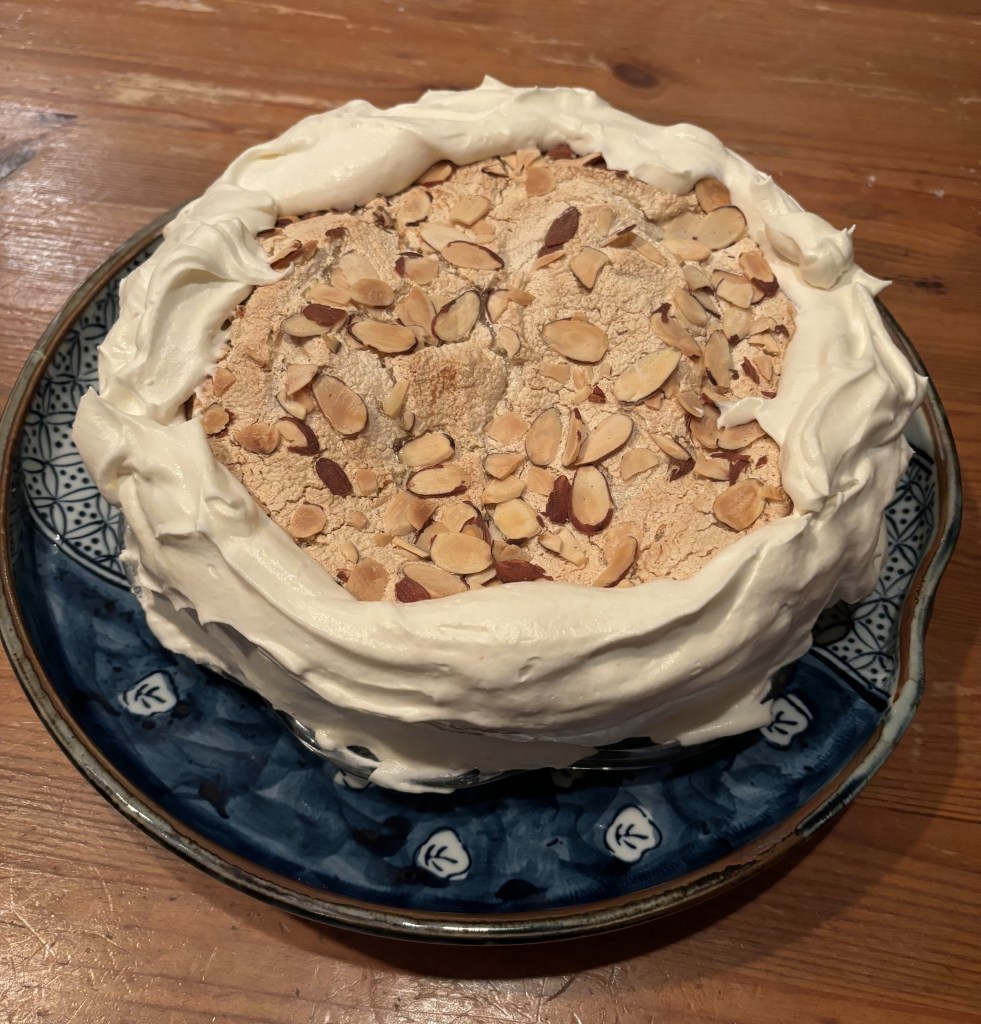
The mystery is solved! In my search for  what I recalled as “the “Blitzkuchen” once served at Schwamkrug’s outside New Braunfels, in the Texas Hill Country, I had the name wrong. It’s a blitz torte, not a blitz kuchen! Several readers sent recipes from German cookbooks indicating that “Blitzkuchen” is a quick cake, usually one layer only. My memory, though? A tall two-layer confection, baked with meringue and almond flakes on top and between the layers! And in my memory, more meringue on the outside, plus some moistness in the filling.

Online I found Oma Gerhild’s “Oma’s Blitz Torte Recipe ––Lightning Cake.” https://www.quick-german-recipes.com/german-blitz-torte-recipe.html  Each almond-flavored layer is baked with meringue and sliced almonds on top of the batter. The recipe offers either custard filling or whipped cream filling. I opted to finish off with whipped cream with powdered sugar and vanilla, not just inside, but around the cake (and in blobs all around the kitchen).

FINALLY! First, that lovely almond taste. Plus, everyone at the table now wore an attractive little white mustache of whipped cream. You don’t get that with a madeleine and a cup of tea, do you, M. Proust?

As October runs into November, Texas Hill Country towns are celebrating Oktoberfest, or, in New Braunfels, Wurstfest. Normally by now our trees would show some fall color––nothing like New England, of course. The cypresses by Lake Austin are turning bronze. Out here north of Dripping Springs, the possum haws are showing their red berries. The cedar elms turned bright yellow, then slowly lost their leaves. The live oaks, thankfully, stay green.

But this year? Drought brings bad news for trees. Cypress-lined creeks are dry…the cypresses’ arched roots groping into the earth for water. Downhill at our place Barton Creek is dry, and I mean dry, with only occasional small pools. Up on the limestone plateau the leaves on some smaller saplings just turned brown and fluttered to the ground, with the tree already looking dead. We’re watering, but in Stage 2 drought restrictions. Will our wells run dry? Have we drained the Trinity aquifers that lie hundreds of feet below?

So, to general geopolitical angst, I’ve added…tree worry.

Trees in books play such a role in our imaginations. After reading Johann David Wyss’s Swiss Family Robinson (1812)—where the shipwrecked family builds a tree-house on their desert island––I always wanted to live in a tree-house! https://en.wikipedia.org/wiki/The_Swiss_Family_Robinson We’re drawn to forests, home of the trees—scary, but sometimes the safest place. In The Sword in the Stone by T. H. White (1939), first of the four volumes that make up The Once and Future King, the Wart (the young Arthur, under Merlin’s tutelage) and Kay meet Little John who tells them about Robin Wood (explaining why it’s not “Robin Hood” and why he lives in the woods (or “‘oods”):

“They’m free pleaces, the ‘oods, and fine pleaces. Let thee sleep in ‘em, come summer, come winter, withouten brick nor thatch, and huntin’ ‘em for thy commons lest thee starve; and smell to ‘em with the good earth in the springtime; and number of ‘em as they brings forward their comely bright leaves, according to order…”

There the boys, the future King and Sir Kay, approach “the monarch of the forest. It was a lime tree as great as that which used to grow at Moor Park in Herefordshire, no less than one hundred feet in height and seventeen feet in girth, a yard above the ground….” Headquarters for Robin Wood and Maid Marian! And there begins a great and perilous adventure for Kay and Wart, who break into the castle of Morgan le Fay, Queen of Air and Darkness—to rescue prisoners paralyzed by magic. (Speaking of paralyzed victims of witches—note how C.S. Lewis later describes turned-to-stone courtyard figures in his first foray into fantasy, The Lion, the Witch and the Wardrobe (1950).)

One writer, Elisabeth Brewer, notes that “The Sword in the Stone shows a passion for trees that White shared with Tolkien. https://bit.ly/3Ceqk. How about the Ents we meet in Fangorn Forest, in J. R. R. Tolkien’s Middle-Earth? Trees that walk…and tend other trees. Not all trees are benign––including the wicked old willow which captures Frodo and friends (rescued by Tom Bombadil).

I’m reading a fascinating graphic (yes, graphic!) book about Tolkien and his close friend C.S. Lewis: The Mythmakers: The Remarkable Fellowship of C.S. Lewis and J.R.R. Tolkien, by John Hendrix. https://bit.ly/4hqiyFr

Tolkien and Lewis met in 1929 in Oxford, where they were, famously, members of a writers’ group, the Inklings, and shared many hours at The Eagle and Child. That’s not all they shared. In 1916, both men experienced horrific warfare on the Western Front in France. Young and just married, Tolkien fought in the trenches, then contracted life-threatening trench fever. At nineteen, Lewis was wounded by shrapnel (from friendly fire) on the Somme, and carried shrapnel in his body the rest of his life. Hendrix’s wonderful book uncovers the sort of salvation two disillusioned veterans found in the healing power of imagination, including Norse mythology and the European fairy tale. Tolkien knew of Yggdrasil, the sacred ash tree central to Norse mythology. https://en.wikipedia.org/wiki/Yggdrasil; https://dc.swosu.edu/cgi/viewcontent.cgi?article=2130&context=mythlore

And how the worlds created by Lewis and Tolkien fired our imaginations! The fantasy world of C.S. Lewis’s Narnia emerged when The Lion, the Witch and the Wardrobe was published (1950). Tolkien’s The Hobbit, or There and Back Again, was first published in 1937 but became a pop-culture phenomenon only in 1960’s, when the paperback edition became available. https://time.com/4941811/hobbit-anniversary-1937-reviews/

Both Lewis and Tolkien had copies of The Sword in the Stone early on. Indeed, in 1939 it was a Book-of-the-Month Club selection. T. H. White 1964 obituary, https://nyti.ms/4hlasht. Curiously, Hendrix’s book on Tolkien and Lewis doesn’t mention T. H. White, perhaps because Hendrix focuses on the impact of war; T.H. White 1906-1964) was born too late to serve in World War I. Nor was he an Oxonian. While C.S. Lewis reportedly disparaged The Sword in the Stone in 1940, he later invited T. H. White to the Inklings if he ever visited Oxford. https://bit.ly/4f4wcww (“Dickieson post”). Perhaps Hendrix doesn’t mention T. H. White because unlike Tolkien and Lewis, though he creates a fantasy world, White grounds The Once and Future King firmly in England.

But Elisabeth Brewer commented in T.H. White’s The Once and Future King that The Sword in the Stone shows a passion for trees that White shared with Tolkien. (Dickieson post.)

What about powerful trees in more recent books? Consider the Whomping Willow, in J. K. Rowling’s Harry Potter and the Wizard of Azkaban? https://bit.ly/4f1koex Magic—but terrorizing—it reveals the secret passage which ultimately allows Harry and friends to discover––well, remember? Indeed, Harry reminds us of T. H. White’s Wart, both with an earnest determination to do right, and a magical tutor.

Maybe children are especially open to tree power because they still climb trees. My dad swooped us off to grad school in Atlanta, and then to Charlotte, before we moved back to Texas. In the southeast I discovered the power of pine trees. We children built an admirable and secret treehouse in the woods, where we surveyed the world from on high. No parents came near to scold or warn: deep in the trees we ruled our own domain. Later in Carolina at eleven, I could climb the neighbors’ big back yard pine all the way to the top. The tree swayed slowly back and forth, but I could see the entire neighborhood and beyond. Tree power.

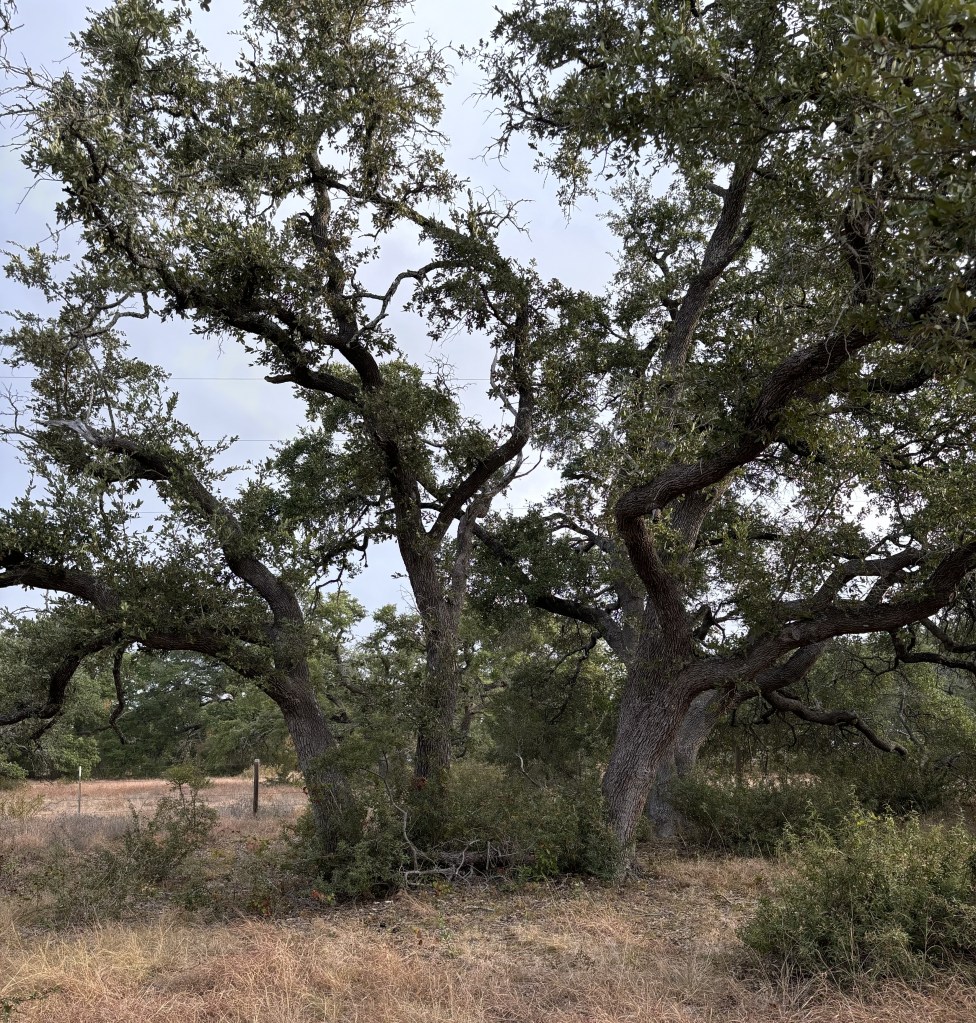
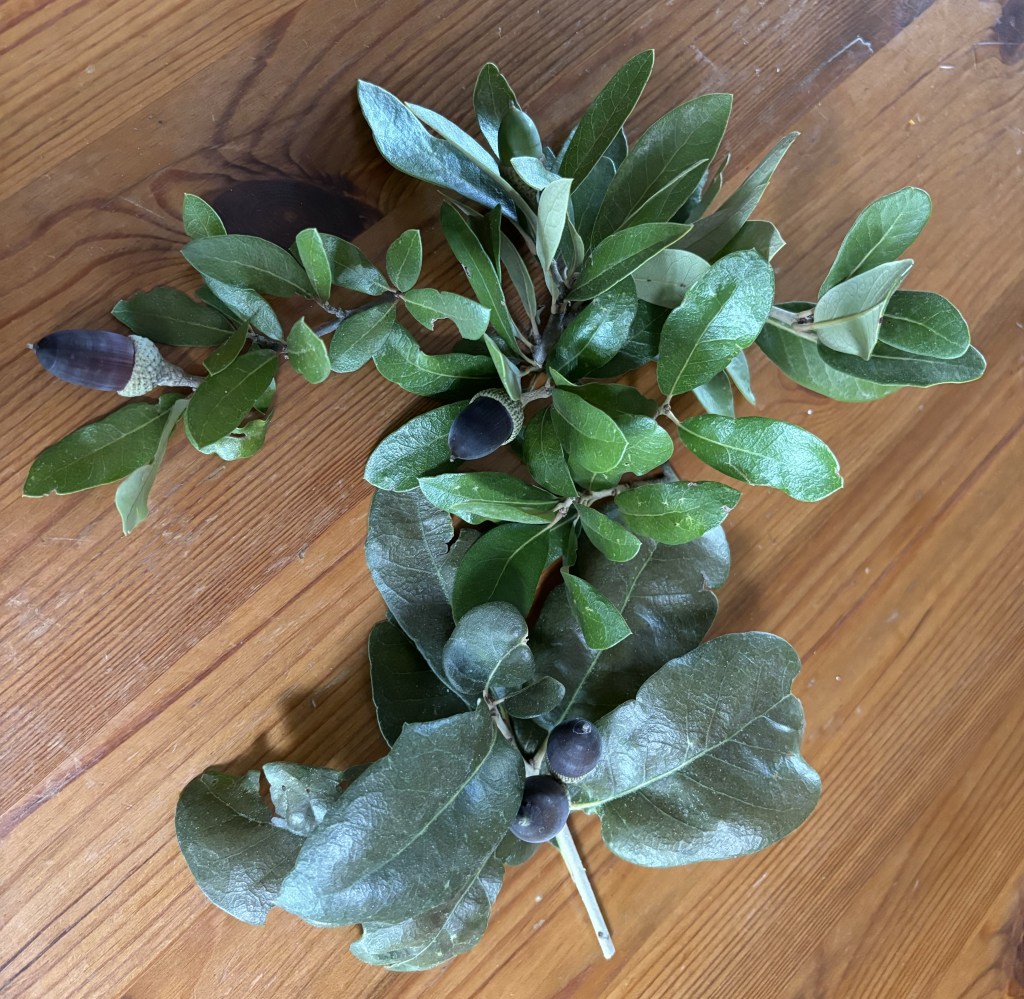
Out here on the Edwards Plateau, in the rugged karst landscape above a hill country creek, live oaks rule. The big evergreens, up to sixty feet tall, with a wide crown and massive limbs close to the ground, are Quercus Virginiana. They often grow in a circle—and you know they are communicating through their root systems. https://www.npr.org/sections/health-shots/2021/05/04/993430007/trees-talk-to-each-other-mother-tree-ecologist-hears-lessons-for-people-too

The way live oaks vary their leaves makes identification tough. On the Edwards Plateau, the species passes into the “shrubby Texas Live Oak”—shorter with smaller trunks: “…[I]ntermediate forms occur between the variety and the species and the distinctions are often difficult,” per Robert Vines, Trees, Shrubs and Woody Vines of the Southwest (1960). Well, thanks.

Now, in drought, with grass turned grayish tan, with dirt powder-dry beneath our feet, we treasure the blessed green of live oaks, often home to swings and hammocks, and providing wide shade to houses, pastures, and somnolent cattle.

Trees inspire us. We know Shakespeare’s song: “Under the greenwood tree, who loves to lie with me…” (As You Like It). The first poem in Wendell Berry’s A Timbered Choir begins, “I go among trees and sit still.”

Mary Oliver’s “Honey Locust” begins,

“Who can tell how lovely in June is the

honey locust tree, or why

A tree should be so sweet and live

            in this world?”

Robert Frost knows his trees: The Road Not Taken, Stopping by Woods on a Snowy Evening, Tree at My Window, Spring Pools, so many. Of course, his Birches:

“When I see birches bend to left and right

Across the lines of straighter darker trees,

I like to think some boy’s been swinging them…”

Frost makes it easy to imagine “some boy” swinging the birches—or Frost imagining that, as he marched through a yellow wood.

And then e.e. cummings, My Father Moved Through Dooms of Love—I like this verse:

“My father moved through theys of we,

Singing each new leaf out of each tree

(and every child was sure that spring

Danced when she heard my father sing)”

And Gerard Manley Hopkins, Spring and Fall:

“Margaret, are you grieving

Over Goldengrove unleaving?”

Yes, trees: later in the poem we find when “worlds of wanwood leafmeal lie.”

The forecast calls for rain. Please cross your fingers.

Helen Currie Foster lives and writes the Alice MacDonald Greer Mystery Series north of Dripping Springs, Texas, loosely supervised by three burros. She’s drawn to the compelling landscape and quirky characters of the Texas Hill Country. She’s also deeply curious about our human history and how, uninvited, the past keeps crashing the party. Currently she’s working on Book 10. Her protagonist, Alice, gets into legal drama, and matters of the heart. Alice does have a treehouse.

Who Do You Love?

 / 

Yes, Bo Diddley, https://www.youtube.com/watch?v=e5tSgiB_Tgc but I like the Thorogood version too bit.ly/4gNi38m

I’ve got a secret. So many books I have NOT read. You’d be shocked. No, really. My husband (retired business professor) admires Tolstoy, especially Anna Karenina. He’s read most of Dickens and every word of Moby Dick–several times. When we were dating he bought Baudelaire’s Les Fleurs du Mal (English translation) because he’d seen it on my shelf. He knows I’m hung up on Virginia Woolf; he’s read Three Guineas. He’s read reams of history—shelves and shelves, plus tome after tome on Richard Feynman and everything that’s going on with astronomy and quantum physics. He forges onward, aiming for the stars at the edge of the universe.

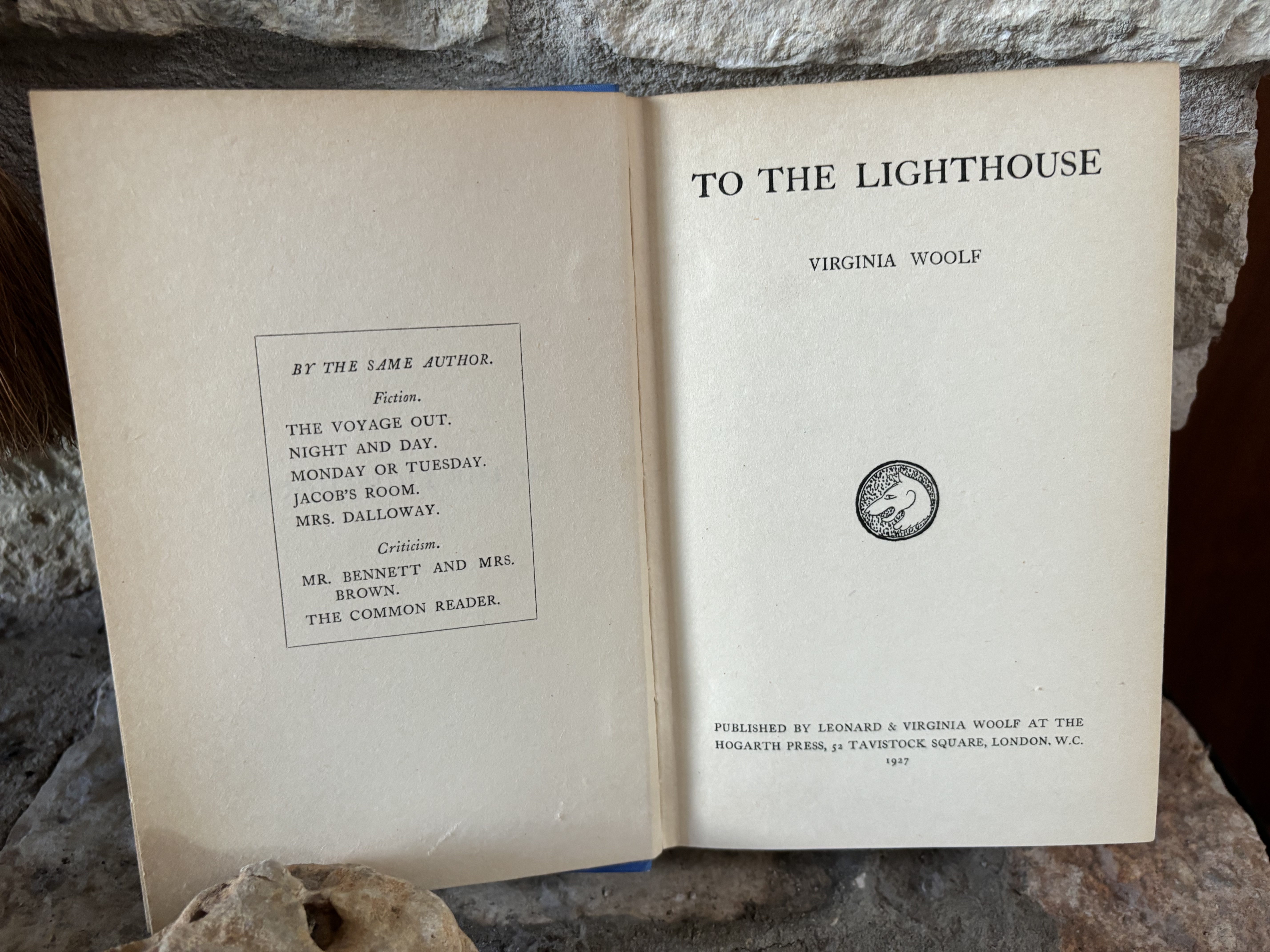
I, however, the English major, the mystery writer? I who should have read All The Books? I confess a powerful secret vice: rereading my favorites, particularly Virginia Woolf. Every year, To the Lighthouse sneaks back into my hand. Why? Why not concentrate only on the new novels, the best-sellers?

Because I have to reread that moment in Part III when, years later, after world war and illness have claimed her beloved friend Mrs. Ramsay and so many of the Ramsay family, the spinster Lily Briscoe returns to the Ramsays’ summer home on the Isle of Skye. https://bit.ly/3zHF77w

Out on the lawn, facing the old white house, she sets up again the unfinished oil painting she began all those years earlier—the painting that had posed such a challenge in Part I as her mind reverberated with the repeated mantra from Professor Ramsay’s obnoxious male philosophy student: “Women can’t paint, can’t write.” During the long day, full of changing light on the sea, and repeated interruptions by other characters, Woolf returns us over and over to Lily, staring at her painting, seeing again the remembered shapes of Mrs. Ramsay and her son James all those years ago. And her artistic effort? Here’s the end of the book:

“It would be hung in the attics, she thought; it would be destroyed. But what did that matter? She asked herself, taking up her brush again. She looked at the steps; they were empty; she looked at her canvas; it was blurred. With a sudden intensity, as if she saw it clear for a second, she drew a line there, in the centre. It was done; it was finished. Yes, she thought, laying down her brush in extreme fatigue, I have had my vision.”

Why do I return to that? So much of the book is touching, gripping, and even hilarious, including the thoughts of Professor Ramsay, a philosophy professor who’s both overbearing and insecure. He delights in his own “splendid mind”: “For if thought is like the keyboard of a piano divided into so many notes, or like the alphabet is ranged in twenty-six letters all in order, then his splendid mind had no difficulty in running over those letters one by one, firmly and accurately, until it had reached, say, the letter Q.  …Very few people in the whole of England ever reach Q.” Then he falters. “But after Q? What comes next? After Q there are a number of letters the last of which is scarcely visible to mortal eyes, but glimmers red in the distance.”  He braces himself, clenches himself. “Q he was sure of. Q he could demonstrate. If Q then is Q—R—” Then “he heard people saying—he was a failure—that R was beyond him. He would never reach R.”  

What an image—the alphabet, R glimmering red in the distance, then fading, fading!  And then of course there’s the famous dinner party featuring Mrs. Ramsay’s boeuf en daube. Surely, just reading this, you smell the simmered sauce, the wine, the bay leaf? The thought crossed my mind that if Professor Ramsay had been offered a sip of the Talisker malt whiskey for which Skye is famous, he’d have felt a bit better. https://www.malts.com/en/talisker (The distillery gives a great tour, too.)

But Lily’s painting? This spinster friend of Mrs. Ramsay, with her amateur brushstrokes? The tale of Lily’s painting, her decision and indecision as she holds her brush, grabbed me all those years ago, and refuses to let go. The same question must hit every musician—“Is this the last note? Did that chord resolve properly? Does it make you feel beauty and longing, or does it just hang there, unfinished?”  Every cook: “A pinch of salt? What about some coriander? To garlic or not to garlic?” Every filmmaker: “Do they walk into the sunset? Or fade out? Or kiss?” And every writer? “Is this character real? Is this setting compelling? Does the plot work? And will anyone care?”

Lily’s painting embodies desire to capture memory, resistance, light and color, and more than that. Isn’t it  her experience? A moment of creation, of recapture, of making a line on a canvas and then feeling completion?  She’s had her vision. If you know of another book where we readers feel such a moment of revelation from the frustrating process of creation—let me know.

Oh, don’t get me wrong. My Kindle received today the brand-new Martin Walker (A Grave in the Woods) and I can’t wait. bit.ly/3Xzqawt Like the other women in his (busy) life,  I love to accompany Inspector Bruno, in his fictional Perigord village of St. Denis, partly because of his cooking. Thank you, Martin Walker, for describing the ham hanging from the kitchen ceiling, the cheerful chickens, and the paté with its duck fat on top, waiting in Bruno’s fridge, and the way Bruno sings La Marseillaise to count how long until he must sizzle the foie de gras before he deglazes the pan. I look forward to new recipes and to finding out who’s buried in the woods.

And a sad farewell: I’ve decided to forgive Elly Griffiths for saying goodbye to Ruth Galloway in her last book in that series, The Last Remains, even though I have loved watching Ruth clamber down into a trench to dig up ancient bones in East Anglia. amzn.to/3ZxU5rv I’ve also savored every page of Alan Bradley’s latest (last?) Flavia de Luce – What Time the Sexton’s Spade Doth Rust – as he allows this delightful protagonist to feel herself beginning to grow up—not too much, not too fast, just enough. https://bit.ly/4dla13A 

And I did just finish We Solve Murders, Richard Osman’s first book in a new series. bit.ly/4ezjIwh  Have to confess I found myself missing Joyce, Ibrahim, Ron, Elizabeth and the other characters of his Thursday Murder Club books. My strong belief is I must care about a mystery protagonist and so far I haven’t completely bought in to his new cadre–though I do like Steve. We’ll see.  I’d be interested in your reactions.

So that’s four new mysteries, just in September. I’m also rereading Virginia Woolf’s The Waves, and finding even more, yes, even more to love about how she brings those characters to vivid life, and how she describes the way we humans think and react to each other.

And out here with the three burros I’m writing the tenth in my Coffee Creek series featuring Alice MacDonald Greer and the gorgeous landscape of the Texas Hill Country, with its pristine (well, so far) bluegreen streams. Water’s for fighting over, right?

But when the going gets tough, you may find me sidling back to the revolving bookcase, on the shelf where Virginia Woolf and all the old faves hang out.

Helen Currie Foster lives and writes north of Dripping Springs, Texas, loosely supervised by three burros. She’s drawn to the compelling landscape and quirky characters of the Texas Hill Country. She’s also deeply curious about our human history and how, uninvited, the past keeps crashing the party. Latest in her award-winning series: Ghost Bones.

Follow her on http://www.facebook.com/helencurriefoster/ and http://www.helencurriefoster.com

Work-Arounds

By N.M. Cedeño

As I type this, I’m seeing double through my right eye. Well, not quite double. On the screen, it’s more like printed letters have their own ghostly echoes lingering directly above and behind. This has been an ongoing issue for over a month due to a dry patch on my cornea, making working on the computer and reading an exhausting slog. My left eye is compensating, allowing me to still have twenty/twenty vision with both eyes open, but I have to take frequent breaks from screens. The eye doctor added a new medicine this past week, so I’m hoping to “see” some improvement soon. If not, the next step is to see a specialist.

I had to come up with a work-around for my current writing project because of the eye-strain. What do you do when reading long articles looking for details that you need for a story makes you tired too quickly? The answer I came up with is “watch videos containing the needed information.”

 Because of eye strain, I’ve found watching videos to be easier than reading long articles. With the help of the Sisters in Crime Webinar Archive of videos, I’ve dug into the structure of the FBI, which crimes are under their jurisdiction, and which aren’t, and how cases are assigned and handled. I also watched a webinar on forensics, because why not. The archive contains a wide variety of videos on topics from writing craft to crime-solving. I’ll be watching more videos even when my eye issue is resolved because of the variety of topics and the amount of information available.

Thanks to YouTube videos, I’ve learned how to prevent the theft of a certain model of car, and I’ve learned about what features the car has to prevent the theft of a cargo trailer that the vehicle might be towing. Various videos helped me learn about the particular model of vehicle I need for a story, its security systems, and about the wide world of custom cargo trailers. Now I know how a thief might get around all of those security features to steal both the vehicle and the trailer, which moves the plot on my work-in-progress forward considerably.

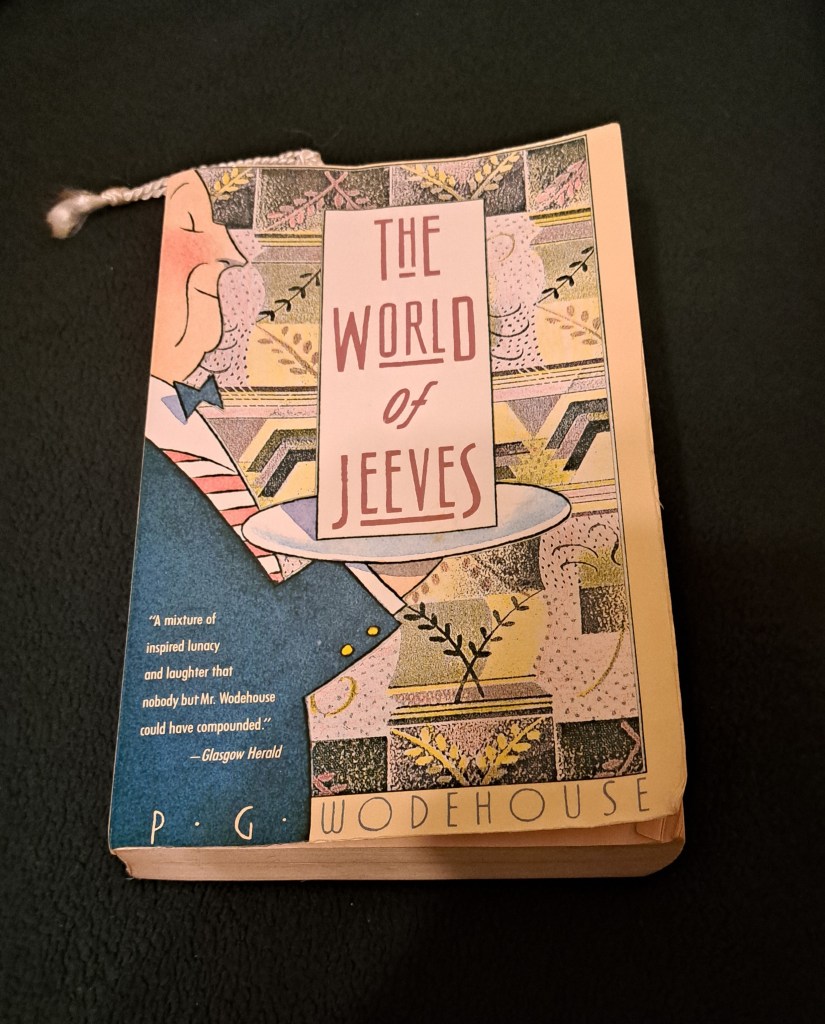
Of course, I’m still reading, but far more slowly than usual. I’ve read a couple books by Donna Leon this month and a lot of P.G. Wodehouse. I read the Wodehouse to lighten my mood. Jeeves and Bertie are wonderful if you need to laugh at something utterly ridiculous. I love Bertie’s confusion as Jeeves gets him out of an unwanted engagement by making him appear to be insane. The story where Jeeves and Bertie aid one of Bertie’s friends who has gone to jail for “biffing” a policeman while drunkenly trying to steal the policeman’s helmet left me in stitches.

On the non-writing front, my middle child starts college this month. He will have moved into dorms on campus by the time this blog posts. Thirteen years ago, a neuropsychologist walked me through the challenges he was facing. I realized he had a long road ahead of him and a lot of work to do. Being what’s now called neurodivergent, he would have to fight to learn many things that are innate to the majority of people: everything from proprioception and bilateral coordination to reading facial expressions. And he did ALL of that hard work. He went from being asked to leave a private school in kindergarten and being placed in special education for three years in elementary school to finishing high school in the top 6% of his class.

He is an incredibly talented, intelligent, outgoing young man with a “punny” sense of humor. Watching him leap into a world that has frequently been unkind to him because of his differences is an emotional challenge for a mom. But I believe he will find his way. He knows how to face obstacles, pick himself up and try again when he fails, and persist in chasing his dreams.

On top of that, my youngest earned her driver’s license this summer and has started going out into the world without me driving her. She is embarking on her senior year of high school and filling out college applications.

Watching my kids spread their wings is breathtaking and anxiety-inducing. An empty nest is on the horizon. My empty nest goals include attending a writing convention or two. I’ve only been to Bouchercon once and I’d like to attend again.

Speaking of Bouchercon, the Anthony Boucher World Mystery Convention is this coming weekend. I won’t be attending, so I hope everything goes well for everyone who is traveling to Nashville to attend. If you are there, stop by the book room and pick up a free copy of the anthology Private Dicks and Disco Balls: Private Eyes in the Dyn-O-Mite Seventies edited by Michael Bracken. I have a story in the anthology called “A Woman’s Place.”

*****

N. M. Cedeño is a short story writer and novelist living in Texas. She is active in Sisters in Crime- Heart of Texas Chapter and is a member of the Short Mystery Fiction Society. Find out more at nmcedeno.com.
SERENDIPITOUS SURPRISES

by Helen Currie Foster

August 19, 2024

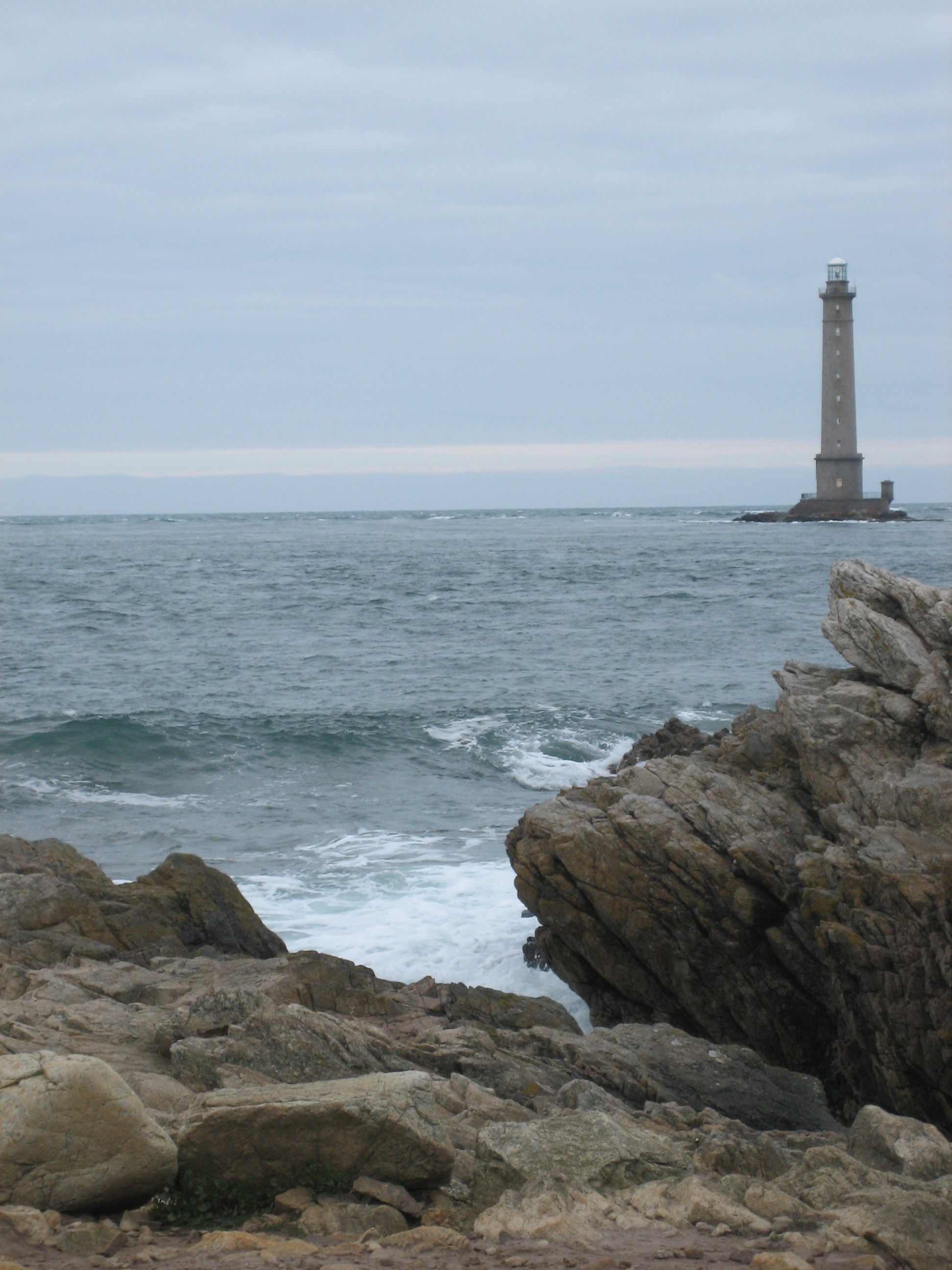
I wasn’t going to mention the dreadful heat. But facing August in Texas requires early rising. And early this morning came two in-spite-of-the-heat surprises. First, moonset of the August Supermoon: 

Second, a tiny frog, less than an inch long, sitting quietly in the shade. Could it be a Texas cricket frog? Maybe some frog-maven will know. Can you spot it here, on the big rock?

Another treasure: an email from a reader who’d read Ghost Cave, first book in my Alice MacDonald Greer Mystery series, and wanted the recipe for the coffee cake served by Alice’s redoubtable elderly friend Ilka:

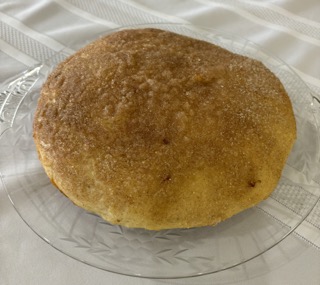
They settled at the tea table. Ilka poured. Bone china, thin and old, the glaze crazed. Like Ilka’s face and hands, thought Alice. The cake stand held something Alice had never seen—a pale smooth yeasty-smelling cake with thin cinnamon topping…

“Oh, goodness, Ilka,” said Alice. “What is that?” The yeast dough, ivory and fragrant, left a mysterious fragrance in the air.

“Cardamom,” said Ilka.

Yikes! I had to tell the inquiring reader I had no recipe! Only—a memory! As kids we were in awe of our neighbor Mrs. Slinn, up the street. She wore her hair pulled back in a bun and longish dresses and, I think, always an apron. When we scruffy little children approached her door she always offered cookies. (We still roll out her classic “teacake” sugar cookie dough to make Santas, snowmen, reindeer.)

But occasionally Mrs. Slinn swept down the street to our kitchen bringing magic: a round yeast coffee cake, no taller than 3 inches in the middle, ivory-gold with a delicate sprinkle of cinnamon and sugar on top. It smelled amazing and when cut into small wedges was absolutely delicious…

To this memory, in Ghost Cave, I’d added cardamom—not a spice we knew when I was little. But where to find a recipe for the inquiring reader?

THE READER HERSELF! She wrote back that she’d located cookbooks from Mason County, Texas (dated 1976), and Fredericksburg (12th edition–Fredericksburg cooks published their first cookbook in 1916!). Each included a recipe for “yeast coffee cake.” (The Fredericksburg recipes include the original names—like Apfelkuchen, Schnecken, Kolatschen.) Which is further proof that mystery readers themselves are bright, curious sleuths. And why hearing from readers is wonderful.

Below you’ll find a slightly modified recipe from the excerpts she sent, but with a little cardamom added.

At a recent book talk I called the relationship between mystery reader and mystery writer a collaboration. Indeed, a primary rule of the 1930 Detection Club in London was that any clue must be instantly produced for the reader. No holding back explanations or back story until the end of the book! Of course that rule was sometimes violated (yes, Madam Christie, we’re talking about you). In contrast, Christie’s contemporary, the New Zealander Ngaio Marsh, occasionally added some colorful backstory at the end, but she also generally had already given the reader fair notice of the clues that identify the murderer.

In her series featuring the elegant Scotland Yard sleuth Roderick Alleyn, Marsh typically begins with the setting––often provided by a variety of characters––of the site where murder will inevitably take place, either in England or New Zealand. The setting could be an artist’s colony (“Colour Scheme”), a tour boat on an English river, a village church hall, a pub, a guest house in New Zealand, an elegant country house (“Dancing Footman”), the London apartment of a practically bankrupt upper-class family (no one seems to have a job) (“Surfeit of Lampreys”). Thus when we open a Marsh mystery, first we meet the potential suspects, including one we may hope is innocent, may hope is truthful. Then comes a seriously tricky murder. (Did someone disturb the fly rod on the wall? Why?) At that point Inspector Alleyn arrives, with his sidekick Fox and the crime scene specialists. For the competitive mystery reader—collaborating with the author to detect the murderer–each detail matters and is promptly disclosed. But who lied? Who was mistaken?

Rest assured Marsh knew her subject matter and her settings: she was an artist, an actor and a theatre director as well as a writer. She lived and worked in England as well as New Zealand. She was appointed Dame Commander of the British Empire in 1966. The Mystery Writers of America bestowed the Grand Master Award for her lifetime achievement as a mystery novelist. https://en.wikipedia.org/wiki/Ngaio_Marsh  I suspect her character Agatha Troy (an artist who finally marries Alleyn) may be in part a portrait of Marsh.

And Marsh received a birthday Google Doodle on April 23, 2015! https://doodles.google/doodle/ngaio-marshs-122nd-birthday/

Marsh’s first book came out in 1934, featuring Alleyn as the upper-class “grandee” who resigned from the foreign service to join Scotland Yard. By then a different sort of sleuth was emerging in the U.S. In 1930 Dashiell Hammett published The Maltese Falcon and we met Sam Spade. In 1933 Raymond Chandler, like Hammett, was already publishing in The Black Mask magazine, and in 1939 he published The Big Sleep, presenting Philip Marlowe. Decades later the mystery genre continues to grow and grow:  Noir! Culinary mysteries! Cozies! Mysteries narrated by dogs! (Spencer Quinn’s Chet and Bernie series.) Cowboy mysteries! Fantasy/sci-fi/mystery! Sleuths in Laos, China, Australia, Scandinavia, Russia, Alaska, Louisiana, national parks, Native American reservations. Edinburgh! The Shetlands! Botswana! Canada! Italy! France! Israel! Scandinavia! Legal thrillers! Spy thrillers! What a wealth of mysteries for us to enjoy.

What about the Texas Hill Country? In her latest adventure, Ghost Bones, lawyer Alice MacDonald Greer grapples with the murder of a deeply respected judge. His death was apparently triggered by his efforts to solve the murders of six people on his property almost two centuries ago. Alice needs all the help she can get from her irrepressible assistant, Silla, and from Ben Kinsear, as she tangles with mystery, legal drama, and matters of the heart.

And a request: if you can identify the tiny froglet above, please share the name!

Helen Currie Foster lives and writes the Alice MacDonald Greer Mystery series north of Dripping Springs, Texas, loosely supervised by three burros. She’s drawn to the compelling landscape and quirky characters of the Texas Hill Country. She’s also deeply curious about our human history and prehistory, and how, uninvited, the past keeps crashing the party. Follow her at www.helen.currie.foster.com.
Nearly Mrs. Slinn’s Coffee Cake, with thanks to a wonderful reader and the cooks of Mason and Fredericksburg!

3/8 c. milk; 2 Tbls. sugar; 1/2 tsp. salt; 1/4 c. butter; 1 beaten egg; 2 tsp. dry yeast; 1 1/2 Tbls. warm water; 1 5sp ground cardamom; 1 3/4 c. flour, plus additional melted butter (about 2 Tbls.) and sugar-cinnamon mixture for topping (about 1 tsp cinnamon to 1/3 c sugar)

Scald milk and pour over the butter, salt and sugar. Stir and let stand until lukewarm. Dissolve yeast in warm water for 5 minutes. Stir egg and yeast mixture into milk mixture.  Stir in 1 tsp cardamom and 1 cup of flour. Beat well. Continue adding remaining flour.  Put dough on lightly floured board and knead until smooth (add a bit more flour if too sticky). Place in greased bowl, cover, and let double in size. Then punch down.

Butter bottom and sides of round 8” pan. Put parchment paper in the bottom.  Pat in dough. Brush with melted butter and sprinkle on the sugar/cinnamon mixture. Let rise again until double in size. Bake at 350 for about 20 minutes or until just turning golden.   Let cool. Serve it forth!