In the Window or On the Table? What I Learned from Amor and Anton

By: Dixie Evatt

Ever since I read A Gentleman in Moscow (2016) I’ve considered Amor Towles writing style to be nearly perfect. So when my niece told me Towles was making an appearance at the Empire Theatre in San Antonio, I booked it. He was there to support the San Antonio Book Festival and to talk about his latest book, Table for Two. It’s a collection of six short stories plus a novella. Unlike some of his other stories, these all take place in the current Millennium. 

Over the evening I learned a interesting things about Towles.

I learned that he is what we used to label in the news business, an “easy interview.” Austin’s own Stephen Harrigan (Big Wonderful Thing, 2019) was on the stage with Towles as moderator but he didn’t get to ask many of the questions on his notepad. Towles was in a talkative mood so needed little prompting. 

I learned that Towles took up writing full time only after success in his first career at a small Wall Street investment firm. 

I learned that once he gets a project in mind, he begins to fill notebook after notebook with hand-written outlines, ideas, scenes, characters. It may take years. He says this process frees his imagination and subconscious to go where beautiful language and the characters’ inner lives take him. 

There was more but of the many memorable things I learned about this accomplished author, what I remember best, and took to heart, was his description of his research process. He said that when writing he intentionally postpones what he calls “applied research” until near the end. During this time he is also reading novels written by others that are set in the same historical period as the book he’s working on. His novel is almost written before he begins deep research.

That’s why he waited until A Gentleman in Moscow was almost finished before traveling to Moscow and checking into the Hotel Metropol, the exclusive hotel where his story about Count Alexander Ilyich Rostov is set. 

Towles advised that details gleaned from this kind of active research should be written into the story much the way one might design the stage for Anton Chekhov’s The Cherry Orchard (1903). Of course Towles would choose this particular play as a point of reference because, like his own novel set in Russia, Chekhov’s tragicomedy also deals with a period of decline for the Russian aristocracy. 

He said that when the curtain rises for the play the audience might see only the suggestion of a cherry orchard through large windows as if were rendered by an impressionist such as Claude Monet or Mary Cassatt. The windows might be framed by plywood bookcases painted to resemble mahogany. In the center of the room there would be a table set with a porcelain tea service.  

When an author is ready to fold research into the story, Towles said it should be presented with similar layers of reality. Some details are just suggested in the background. Some, like the bookcases, give the scene the appearance of reality but need not be too detailed. Then there are aspects of research that can’t be given short shrift. For these, the author must adhere to absolute authenticity. The audience needs to hear the chair move across the floor and the teacup rattle in the saucer. The challenge for me is where all of the information that I’ve accumulated in my own research belongs – in the window or on the table?

Charles McNulty, theater critic for the Los Angeles Times, said in a June 6, 2022, review of a local revival of The Cherry Orchard, “Big things occur in Chekhov. Houses are lost, guns occasionally go off, and people die. But the focus is on muddling through.” 

Much the same might be said about A Gentleman in Moscow and the subtle use of active research by Towles so that his story isn’t swallowed up in the details. 

***

Cover of A Gentleman in Moscow via Amazon

Image of Anton Chekov via Wikipedia. Public domain.

Image of stage of The Cherry Orchard via Wikipedia. Public domain.

***

A former political reporter in Austin, Dixie also taught writing at Syracuse University. When she teamed up with Sue Cleveland to write fiction, they sold a screenplay to a Hollywood producer. Although the movie was never made, the seed money financed ThirtyNineStars, their publishing company. Through it they published two award-winning thrillers (Shrouded and Digging up the Dead) under the pen name, Meredith Lee. Dixie’s first solo mystery was Bloodlines & Fencelines, set in a tiny Texas town near Austin. Kirkus reviews described the book as, “A twisty whodunit that’s crafted with care and saturated with down-home Southern charm.” She is working on second mystery in the series. www.dlsevatt.com

“Everybody Eats Mushrooms.” Some Live to Tell the Tale.

By M. K. Waller

Today’s post comprises two parts–a bit of fiction followed by a bit of fact–linked by a “fleshy, spore-bearing fruiting body of a fungus” and a mystery writer who used it as a murder weapon–and later confessed to something even worse.

I.

The following flash fiction was inspired by a photo prompt on Friday Fictioneers, a weekly writing challenge sponsored by Rochelle Wisoff-Fields.

‘SHROOMS

John ambled into the kitchen. “What’s cooking?”

“Mushroom gravy.” Mary kept stirring.

John frowned. “Toadstools. Fungi. Dorothy Sayers killed someone with Amanita.

“These are morels.” She added salt. “Everybody eats mushrooms.”

“I don’t.”

“Suit yourself.”

He sat down. “Where’d you buy them?”

“I picked them.”

You?

“Aunt Helen helped. She knows ‘shrooms.” Mary held out a spoonful. “Taste.”

“Well . . . ” John tasted. “Mmmm. Seconds?”

“Yoo-hoo.” Aunt Helen bustled in. “See my brand new glasses? Those old ones–yesterday I couldn’t see doodly squat.”

Mary looked at the gravy, then at John. “Maybe you should spit that out.”

II.

The following is a guest post I wrote for Manning Wolfe’s Bullet Books Speed Reads blog. In it, I explain what an author does when she doesn’t have a clue about the subject she’s writing about.

There are many rules for writers. Two of the major ones: Write what you know and Write what you love.

I was pleased that Stabbed, which I co-wrote with Manning Wolfe, was set in Vermont. I love vacationing there: mountains and trees, summer wildflowers and narrow, winding roads, rainstorms and starry nights, white frame churches and village greens.

In Chapter 1, Dr. Blair Cassidy, professor of English, arrives home one dark and stormy night, walks onto her front porch, and trips over the body of her boss, Dr. Justin Capaldi. She locks herself in her car and calls the sheriff. The sheriff arrives and . . .

What happens next? Vermont is a small state. Who takes charge of murder investigations? The sheriff? Or the state police? What do their uniforms look like? Where do major rail lines run? What’s the size of a typical university town? And a typical university? What else had I not noticed while driving through the mountains?

Not knowing the answers, I defaulted to a third rule: Write what you learn. Research. Research. Research. The best mystery authors have been avid researchers.

Agatha Christie, for example, is known for her extensive knowledge of poisons. As a pharmacy technician during World War I, she did most of her research on the job before she became a novelist. Later she dispatched victims with arsenic, strychnine, cyanide, digitalis, belladonna, morphine, phosphorus, veronal (sleeping pills), hemlock, and ricin (never before used in a murder mystery). In The Pale Horse, she used the less commonly known thallium. Christie’s accurate treatment of strychnine was mentioned in a review in the Pharmaceutical Journal.

Francis Iles’ use of a bacterium was integral to the plot in Malice Aforethought. His character, Dr. Bickleigh, serves guests sandwiches of meat paste laced with Clostridium botulinum and waits for them to develop botulism. If Dr. Bickleigh had known as much about poisons as his creator did, he wouldn’t have been so surprised when his best-laid plans went, as Robert Burns might have said, agley.

Among modern authors, P.D. James is known for accuracy. Colleague Ruth Rendell said that James “always took enormous pains to be accurate and research her work with the greatest attention.” Before setting Devices and Desires near a nuclear power station, she visited power plants in England; she even wore a protective suit to stand over a nuclear reactor. Like Christie, James used information acquired on the job—she wrote her early works during her nineteen years with the National Health Service—for mysteries set in hospitals.

Most authors don’t go as far as to stand over nuclear reactors to be sure they get it right, but even the simplest research can be time-consuming.

And no matter how hard they strive for accuracy, even the most meticulous researchers sometimes make errors.

Dorothy L. Sayers was as careful in her fiction as she was in her scholarly writing. But she confessed in a magazine article that The Documents in the Case contained a “first-class howler”: A character dies from eating the mushroom Amanita muscaria, which contains the toxin muscarine. Describing the chemical properties of muscarine, Sayers said it can twist a ray of polarized light. But only the synthetic form can do that—the poison contained in the mushroom can’t.

Considering Sayers’ body of work, this one “howler” seems a very small sin, and quite forgivable.

Most readers, however, don’t forgive big mistakes, and reputable writers don’t expect them to. Thorough research is a mark of respect for readers.

Sometimes, getting the facts straight in fiction has real-life consequences the author can’t predict. Christie’s The Pale Horse is credited with saving two lives: In one case, a reader recognized the symptoms of thallium poisoning Christie had described and saved a woman whose husband was slowly poisoning her; in a second, a nurse who’d read the book diagnosed thallium poisoning in an infant. The novel is also credited with the apprehension of one would-be poisoner.

Back to Stabbed—Well, we don’t expect it to save lives or help catch criminals. But doing my due diligence and reading up on Vermont’s railways, demographics, and criminal procedure set the novella on a sound factual footing.

Unlike Christie, Iles, and Sayers, however, I didn’t have to expend too much effort learning about how the murder weapon worked. One look at the book’s title and–well, d’oh–no research needed.

***

Learn more about Friday Fictioneers at Rochelle Wisoff-Fields’ blog and on their Facebook page.

***

M. K. Waller (Kathy) is a former teacher, former librarian, former paralegal, and former pianist at various small churches desperate for someone who could find middle C.

She writes crime fiction, literary fiction, humor, memoir, and whatever else comes to mind.

She grew up in Fentress,  population ~ 150 in 1960, on the San Marcos River in Central Texas, the Blackland Prairie, and memories of the time and the place inform much of her fiction.

Except for the part about murders. Fentress didn’t have any murders. At least any that people talked about.

She now lives in Austin.

Creating Multiple Identities: the Research Rabbit Hole

by N.M. Cedeño

Setting a story in the past requires the author to do research to make sure the details of the story are correct. For me, researching topics means risking falling down the research rabbit hole and discovering way more information than I need. This week’s research topic: how a character could create fake identities during the 1960s and 1970s.

My current work-in-progress, a short story, involves a character with a penchant for using fake identities in the late 1960s and early 1970s. I wanted to know how hard it would be for my character to have multiple bank accounts and jobs under different identities during that time period. This necessitated research into social security numbers (SSNs) and how they were issued in the past.

Creating a fake identity prior to 1974 took very little effort because laws regarding obtaining SSNs and starting bank accounts were lax. For instance, for my character to open bank accounts under different names was fairly easy. Social security numbers were not required for starting financial accounts at banks or other institutions until 1983. However, even if the banks had required SSNs, my character could have easily provided multiple SSNs for multiple fake identities.

Before April 1974, anyone could request a social security number by completing an application without providing evidence of their age, identity, or citizenship status. Electronic tracking of social security numbers, using a punch card computer system didn’t start until 1979. This ease in obtaining SSNs led to all kinds of irregularities and problems in the system that lasted for decades. As late as 2007, the Social Security Administration identified 4.7 million people who had more than one SSN. Most of those people had requested numbers before 1974 when the requirements for providing evidence of identity and age went into effect.

Why did so many people have more than one social security number? Was identity fraud rampant?  

No. Most of those people weren’t trying to commit any crime. After SSNs were introduced in 1936, not everyone understood how they worked. Some people thought they needed a new number every time they started a new job. If workers lost the card with their number on it, they simply applied for a new number. Other people applied for a social security number when the cards were first introduced. Then, when they started working a new job, they filled out paperwork provided by their employer to get another one as employers tried to make sure their employees had SSNs.

It wasn’t even unusual for more than one person to use the same SSN.

For example, in 1938, a wallet manufacturer in New York sold wallets in stores with a sample social security card inside to show the buyer how the card would fit in the wallet. That sample social security card had a number on it which many buyers of the wallet then adopted as their own. By 1943, at least 5,755 were using the sample SSN that came with the wallet. As late as 1977, twelve people were still using that same number.

Prior to the late 1980s, most people didn’t have to get a social security number until they got a job and had to pay taxes. A pilot program to get children SSNs at birth started in 1987. Before 1986, most kids didn’t need SSNs since they could be listed as dependents on tax forms without one. From the time the SSN was introduced in 1936 until the late 1980s, most people only applied for social security numbers when they reached a point in life where they needed one. Therefore, it was common for adults to apply for cards.

All of this means that the character in my story could easily have created multiple fake identities before 1974 by filling out applications for multiple SSNs. He could hold jobs under different SSNs and keep many unconnected bank accounts. But now, all of this research will be filed away, because I can’t use it in my story. I only needed to know that my character could indeed obtain documentation for multiple fake identities without getting caught immediately.

~~~~~

N. M. Cedeño is a short story writer and novelist living in Texas. She is currently working on a paranormal mystery series called Bad Vibes Removal Services. Ms. Cedeño is active in Sisters in Crime- Heart of Texas Chapter. Find out more at nmcedeno.com.

Note: All pictures by Pixabay.

Down the Research Rabbit Hole

Have you ever fallen down the research rabbit hole when looking for details for your writing?

whirlpool-30390_640
by Pixabay

I have. Because I read extensively in a variety of nonfiction areas, I usually know where to look for information that I want to include in my novels and stories. However, my extreme curiosity, while helpful in writing, is a dangerous thing when researching. It’s very easy to fall down the internet research rabbit hole. While searching for a simple detail I need, I may find one article that leads me to another and another. Before I know it, I’ve lost an hour reading fascinating articles when all I really needed was a single detail for a single sentence in a story.

In my Bad Vibes Removal Services series, the character of Lea, who sees ghosts and is ultra-sensitive to other people’s emotions and moods, is a student of ancient history who is working to earn her master’s degree. As a student of history, she is particularly interested in studying the daily habits of people in ancient civilizations. She is fascinated by hair styles, clothing styles, perfumes, and hygiene practices from bygone eras. Her interest in the subject drives her to try ancient clothing styles, hairdos, and makeup as a hobby.

When I chose this pastime for the character, I foresaw that I would have to do some research to bring the character to life. For each successive story, I had to add details about what historical look Lea was trying on herself. Sometimes, I chose simple things, like kohl around her eyes in an ancient Egyptian look. More complicated styles I researched, looking for scholarly articles on ancient hair styles.

For example, in the book Degrees of Deceit, Lea wears her hair in a Suebian knot, a typically male hairstyle described by Tacitus in the first century as being worn by certain Germanic tribes. I was familiar with this hair style because an interest in mummies led me to read articles about bog bodies. Bog bodies are corpses recovered from peat bogs, some of which were mummified and showed signs of having been murdered.

800px-Osterby_Man_Suebian-Knot
Osterby Man with Suebian knot

To put details about the Suebian knot hairstyle in my book, searched for what I remembered seeing in a picture, an odd looping hairstyle on the side of the head of a partially mummified skull from a bog body. So I found the picture I remembered, Osterby Man’s head with its peat-dyed reddish-orange hair. That led me to another article I hadn’t seen before, the Dätgen Man, who also wore a Suebian Knot, but his hair loop was on the back of his head. That led me to the hair on other bog bodies including one with a 90-centimeter braid tied in a complex knot. After that I lost lots of time down the rabbit hole of bog bodies. Here is a link to a list of bog bodies for the curious.

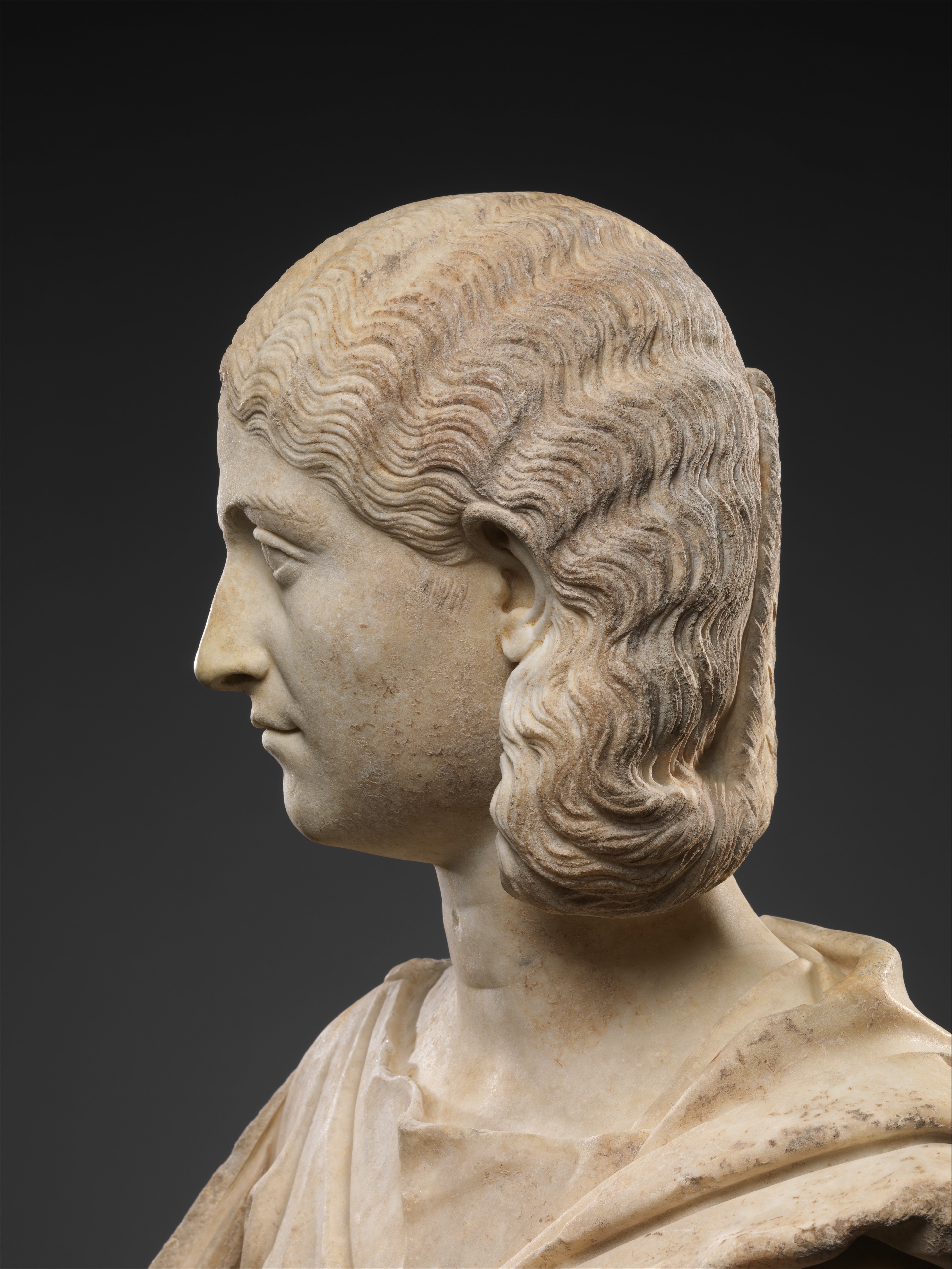
FemaleRomanBust
Bust of a Roman woman, from the Met Collection

Statues and portrait busts from ancient Greece and Rome provided another great resource for hairstyles for my character Lea. The plethora of material from these ancient civilizations has been a wonderful source of details for my writing. However, because of the enormous volume of information, it’s very easy to get lost, even lose hours of time, in reading. I’ve read about the plaster casts of victims of Mount Vesuvius in Pompeii, some of which are so detailed you can see clothing and hair outlines. I’ve read about lower class hairstyles and upper-class hairstyles, children’s clothing, and hygiene practices, far more information than I’ll need for my stories.

Then, I really fell down the research rabbit hole. I found Janet Stephens’ helpful YouTube channel videos. As a hairstyle archaeologist, she walks the viewer through creating an array of ancient hairstyles. This is exactly the kind of thing my character Lea would love. For those who want to join me down the rabbit hole, watch a few of Ms. Stephens’ videos. They are fascinating.

How about you? Have you ever “fallen down the rabbit hole” while looking something up on the internet? If you haven’t, please tell me how you avoid that pitfall.

****

N. M. Cedeño is a short story writer and novelist living in Texas. She is currently working on a series called Bad Vibes Removal Services. The second novel in the series, entitled Degrees of Deceit, came out in August 2019.  Ms. Cedeño is active in Sisters in Crime- Heart of Texas Chapter.