Curious Animals and Recent Reads

by Helen Currie Foster

New reads! If, like me, you desperately miss John le Carré, consider A Spy Alone, the 2023 debut spy thriller by Charles Beaumont, a field operative veteran of Britain’s MI-6. https://bit.ly/3ZzHjHs His premise is fascinating: we know of the “Cambridge Five” who spied for Russia from the 1930’s to 1950’s—Kim Philby, Guy Burgess, Donald Maclean, Anthony Blunt and John Cairncross. https://en.wikipedia.org/wiki/Cambridge_Five But has there ever been, or could there be, a spy ring linked to Oxford? Beaumont’s protagonist Simon Sharman feels real, right from the first page:

“It is their shoes that give them away. As a lifelong fieldman, Simon Sharman hasn’t forgotten the lesson: walkers might change their jackets, pull on a pair of glasses, even a wig. But nobody changes their shoes on a job. Look at their shoes. 

I was hooked. Warning: Beaumont’s book is contemporary, well-written, tense, and may interfere with sleep. 

Two other recent reads: old adventure and a new “adult fantasy.” I’d never heard of The Long Ships by Frans G. Bengtsson (1954). Set from 980 to 1010 A.D., the book recounts the wide-ranging adventures of Norseman Red Orm Tostesson, and the collision between Christian priests (the “shaven men”) and the Norse culture of Skania at the south tip of Sweden. Now I know what it meant to go “a-viking”—to go sea-raiding! 500 pages, with Red, a very engaging Norseman. Great maps, too.

The Lost Bookshop, by Evie Woods (2024), offers time travel between the 1920’s and 30’s in Britain, and the present; a search for a lost Brontë manuscript; a disappearing attic; and disappearing and reappearing characters.

I confess I flipped through big chunks, relieved when true love finally won out after two women, generations apart, survive appalling treatment. The disappearing attic reminded me of Susan Cooper’s Over Sea, Under Stone,

and of course the wardrobe into Narnia in The Lion, the Witch and the Wardrobe. I’m always up for secret doors. 

I’m rereading a fascinating and fairly demanding study by Graham Robb, who has probably bicycled and walked further in Britain and France than most humans.

In The Search for Middle Earth: Mapping the Lost World of the Celts (2013)he describes how the Keltoi, or Celts, developed a system of surveying based on a midline transected by the lines of the summer and winter solstice to estimate travel distances and times—a feat not replicated for centuries. He maps the Heraklean Way, the path from southwestern Iberia that runs northeast across the Pyrenees to the Alps along the diagonal of the solstice sun, which Hannibal took when he invaded Italia. He describes Druid schooling (20 years to learn) and maps out protohistoric forts which turn out to lie along survey lines. He provides amazing maps. Two ongoing lessons from Robb’s devoted research: the winners write history; and humans tend to underestimate the accomplishments of earlier civilizations. 

Several of you asked about the three burros, given the recent cold snap. Thank you, they’re well. Their hair’s not waterproof so in cold rain they gather on the south side of the stable, under the roof, safe from rain and the north wind. They were relieved to see green grass again after the drought broke, but they’re also eating—and rolling in––green hay. And mud!

Yet despite hay, they gather outside the gate every morning and afternoon for carrots. They consider this part of their deal.
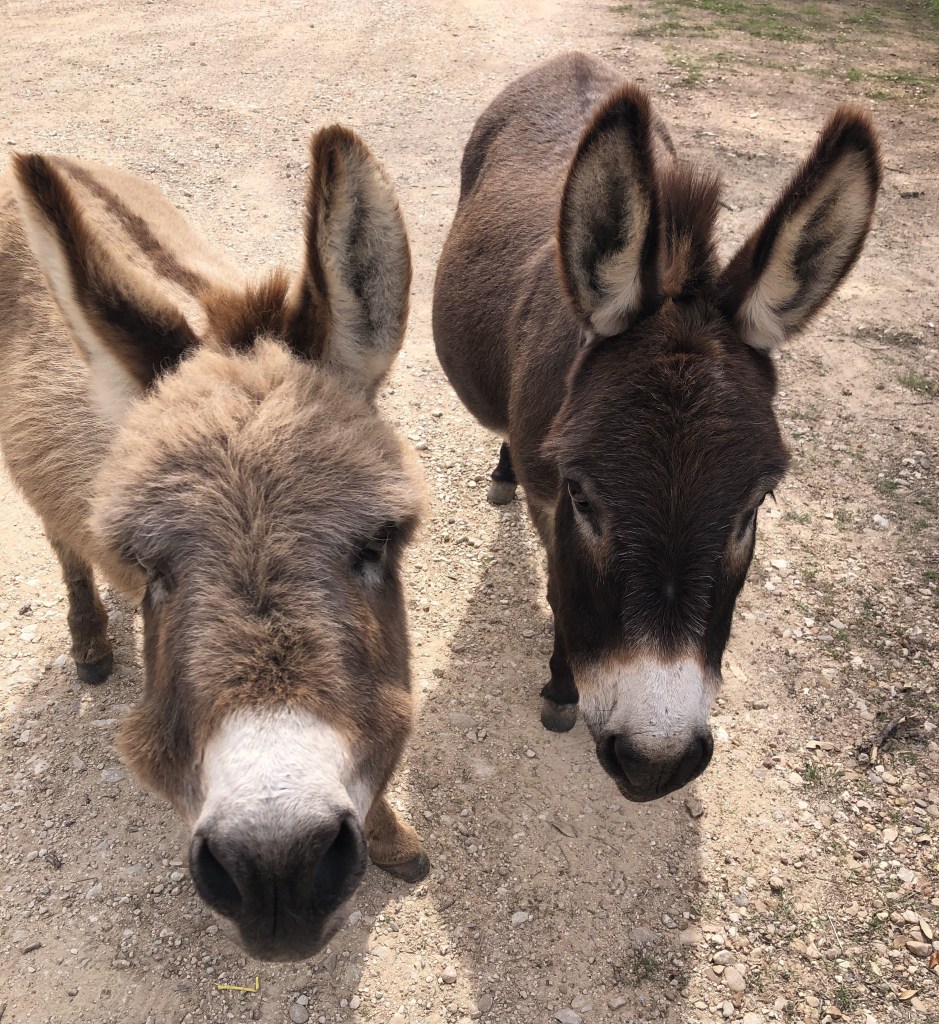
Burros are curious. They amble over to watch us garden and hang up laundry. They need company. They graze near each other. They may live into their 40’s. Sebastian, the short stubby knock-kneed male who invited himself to live here, may be 35 or more. Amanda (who insists I tell you she’s registered, with papers) may be 20. Her daughter Caroline is 12. Sebastian deems it his duty to bray loudly when any person or car appears at the end of the driveway, and to welcome the sun every morning with a stunningly loud bray. Now both Amanda and Caroline have begun to bray occasionally. 
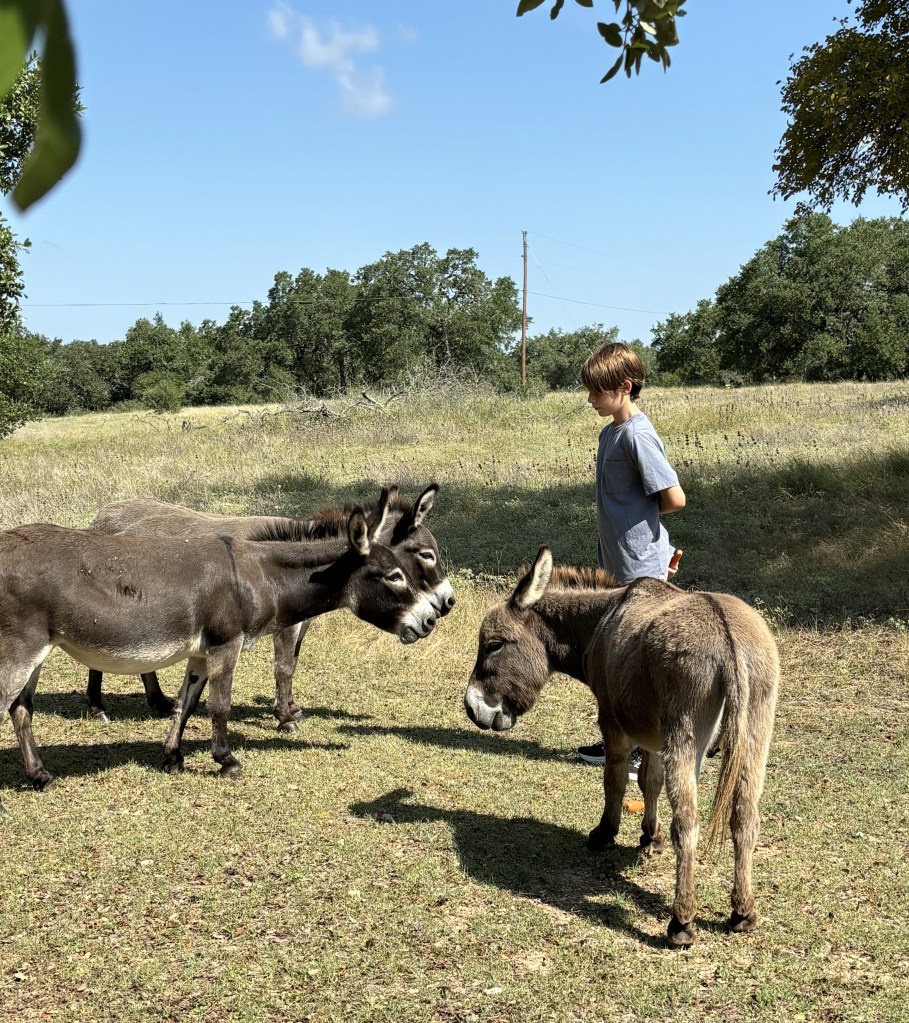
Only donkeys can bray. Unlike horses or zebras, donkeys begin a bray on the inhale and continue braying on the exhale. They have great hearing—supposedly they can hear another donkey bray 60 miles away. 

They especially detest canids and will attack, dance on and kick dogs, coyotes, bobcats, foxes. A spooked horse will run away: donkeys stand together until they decide what they’re going to do. This morning, leaving for the post office, I saw the three donkeys standing together, knees locked, ears cocked, eyes fixed on two trespassing dogs who’d strayed across the cattleguard and into the donkeys’ domain. 

The dogs immediately acknowledged their gross error of judgment, raced frantically away and never returned.
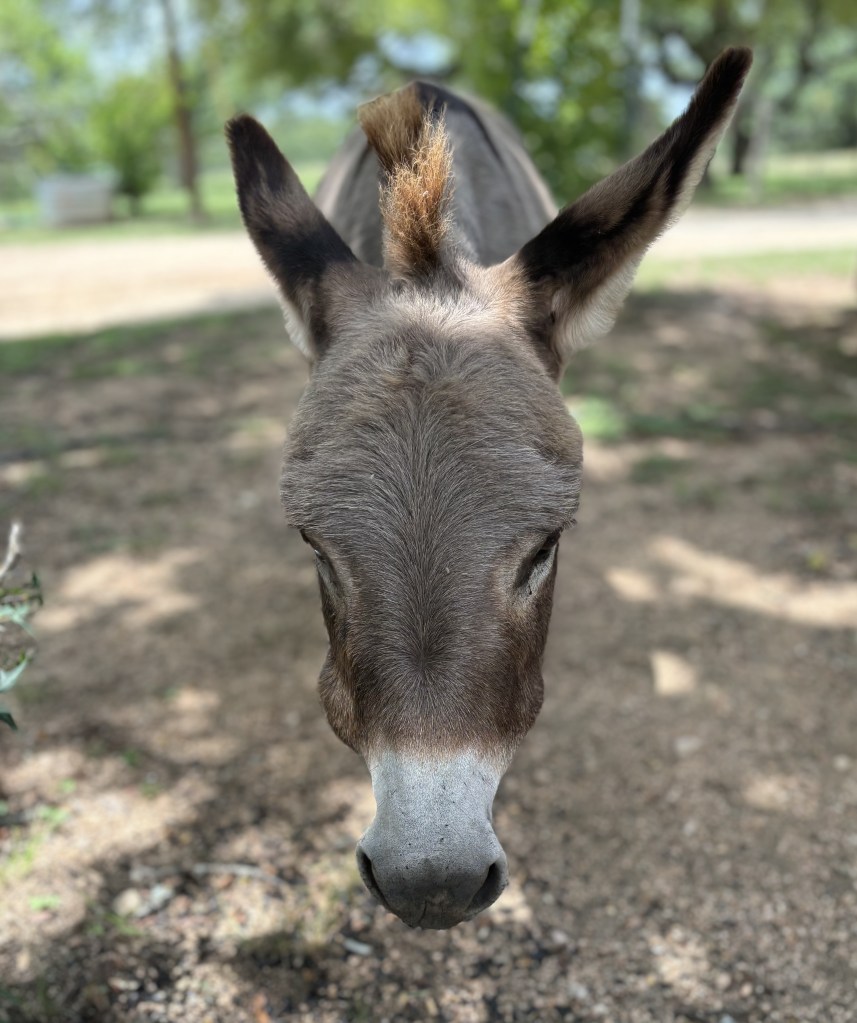
If donkeys could read (wait—maybe they can, but have trouble turning the pages), I predict they’d prefer mysteries. They enjoy puzzles (like how to lift the chain and invade the fenced garden). 
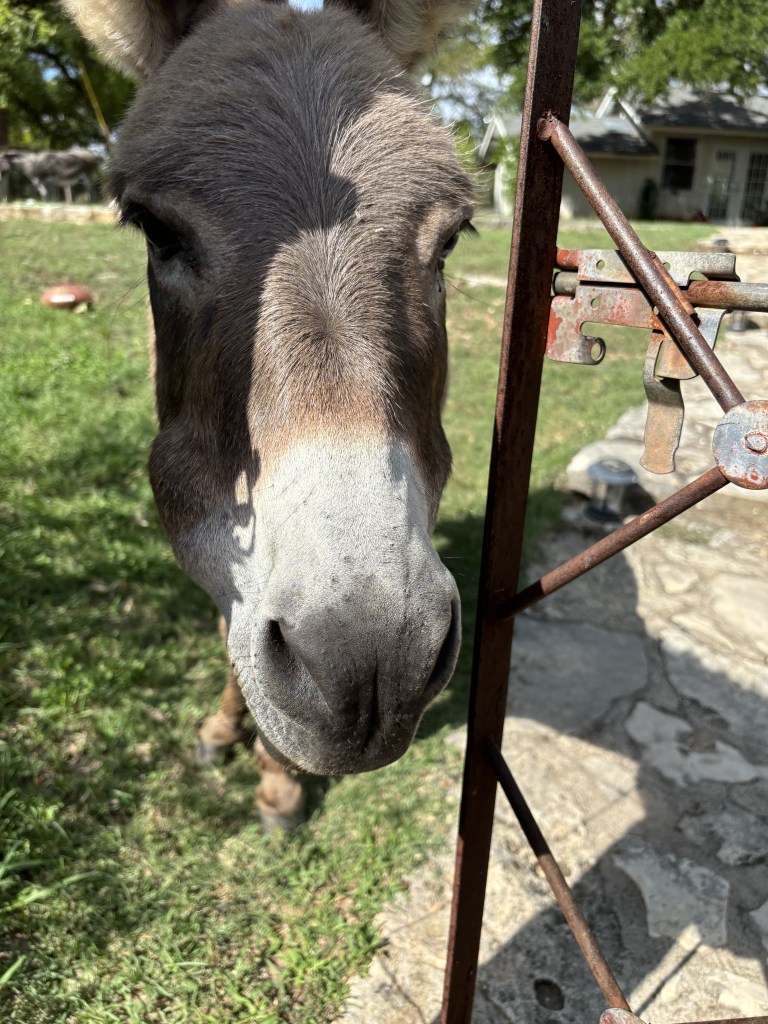
Humans and donkeys. We are both curious animals.

Helen Currie Foster lives and writes the Alice MacDonald Greer Mystery Series north of Dripping Springs, Texas, loosely supervised by three burros. She’s drawn to the compelling landscape and quirky characters of the Texas Hill Country. She’s also deeply curious about our human history and how, uninvited, the past keeps crashing the party! Currently she’s working on Book 10. Her protagonist, Alice, gets into legal drama, and matters of the heart. Alice does have a treehouse…
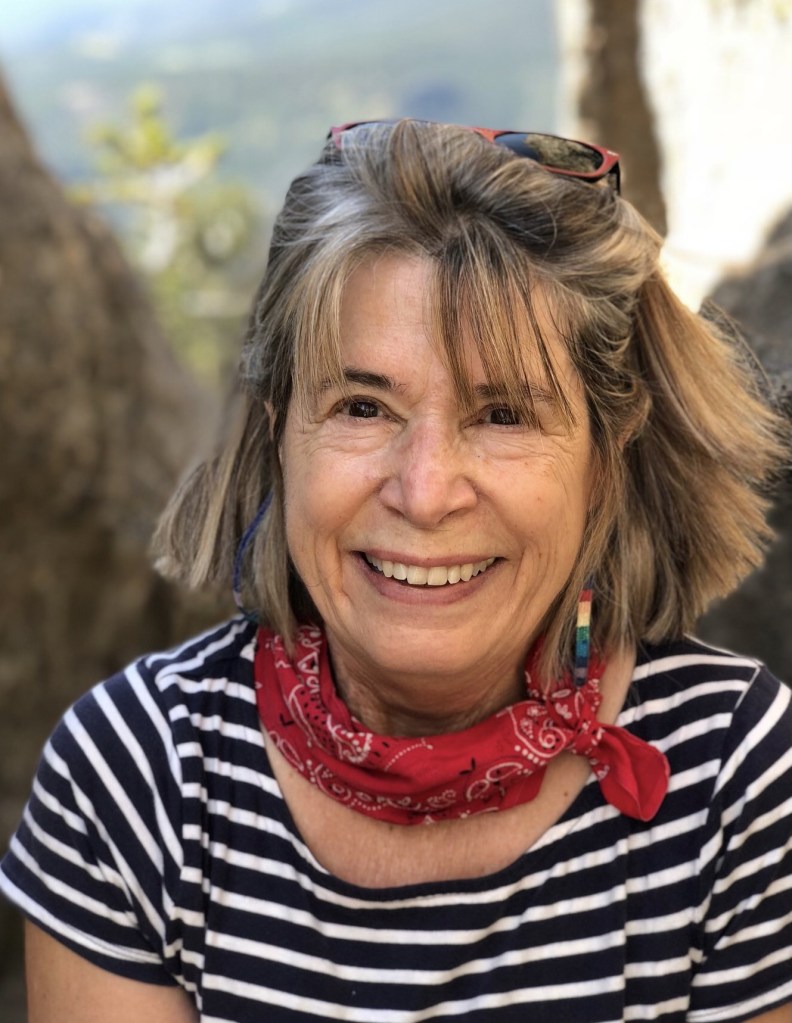
Follow Helen at http://www.helencurriefoster.com and on Amazon and Facebook, https://www.facebook.com/helencurriefoster

SERENDIPITOUS SURPRISES

by Helen Currie Foster

August 19, 2024

I wasn’t going to mention the dreadful heat. But facing August in Texas requires early rising. And early this morning came two in-spite-of-the-heat surprises. First, moonset of the August Supermoon: 

Second, a tiny frog, less than an inch long, sitting quietly in the shade. Could it be a Texas cricket frog? Maybe some frog-maven will know. Can you spot it here, on the big rock?

Another treasure: an email from a reader who’d read Ghost Cave, first book in my Alice MacDonald Greer Mystery series, and wanted the recipe for the coffee cake served by Alice’s redoubtable elderly friend Ilka:

They settled at the tea table. Ilka poured. Bone china, thin and old, the glaze crazed. Like Ilka’s face and hands, thought Alice. The cake stand held something Alice had never seen—a pale smooth yeasty-smelling cake with thin cinnamon topping…

“Oh, goodness, Ilka,” said Alice. “What is that?” The yeast dough, ivory and fragrant, left a mysterious fragrance in the air.

“Cardamom,” said Ilka.

Yikes! I had to tell the inquiring reader I had no recipe! Only—a memory! As kids we were in awe of our neighbor Mrs. Slinn, up the street. She wore her hair pulled back in a bun and longish dresses and, I think, always an apron. When we scruffy little children approached her door she always offered cookies. (We still roll out her classic “teacake” sugar cookie dough to make Santas, snowmen, reindeer.)

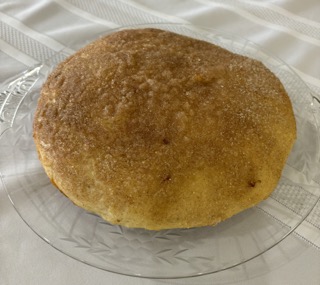
But occasionally Mrs. Slinn swept down the street to our kitchen bringing magic: a round yeast coffee cake, no taller than 3 inches in the middle, ivory-gold with a delicate sprinkle of cinnamon and sugar on top. It smelled amazing and when cut into small wedges was absolutely delicious…

To this memory, in Ghost Cave, I’d added cardamom—not a spice we knew when I was little. But where to find a recipe for the inquiring reader?

THE READER HERSELF! She wrote back that she’d located cookbooks from Mason County, Texas (dated 1976), and Fredericksburg (12th edition–Fredericksburg cooks published their first cookbook in 1916!). Each included a recipe for “yeast coffee cake.” (The Fredericksburg recipes include the original names—like Apfelkuchen, Schnecken, Kolatschen.) Which is further proof that mystery readers themselves are bright, curious sleuths. And why hearing from readers is wonderful.

Below you’ll find a slightly modified recipe from the excerpts she sent, but with a little cardamom added.

At a recent book talk I called the relationship between mystery reader and mystery writer a collaboration. Indeed, a primary rule of the 1930 Detection Club in London was that any clue must be instantly produced for the reader. No holding back explanations or back story until the end of the book! Of course that rule was sometimes violated (yes, Madam Christie, we’re talking about you). In contrast, Christie’s contemporary, the New Zealander Ngaio Marsh, occasionally added some colorful backstory at the end, but she also generally had already given the reader fair notice of the clues that identify the murderer.

In her series featuring the elegant Scotland Yard sleuth Roderick Alleyn, Marsh typically begins with the setting––often provided by a variety of characters––of the site where murder will inevitably take place, either in England or New Zealand. The setting could be an artist’s colony (“Colour Scheme”), a tour boat on an English river, a village church hall, a pub, a guest house in New Zealand, an elegant country house (“Dancing Footman”), the London apartment of a practically bankrupt upper-class family (no one seems to have a job) (“Surfeit of Lampreys”). Thus when we open a Marsh mystery, first we meet the potential suspects, including one we may hope is innocent, may hope is truthful. Then comes a seriously tricky murder. (Did someone disturb the fly rod on the wall? Why?) At that point Inspector Alleyn arrives, with his sidekick Fox and the crime scene specialists. For the competitive mystery reader—collaborating with the author to detect the murderer–each detail matters and is promptly disclosed. But who lied? Who was mistaken?

Rest assured Marsh knew her subject matter and her settings: she was an artist, an actor and a theatre director as well as a writer. She lived and worked in England as well as New Zealand. She was appointed Dame Commander of the British Empire in 1966. The Mystery Writers of America bestowed the Grand Master Award for her lifetime achievement as a mystery novelist. https://en.wikipedia.org/wiki/Ngaio_Marsh  I suspect her character Agatha Troy (an artist who finally marries Alleyn) may be in part a portrait of Marsh.

And Marsh received a birthday Google Doodle on April 23, 2015! https://doodles.google/doodle/ngaio-marshs-122nd-birthday/

Marsh’s first book came out in 1934, featuring Alleyn as the upper-class “grandee” who resigned from the foreign service to join Scotland Yard. By then a different sort of sleuth was emerging in the U.S. In 1930 Dashiell Hammett published The Maltese Falcon and we met Sam Spade. In 1933 Raymond Chandler, like Hammett, was already publishing in The Black Mask magazine, and in 1939 he published The Big Sleep, presenting Philip Marlowe. Decades later the mystery genre continues to grow and grow:  Noir! Culinary mysteries! Cozies! Mysteries narrated by dogs! (Spencer Quinn’s Chet and Bernie series.) Cowboy mysteries! Fantasy/sci-fi/mystery! Sleuths in Laos, China, Australia, Scandinavia, Russia, Alaska, Louisiana, national parks, Native American reservations. Edinburgh! The Shetlands! Botswana! Canada! Italy! France! Israel! Scandinavia! Legal thrillers! Spy thrillers! What a wealth of mysteries for us to enjoy.

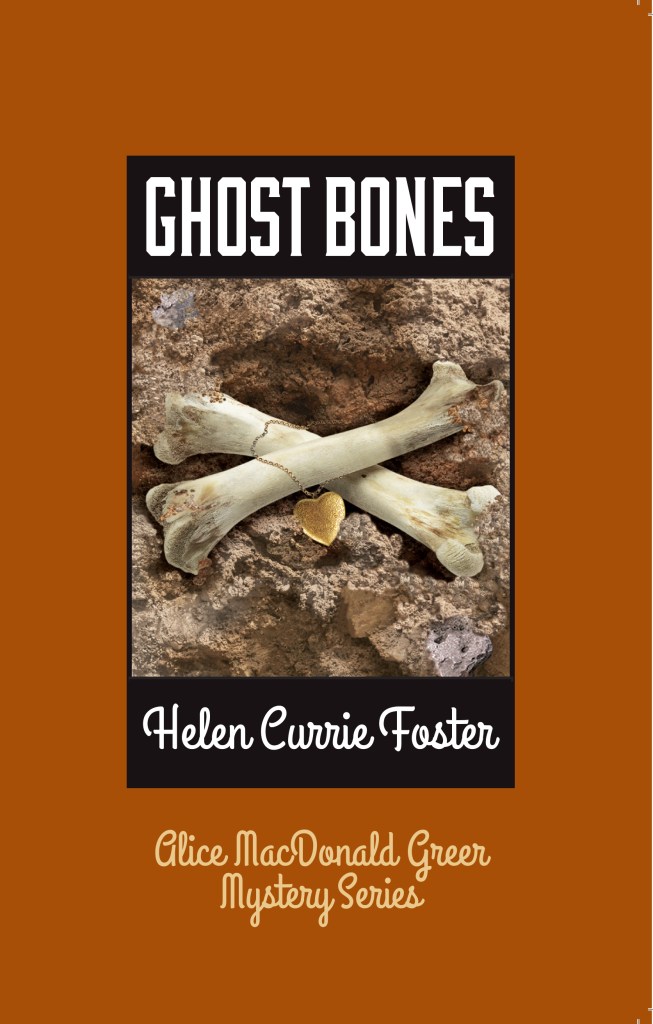
What about the Texas Hill Country? In her latest adventure, Ghost Bones, lawyer Alice MacDonald Greer grapples with the murder of a deeply respected judge. His death was apparently triggered by his efforts to solve the murders of six people on his property almost two centuries ago. Alice needs all the help she can get from her irrepressible assistant, Silla, and from Ben Kinsear, as she tangles with mystery, legal drama, and matters of the heart.

And a request: if you can identify the tiny froglet above, please share the name!

Helen Currie Foster lives and writes the Alice MacDonald Greer Mystery series north of Dripping Springs, Texas, loosely supervised by three burros. She’s drawn to the compelling landscape and quirky characters of the Texas Hill Country. She’s also deeply curious about our human history and prehistory, and how, uninvited, the past keeps crashing the party. Follow her at www.helen.currie.foster.com.

Nearly Mrs. Slinn’s Coffee Cake, with thanks to a wonderful reader and the cooks of Mason and Fredericksburg!

3/8 c. milk; 2 Tbls. sugar; 1/2 tsp. salt; 1/4 c. butter; 1 beaten egg; 2 tsp. dry yeast; 1 1/2 Tbls. warm water; 1 5sp ground cardamom; 1 3/4 c. flour, plus additional melted butter (about 2 Tbls.) and sugar-cinnamon mixture for topping (about 1 tsp cinnamon to 1/3 c sugar)

Scald milk and pour over the butter, salt and sugar. Stir and let stand until lukewarm. Dissolve yeast in warm water for 5 minutes. Stir egg and yeast mixture into milk mixture.  Stir in 1 tsp cardamom and 1 cup of flour. Beat well. Continue adding remaining flour.  Put dough on lightly floured board and knead until smooth (add a bit more flour if too sticky). Place in greased bowl, cover, and let double in size. Then punch down.

Butter bottom and sides of round 8” pan. Put parchment paper in the bottom.  Pat in dough. Brush with melted butter and sprinkle on the sugar/cinnamon mixture. Let rise again until double in size. Bake at 350 for about 20 minutes or until just turning golden.   Let cool. Serve it forth!

THE NAME OF THE ROSE IS—wait, how do you pronounce that?

BY HELEN CURRIE FOSTER

April 1! It’s spring, with a riot of bluebonnets this year.

Plus paintbrush! Winecup! Verbena! Prairie celestials (so lovely)!

And within the fence, safe from our marauding burros, the roses are opening their petals and sharing their beauty.  Humans have been growing and hybridizing roses for millenia. I favor those with deep rose fragrance. This year the sniff prize goes to Madame Isaac Pereire,

but Zephirine Drouhine is a strong contender as well—sweet perfume, but no thorns!

Blooming with pride are Cramoisi Superieur, fun to pronounce, and dainty little Perle d’or, below.

Yes, the French have been busy.  But I’m waiting on the spectacular Star of the Republic, which is covered with buds that will become exquisite cream and pink roses,  and is almost as tall as Texas.

Thanks for human ingenuity and the deep love of beauty and fragrance that resulted in these roses. We humans are so able to produce beauty—and yet we mystery readers and writers know how gripped we are by the companion question: why do humans commit the primal sin of murder?

I’ve been reading a riveting book called How the Mind Changed, A Human History of Our Evolving Brain (2022), by neuroscientist Joseph Jebelli, who studies the genetic history of the human brain. I’ve had to put stickers and checks on so many pages!

Jebelli says that, starting about 7 million years (or 230,000 generations) ago, when humans split from chimps, our brains were only 350 cm3 big. Then 3.5 million years ago, when our ancestor Lucy came along, we got a new uniquely human gene that gave us a folding neocortex and nearly doubled our brain size to 650 cm3.

Later, he says, our brains bloomed to 900 cm3, when we began cooking (maybe 2.7 million years ago), then to 1000 cm3, about 2.5 million years ago, then to 1500 cm3 500,000 years ago, and then grew another 25% by the time, 300,000-400,000 years ago, when Homo sapiens appeared.

Later research shows—the bigger the brain, the bigger the social group. Id., 69.

And lucky Homo sapiens came along when our planet was in extreme ecological instability: “African megadroughts depleted the land’s fresh water; vanishing grasslands diminished the number of animals available…” Homo sapiens spread across the planet, interbreeding along the way with the Neanderthals (who went extinct around 40,000 years ago), and the Denisovans, Neanderthal cousins from Asia. Most humans outside Africa carry around 2 percent Neanderthal-derived DNA while today humans in Papua New Guinea and Australia possess up to 6% Denisovan DNA.

Now we have tools of advanced microscopy and molecular genetics to use “the mosaic of neurons, the constellation of synapses and the tributaries of molecules to learn the age of the brain and the transformations it has seen.” Îd., 21.

But it’s Jebelli’s discussion of brain research on “fair play” that I find most fascinating – whether the experiment uses rats, vampire bats, or humans. “Our minds intuitively draw a distinction between unfair equality (all students receiving the same…grades regardless of merit) and fair inequality (the doctor earning more than the cleaner). When push comes to shove, humans nearly always prefer fair inequality to unfair equality.” Jebelli goes on to explain that when we humans engage in fair play, we experience a surge of neural activity in our brain’s reward centers, releasing dopamine, oxytocin, serotonin and endorphins. Id., 68.

Watch out: scientists are identifying gene mutations that explain amazing things. “Non-monogamous brains tend to have a special kind of dopamine receptor gene called DRD4, which is linked to promiscuity and infidelity.” Id., 78. Use that in a plot, mystery-writers!

But I was thrilled by the focus on the link between strong imagination and intelligence in our “default network, a brain system that participates in daydreaming, mind wandering, reflective thinking and imagining the future….People who engage in these cognitive practices…have greater access to the states of mind necessary to solve complex problems.” Id., 115. Jebelli says our default networks are only active when we’re not focused on a task, “when the brain is cycling through thoughts not associated with the immediate environment.”  In other words, the default network contrasts with our executive control network.  Jebelli makes another leap: compassion also stimulates the default network. “Compassion requires imagination. ‘Climb into his skin and walk around in it,’ Atticus tells Scout.” But imagination also requires compassion.  Id., 119.

Why has this book grabbed me? As a mystery writer I wrestle with why some humans will run into the street to save a child from a bus, and some will just watch; and why and how some humans invent gripping new imaginative worlds (Lord of the Rings, Harry Potter, Slough House, Yoknapatawpha County, the Forest of Arden, Hat Creek and the saga of Lonesome Dove) that tell of human struggles and victories, tragedies and comedies. Yes, writers who stimulate our “default networks”!

So you might like to take a peek at How the Mind Changed—check out the chapter on that age-old conundrum––what is consciousness? And the chapter on different minds, or neurodiversity, including genetic components. And the chapter on the new field of neurocriminology: what makes humans commit crimes? Which brain regions are responsible for violence? One possibility—it’s an area of the hypothalamus called the ventromedial hypothalamus, “an ancient brain region that has been conserved throughout mammalian evolution.” Yikes!

As Jebelli notes, plots will abound from this inquiry, this research. As always, inquiring minds want to know.

Meanwhile, it’s April! So let us now praise Geoffrey Chaucer – whose compassion and imagination gave us “Whan that April with his showres soote The droughte of March hath perced to the roote, And bathed every veine in swich licour, Of which vertu engendred is the flowr…”

And further to celebrate—Book 9 of my Alice MacDonald Greer legal thriller series has gone off for copy-edit. Yes, again the primal crime has been committed…!

Why They’re Favorites…? On Rereading

BY HELEN CURRIE FOSTER

What’s your favorite place to read? A certain chair? The one with a lamp that shines on your book, not in your eyes? Perhaps a ferryboat seat, where you glance up at the horizon, then down at your book? On a plane, or train?

When I was young our house had an elm tree in the back yard which was not only climbable, but offered two branches that stuck out at the perfect angle for a lounging pre-adolescent. Even better—the lounger was invisible from the house. I could scramble up, arrange myself, open my book—and be left unfound, undisturbed, for some time.

A later joy was climbing on the New Haven RR in Boston after final exams (Chaucer, Shakespeare), armed with the latest James Bond and the very biggest Hershey bar with almonds, and being rocked south for miles along the coastline. Uninterrupted.

And I confess to rereading books. I further confess to rereading children’s books. Maybe a more accurate word is: revisiting. At least every two years, I pick up Kipling’s Kim, finding my way to the part where Kim guides his Tibetan lama, who seeks a sacred river, on a pilgrimage into the high deodar forests of the Himalayas. I can almost smell the trees. There Kim steals the Russian spies’ notes––his own initiation into the Great Game. Even more satisfying? The long afternoon where, exhausted, he is “taken apart” by Eastern massage and finally stumbles out, recovered, to find his lama at the brink of—well, no spoilers.

Why this gravitational pull of favorite children’s books?

Maybe because the best children’s books feature enterprise, surprise, disguise. And—most important––the discovery of identity.

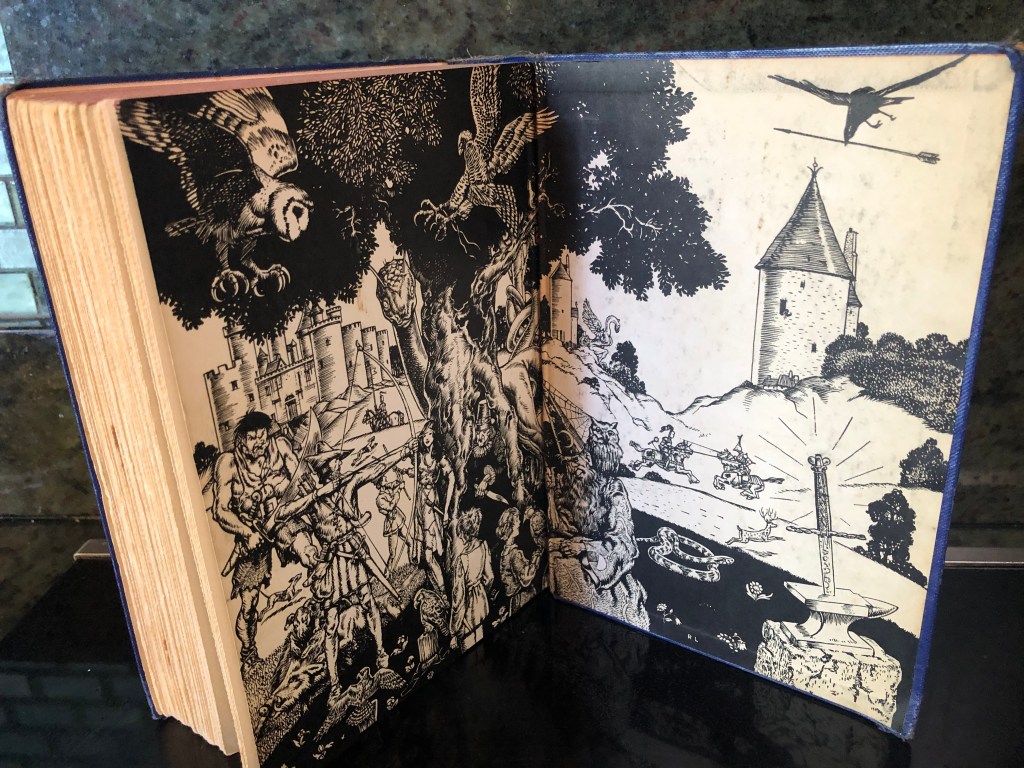
Consider The Sword in the Stone, where Merlin transforms Wart into various animals (badger, owl, fish) who teach him survival techniques (“put your back into it!”). And magic! Giants! Griffins! The Queen of Air and Darkness! (See volume below–griffin looming behind tree.) One favorite moment? When Merlin transforms Wart to a raptor—a small merlin––who must sit for desperate minutes during his formal initiation, near the maddened and perilous Peregrine. Why does Wart need Merlin’s special tutelage? Because of his identity, which he and we will finally discover.

Others I still pull off the shelf: The Wind in the Willows, especially Mole’s tearful return home, where he recognizes his true self.

Also Susan Cooper’s The Dark Is Rising. Maurice Sendak’s Nutshell Library – memorizing all the poems. I sneak back to Harry Potter—a feast of enterprise, surprise, disguise, and Harry’s search for his own identity. Occasionally I return to Lord of the Rings––especially the battle for Gondor. You’ll note I missed out on Jack London and many others. But there’s always The Lion, the Witch and the Wardrobe—remember that wondrous moment when Lucy slips through the back of the wardrobe, past all the mothballed coats…into magic? Into the snowy landscape where she meets Mr. Tumnus the faun? Into the realm where––as Lucy later discovers––she is Queen Lucy?

You have your favorites. So do our collective children and grandchildren. Bookstore shelves still offer children tales of enterprise, surprise, disguise—and characters discovering their own identities.

And fortunately, children’s books needn’t follow the 1930 Detection Club’s 10 Rules for Writing a Mystery. Rule #2: “All supernatural or preternatural agencies are ruled out as a matter of course.” Following Rule #2 would let out magic, of course, and its enormous space for imagination. (If you, like me, crave an occasional touch of magic for grown-ups, try Remarkably Bright Creatures by Shelby Van Pelt. amzn.to/44iIoVj)

As a mystery writer/reader I usually write about mystery. But thinking lately about the bibliophile’s favorites—favorite reading spots, favorite chairs, favorite characters––has sent me down a different path. Why reread? Wait––why revisit?

What is it about the end of Kim, or the plight of Frodo and Samwise in Shelob’s lair, or Harry Potter’s first moment on his broom, learning how good he is at Quidditch––that whispers, “read it again!”

I reread mysteries too. Have you reread a Dorothy Sayers, a Ngaio Marsh, a Sherlock Holmes? Or John le Carré? How many times have you read Tinker, Tailer, Soldier, Spy, or Smiley’s People? (Come on, spy thrillers are part of the mystery-thriller-spy novel genre.) And why do we reread le Carré? One character in particular: George Smiley.

Smiley first appears on page 1 of chapter 1, titled “A Brief History of George Smiley,” in Call for the Dead, le Carré’s first book, published in 1961. Smiley’s marriage to the aristocratic Lady Ann Sercomb has ended when she abandoned him, and he’s described as follows: “Short, fat and of a quiet disposition, he appeared to spend a lot of money on really bad clothes, which hung about his squat frame like skin on a shrunken toad.”

We learn of his deep love of 17th century German literature, his success at Oxford, his recruitment by MI-6, his dangerous service abroad as a spy in WWII. Not a commanding figure, no. But le Carré allows us to glimpse his sharp mind, his penetration, his ability to absorb all he hears. Smiley’s work as an intelligence officer provides him “with what he had once loved best in life: academic excursions into the mystery of human behaviour, disciplined by the practical application of his own deductions.”

Smiley appears next in A Murder of Quality (1962), where Smiley’s solution to the murder rests on a scathing critique of the snobbishness of British public schools (le Carré despised his own experience at such a school).

By the time we reach Tinker, Tailor, Soldier, Spy (1974), Smiley has been put out to grass at MI-6 under the new regime headed by Bill Haydon, who has seduced Smiley’s wife Ann and taken over London Station after causing the bitter dismissal of Control as its head.

In Tinker, Tailor, Smiley is plucked out of retirement to interview a somewhat dubious British agent who claims the Russians may have placed a mole inside MI-6. Here’s Smiley, listening to the agent’s tale:

“He sat leaning back with his short legs bent, head forward, and plump hands linked across his generous stomach. His hooded eyes had closed behind the thick lenses. His only fidget was to polish his glasses on the silk lining of his tie, and when he did this, his eyes had a soaked, naked look that was embarrassing to those who caught him at it.”

Smiley’s investigation marches ahead. The BBC wants to make a series of Tinker, Tailor. And John le Carré has an actor in mind: Alec Guinness. https://www.theguardian.com/tv-and-radio/2019/sep/05/tinker-tailor-soldier-spy-40-years-on-alec-guinness

Le Carré’s letter to Sir Alec Guinness (3 March 1978) appears in A Private Spy / The Letters of John le Carré, at 213. He tells Sir Alec:

“Apart from plumpness, you have all the other physical qualities: a mildness of manner, stretched taut, when you wish it, by an unearthly stillness and an electrifying watchfulness. In the best sense, you are uncomfortable company, as I suspect Smiley is. An audience wishes––when you wish it––to take you into its protection. It feels responsible for you, it worries about you. I don’t know what you call that kind of empathy, but it is very rare, & Smiley and Guinness have it: when either of you gets his feet wet, I can’t help shivering.”

I love that “as I suspect Smiley is.” Does the author’s own speculation about George Smiley explain, in part, why we readers become so attached to this character? What drives us to Smiley’s side? Is it his apparent ineffectualness, his vulnerability, his stillness, his watchfulness, entwined with our certainty that he will somehow keep going?

Not until 1979 in Smiley’s People does Smiley achieve final vindication, catching the Russian master-spy who conceived the long set of steps that led to Haydon’s seduction and Control’s fall. At the climax, we (along with Smiley and his fellow spy Peter Guillam) await the possible arrival of the Russian in cold war Berlin, at the crossing point from East Germany. Will the spy make it across the bridge? Guillam asks what cover the Russian will use:

Smiley sat opposite him across the little plastic table, a cup of cold coffee at his elbow. He looked somehow very small inside his overcoat.

“’Something humble,” Smiley said. “Something that fits in. Those who cross here are mostly old-age pensioners, I gather.’ He was smoking one of Guillam’s cigarettes and it seemed to take all his attention.”

At book’s end, we are waiting with Smiley. It’s cold there by the Berlin bridge. I expect Smiley’s feet are wet. Like the author, “I can’t help shivering.” When we know a character’s vulnerabilities, we begin to perceive true identity.

For Smiley, for all the characters created by their authors with such vividness and such vulnerability that we seem to feel what they feel, for such characters–I reread. Yes, the better word is revisit: I go back just to be sure the characters are still there, still available, still waiting quietly on the shelf. And, yes, just as good as I thought they were.

I’d love to hear your favorites (reading spots, children’s books) and the favorite characters you…revisit.

March Madness?!

by Helen Currie Foster

“MARCH MADNESS”? In the Texas Hill Country, “March Madness” doesn’t only mean NCAA basketball. Its alternate form: Demented Spring Gardening. Too early, you say? Well, according to the snakes, spring’s already here.

Of course it’s not officially spring yet. Just three weeks ago, here north of Dripping Springs, Texas, the entire landscape—every tree, every leaf–was shrouded in solid ice. But this week, well before the equinox, beneath the oaks you’ll spot the amazing heartbreakingly beautiful fuchsia of the redbuds.

And roses! The tender yellow flowers of the Lady Banksia rose are cascading from the oak tree that serves as her trellis.

On other branches you can see the first luxurious pink buds of Souvenir de Malmaison, named for Empress Josephine’s rose garden, beginning to open.

In the garden the ineffably fragrant Zephirine Drouhin is performing her slow tease, loosening the green sepals, delicately unveiling her bright pink petals.

I’ve already planted two new and reputedly very fragrant roses––Madame Plantier, and Cramoisi Superieur. (What a name!) And I replanted Buff Beauty, which produces buff and yellow and apricot blooms. Still waiting for two more—Savannah and Sweet Mademoiselle, both promising strong fragrance. Seriously, a rose without fragrance? Isn’t it disappointing to lean forward into a rose, inhale…and…nothing? As Shakespeare points out in Sonnet 56:

The rose looks fair, but fairer we it deem

For that sweet odour which doth in it live.

But for sheer fragrant spring bravado, tinged with peril, what about the ridiculous grape Kool-Aid smell of Texas mountain laurel? Intoxicating and loopy. The plant—sophora secundifolia–– isn’t called “Texas mescal bean” for nothing. https://www.wildflower.org/plants/result.php?id_plant=sose3: “The brilliant red seeds contain the highly poisonous alkaloid cytisine (or sophorine) – this substance is related to nicotine and is widely cited as a narcotic and hallucinogen.”

Poets give us strong language for the power of spring. From Dylan Thomas: “The force that through the green fuse drives the flower…”  https://poets.org/poem/force-through-green-fuse-drives-flower

From “in-Just” by e.e. cummings:

in Just- 

spring          when the world is mud- 

luscious the little 

lame balloonman 

whistles          far          and wee 

“Mud-luscious!” Cummings captures the joys of digging, planting, splashing—of being a child in spring. https://www.poetryfoundation.org/poems/47247/in-just

“A Light exists in Spring” by Emily Dickinson was new to me. I treasure her recognition, her human diagnosis, of that first moment when we notice the magical presence of spring. It begins:

A Light exists in Spring
Not present on the Year
At any other period —
When March is scarcely here

A Color stands abroad
On Solitary Fields
That Science cannot overtake
But Human Nature feels.

bit.ly/420VlSC

More symptoms of March Madness? The powerful, even uncontrollable, urge to fill your cart full of geraniums, dirt, mulch, annuals, perennials, unknown roses, tomato plants, new trees… Trudging a quarter mile from the local native plants emporium to your car, lugging a red wagon full of blue sage, lantana, and other plants hopefully accurate in describing themselves as “deer-resistant”… Other symptoms include impassioned online review of rose varieties, frantic ripping open of seed packets and daily watering of small unlabeled pots, then staring at tiny emerging seedlings and wondering—what are you? Is that the fennel or the Aji Crystal Pepper or the Mexican plum?

I’d never heard of Mexican plum until a friend gave me a jar of her amazing Mexican plum jam. She described the trees as small, with fragrant white blossoms. So I ordered seeds. The very small print on the seed packet required “stratification” in the refrigerator. Well, I tried. Every morning I peer at the still-empty pots of dirt… little plants, where are you? Can you live in the Hill Country?

Also—perhaps prematurely—we dragged hay bales into the garden and embarked on the great Haybale Tomato experiment:

Supposedly, according to our favorite local well-driller, this approach produces for one local rancher “the most beautiful tomatoes in the Hill Country.” Our donkeys kept sticking their muzzles through the fence, trying to eat the bales. Watch this space. https://www.youtube.com/watch?v=z2jjIHgmypM

Gardens can be perilous. Think of Eden. But how many murder mysteries are set in gardens, or involve garden poisons? If you haven’t already become a fan of Reginald Hill, you might try Deadheads. Dalziel and Pascoe solve virtually every murder presented to them in their Yorkshire police headquarters. In this one, roses abound, beginning on the first page. And rose culture. And… murder. bit.ly/3Fgce23

Texas author Susan Wittig Albert knows her way around poisonous plants, in Texas or elsewhere. I just finished her Hemlock, Book 28 in her China Bayles series. This mystery—impressively researched, and fast-moving–takes the reader to the Blue Ridge mountains and theft of a rare botanical book, with deft historical backstory.  https://susanalbert.com/hemlock-book-28/

For more on Texas mountain laurel, its power and peril – see Ghost Dog, Book 2 in my Alice MacDonald Greer Mystery series. bit.ly/3YIotv5

The weather report threatens another cold snap this week—even (gasp!) a possible freeze. But right now it’s 74 degrees. Geraniums to plant. Blue sage. Tomatoes to water. Yes, it’s hubris, exposing these tender plants so early to the vagaries of Hill Country weather, but—I can’t help it. I just saw a big bud on Star of the Republic! I swear it wasn’t there yesterday. March Madness reigns!

Find Helen Currie Foster on Facebook or at http://www.helencurriefoster.com. The eight books of the Alice MacDonald Greer Mystery series, including the most recent, Ghosted, amzn.to/3YrJBXf, are available at Austin’s BookPeople as well as on Amazon (Kindle and Paperback).

THE POWER OF THE QUESTION MARK

Why do we mystery readers read the next line? Turn to the next page?

Some writers have the knack of persuading us–for example, Tony Hillerman. His mysteries feature Navajo police Joe Leaphorn, Jim Chee and Bernadette Manuelito. Never forget that Hillerman was a journalist before he wrote mysteries. I’m betting he excelled at attention-catching ledes that made you read his news articles. An early example of his getting us to turn to the next page occurs in The Dark Wind (1982), page 1:

“The Flute Clan boy was the first to see it. He stopped and stared. ‘Someone lost a boot,’ he said. Even from where he stood, at least fifteen yards farther down the trail, Albert Lomatewa could see that nobody had lost the boot. The boot had been placed, not dropped. It rested upright, squarely in the middle of the path, its pointed toe aimed toward them…”

Come on, you’ll turn the page, right?

For me, the same holds true for poetry. Untangling a new poem demands commitment. I confess the combination of the title and first lines can draw me right in. Masters of such trickery include Robert Frost and Billy Collins. Take for instance Frost’s “Mending Wall,” from North of Boston (1914): “Something there is that doesn’t love a wall…” Well, I want to know what. Or “After Apple Picking”: “My long two-pointed ladder’s sticking through a tree/ Toward heaven still…” I won’t leave that ladder quite yet.

Billy Collins simply uses a one-two punch: first his title, then the first lines, and you’re hooked. From Aimless Love (2013), titled “Hell”: “I have a feeling that it is much worse/ Than shopping for a mattress at a mall…”

When that combination–title plus opening lines–arouses my curiosity, it’s because I feel I’m experiencing along with the poet. Where’s the poet going? I’ll follow to find out (and Collins’s self-deprecating humor keeps me reading).

Okay, we’re curious animals. We’ve been asking “WHY?” at least since we were two. Theories abound. Is it because we’re responding to our outside world? Or is it innate–instinctual? Genetic? Do we get a dopamine rush from capturing new information? “Drive theory” calls curiosity a naturally-occurring urge we have to satisfy–a reason we read mysteries and work crossword puzzles. Alternatively, “incongruity theory” suggests we tend to see the world as orderly and predictable, but we become curious when an external event doesn’t fit our perceived order. Do mystery readers experience curiosity falling within each category? We want to find missing information (Clues!)–drive theory. And maybe we want a satisfying conclusion (justice served, the murderer punished, motives revealed) –incongruity theory.

Scientists are currently wildly curious (sorry) about human and animal curiosity.https://science.howstuffworks.com/life/evolution/curiosity.htm.

https://www.psypost.org/2022/o7/new-psychology-research-reveals-a-dark-side-of-curiosity-63583

I suspect readers are like Leonardo da Vinci. Mario Livio asks, in Why: What Makes Us Curious (2017), what distinguished Leonardo from his predecessor anatomists, hydraulicists, botanists? “Leonardo had an unquenchable curiosity which he attempted to satisfy directly through his own observations rather than by relying on statements by figures of authority.”

Just like mystery readers. We insist on discovering each clue for ourselves. Woe betide the writer who cheats us–hides a clue, or packs the last chapter with explanations we had no chance to discover directly through our own observations. Not only cheatsy, but contrary to a key provision in the original Detection Club rules. https://murder-mayhem.com/the-detection-club-rules. A violation of our beloved genre!

We need for the sleuth to ask the right questions. An Austin detective recently gave an absolutely riveting presentation to our Heart of Texas Sisters in Crime chapter, describing how to conduct an interview of a potential suspect (not under arrest) who’s been asked to talk to the police. He said the interviewer needs to be likable–should give the suspect no reason to dislike him. The initial greeting should create a sense of reciprocity but also mention the sleuth’s authority. The detective begins the interview in a calm, low voice, giving the suspect autonomy and building rapport: “Is it okay if I call you Alec?” “Tell me a little bit about yourself.” He elicits the suspect’s story, then goes over it, watching for nonverbal indications of uncomfortable areas (the suspect changes posture, etc.). He watches for signs of deception–easy to detect if the suspect lies, harder to detect if the suspect fails to answer the question completely or directly, or restates the question to avoid having to answer the actual query, During the interview, the sleuth must keep a neutral face even if the suspect confesses something disgusting or shocking: “The second the suspect senses judgment on your part, they won’t talk to you.”

The mystery sleuth–professional or amateur–must recognize key questions. Take Anthony Horowitz’s Moonflower Murders–a follow-on to his Magpie Murders, featuring a contemporary murder mystery again wrapped around an earlier mystery involving the fictional detective Atticus Pund. Protagonist Susan Ryeland asks: why did the waiter at the posh club drop the plates? And why did her boss’s assistant quit her job at the publishing company? I’ll leave you to find out. Ryeland’s dogged pursuit of the answers to these key questions nearly gets her killed. But she solves the murder.

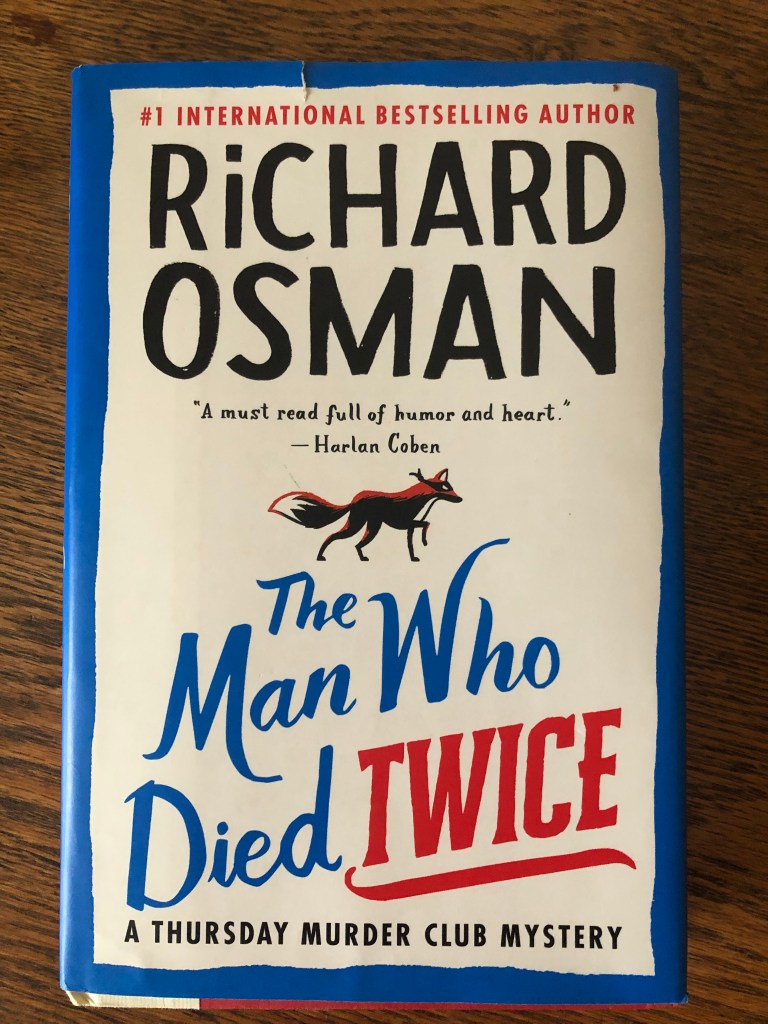
For an entirely different creative use of the question mark, with a twist: study (or just enjoy) Richard Osman. His often comic Thursday Murder Club mysteries revolve around a group of retirees in a comfortable retirement village. The club’s purpose? Solving cold cases. The disparate characters contribute varied personalities and talents–a Zen-focused psychiatrist (Ibrahim), a vivacious widowed nurse (Joyce), a burly ex-union organizer (Ron), and the mysterious former spy (Elizabeth.

Osman brings these characters to life not by a predictable prosy description, but by the questions they ask and answer. In the club meeting on page 1 of The Man Who Died Twice, Joyce asks, “Do you think a dog might be good company?…I thought I might either get a dog or join Instagram.” Ibrahim: “I would advise against it.” The day’s topic is murder; but with such a Q and A, we begin to grasp the nature of this somewhat wacky group. We’re allowed to read Joyce’s diary, in which she comes across as convivial, a bit ditsy, and quite shrewd.

Osman extends this technique to other characters. When drug dealer Connie introduces herself to Chris and Donna, police officers who hope to engage in a sting and arrest her, we get this:

“What’s your eye shadow?” Connie asks Donna.

“Pat McGrath, Gold Standard,” says Donna.

“It’s lush,” says Connie.

Connie’s a murderous drug dealer. But hey! She’s also into fashion. And Donna? Same.

Osman also uses those hanging questions as hooks. At the end of chapter 17, we’re eavesdropping on Joyce’s diary. The daily entry ends, “I wonder if anyone else is awake?” Now turn the page to chapter 18: “Ryan Baird is awake. He is currently playing Call of Duty online. He is spraying machine gun fire at full volume while his neighbors bang on the walls.”

You’ll be glad to know Ryan will get his, but the clever Q and A hooks us into the next chapter and expands Ryan’s character.

Osman’s Q and A also deepens the relationship between two unlikely friends, Joyce and Elizabeth:

“What do you and I talk about, Joyce?” asks Elizabeth.

Joyce thinks. “It’s been mainly murder, hasn’t it? Since we met?”

Thank you, Richard Osman. This is fun.

Just in case you’re wondering whether you (or your friends and relatives) ask enough questions, or ask the right or wrong questions, or have no clue how to keep a conversation going, or (heaven help us) don’t know how to ask questions of a group, here are 450 suggestions. Unfortunately, this collection didn’t include a list of “ideal questions for solving a murder.” https://www.scienceofpeople.com/questionos-to-ask-people

But, like Leonardo, we readers will discover those questions “directly through [our] own observations.”

My next book in the Alice MacDonald Greer Mystery series, Ghosted, will be out soon. Toward the end the protagonist, Alice, asks a key question. Watch for it! Happy Holidays!

Helen Currie Foster writes the Alice MacDonald Greer Mystery series, set in the Texas Hill Country. She lives north of Dripping Springs, loosely supervised by three burros. She’s active with Austin Shakespeare, Heart of Texas Sisters in Crime, and the Hays County Master Naturalists (still trying to learn those native grasses). Her most recent book, Ghost Daughter, was named Eric Hoffer Book Award Grand Prize Short List Finalist, as well as Finalist in the 2022 Next Generation Indie Book Awards, and Finalist in the 16th Annual National Indie Excellence Awards.