The Woods Are Lovely: A Passion for Trees

Helen Currie Foster

October 29, 2024

The mystery is solved! In my search for  what I recalled as “the “Blitzkuchen” once served at Schwamkrug’s outside New Braunfels, in the Texas Hill Country, I had the name wrong. It’s a blitz torte, not a blitz kuchen! Several readers sent recipes from German cookbooks indicating that “Blitzkuchen” is a quick cake, usually one layer only. My memory, though? A tall two-layer confection, baked with meringue and almond flakes on top and between the layers! And in my memory, more meringue on the outside, plus some moistness in the filling.

Online I found Oma Gerhild’s “Oma’s Blitz Torte Recipe ––Lightning Cake.” https://www.quick-german-recipes.com/german-blitz-torte-recipe.html  Each almond-flavored layer is baked with meringue and sliced almonds on top of the batter. The recipe offers either custard filling or whipped cream filling. I opted to finish off with whipped cream with powdered sugar and vanilla, not just inside, but around the cake (and in blobs all around the kitchen).
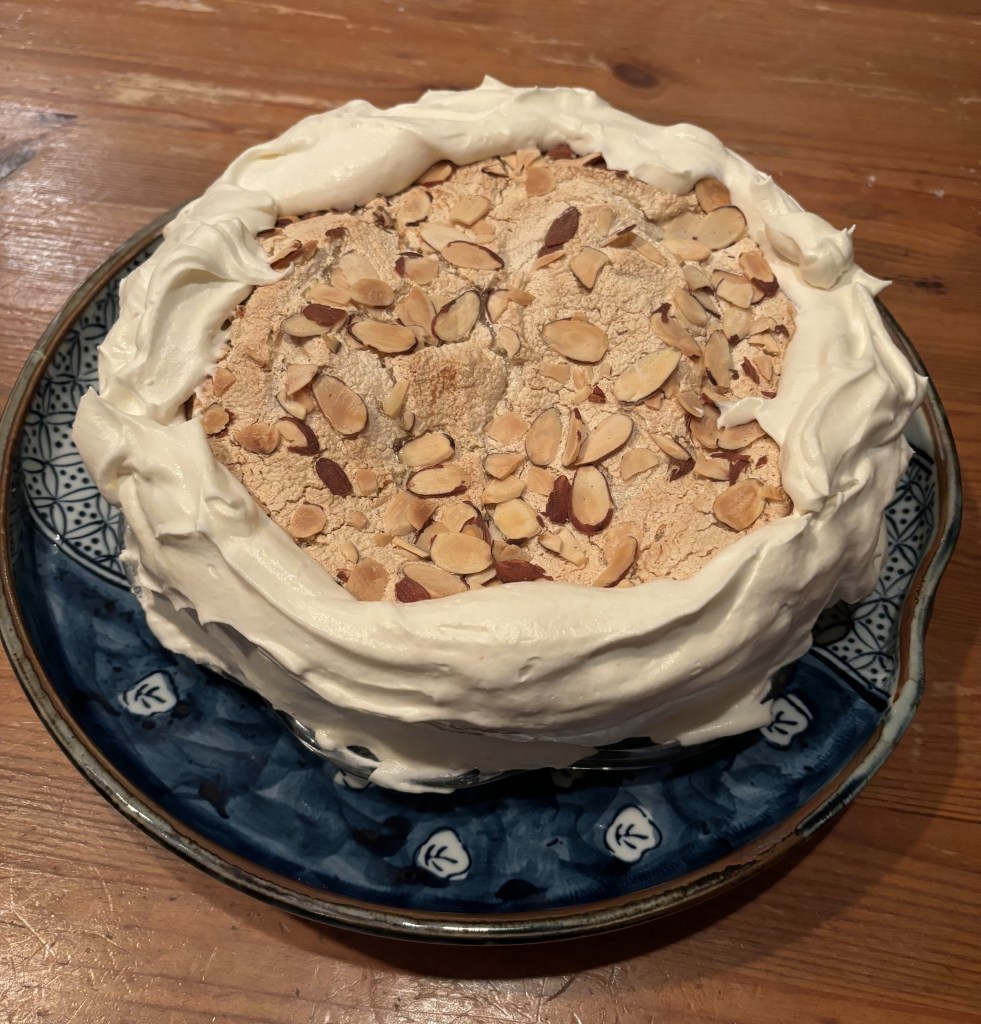
FINALLY! First, that lovely almond taste. Plus, everyone at the table now wore an attractive little white mustache of whipped cream. You don’t get that with a madeleine and a cup of tea, do you, M. Proust?

As October runs into November, Texas Hill Country towns are celebrating Oktoberfest, or, in New Braunfels, Wurstfest. Normally by now our trees would show some fall color––nothing like New England, of course. The cypresses by Lake Austin are turning bronze. Out here north of Dripping Springs, the possum haws are showing their red berries. The cedar elms turned bright yellow, then slowly lost their leaves. The live oaks, thankfully, stay green.

But this year? Drought brings bad news for trees. Cypress-lined creeks are dry…the cypresses’ arched roots groping into the earth for water. Downhill at our place Barton Creek is dry, and I mean dry, with only occasional small pools. Up on the limestone plateau the leaves on some smaller saplings just turned brown and fluttered to the ground, with the tree already looking dead. We’re watering, but in Stage 2 drought restrictions. Will our wells run dry? Have we drained the Trinity aquifers that lie hundreds of feet below?

So, to general geopolitical angst, I’ve added…tree worry.

Trees in books play such a role in our imaginations. After reading Johann David Wyss’s Swiss Family Robinson (1812)—where the shipwrecked family builds a tree-house on their desert island––I always wanted to live in a tree-house! https://en.wikipedia.org/wiki/The_Swiss_Family_Robinson We’re drawn to forests, home of the trees—scary, but sometimes the safest place. In The Sword in the Stone by T. H. White (1939), first of the four volumes that make up The Once and Future King, the Wart (the young Arthur, under Merlin’s tutelage) and Kay meet Little John who tells them about Robin Wood (explaining why it’s not “Robin Hood” and why he lives in the woods (or “‘oods”):

“They’m free pleaces, the ‘oods, and fine pleaces. Let thee sleep in ‘em, come summer, come winter, withouten brick nor thatch, and huntin’ ‘em for thy commons lest thee starve; and smell to ‘em with the good earth in the springtime; and number of ‘em as they brings forward their comely bright leaves, according to order…”

There the boys, the future King and Sir Kay, approach “the monarch of the forest. It was a lime tree as great as that which used to grow at Moor Park in Herefordshire, no less than one hundred feet in height and seventeen feet in girth, a yard above the ground….” Headquarters for Robin Wood and Maid Marian! And there begins a great and perilous adventure for Kay and Wart, who break into the castle of Morgan le Fay, Queen of Air and Darkness—to rescue prisoners paralyzed by magic. (Speaking of paralyzed victims of witches—note how C.S. Lewis later describes turned-to-stone courtyard figures in his first foray into fantasy, The Lion, the Witch and the Wardrobe (1950).)

One writer, Elisabeth Brewer, notes that “The Sword in the Stone shows a passion for trees that White shared with Tolkien. https://bit.ly/3Ceqk. How about the Ents we meet in Fangorn Forest, in J. R. R. Tolkien’s Middle-Earth? Trees that walk…and tend other trees. Not all trees are benign––including the wicked old willow which captures Frodo and friends (rescued by Tom Bombadil).

I’m reading a fascinating graphic (yes, graphic!) book about Tolkien and his close friend C.S. Lewis: The Mythmakers: The Remarkable Fellowship of C.S. Lewis and J.R.R. Tolkien, by John Hendrix. https://bit.ly/4hqiyFr

Tolkien and Lewis met in 1929 in Oxford, where they were, famously, members of a writers’ group, the Inklings, and shared many hours at The Eagle and Child. That’s not all they shared. In 1916, both men experienced horrific warfare on the Western Front in France. Young and just married, Tolkien fought in the trenches, then contracted life-threatening trench fever. At nineteen, Lewis was wounded by shrapnel (from friendly fire) on the Somme, and carried shrapnel in his body the rest of his life. Hendrix’s wonderful book uncovers the sort of salvation two disillusioned veterans found in the healing power of imagination, including Norse mythology and the European fairy tale. Tolkien knew of Yggdrasil, the sacred ash tree central to Norse mythology. https://en.wikipedia.org/wiki/Yggdrasil; https://dc.swosu.edu/cgi/viewcontent.cgi?article=2130&context=mythlore

And how the worlds created by Lewis and Tolkien fired our imaginations! The fantasy world of C.S. Lewis’s Narnia emerged when The Lion, the Witch and the Wardrobe was published (1950). Tolkien’s The Hobbit, or There and Back Again, was first published in 1937 but became a pop-culture phenomenon only in 1960’s, when the paperback edition became available. https://time.com/4941811/hobbit-anniversary-1937-reviews/

Both Lewis and Tolkien had copies of The Sword in the Stone early on. Indeed, in 1939 it was a Book-of-the-Month Club selection. T. H. White 1964 obituary, https://nyti.ms/4hlasht. Curiously, Hendrix’s book on Tolkien and Lewis doesn’t mention T. H. White, perhaps because Hendrix focuses on the impact of war; T.H. White 1906-1964) was born too late to serve in World War I. Nor was he an Oxonian. While C.S. Lewis reportedly disparaged The Sword in the Stone in 1940, he later invited T. H. White to the Inklings if he ever visited Oxford. https://bit.ly/4f4wcww (“Dickieson post”). Perhaps Hendrix doesn’t mention T. H. White because unlike Tolkien and Lewis, though he creates a fantasy world, White grounds The Once and Future King firmly in England.

But Elisabeth Brewer commented in T.H. White’s The Once and Future King that The Sword in the Stone shows a passion for trees that White shared with Tolkien. (Dickieson post.)

What about powerful trees in more recent books? Consider the Whomping Willow, in J. K. Rowling’s Harry Potter and the Wizard of Azkaban? https://bit.ly/4f1koex Magic—but terrorizing—it reveals the secret passage which ultimately allows Harry and friends to discover––well, remember? Indeed, Harry reminds us of T. H. White’s Wart, both with an earnest determination to do right, and a magical tutor.

Maybe children are especially open to tree power because they still climb trees. My dad swooped us off to grad school in Atlanta, and then to Charlotte, before we moved back to Texas. In the southeast I discovered the power of pine trees. We children built an admirable and secret treehouse in the woods, where we surveyed the world from on high. No parents came near to scold or warn: deep in the trees we ruled our own domain. Later in Carolina at eleven, I could climb the neighbors’ big back yard pine all the way to the top. The tree swayed slowly back and forth, but I could see the entire neighborhood and beyond. Tree power.
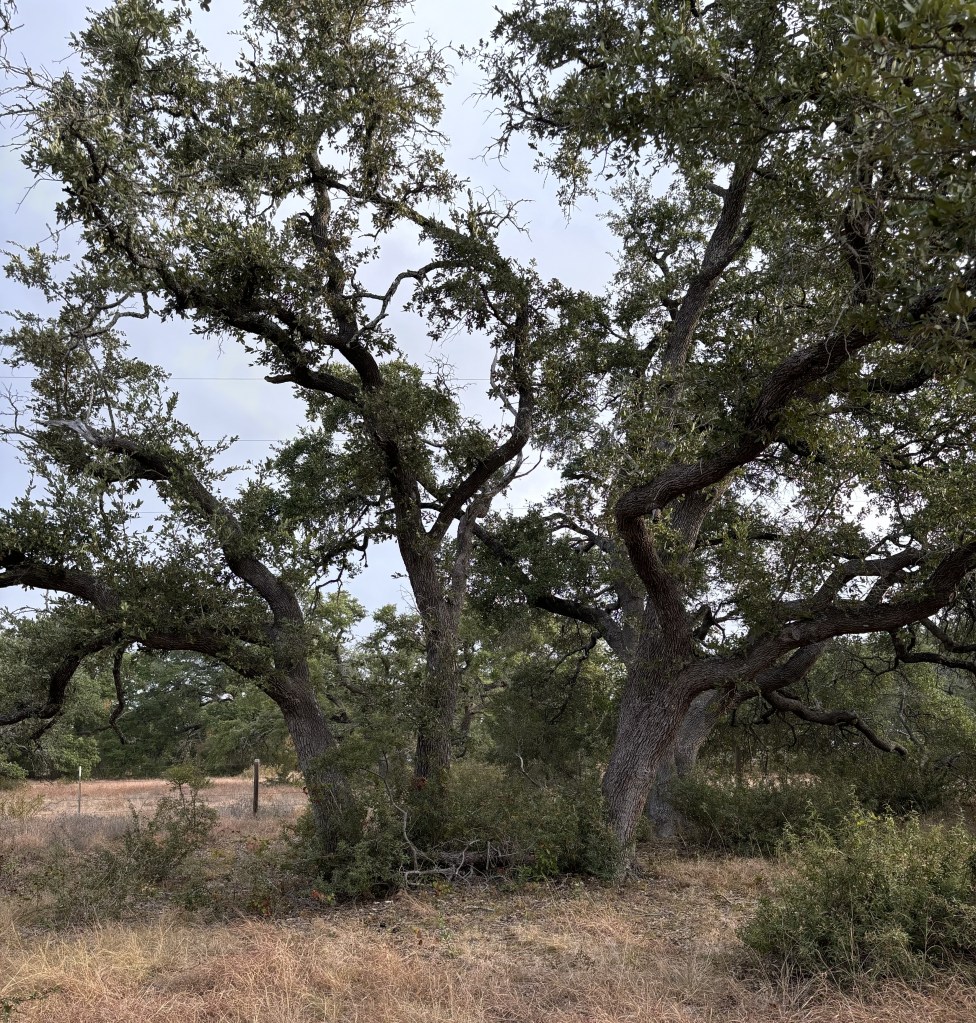
Out here on the Edwards Plateau, in the rugged karst landscape above a hill country creek, live oaks rule. The big evergreens, up to sixty feet tall, with a wide crown and massive limbs close to the ground, are Quercus Virginiana. They often grow in a circle—and you know they are communicating through their root systems. https://www.npr.org/sections/health-shots/2021/05/04/993430007/trees-talk-to-each-other-mother-tree-ecologist-hears-lessons-for-people-too

The way live oaks vary their leaves makes identification tough. On the Edwards Plateau, the species passes into the “shrubby Texas Live Oak”—shorter with smaller trunks: “…[I]ntermediate forms occur between the variety and the species and the distinctions are often difficult,” per Robert Vines, Trees, Shrubs and Woody Vines of the Southwest (1960). Well, thanks.
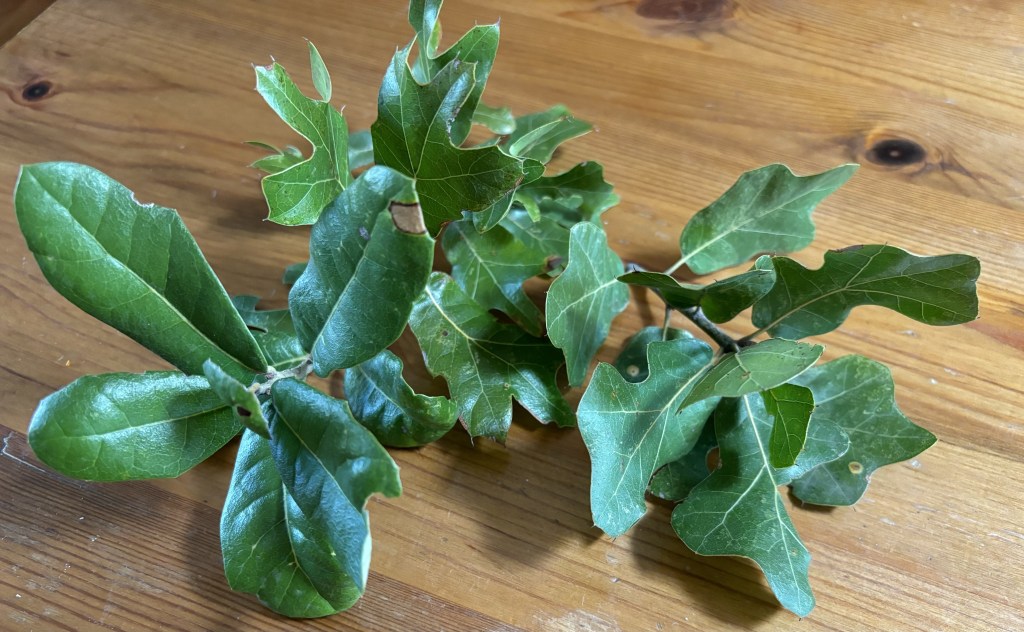
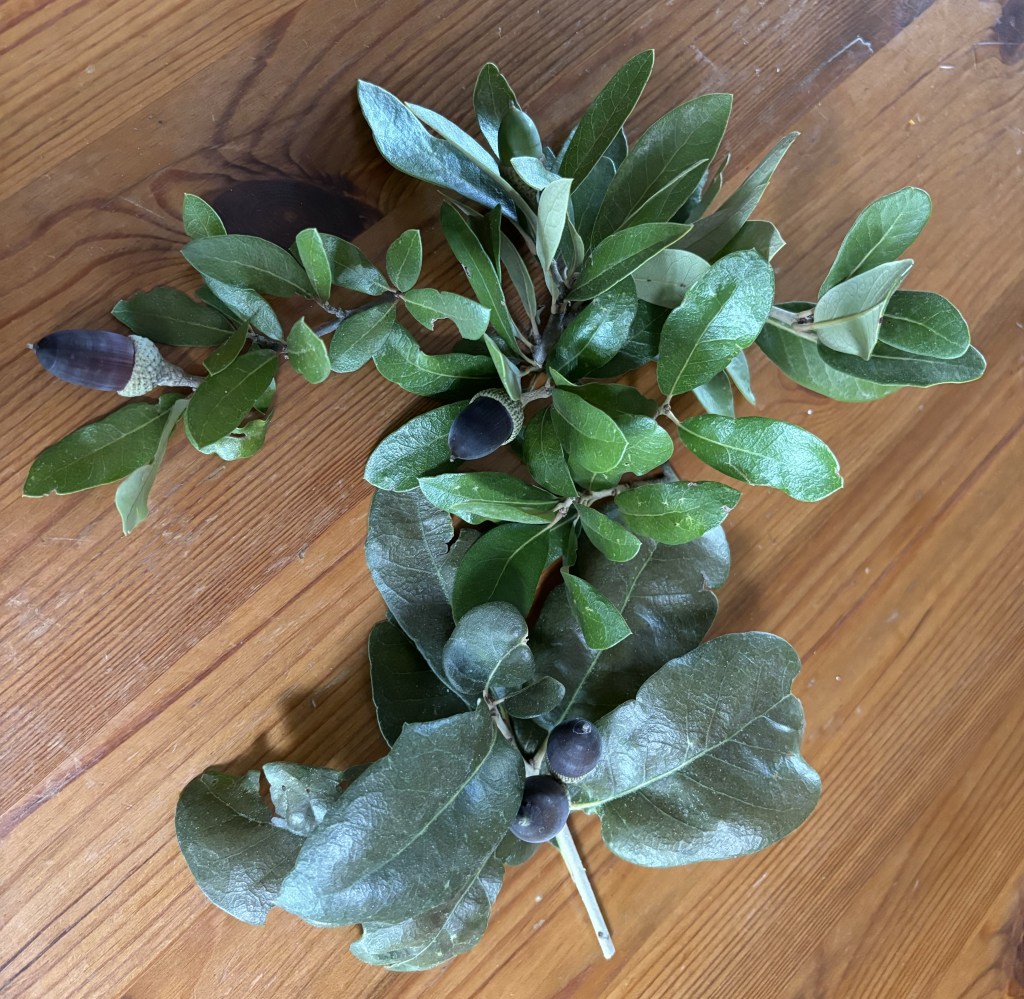
Now, in drought, with grass turned grayish tan, with dirt powder-dry beneath our feet, we treasure the blessed green of live oaks, often home to swings and hammocks, and providing wide shade to houses, pastures, and somnolent cattle.

Trees inspire us. We know Shakespeare’s song: “Under the greenwood tree, who loves to lie with me…” (As You Like It). The first poem in Wendell Berry’s A Timbered Choir begins, “I go among trees and sit still.”

Mary Oliver’s “Honey Locust” begins,

“Who can tell how lovely in June is the

honey locust tree, or why

A tree should be so sweet and live

            in this world?”

Robert Frost knows his trees: The Road Not Taken, Stopping by Woods on a Snowy Evening, Tree at My Window, Spring Pools, so many. Of course, his Birches:

“When I see birches bend to left and right

Across the lines of straighter darker trees,

I like to think some boy’s been swinging them…”

Frost makes it easy to imagine “some boy” swinging the birches—or Frost imagining that, as he marched through a yellow wood.

And then e.e. cummings, My Father Moved Through Dooms of Love—I like this verse:

“My father moved through theys of we,

Singing each new leaf out of each tree

(and every child was sure that spring

Danced when she heard my father sing)”

And Gerard Manley Hopkins, Spring and Fall:

“Margaret, are you grieving

Over Goldengrove unleaving?”

Yes, trees: later in the poem we find when “worlds of wanwood leafmeal lie.”

The forecast calls for rain. Please cross your fingers.

Helen Currie Foster lives and writes the Alice MacDonald Greer Mystery Series north of Dripping Springs, Texas, loosely supervised by three burros. She’s drawn to the compelling landscape and quirky characters of the Texas Hill Country. She’s also deeply curious about our human history and how, uninvited, the past keeps crashing the party. Currently she’s working on Book 10. Her protagonist, Alice, gets into legal drama, and matters of the heart. Alice does have a treehouse.

Thanksgiving–for Books Reread

by Helen Currie Foster

Now and then, when I sneak a book off the shelf, glancing around to be sure no one notices it’s a children’s book…or pick up an old LeCarré…I’m grateful for the joy of rereading.

Rather like upcoming Thanksgiving dinners! Think of their literary content! Suspense, of course–is that turkey really done? Imminent peril–are the drippings sufficient for decent gravy? Strong characters–the usual suspects are arriving at the table! Ethical challenges–no comments on the burnt marshmallow topping on the yams. And, hopefully, enough whipped cream for a happy ending!

Of course an invitee may decide to bring Something New. (I refer to an aunt’s “Pumpkin Chiffon” creation, still infamous years later. I mean, it wasn’t pumpkin pie and never would be.) In the face of such unwonted (unwanted) novelty we draw back: we don’t want something new: we want…reassurance.

So many good books are out now, deserving our attention–Lawrence Wright’s Mr. Texas, Paulette Jiles’s Chenneville, Paul Woodruff’s Living Toward Virtue, and my dear friend Dr. Megan Biesele’s amazing memoir about her anthropological adventures in the Kalahari, Once Upon a Time Is Now. https://amzn.to/3MSVL7y

But sometimes I return to the old faves, craving (especially these days)…reassurance.

What sort of reassurance? How about vindication for a beloved character in trouble? See the end of William Faulkner’s Intruder in the Dust (1948), a murder mystery where Lucas Beauchamp with his gold toothpick is saved from lynching with the help of two teens and an old lady. It’s a precursor to Harper Lee’s To Kill a Mockingbird (which has a sadder ending).

Children’s books require vindication of the hero. Lucy receives that in The Lion, the Witch and the Wardrobe, when her older siblings finally follow her through the back of the wardrobe into Narnia and discover her amazing story is true.

As a Le Carré follower, I remain thrilled by A Legacy of Spies (2017). And yes, like many of his spy thrillers, it’s a murder mystery. Our first-person narrator is “young Peter Guillam” who won our hearts earlier as the man that master spy George Smiley could always count on. White-haired, a bit deaf, and back home on the Breton coast, he’s no longer protected by the now-retired Smiley, and Britain’s foreign service (the “Circus”) has hauled Guillam to England and arrested him. The Circus is plotting an unconscionable rewrite of agency history, with Guillam cast as the villain.

But this old dog still knows old tricks, and, yes, is vindicated! We rejoice, reassured, when Peter Guillam once again is strolling the Breton coast, with a furious Smiley about to descend with a vengeance on the Circus.

Other great rereads for reassurance: Patrick O’Brian’s Aubrey-Maturin sea novels. The last pages of The Commodore (Book 17) provide classic vindication for our surgeon-spy, Stephen Maturin. After many perils, barely surviving yellow fever, and finally encountering his beloved potto https://en.wikipedia.org/wiki/Potto, Maturin learns of the death of a most vicious but hitherto unnamed enemy, who has plotted Maturin’s downfall, even his murder, for years (through many volumes). Just pages later Maturin experiences the wild joy of an unexpected reunion with his lost Diana. O’Brian’s unsurpassed powerful brevity can create the sudden turns and arouse the fierce emotions that satisfy a happy (re)reader.

My housemate reports that his rereads include The Cruel Sea by Nicholas Monserrat, Cannery Row, Pride and Prejudice, certain sections of Moby Dick, and more.

This Thanksgiving I give thanks for books, new and old. Do you remember learning to read? I do. Early one morning, age five, I opened a new book titled Children’s Book of Knowledge. The long strings of separate curly letters abruptly morphed into words. Like a bolt of lightning! I could read! Words became magnetic: I couldn’t keep my eyes away. I read everything–stray magazines, newspapers, the Cheerios box. I was now independent. No waiting for grown-ups to dispense information: I could simply read for myself! (With a library book stashed inside my desk at East Elementary–unfortunately confiscated by the teacher.)

Reading sets us free, gives us resources, gives us respite, gives us independence..and reassurance. Happy Thanksgiving!

I’m working on the ninth novel in the Alice MacDonald Greer Mystery series set in Coffee Creek, Texas, in the Hill Country. You can be sure the inhabitants insist on cornbread dressing and pumpkin pie with whipped cream. The burros will hope for leftovers.

Why They’re Favorites…? On Rereading

BY HELEN CURRIE FOSTER

What’s your favorite place to read? A certain chair? The one with a lamp that shines on your book, not in your eyes? Perhaps a ferryboat seat, where you glance up at the horizon, then down at your book? On a plane, or train?

When I was young our house had an elm tree in the back yard which was not only climbable, but offered two branches that stuck out at the perfect angle for a lounging pre-adolescent. Even better—the lounger was invisible from the house. I could scramble up, arrange myself, open my book—and be left unfound, undisturbed, for some time.

A later joy was climbing on the New Haven RR in Boston after final exams (Chaucer, Shakespeare), armed with the latest James Bond and the very biggest Hershey bar with almonds, and being rocked south for miles along the coastline. Uninterrupted.

And I confess to rereading books. I further confess to rereading children’s books. Maybe a more accurate word is: revisiting. At least every two years, I pick up Kipling’s Kim, finding my way to the part where Kim guides his Tibetan lama, who seeks a sacred river, on a pilgrimage into the high deodar forests of the Himalayas. I can almost smell the trees. There Kim steals the Russian spies’ notes––his own initiation into the Great Game. Even more satisfying? The long afternoon where, exhausted, he is “taken apart” by Eastern massage and finally stumbles out, recovered, to find his lama at the brink of—well, no spoilers.

Why this gravitational pull of favorite children’s books?

Maybe because the best children’s books feature enterprise, surprise, disguise. And—most important––the discovery of identity.

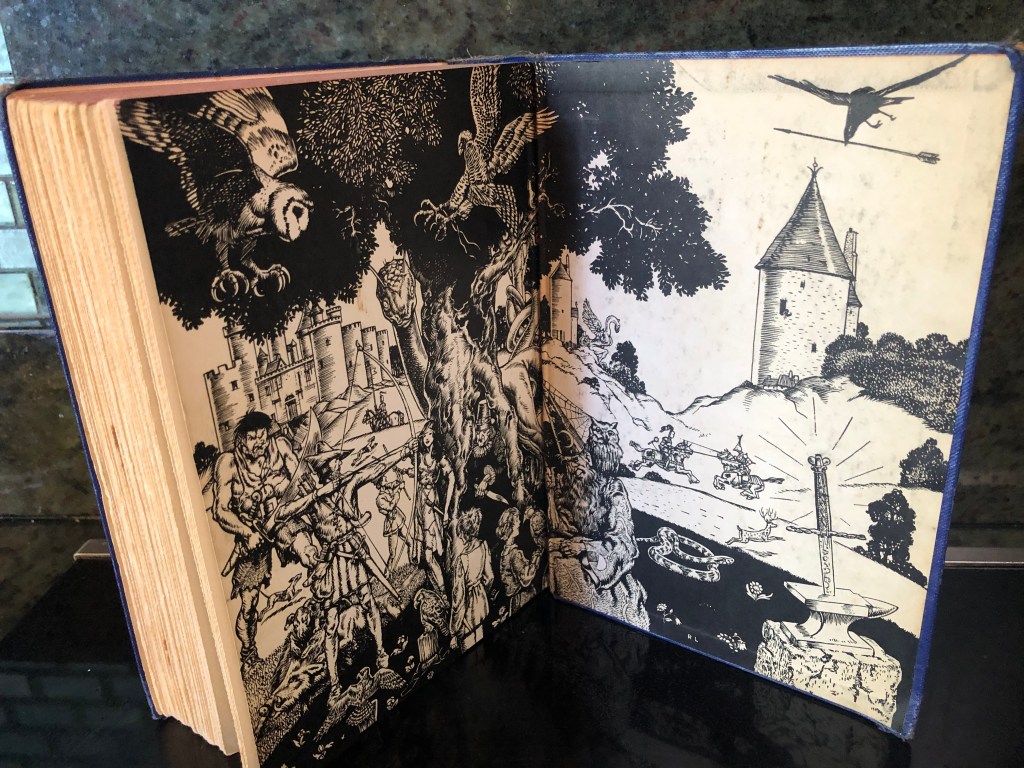
Consider The Sword in the Stone, where Merlin transforms Wart into various animals (badger, owl, fish) who teach him survival techniques (“put your back into it!”). And magic! Giants! Griffins! The Queen of Air and Darkness! (See volume below–griffin looming behind tree.) One favorite moment? When Merlin transforms Wart to a raptor—a small merlin––who must sit for desperate minutes during his formal initiation, near the maddened and perilous Peregrine. Why does Wart need Merlin’s special tutelage? Because of his identity, which he and we will finally discover.

Others I still pull off the shelf: The Wind in the Willows, especially Mole’s tearful return home, where he recognizes his true self.

Also Susan Cooper’s The Dark Is Rising. Maurice Sendak’s Nutshell Library – memorizing all the poems. I sneak back to Harry Potter—a feast of enterprise, surprise, disguise, and Harry’s search for his own identity. Occasionally I return to Lord of the Rings––especially the battle for Gondor. You’ll note I missed out on Jack London and many others. But there’s always The Lion, the Witch and the Wardrobe—remember that wondrous moment when Lucy slips through the back of the wardrobe, past all the mothballed coats…into magic? Into the snowy landscape where she meets Mr. Tumnus the faun? Into the realm where––as Lucy later discovers––she is Queen Lucy?

You have your favorites. So do our collective children and grandchildren. Bookstore shelves still offer children tales of enterprise, surprise, disguise—and characters discovering their own identities.

And fortunately, children’s books needn’t follow the 1930 Detection Club’s 10 Rules for Writing a Mystery. Rule #2: “All supernatural or preternatural agencies are ruled out as a matter of course.” Following Rule #2 would let out magic, of course, and its enormous space for imagination. (If you, like me, crave an occasional touch of magic for grown-ups, try Remarkably Bright Creatures by Shelby Van Pelt. amzn.to/44iIoVj)

As a mystery writer/reader I usually write about mystery. But thinking lately about the bibliophile’s favorites—favorite reading spots, favorite chairs, favorite characters––has sent me down a different path. Why reread? Wait––why revisit?

What is it about the end of Kim, or the plight of Frodo and Samwise in Shelob’s lair, or Harry Potter’s first moment on his broom, learning how good he is at Quidditch––that whispers, “read it again!”

I reread mysteries too. Have you reread a Dorothy Sayers, a Ngaio Marsh, a Sherlock Holmes? Or John le Carré? How many times have you read Tinker, Tailer, Soldier, Spy, or Smiley’s People? (Come on, spy thrillers are part of the mystery-thriller-spy novel genre.) And why do we reread le Carré? One character in particular: George Smiley.

Smiley first appears on page 1 of chapter 1, titled “A Brief History of George Smiley,” in Call for the Dead, le Carré’s first book, published in 1961. Smiley’s marriage to the aristocratic Lady Ann Sercomb has ended when she abandoned him, and he’s described as follows: “Short, fat and of a quiet disposition, he appeared to spend a lot of money on really bad clothes, which hung about his squat frame like skin on a shrunken toad.”

We learn of his deep love of 17th century German literature, his success at Oxford, his recruitment by MI-6, his dangerous service abroad as a spy in WWII. Not a commanding figure, no. But le Carré allows us to glimpse his sharp mind, his penetration, his ability to absorb all he hears. Smiley’s work as an intelligence officer provides him “with what he had once loved best in life: academic excursions into the mystery of human behaviour, disciplined by the practical application of his own deductions.”

Smiley appears next in A Murder of Quality (1962), where Smiley’s solution to the murder rests on a scathing critique of the snobbishness of British public schools (le Carré despised his own experience at such a school).

By the time we reach Tinker, Tailor, Soldier, Spy (1974), Smiley has been put out to grass at MI-6 under the new regime headed by Bill Haydon, who has seduced Smiley’s wife Ann and taken over London Station after causing the bitter dismissal of Control as its head.

In Tinker, Tailor, Smiley is plucked out of retirement to interview a somewhat dubious British agent who claims the Russians may have placed a mole inside MI-6. Here’s Smiley, listening to the agent’s tale:

“He sat leaning back with his short legs bent, head forward, and plump hands linked across his generous stomach. His hooded eyes had closed behind the thick lenses. His only fidget was to polish his glasses on the silk lining of his tie, and when he did this, his eyes had a soaked, naked look that was embarrassing to those who caught him at it.”

Smiley’s investigation marches ahead. The BBC wants to make a series of Tinker, Tailor. And John le Carré has an actor in mind: Alec Guinness. https://www.theguardian.com/tv-and-radio/2019/sep/05/tinker-tailor-soldier-spy-40-years-on-alec-guinness

Le Carré’s letter to Sir Alec Guinness (3 March 1978) appears in A Private Spy / The Letters of John le Carré, at 213. He tells Sir Alec:

“Apart from plumpness, you have all the other physical qualities: a mildness of manner, stretched taut, when you wish it, by an unearthly stillness and an electrifying watchfulness. In the best sense, you are uncomfortable company, as I suspect Smiley is. An audience wishes––when you wish it––to take you into its protection. It feels responsible for you, it worries about you. I don’t know what you call that kind of empathy, but it is very rare, & Smiley and Guinness have it: when either of you gets his feet wet, I can’t help shivering.”

I love that “as I suspect Smiley is.” Does the author’s own speculation about George Smiley explain, in part, why we readers become so attached to this character? What drives us to Smiley’s side? Is it his apparent ineffectualness, his vulnerability, his stillness, his watchfulness, entwined with our certainty that he will somehow keep going?

Not until 1979 in Smiley’s People does Smiley achieve final vindication, catching the Russian master-spy who conceived the long set of steps that led to Haydon’s seduction and Control’s fall. At the climax, we (along with Smiley and his fellow spy Peter Guillam) await the possible arrival of the Russian in cold war Berlin, at the crossing point from East Germany. Will the spy make it across the bridge? Guillam asks what cover the Russian will use:

Smiley sat opposite him across the little plastic table, a cup of cold coffee at his elbow. He looked somehow very small inside his overcoat.

“’Something humble,” Smiley said. “Something that fits in. Those who cross here are mostly old-age pensioners, I gather.’ He was smoking one of Guillam’s cigarettes and it seemed to take all his attention.”

At book’s end, we are waiting with Smiley. It’s cold there by the Berlin bridge. I expect Smiley’s feet are wet. Like the author, “I can’t help shivering.” When we know a character’s vulnerabilities, we begin to perceive true identity.

For Smiley, for all the characters created by their authors with such vividness and such vulnerability that we seem to feel what they feel, for such characters–I reread. Yes, the better word is revisit: I go back just to be sure the characters are still there, still available, still waiting quietly on the shelf. And, yes, just as good as I thought they were.

I’d love to hear your favorites (reading spots, children’s books) and the favorite characters you…revisit.

FOOD AND A GATHERING PLACE

by Helen Currie Foster

A critical tool for mystery writers is creation of a gathering place. We watch desperate clients rush straight to Sherlock Holmes’s Baker Street lodgings––often the first place where we meet his client, learn what the client hopes Holmes will do, and encounter Watson, Lestrade, and various witnesses. A gathering place gives us––and the sleuth, whether amateur or professional––a place to meet characters, assess the social structure, and see investigation  in action. Sometimes it’s the crime scene itself.

A gathering place can provide the writer an opportunity to comply with one of the key rules (or guidelines) of the original 1930 Detection Club: “The criminal must be someone mentioned in the early part of the story, but must not be anyone whose thoughts the reader has been allowed to follow.” https://murder-mayhem.com/the-detection-club-rules We may not always meet or learn of the criminal at a gathering place, but it can provide a useful location for the author to make that first mention.

And we’re humans, so we appreciate gathering places that involve food and drink! We learn so much there, about our protagonist and key characters.

When we first meet Bruno, chief of police in a small town in the French Dordogne, the author immediately shows us the contents of Bruno’s police van, including: “one basket containing newly laid eggs from his own hens, and another with his garden’s first spring peas…Tucked neatly to one side were a first-aid kit, a small tool chest, a blanket, and a picnic hamper with plates and glasses, salt and pepper, a head of garlic and a Laguiole pocketknife with a horn handle and a corkscrew. Tucked under the front seat was a bottle of not-quite-legal eau-de-vie from a friendly farmer. He would use this to make his private stock of vin de noix when the green walnuts were ready…” Martin Walker, Bruno, Chief of Police (Book 1 of the series). Hmm: a resourceful and picnic-prepared detective.

Bruno routinely uses a couple of gathering places involving food, first and foremost his own farm above the Vézère River, in country humans have cherished for over 30,000 years. We learn of Bruno’s garden, his hunting, and the dishes he makes for guests. In the latest book, To Kill a Troubadour, Bruno demonstrates his omelet techniques and also carries six jars of his venison pâté to a village feast. (Martin Walker now has a cookbook.) But Bruno visits other gathering places, including his favorite bakery (Fauquet’s) where he buys his morning croissants—one of which he always feeds his puppy. The garden, the venison, the eggs, the wine opener, the bakery, the puppy, the croissants—they’re part of Bruno, and key to the setting.

Inspector Jules Maigret? His setting is typically Paris, where the Brasserie Dauphine delivers late-night sandwiches and beer to his office at the Quai des Orfèvres when he interviews a defendant. He and his colleagues must eat during investigations, of course—at the office and elsewhere. In Maigret Bides His Time he dines at the Clou Doré, a luxurious restaurant owned by a man Maigret suspects of jewel thefts. The waiter: “I recommend the paella this evening… To go with it, a dry Tavel, unless you prefer a Pouilly Fumé.” During the meal, Maigret “seemed to be concerned only with the food and the deliciously fruity wine.” But we readers know otherwise: he’s absorbing atmosphere, clues, little “tells.” In each book, Maigret finds a bar, a brasserie, a restaurant, which can serve as the gathering place where he assembles information that ultimately leads to a solution. Food and drink help create this distinctively French setting.

I do feel it’s unlikely that Four Corners policewoman Bernadette Manuelito would try Bruno’s venison pâté, and I’m not sure her husband, Jim Chee, would either. So far as I recall neither has visited France. They live and work in Navajo and Hopi land, in the series begun by Tony Hillerman and continued by his daughter, Anne Hillerman. In The Wailing Wind, Jim Chee and his former boss, Lieutenant Joe Leaphorn, “got a table at the Navajo Inn, ordered coffee. Chee would eat a hamburger with fries as always.” Leaphorn says, “I always have an enchilada.” In Anne Hillerman’s Rock with Wings, “Bernie asked Chee to order her usual, a hamburger and a Coke.” She can tolerate pepperoni pizza, but abjures salad. https://www.amazon.com/Rock-Wings-Leaphorn-Manuelito-Novel/dp/0062821733/ref=tmm_pap_swatch_0?_encoding=UTF8&qid=1663609808&sr=8-2

The Hillerman setting is not the Navajo Inn, not a particular bar, not a particular bakery. It’s the entire Four Corners, a vast arena of mountains and mesas sacred to Navajo and Hopi memory, with enormous views and laconic characters, careful in their speech, who drive miles to find gas or food. A garden of tender green peas? No. When he hikes into the mountains on a case, Jim Chee packs a bologna sandwich—not venison pâté. Food is essential, food is basic, and eating is often a solitary experience, while Bernadette Manuelito or Jim Chee are out in an arroyo, tracking a killer. The landscape feels too large for a single gathering place—although Jim Chee’s trailer, Captain Largo’s or Leaphead’s offices, or Bernadette’s mother’s house see occasional gatherings.

Coke and hamburger versus venison pâté or paella (French version) and Tavel? Famous cultural anthropologist Claude Lévi-Strauss wrote, “Cooking is a language… through which society unconsciously reveals its structure.” Also known—by mystery readers–as setting.

For her Richard Jury series Martha Grimes takes us to various venues in London and elsewhere, such as Brown’s Hotel (The Dirty Duck), and the Members Room at Borings (the club to which Jury’s friend Melrose Plant belongs) (The Old Wine Shades). She uses pub names as her titles, and the pub can serve as a gathering place, as it does in The Old Wine Shades. Another repeat gathering place is Melrose’s stately country home, Ardry End, which is subject to invasion by Agatha, his aunt-by-marriage, who greedily demolishes all the “fairy cakes” made by Melrose’s excellent cook, Martha. https://www.christinascucina.com/butterfly-cupcakes-british-butterfly-cakes/

Martha knows that when he breakfasts at Ardry End, Richard Jury lusts after her mushrooms: “Jury spooned eggs and a small pile of mushrooms onto his plate, then forked up sausages (a largish number), speared a tomato and sat down.” Shortly thereafter Martha reappears with “a steaming silver dish… ‘Mushrooms! I knew you’d be wanting more o’ my mushrooms!’” And he did. There’s something intimate about watching favorite characters have breakfast—possibly the most individually designed meal we eat. Right?

Grimes invents the Jack and Hammer Pub as the gathering place where Melrose meets his eclectic (nutty) village friends. At the Jack and Hammer we meet the cast of characters Grimes rotates through this series, and watch the friends (and Melrose) try to puzzle out the solution to the murder Richard Jury must solve. We learn the talents and deficits of these friends, their secret loves, and what they order from the bar.

Reading what characters eat and drink enriches our feeling of presence in a book. It pulls our own senses and memories into what we’re reading. We can taste the paella, taste the hamburger, remember our favorite burger joint, our favorite restaurant. We begin to participate in the mystery’s setting. Bernie bites her hamburger; Maigret takes a sip; so do we.

Our reactions to food live in our memory, linked to our senses of smell—and taste. “Smell and taste are closely linked. The taste buds of the tongue identify taste, and the nerves in the nose identify smell. Both sensations are communicated to the brain, The taste buds of the tongue identify taste, and the nerves in the nose identify smell. Both sensations are communicated to the brain, which integrates the information so that flavors can be recognized and appreciated. Some tastes—such as salty, bitter, sweet, and sour—can be recognized without the sense of smell. However, more complex flavors (such as raspberry) require both taste and smell sensations to be recognized.” https://www.merckmanuals.com/home/ear,-nose,-and-throat-disorders/symptoms-of-nose-and-throat-disorders/overview-of-smell-and-taste-disorders#:~:text=The%20taste%20buds%20of%20the,without%20the%20sense%20of%20smell.

Proust was right about food and memory: “Odors take a direct route to the limbic system, including the amygdala and the hippocampus, the regions related to emotion and memory.” https://news.harvard.edu/gazette/story/2020/02/how-scent-emotion-and-memory-are-intertwined-and-exploited/#:~:text=Smells%20are%20handled%20by%20the,related%20to%20emotion%20and%20memory

And why shouldn’t this be so? At least partly, cooking defines us as human. Humans apparently mastered fire and began cooking at least 500,000 years ago; possibly our human ancestors began cooking as much as 1.8 million years ago. No wonder food and memory are entwined in our brains. https://www.scientificamerican.com/article/food-for-thought-was-cooking-a-pivotal-step-in-human-evolution/;

https://www.nationalgeographic.com/foodfeatures/evolution-of-diet/#:~:text=Our%20human%20ancestors%20who%20began,more%20fuel%20for%20our%20brains;

https://www.nationalgeographic.com/animals/article/121026-human-cooking-evolution-raw-food-health-science

On that note, I’ve just finished the draft of Book 8 in my Alice MacDonald Greer Mystery series, Ghosted. The central gathering place? The Beer Barn, an iconic Texas Hill Country dancehall and roadhouse. Food? Critical. Luis’s enchiladas and Conroy’s barbecue? They call!

Helen Currie Foster lives and writes in the Texas Hill Country, north of Dripping Springs, loosely supervised by three burros. She’s active with Austin Shakespeare and the Heart of Texas Chapter of Sisters in Crime, as well as Hill Country Master Naturalists (still trying to learn those native grasses). Her Ghost Daughter, Book 7 in the Series,

was named 2022 Eric Hoffer Award Grand Prize Short List, as well as Finalist, 2022 Next Generation Indie Book Awards, and 16th Annual National Indie Excellence Awards.

How to Paint a Horse?

by Helen Currie Foster

Like many of you I’m fascinated by prehistory, always hoping for a chance to clamber up (or down) to visit incredible cave paintings. My first mystery, Ghost Cave, was inspired by climbing to cave shelters where the Devil’s River meets the Rio Grande. Ghost Cave’s cover? The famous White Shaman images. https://www.amazon.com/s?k=Helen+Currie+Foster+ghost+cave&crid=24J6S4P7832FF&sprefix=helen+currie+foster+ghost+cave%2Caps%2C129&ref=nb_sb_noss

In the Dordogne, in southern France, I heard the echo of the iron cover banging into place to close the entrance to the Pech Merle cave to prevent damage from outside air. Down the clanging iron stairs we went, along chilly stone tunnels, and then—the horses! Oh, the spotted horses, so real you could almost hear them breathe. They’ve been carbon-dated to 25,000 BCE. I’ve waited in line to see the famous Font de Gaume at Les Eyzies, also in the Dordogne, and hiked, shivering, to see the pictures deep in the Pyrenees cave at Niaux. I long to visit them all. Sometimes my companions balk.

Confronted by such artistry, such deft depictions, simultaneously spare and rich, like Chinese scroll landscapes or Picasso’s early drawings, haven’t you wondered about the artists? Why were they so deep in these dark, perilous caves? What was their life—or death—outside?

Today, with climatic violence the new normal, and new discoveries daily about human prehistory (including 23 and Me’s calculation of our personal percentages of Neanderthal ancestry), I’m more and more curious every day about our long-ago ancestors. The real question, of course: what is it to be human?

Welcome to  “The Dawn of Everything: A New History of Humanity,” a tome by two Brits—David Graeber, the late professor of anthropology at London School of Economics, and David Wengrow, professor at the Institute of Archaeology, University College London. “The Dawn of Everything”? Sounds ferociously ambitious—overarching, maybe overreaching. But my best friend from high school—Dr. Megan Biesele, distinguished anthropologist—said “let’s read and discuss.” Easy for her to say: the tome is 526 pages long, with 83 pages of notes and a 62-page bibliography. https://www.amazon.com/Dawn-Everything-New-History-Humanity/dp/0374157359

Graeber and Wengrow boldly challenge our “received understanding” of an original state of innocence and equality, followed by the invention of agriculture and higher population levels and creation of cities leading inevitably to the rise of hierarchy and inequality. They employ often hilarious section headings. Example: “How the conventional narrative of human history is not only wrong, but quite needlessly dull.” (At 21.) (For a shorter version, see their Fall 202 article: https://www.laphamsquarterly.org/democracy/hiding-plain-sight.)

“The Dawn” asserts that the ideas of individual liberty and political equality we cherish today weren’t an outgrowth of the European enlightenment, but inspired by Native American critiques of their European invaders. The relevant heading: “In which we consider what the inhabitants of New France made of their European invaders, especially in matters of generosity, sociability, material wealth, crime, punishment and liberty.” (At 37.) One French evangelist sent to the Algonkian Mi’kmaq wrote, “They consider themselves better than the French: ‘For,’ they say, ‘you are always fighting and quarrelling among yourselves; we live peaceably. You are envious and are all the time slandering each other; you are thieves and deceivers; you are covetous, and are neither generous nor kind; as for us, if we have a morsel of bread we share it with our neighbour.” This missionary was irritated that the Mi’kmaq would constantly assert they were richer than the French, who had more possessions, because they themselves had “ease, comfort and time.” Such records by missionary priests were compiled in 71 volumes of Jesuit Relations (1633-1673). 

I’d never heard of the Wendat tribe’s philosopher statesman Kandiaronk, reportedly a highly skillful debater, who during the 1690’s was invited to participate in a sort of salon, where he shared his devastating moral and intellectual critique of European society. Kandiaronk sounds amazing: one priest described him as “always animated, full of wit, and generally unanswerable.” His arguments were included in Dialogues (1703), published by an impoverished French aristocrat named Louis-Armand de Lom d’Arce. Kandiaronk held that European-style punitive law, like the religious doctrine of eternal damnation, wasn’t required by innate human corruption but by a society that encouraged selfish and acquisitive behavior. Nor had I heard that Kandiaronk’s critiques were adopted by French Enlightenment figures during the 1700’s. I hadn’t realized that substantial origins of the French “enlightenment” were…North American. 

 “The Dawn” discusses the Huron concept called Ondinnonk, a secret desire of the soul manifested by a dream: “Hurons believe that our souls have other desires, which are, as it were, inborn and concealed…They believe that our soul makes these natural desires known by means of dreams…Accordingly when these desires are accomplished, it is satisfied; but, on the contrary, if it be not granted what it desires, it becomes angry, and not only does not give its body the good and the happiness that it wished to procure for it, but often it also revolts against the body, causing various diseases, and even death…” Apparently tribe members spent time communally trying to decipher the meaning of others’ dreams and, sometimes, trying to help each other realize their dreams. (At 23-4, 454-5, 486, 608 n74.) 

After this startling introduction to an unknown genius (I mean, I’d have loved to learn about Kandiaronk back in 10th grade…or any grade, really—and apparently his ideas can be found: https://books.google.com/books/about/Native_American_Speakers_of_the_Eastern.html?id=Fu1yAAAAMAAJ), Graeber and Wengrow provide extensive examples of our incorrect assumptions. They argue that the notion that humans inevitably moved from hunting and foraging to static agricultural lives (with inevitable hierarchy and inequality) isn’t borne out by current archeology. They point to many cultures which rejected “big ag,” opting instead to keep hunting and foraging, making occasional gardens, and spending winters in river lowlands, moving to highlands in the summer with their flocks. (This made me think of the French Pyrenees, where the “transhumance” –taking livestock to the hills—still happens.) They argue that cities weren’t inevitably hierarchical, and that many arose with populations that—even if they had kings—made their decisions collectively, not hierarchically.

“The Dawn” is unsettling. Are we “stuck” today in ideas that are not in fact “inevitable” aspects of human social organizations? Are we less creative, socially speaking, than our forebears? Well, I’ve only made it to page 486. I’ll let you know how this turns out. If I’m intellectually “stuck,” I hope not to stay that way.

But back to the caves and the art on those seeping limestone walls. My strong impression is that we frequently underestimate those who traveled before us. We assume that the ways of today’s world manifests “progress” over our past. Surely that’s true: we did manage at least temporarily to get rid of smallpox…one small victory. But apparently there’s a great deal we’ve lost, forgotten, or never known…I mean, what is the meaning of the White Shaman picture? Did the artists ride the spotted horses painted in Pech Merle? Or just admire the herds from a distance?

“The Dawn of Everything” offers fodder for that most delightful and enduring attribute of our species: curiosity. I’m still chewing on these ideas. One topic is the surprising variety of ways that societies treat—or eschew—wealth. Another that nags at me is the Wendat condemnation of our punitive habits. Dialogues reported that rather than punish culprits, “the Wendat insisted the culprit’s entire lineage or clan pay compensation. This made it everyone’s responsibility to keep their kindred under control.” Wow. Just one of the things I’ll be thinking about…

Meanwhile, a delightful book, beautifully written, which offers windows onto the 21st century culture of Kandiaronk’s relatives is the best-selling Braiding Sweetgrass by botanist Robin Wall Kimmerer, a member of the Citizen Potawatomi Nation. https://www.amazon.com/s?k=kimmerer+braiding+sweetgrass&crid=J2LA9POFHIJK&sprefix=kimmerer%2Caps%2C244&ref=nb_sb_ss_ts-doa-p_1_8

I found Braiding Sweetgrass so touching, especially the chapter called Allegiance to Gratitude, describing the children in the Onondaga Nation school reciting the traditional Haudenosaunee “Thanksgiving Address,” the Words That Come Before All Else. Most sections of this Address end, “Now our minds are one.” Maybe this is a living example of a communal tradition that molds a society. I recommend this book.

Helen Currie Foster lives and writes the Alice MacDonald Greer Mystery series north of Dripping Springs, supervised by three burros. She remains fascinated by human prehistory and how, uninvited, our pasts keep crashing the party. Her latest is Book 7, Ghost Daughter. “An appealing sleuth headlines a solid thriller with panache” —Kirkus Reviews