When I start a new mystery novel, there are a lot of decisions that must be made. Is someone going to die? Who’s the murderer? Who’s the victim? What is the setting for the book—location? Era? Is the book intended to be an escape from the world or immerse the reader in a world of reality, using the current (or historical) goings on to push the story forward?
Many authors (past and present) are fearless in their desire to delve into reality and what they have to say about it. They refuse to hide or camouflage their belief system in the telling. Sounds like freedom of expression, to me. So what’s up with all the following authors (living and dead) whose books are being banned?
George Orwell was such an author. His novels Animal Farm (1945) and Nineteen Eight-Four (1949) made very clear Orwell’s admonishment of communism, censorship and surveillance. Using phrases such as “cold war,” “newspeak,” and “Big Brother,” Orwell introduced terms that are now prevalent in our world.
Margaret Atwood, author of The Handmaid’s Tale (1985), chooses to shed light on her view that the males subjugate females. Presented on stage, in opera and on film, the book was given new life as the widely popular 2017 Hulu series which brought the novel back into the limelight.
Ayn Rand’s most popular books, The Fountainhead (1943) and Atlas Shrugged (1947), spoke to her belief in the morality of rational self-interest. Rand described her philosophy “Objectivism”, as “the concept of man as a heroic being, with his own happiness as the moral purpose of his life, with productive achievement as his noblest activity, and reason as his only absolute.”
I chose to highlight these authors because they were very clear in expressing their thoughts on the world, but there are many authors who fit this bill. Consider Harriet Beecher Stowe’s book Uncle Tom’s Cabin. Lincoln referred to her as the lady who started the Civil War. John Steinbeck’s book The Grapes of Wrath showed the shocking poverty and problems of thousands of immigrants. Even Charles Dickens wrote about the plight of the poor in Oliver Twist.
The author walks a tightrope when it comes to controversial content. In present day, people seem to be more divided on what is right and what is fair and what subjects are forbidden territory. Most writers do not write to be controversial, but on other the hand, writers must be true to themselves as to what they put on the page.
The decision belongs to the writer. Consequences, good or bad, will follow. But hopefully the author has the grist to hold their heads high, knowing they’ve told their own truths. As Shakespeare wrote in Hamlet, “To thine own self be true.”
Seems to me that is exactly what freedom of expression is all about.
K.P. Gresham, Author
Professional Character Assassin
K.P. Gresham is the award-winning author of the Pastor Matt Hayden Mystery Series as well as several stand-alone novels. Active in Sisters in Crime and the Writers League of Texas, she has won Best Novel awards from the Bay Area Writers League as well as the Mystery Writers of America.
I would love to ignore housework, but it is a necessary evil. From early childhood, I was raised on the mantra of Cleanliness is next to Godliness, a phrase created from Psalms 45:8 All Your robes are fragrant with myrrh and aloes and cassia….” Propelling this phrase into popularity is credited to preacher John Wesley, circa 1791, in his sermon, “On Dress.”But I digress. If you can hire outside help to get it done, I salute you, but in my life, the chores involved in maintaining a generally clean home belong to me. I do, however, have some unorthodox help, although they lift not one finger.
As I slog through the early morning tasks of chasing dust bunnies, cat hair, and cleaning, two of my favorite fictional TV sleuths keep me company. They are as different from one another as they are from me.
JB Fletcher (Jessica) is down-to-earth, self-possessed, independent, and a mystery writer. In the early episodes, she is not a wealthy author with a staff to clean, cook, garden, and do minor repairs. She does it all herself and types her own manuscripts on an old-fashioned typewriter – not even on a word processor. Jessica, a retired high-school English teacher and a childless widow, writes a novel to distract herself from the death of her beloved husband. Her nephew, Grady, reads it, thinks it’s terrific, and sends it to a New York City publisher. The publisher was immediately taken with the book and decided to publish and sell it. Thus, JB Fletcher, a new mystery author, is born and a new vocation emerges for a woman in the second season of life.
Throughout the series, Jessica progresses and grows as a writer, as does her reputation for being exceptionally astute. Her observations and deductions are worthy of any professional police officer or Private Eye – and she is often consulted by both, as the storylines create different scenarios involving murders. Through all the changes and growth, this classy lady, and amateur sleuth, never loses the personality qualities that set her apart.
Two of my favorite episodes in this long-running TV series are Incident in Lot 7, set in Hollywood. There is a murder in the Hitchcock Psycho House, and the episode has a deliciously spooky ending.
The Witches Curse takes place in Jessica’s fictional hometown of Cabot Cove, with the arrival of Mariah Osborne, believed to be a witch. A circuit court judge mysteriously falls from a bell tower, and a suspicious fire ravages an insurance agent’s home. Is it witchcraft? Enter Jessica Fletcher to find the answers and solve the crimes.
For additional company, entertainment, and murder, I turn to my favorite TV homicide detective, Lieutenant Colombo of the LA Police Department. As soon as I tune in, I smile.
Deliberately clumsy and unkempt, Colombo wears scuffed shoes and a wrinkled, ill-fitting trench coat over rumpled clothes. His facade as a mid-level cop with run-of-the-mill capabilities is fun to watch.
While JB Fletcher’s situations are more of a mystery, Lt. Colombo’s fall into the category of suspense/thriller. The audience almost always sees the crime committed at the beginning of the show. The main question is how will the bungling Colombo solve the case, or will he encounter a criminal more ingenious than he is? (I’ve never seen that). Unlike Sherlock Holmes, who leads with his abilities, Colombo hides behind a nasty cigar, always in hand, and his habit of saying goodbye – but then, “just one more thing,” to the annoyance of other characters who wish to be rid of him. Of course, this masquerade of disheveled clothes and a muddled mind makes most criminals underestimate his remarkable crime solving abilities.
In Ransom for a Dead Man, originally aired in the first season, Colombo encounters wily opponent Leslie Williams, a homicidal attorney who contrives a complex plot to get rid of her husband. Willliams calls Colombo out on his grubby subterfuge and her brilliance challenges his ability to capture this elusive adversary.
These are examples of cases that hold my attention while I vacuum, dust and clean. Plots unfold, triggering ideas as I move from room to room. I stop my chores, grab a pencil or pen, writing paper, or sometimes just a scrap of paper and jot them down before they disappear.
A Colombo episode ignited a spark for a gripping short story. I’ve also unearthed an ingenious technique of committing a near-imperceptible murder, which I’ll weave into book four of the Housekeeper Mystery Series. The protagonists in this series are none other than Father Melvyn Kronkey and Mrs. B. an ordinary woman with character traits not unlike the down-to-earth, homey, JB Fletcher. As in Colombo, their detecting journeys are filled with high-stakes games of cat-and-mouse with Mrs. B. Father Melvyn on one side and criminals on the other.
Though it may be dull and mundane, vacuuming up cat fur and chasing after dust bunnies gives me time to think about murder. I never actually do it, of course, and the cat is safe from me.
We all have stressful times in our lives that can suck energy from us and leave us worn out. The first six to twelve months of caring for a newborn infant. The massive work project with a looming deadline. The weeks to months preparing for a wedding. The process of moving to a new location. The details involved in dealing with the aftermath of death. The process of grieving. Living through a pandemic. Some events are even cyclical, like tax season for a CPA, or what some moms dub “Maycember.”
How do you recover when your writing output is decreasing because your mental and physical resources are stretched too thin?
Some people take a vacation. My favorite solution to recharge is to go walk on a beach somewhere and let the ocean waves sooth my soul for as many days as possible. The beach is my happy place. I’m lucky that Texas has 367 miles of shoreline, most of it with sandy beaches. The closest ones to me are a four hour drive away. The farthest (with a view of the Space X launch tower at Boca Chica in the distance) is an eight hour drive. But I’m not picky. Any beach will do. At the beach, my mind is free to roam, allowing new ideas to increase from a trickle to a flood.
But what if I can’t get away for a vacation?
Exercise. Take walks in a nearby park and listen to the birds in the trees. (But not when the heat index is 118 degrees Fahrenheit, as it is this week.) Exercise indoors if that’s the only option. Don’t fall off the wagon when it comes to exercise or that decrease in writing output may become a complete stoppage.
What else?
Read widely. Read to learn something new. Which isn’t to say I don’t read all the time. However, most of my reading during madly busy times is for “work” purposes. I’m constantly reading what’s being published in the magazines to which I submit short stories. Some of the stories I love. Others are well done, but not necessarily to my taste. But this, for me, is survival mode reading because it is limited in scope.
Reading nonfiction- long articles and whole books- about people, places, events, and eras that are unfamiliar to me is one of the ways that I recharge my creative batteries. Learning stimulates my brain. Letting myself enjoy everything from short stories and novels to science, history, and philosophy helps me thrive and keeps my writing flowing.
Allow myself large blocks of reading time. Knowing I only have a few minutes to read, while half my brain is on alert, watching or waiting for someone or something, doesn’t recharge me. So when the pace of life slows after a period of frenetic activity, I take the time to read in large blocks, for several hours at a time and devour new material.
So what do you do? What helps keep your writing flowing during times when the emotional and physical demands of life drain your resources?
*****
N. M. Cedeño is a short story writer and novelist living in Texas. She is active in Sisters in Crime- Heart of Texas Chapter and is a member of the Short Mystery Fiction Society. Find out more at nmcedeno.com
In My Reading Life, a grand book about reading and writing, author Pat Conroy says, “The most powerful words in English are ‘tell me a story…'” bit.ly/3PpSoHF
Yes! And don’t we know stories demand––require––insist on characters? Fairy tales––Jack in the Beanstalk, Hansel and Gretel. Epics––The Fellowship of the Ring, Star Wars.
I love the beginning of Emily Wilson’s recent translation of The Odyssey: bit.ly/43Bdjvi
Tell me about a complicated man,
Muse, tell me how he wandered and was lost
When he had wrecked the holy town of Troy…
…Now, goddess, child of Zeus,
Tell the old story for our modern times.
Find the beginning.
So, how do writers create memorable characters? What works to create character? And why do we care? Isn’t it because character drives narrative?
Recall Shakespeare’s famous terse description in Julius Caesar: “Yon Cassius hath a lean and hungry look…” Those ambiguous words reach beyond the man’s shape or facial expression to hint at driving ambition…the very subject which drives the play’s narrative.
How does Jane Austen create character? Looking back, I am surprised by the lack of physical description. She doesn’t tell us what Mr. or Mrs. Bennet, or the five daughters, look like. We’re given a few visual breadcrumbs, told that Bingley and Darcy are “handsome” and that Bingley “wore a blue coat and rode a black horse.” But her characters, with their personalities, their actions, largely come to life in our minds otherwise: by conversation.
Elizabeth overhears Mr. Darcy describing her as “tolerable but not handsome enough to tempt me”—a criticism she later recounts to friends, “for she had a lively, playful disposition.” Okay, there’s one aspect of Elizabeth—lively and playful. Yet after telling friends that Elizabeth “had hardly a good feature in her face,” Darcy “began to find it was rendered uncommonly intelligent by the beautiful expression of her dark eyes.” So she’s also intelligent! Elizabeth tells her sister Jane, “you are a great deal too apt…to like people in general. You never see a fault in any body.” Elizabeth is not just “playful” and “intelligent,” but a critical observer.
Using dialogue––what Elizabeth and Darcy say––Austen shows us how Elizabeth—and ultimately Darcy––think. In a world focused on superficiality—class, wealth, appearance, social skills and niceties––Austen makes us care about two characters who are too smart, too critical, too thoughtful, not to keep thinking and––ultimately––change their minds. Their characteristics (both pride and prejudice!) drive the narrative.
But hey, what about those dark eyes? Mr. Darcy disturbs the haughty Miss Bingley by saying he’s meditating on “the very great pleasure which a pair of fine eyes in the face of a pretty woman can bestow.” As all Austen readers know, that specific detail––“[A] pair of fine eyes”––will also powerfully move the plot.
Texas’s Larry McMurtry shows us how conflict between characters drives narrative. In his Lonesome Dove, the first character we meet is Augustus, sitting on the porch at the Hat Creek Cattle Company, in “the smidgin of shade he had to work with.” He has retrieved his jug from the springhouse and, as is his custom, he’s drinking Tennessee mash whiskey, which makes him feel “feel nicely misty inside.”
We’re in Augustus’s point of view when we meet his counterpoint, the other key character, his stubborn partner Captain Woodrow Call. Augustus, when he hears the whir of a nervous rattler in the corner of the springhouse, believes “in giving creatures a little time to think.” He doesn’t shoot the snake; he waits until the rattler has “calmed down” and crawled out a hole. He contrasts his own behavior to Call’s:
Call had no respect whatsoever for snakes, or for anyone who stood aside for snakes. He treated rattlers like gnats, disposing of them with one stroke of whatever tool he had in hand. “A man that slows down for snakes might as well walk,” he often said.
As Call and their diffident hand, PeaEye, arrive at the porch, Augustus notes that while he himself stands four inches taller than Call, and Pea Eye three inches taller, there’s no way to convince Pea Eye that Call is the short man: “Call had him buffaloed.” Augustus knows that if a man means to hold his own with Call, that man must keep in mind that Call isn’t as big as he seemed. Thus Augustus begins many a day by remarking, “You know, Call, you ain’t really no giant.”
McMurtry doesn’t give us a detailed physical description of Augustus or Call. Instead, we hear them banter. We see Call’s impact on others, and how Augustus works to maintain his own status vis à vis Call. Right off the bat McMurtry makes us feel the sheer force of two characters, two magnetic and conflicting personalities, and their relationship, as we’re launched into this epic tale. Their characters, the combined magnetism and conflict, drive us to Montana…and back…
We first meet Sir Arthur Conan Doyle’s character Sherlock Holmes in A Study in Scarlet, when Holmes is introduced to the narrator, Dr. Watson, as a potential roommate. Watson walks into the lab: “There was only one student in the room, who was bending over a distant table absorbed in his work. At the sound of our steps he glanced round and sprang to his feet with a cry of pleasure. ‘I’ve found it! I’ve found it,’ he shouted to my companion, running towards us with a test-tube in his hand.” Then he shakes hands with Watson: “You have been in Afghanistan, I perceive.” Watson is astonished. bit.ly/3N0U4Ep
We get no actual physical description of Holmes until Chapter Two. Instead, we confront Holmes’s vigor, curiosity, perspicacity, confidence in his own powers. Similarly, in “A Scandal in Bohemia,” Watson first describes Holmes’s “immense faculties and extraordinary powers of observation” in deciphering clues. Then, looking up from the street, Watson sees the detective’s silhouette on the window-shade: “I saw his tall, spare figure pass twice…He was pacing the room swiftly, eagerly, with his head sunk upon his chest and his hands clasped behind him.” Watson instantly knows, “He was at work again.”
The author engraves that image of Holmes, pacing eagerly, on our imaginations. We can’t wait to see Holmes in action: that’s what we’re reading for.
Herman Melville deprives the reader as well as Ishmael, the narrator of Moby Dick, of even one glance at Captain Ahab until Chapter 28, when Ishmael is well out to sea on the whaling ship Pequod. Ahab finally appears on deck and stands erect, holding on by a shroud, his bone peg-leg planted in the auger hole drilled on deck for that purpose:
There was an infinity of firmest fortitude, a determinate, unsurrenderable wilfulness, in the fixed and fearless, forward dedication of that glance. Not a word he spoke; nor did his officers say aught to him; though…they plainly showed the uneasy, if not painful, consciousness of being under a troubled master eye…moody stricken Ahab stood before them with a crucifixion in his face; in all the nameless regal overbearing dignity of some mighty woe.
The word “character” comes from the Greek root for “engraving tool.” https://www.merriam-webster.com/dictionary/character If ever character was engraved on a person’s body, Melville’s description of Ahab and his impact on his shipmates qualifies. The uneasy silence of the officers! The crucifixion in Ahab’s face! His unsurrenderable wilfulness, fixed and fearless!
If that’s not enough foreshadowing, in Chapter 36, Ahab demands the entire crew to assemble and then hammers a gold piece to the mast for the first man who sees the white whale which took off Ahab’s leg—Moby Dick. Starbuck objects: he signed on to hunt whales, not to take vengeance on a mere animal, which he calls blasphemous. But Ahab makes the rest of the crew swear: “Death to Moby Dick!” Melville creates a character whose physical description conveys tragic history and deep emotion, and whose forceful actions persuade the crew to follow him. We know there’s no stopping Ahab now. And we haven’t yet met the whale.
Pat Conroy also tells us, in My Reading Life, of the day his beloved high school English teacher, Greg Norris, took sixteen-year old Conroy to visit the poet Archibald Rutledge. Rutledge “suggested that I make the close observation of nature part of my life’s work and that I learn the actual names of things,” because “specifics always proved fruitful to the validity of any narrative”:
“A Cherokee rose, not just a rose. A swallowtail butterfly, not just a butterfly. That kind of thing,” he said. “Get the details right. Always the details.”
Always a great reminder for mystery writers. My character Alice, in the Alice MacDonald Greer Mystery series––stays on me to get the details right. https://bit.ly/3qC2fzI
So–tell me a story! Show me the character! Get the details! And we’re off!
Two women are walking down the road and pass a frog sitting in the grass. “Hey,” says the frog.
“Wow. It’s a talking frog,” says one of the women. She picks the frog up and holds it in her hand.
The frog says, “Listen, I’m not really a frog. Actually, I’m a critically acclaimed writer. A spell was cast on me and I was turned into a frog. But if you kiss me I’ll turn back into a critically acclaimed writer.”
“Well, I’ll be damned,” says the woman, and puts the frog in her pocket.
Her friend asks, “Aren’t you going to kiss it?”
And she answers, “Hell, no. I’ll make a lot more money with a talking frog.”
*
In 2009, I accepted a challenge to write a four-sentence review of Nancy Peacock’s memoir A Broom of One’s Own. Starting well before the due date, I wrote the first sentence of the review—over and over—and deleted it. Over and over. Sometimes I wrote the same sentence several times in a row. Sometimes I composed a new sentence to demolish. After weeks of literary and rhetorical torment, I produced the following:
*
I like Nancy Peacock’s A Broom of One’s Own: Words About Writing, Housecleaning & Life so much that it’s taken me over two months and two missed deadlines to untangle my thoughts and write this four-sentence review, an irony Peacock, author of two critically acclaimed novels, would no doubt address were I in one of her writing classes.
She would probably tell me that there is no perfect writing life; that her job as a part-time housecleaner, begun when full-time writing wouldn’t pay the bills, afforded time, solitude, and the “foundation of regular work” she needed; that engaging in physical labor allowed her unconscious mind to “kick into gear,” so she became not the writer but the “receiver” of her stories.
She’d probably say that writing is hard; that sitting at a desk doesn’t automatically bring brilliance; that writers have to work with what they have; that “if I don’t have the pages I hate I will never have the pages I love”; that there are a million “saner” things to do and a “million good reasons to quit” and that the only good reason to continue is, “This is what I want.”
So, having composed at least two dozen subordinated, coordinated, appositived, participial-phrase-stuffed first sentences and having discarded them before completion; having practically memorized the book’s text searching for the perfect quotation to end with; and having once again stayed awake into the night, racing another missed deadline, I am completing this review—because I value Nancy Peacock’s advice; and because I love A Broom of One’s Own; and because I consider it the equal of Anne Lamott’s Bird by Bird; and because I want other readers to know about it; and because this is what I want.
*
Waller Answers Directly with One Sentence: When it takes you over two months to eke out four sentences, don’t quit your day job.
*
Hear Nancy Peacock talk about A Broom of One’s Own, and about her early novels, on North Carolina Bookwatch.
This review first appeared on Whiskertips. Part of the post appeared here in June 2022. Part of it didn’t.
Look out, there, you young whipper-snappers – (anyone under the age of 60.) Pursuing exciting and noteworthy activities like crime-solving isn’t limited to those more youthful people. Your elders are still learning and finding new avenues and adventures too. Here’s a surprise for you. You grow in wisdom exponentially when you pass the half-century mark, as we see in so many of the senior sleuths in today’s fiction.
There is a surging interest in books with senior sleuths that may be generated by those who have raised their children to adulthood, retired or are semi-retired from their vocations, professions, and jobs, and still have active minds and bodies. They enjoy reading about contemporaries in fiction with the same attributes of time, curious minds, and the inclination to fit puzzles together, and not just on a tabletop.
Or perhaps this new appreciation for exciting possibilities after Social Security and Medicare kick in is on the rise among the youngster (under age fifty) who want something to look forward to beyond the antiquated concept that life slows down after sixty. Then it’s all dreary golf, bingo, and blue plate specials – while you wait to die. The authors of the older sleuth mysteries squash that concept with humor and wisdom.
Our elderly protagonists may stumble in their quests to solve crimes, but it doesn’t faze them because they know making mistakes is part of growing older gracefully. They’re stronger for having experienced the fullness of life with pain, sorrow, joy, failure, accomplishment, and everything else that goes with it.
Unlike many Asian, Native American Indian, and African cultures where elders are considered people of greater wisdom to be respected and consulted, Americans, obsessed with the youth and beauty fetish, fear aging and often shun aging.
In Greece, ‘old man’ is not a derogatory term. In Greek-American cultures, old age is honored and celebrated, and respect for elders is central to the family.” The African proverb, ‘A village without the elderly is like a well without water, ‘expresses their cultural approach to old age.
The importance of older generations is emerging in our society as Americans continue living longer. As noted by Alison Bryant, Ph.D., senior vice president of research at AARP (a nonprofit organization focused on civic engagement for people 50 years and over), “As Americans continue living longer, society must redefine what it means to get older. It’s encouraging that most older adults feel positive about their lives…. But we have work to do to disrupt damaging negative associations around aging.”
We hope that America’s cultural view of the beauties and blessings of growing older is improving, and it’s feasible that the surge of interest in the senior sleuths of fiction will help. Life often does imitate art, and the adventures and lives of fictitious characters will help turn younger Western attitudes into a more positive recognition of all seniors have to offer.
In the Housekeeper Mystery Series, Mrs. B., the protagonist, is a feisty, energetic, strong-willed, and outspoken senior citizen who has raised her children to adulthood, battled and beaten breast cancer, then lost her beloved husband.
In book one, I’m Going to Kill that Cat, on a lark, Mrs. B. answers an ad for a new housekeeper needed at St. Francis de Sales. She is invited to interview for the position and is hired by the pastor, Father Melvyn Kronkey. Thinking her new vocation was just the care and upkeep of the priests and the rectory, she could never have imagined the new life of solving crimes she’d be thrust into when she rang the doorbell of the rectory.
Below, I have included several links to a wide range of mysteries featuring senior sleuths, the motivations of the authors who wrote them, and information on cultures that deeply respect age.
And remember: We are older, but we are not dead. Not by a long shot! Who knew getting old was so much fun?
What’s your favorite place to read? A certain chair? The one with a lamp that shines on your book, not in your eyes? Perhaps a ferryboat seat, where you glance up at the horizon, then down at your book? On a plane, or train?
When I was young our house had an elm tree in the back yard which was not only climbable, but offered two branches that stuck out at the perfect angle for a lounging pre-adolescent. Even better—the lounger was invisible from the house. I could scramble up, arrange myself, open my book—and be left unfound, undisturbed, for some time.
A later joy was climbing on the New Haven RR in Boston after final exams (Chaucer, Shakespeare), armed with the latest James Bond and the very biggest Hershey bar with almonds, and being rocked south for miles along the coastline. Uninterrupted.
And I confess to rereading books. I further confess to rereading children’s books. Maybe a more accurate word is: revisiting. At least every two years, I pick up Kipling’s Kim, finding my way to the part where Kim guides his Tibetan lama, who seeks a sacred river, on a pilgrimage into the high deodar forests of the Himalayas. I can almost smell the trees. There Kim steals the Russian spies’ notes––his own initiation into the Great Game. Even more satisfying? The long afternoon where, exhausted, he is “taken apart” by Eastern massage and finally stumbles out, recovered, to find his lama at the brink of—well, no spoilers.
Why this gravitational pull of favorite children’s books?
Maybe because the best children’s books feature enterprise, surprise, disguise. And—most important––the discovery of identity.
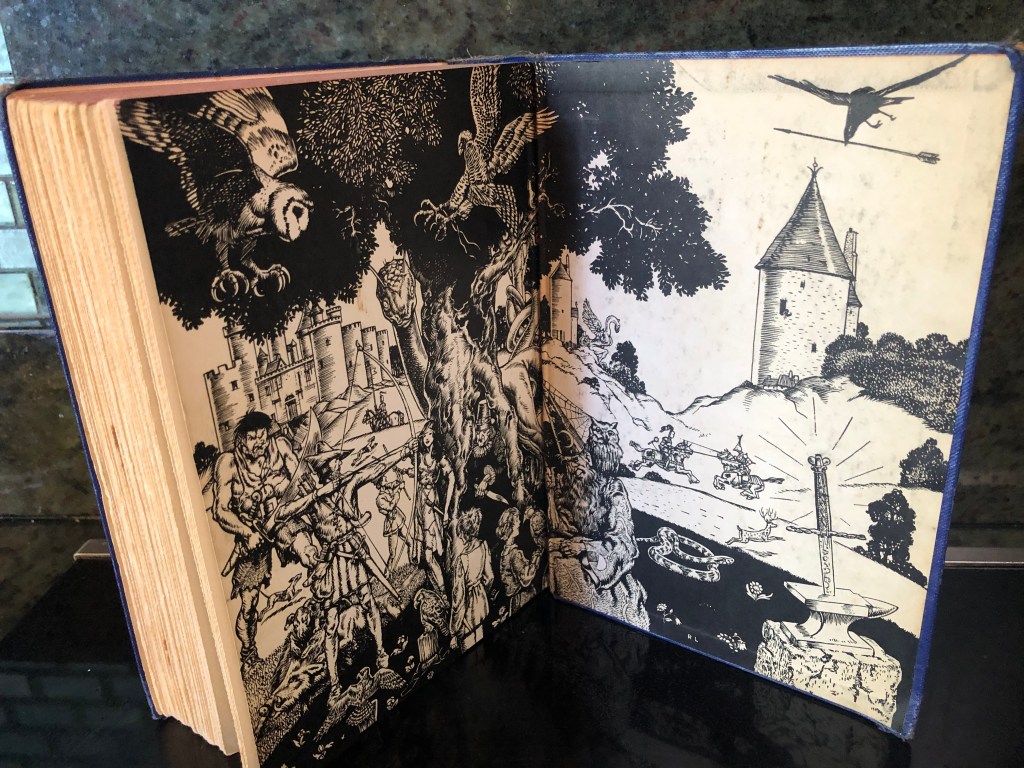
Consider The Sword in the Stone, where Merlin transforms Wart into various animals (badger, owl, fish) who teach him survival techniques (“put your back into it!”). And magic! Giants! Griffins! The Queen of Air and Darkness! (See volume below–griffin looming behind tree.) One favorite moment? When Merlin transforms Wart to a raptor—a small merlin––who must sit for desperate minutes during his formal initiation, near the maddened and perilous Peregrine. Why does Wart need Merlin’s special tutelage? Because of his identity, which he and we will finally discover.
Others I still pull off the shelf: The Wind in the Willows, especially Mole’s tearful return home, where he recognizes his true self.
Also Susan Cooper’s The Dark Is Rising. Maurice Sendak’s Nutshell Library – memorizing all the poems. I sneak back to Harry Potter—a feast of enterprise, surprise, disguise, and Harry’s search for his own identity. Occasionally I return to Lord of the Rings––especially the battle for Gondor. You’ll note I missed out on Jack London and many others. But there’s always The Lion, the Witch and the Wardrobe—remember that wondrous moment when Lucy slips through the back of the wardrobe, past all the mothballed coats…into magic? Into the snowy landscape where she meets Mr. Tumnus the faun? Into the realm where––as Lucy later discovers––she is Queen Lucy?
You have your favorites. So do our collective children and grandchildren. Bookstore shelves still offer children tales of enterprise, surprise, disguise—and characters discovering their own identities.
And fortunately, children’s books needn’t follow the 1930 Detection Club’s 10 Rules for Writing a Mystery. Rule #2: “All supernatural or preternatural agencies are ruled out as a matter of course.” Following Rule #2 would let out magic, of course, and its enormous space for imagination. (If you, like me, crave an occasional touch of magic for grown-ups, try Remarkably Bright Creatures by Shelby Van Pelt. amzn.to/44iIoVj)
As a mystery writer/reader I usually write about mystery. But thinking lately about the bibliophile’s favorites—favorite reading spots, favorite chairs, favorite characters––has sent me down a different path. Why reread? Wait––why revisit?
What is it about the end of Kim, or the plight of Frodo and Samwise in Shelob’s lair, or Harry Potter’s first moment on his broom, learning how good he is at Quidditch––that whispers, “read it again!”
I reread mysteries too. Have you reread a Dorothy Sayers, a Ngaio Marsh, a Sherlock Holmes? Or John le Carré? How many times have you read Tinker, Tailer, Soldier, Spy, or Smiley’s People? (Come on, spy thrillers are part of the mystery-thriller-spy novel genre.) And why do we reread le Carré? One character in particular: George Smiley.
Smiley first appears on page 1 of chapter 1, titled “A Brief History of George Smiley,” in Call for the Dead, le Carré’s first book, published in 1961. Smiley’s marriage to the aristocratic Lady Ann Sercomb has ended when she abandoned him, and he’s described as follows: “Short, fat and of a quiet disposition, he appeared to spend a lot of money on really bad clothes, which hung about his squat frame like skin on a shrunken toad.”
We learn of his deep love of 17th century German literature, his success at Oxford, his recruitment by MI-6, his dangerous service abroad as a spy in WWII. Not a commanding figure, no. But le Carré allows us to glimpse his sharp mind, his penetration, his ability to absorb all he hears. Smiley’s work as an intelligence officer provides him “with what he had once loved best in life: academic excursions into the mystery of human behaviour, disciplined by the practical application of his own deductions.”
Smiley appears next in A Murder of Quality (1962), where Smiley’s solution to the murder rests on a scathing critique of the snobbishness of British public schools (le Carré despised his own experience at such a school).
By the time we reach Tinker, Tailor, Soldier, Spy (1974), Smiley has been put out to grass at MI-6 under the new regime headed by Bill Haydon, who has seduced Smiley’s wife Ann and taken over London Station after causing the bitter dismissal of Control as its head.
In Tinker, Tailor, Smiley is plucked out of retirement to interview a somewhat dubious British agent who claims the Russians may have placed a mole inside MI-6. Here’s Smiley, listening to the agent’s tale:
“He sat leaning back with his short legs bent, head forward, and plump hands linked across his generous stomach. His hooded eyes had closed behind the thick lenses. His only fidget was to polish his glasses on the silk lining of his tie, and when he did this, his eyes had a soaked, naked look that was embarrassing to those who caught him at it.”
Le Carré’s letter to Sir Alec Guinness (3 March 1978) appears in A Private Spy / The Letters of John le Carré, at 213. He tells Sir Alec:
“Apart from plumpness, you have all the other physical qualities: a mildness of manner, stretched taut, when you wish it, by an unearthly stillness and an electrifying watchfulness. In the best sense, you are uncomfortable company, as I suspect Smiley is. An audience wishes––when you wish it––to take you into its protection. It feels responsible for you, it worries about you. I don’t know what you call that kind of empathy, but it is very rare, & Smiley and Guinness have it: when either of you gets his feet wet, I can’t help shivering.”
I love that “as I suspect Smiley is.” Does the author’s own speculation about George Smiley explain, in part, why we readers become so attached to this character? What drives us to Smiley’s side? Is it his apparent ineffectualness, his vulnerability, his stillness, his watchfulness, entwined with our certainty that he will somehow keep going?
Not until 1979 in Smiley’s People does Smiley achieve final vindication, catching the Russian master-spy who conceived the long set of steps that led to Haydon’s seduction and Control’s fall. At the climax, we (along with Smiley and his fellow spy Peter Guillam) await the possible arrival of the Russian in cold war Berlin, at the crossing point from East Germany. Will the spy make it across the bridge? Guillam asks what cover the Russian will use:
Smiley sat opposite him across the little plastic table, a cup of cold coffee at his elbow. He looked somehow very small inside his overcoat.
“’Something humble,” Smiley said. “Something that fits in. Those who cross here are mostly old-age pensioners, I gather.’ He was smoking one of Guillam’s cigarettes and it seemed to take all his attention.”
At book’s end, we are waiting with Smiley. It’s cold there by the Berlin bridge. I expect Smiley’s feet are wet. Like the author, “I can’t help shivering.” When we know a character’s vulnerabilities, we begin to perceive true identity.
For Smiley, for all the characters created by their authors with such vividness and such vulnerability that we seem to feel what they feel, for such characters–I reread. Yes, the better word is revisit: I go back just to be sure the characters are still there, still available, still waiting quietly on the shelf. And, yes, just as good as I thought they were.
I’d love to hear your favorites (reading spots, children’s books) and the favorite characters you…revisit.
This post doesn’t aim to inform, persuade, or entertain. It’s more of an observation, a meditation, a rumination, a mulling over, a puzzling. A rambling through recent events and old secrets. A mystery.
I. The Story
Crime fiction writer Anne Perry died in Los Angeles on April 10. She was eighty-four. A native of New Zealand and long-time resident of Scotland, she published her first mystery novel, The Cater Street Hangman, in 1979. Her latest, The Fourth Enemy, was published the week before her death. A final novel,A Traitor Among Us, will appear in September 2023.
In all, Perry published over a hundred books: the Thomas and Charlotte Pitt series (32 novels); the Daniel Pitt series (6 novels); the William Monk series (24 novels); the Elena Standish series (5 novels); the World War I series (5 novels); the Christmas Stories (20 novellas); the Christmas Collections (6 anthologies); a fantasy series (2 novels); the Timepiece series (4 novellas for young adults with dyslexia); standalone novels (7); and three volumes of nonfiction. She also contributed to and edited four short story anthologies. To date, over 26 million copies of her books have been sold.
In 2014, freelance writer Lenny Picker wrote in Publisher’s Weekly, “Quantity for Perry has not come at the cost of quality. She’s won major mystery awards, including an Edgar and two Anthonys, which demonstrate the esteem of fellow writers and fans alike.” At the 2009 Malice Domestic, she received the Agatha Award for lifetime achievement.
“Her belief in free will,” writes Picker, “allows Perry to hope for spiritual progress, both for herself and for humanity at large.”
He continues, “Perry’s writings are an effort to facilitate such progress. Through mystery and fantasy, she aspires to make a difference in her readers’ lives, by teaching them, in her words, ‘something of the human condition—a wisdom and compassion, an understanding of life that enables feeling empathy for people whose paths may be very different from our own.'”
Crime writer Ruth Rendell has died aged 85, her publisher says.
She wrote more than 60 novels in a career spanning 50 years, her best-known creation being Inspector Wexford, which was turned into a highly successful TV series.
Rendell, one of Britain’s best-selling contemporary authors, also wrote under the pen-name Barbara Vine.
Crime author Anne Perry, who, as a teenager helped murder her friend’s mother, has died aged 84.
The writer served five years in prison from the age of 15 for bludgeoning Honorah Mary Parker to death.
Perry died in a Los Angeles hospital, her agent confirmed. She had been declining for several months after suffering a heart attack in December. . . .
Her first novel, The Cater Street Hangman, was published in 1979. She went on to write a string of novels across multiple series, which collectively sold 25 million copies around the world.
Three major British writers of crime fiction die. They were contemporaries. They were prolific. Their novels received both popular and critical acclaim.
One major British news outlet reports the deaths. But the third report expends over 300 words before focusing on the author’s literary career–and then devotes only ninety-nine words to her books.
P. D. James lived an exemplary life, untouched by notoriety. The most serious offense I’ve found reported about Ruth Rendell is that on her first writing job, reporting for a newspaper in Essex, ” . . . she was forced to resign after filing a story about a local sports club dinner that she hadn’t attended. Her report failed to mention that the after-dinner speaker had died half-way through the speech.”
But Anne Perry was a murderer. In 1954, when she was fifteen, she helped to bludgeon her best friend’s mother to death. Convicted, she served five years in a New Zealand prison, was released under a new name and identity, joined her family in the United Kingdom, and worked for twenty years in what her New York Times obituary refers to as “less creative fields,” before becoming a writer. In 1994, forty years after the murder, and fifteen years after the publication of her first novel, her secret became public. She has since spoken about it in interviews. Although the Personal Biography on her official website omits reference to the crime, she has never claimed innocence. In the reporter’s judgment, Perry’s criminal past was of more import than her years as a literary superstar.
III. Social Media
Readers, too, judge. So do other writers.
Comments on Perry’s Facebook page express admiration for her and sadness at her passing. Elsewhere, however, reactions are mixed. A paraphrased and truncated sample of what I’ve seen on social media follows:
Perry was a gracious person and a brilliant writer. She should be remembered that way.
She was a murderer. She should have written in a different genre. A murderer shouldn’t write about murder.
Reading her books and knowing what she did–it makes me feel weird.
She didn’t celebrate murder in her books. She brought murderers to justice.
Can writers choose what they write? Choose what they’re good at? Perry tried writing historical fiction but didn’t succeed. Should she have refused to do what she did best?
She had to make a living.
It doesn’t matter what she was; it’s what she became that counts.
She served her time, paid her debt to society.
Five years isn’t enough to make up for murder.
She behaved badly at the trial. She laughed. She’s never expressed remorse.
Maybe bringing criminals to justice in her fiction was an attempt to atone.
It’s impossible to atone for murder.
What about redemption? Don’t you believe in redemption?
When you buy her books, you’re supporting her and condoning murder.
She made a major contribution to the mystery genre and to the culture.
She was a great person.
She read some of my work and offered advice. She was very helpful.
If she’d been a man who committed a brutal murder, would the public let her off so easily?
I love her books. I don’t care what she did before.
She was a murderer.I’ve never read her books and never will read them.
Her books raised awareness of social issues.
It’s a shame reporters dredge up all that business about the murder. That shouldn’t be her legacy.
Leave her to heaven And to those thorns that in her bosom lodge To prick and sting her.
The evil that men do lives after them; The good is oft interrèd with their bones.
All right–Shakespeare wrote those last two, and he didn’t post them on social media. But they’ve been looping through my brain over the past week, so I thought I’d throw them in.
IV. The Questions
The social media exchange is about more than just Anne Perry. It concerns how we view the relationship between artists and their art.
How do we separate writers from what they’ve written? Can we? Should we try?
And what do readers have the right to expect of writers, beyond words on the page? Do good writers have to be Good People? Just how good do they have to be? When people who’ve done bad deeds write good books, are we wrong to read them?
If writers and their books are inextricably linked, and reading is wrong, how much imperfection should we tolerate before we take those books off our To Be Read list? (Should books by Bad People be pulled from library shelves?*)
Or maybe reading isn’t the issue–maybe it’s money.
When we purchase books by writers whose past acts are abhorrent to us, and thus support them financially, do we condone their crimes? Money talks, but what exactly does it say?
Does time matter? What if a writer is dead, and the crime is long past, and our purchase instead supports heirs, publishers, booksellers–are we still enablers?
Is there a flip side? Do writers–artists–have a responsibility to the public? When they behave unacceptably–in Perry’s case, an understatement–should they expect the public to embrace their creations on merit alone?
Had Perry become a painter or sculptor, would the discussion be different?
Does Art stand on merit alone, independent of its creator?
Should there be a discussion at all? Are these questions a waste of time, gray cells, and energy, and not worth the pixels they’re written in?
Is Shakespeare correct:
There is nothing either good or bad but thinking makes it so.
V. One Answer
To Perry, at least, the issue was more than academic. The New York Times obituary quotes from the 2009 documentary film Anne Perry: Interiors:
“‘In a sense it’s not a matter — at the end — of judging,’ she said in the documentary. ‘I did this much good and that much bad. Which is the greater?’
“’It’s in the end, Who am I? Am I somebody that can be trusted? Am I someone that is compassionate, gentle, patient, strong?’ She mentioned other traits: bravery, honesty, caring. ‘If you’re that kind of person — if you’ve done something bad in the past, you’ve obviously changed.’
“She concluded, ‘It’s who you are when time’s up that matters.‘”
*****
Sources–And possibly a summing-up of everything that comes before:
Leave her to heaven And to those thorns that in her bosom lodge To prick and sting her. William Shakespeare, Hamlet, I, v
The evil that men do lives after them; The good is oft interrèd with their bones – William Shakespeare,Julius Caesar, III, ii
Why, then, ’tis none to you, for there is nothing either good or bad but thinking makes it so. – William Shakespeare, Hamlet, II, ii
*
*Librarians select books and materials based on their reading of multiple reviews published in professional journals, without regard to the Goodness or Badness of the authors. It’s a matter of professional ethics.
In novels, mystery often equates with danger. Whether in fiction or reality, it requires determination, dedication, and a willingness to face the unknown, which can be dangerous on many levels.
In The Fisherman’s Tomb, by John O’Neill, the quest to find the bones of the man Jesus appointed the first among the apostles, Simon, called Peter, upon which Jesus would build his church, became a 75-year search beneath the Vatican, and fraught with politics and dangers, including a world war. On a religious level, it was a courageous undertaking because, over the centuries, opinions proliferated about whether or not Peter ever entered Rome and whether or not he was crucified there. Was it fact or unsubstantiated legend?
John O’Neill was no stranger to archeology or Ancient Roman history. He had made a lifetime study of Roman Archeology, traveling throughout what was once the Roman World to visit sites and digs. An Annapolis graduate and lawyer, the author of the best-seller, Unfit for Command, and a former U.S. Supreme Court law clerk, it was when he became friends with the children and grandchildren of George Strake that he learned the story of this massive project and its discoveries. O’Neill felt it was a story that had to be told, and it became the book, The Fisherman’s Tomb.
The author acquaints us with the major players. George Strake, the man who financed much of the research. A quiet Texas oilman, and devout Catholic, Strake was the discoverer of the immense Conroe field in Houston. Two popes. Pius XII, “who, unlike some of his predecessors, saw science – particularly archeology-as an ally, not an enemy of Christianity,” and Paul VI, who brought in an outsider and a woman. Despite any misgivings or fears about the possibility that Peter was never in Rome and never crucified there, which would have changed and possibly destroyed the traditions dear to the hearts of the faithful, both popes encouraged and supported the search. The truth, they felt, was too important.
Pope Pius XII, began the project and was determined to keep it a complete secret except for George Strake. It began in earnest in 1939, with the death of Pius XI, who had one request: “to be buried under St. Peter’s Basilica in a simple grave.” To honor his request, an excavation team began to dig beneath the basilica. When a workman fell through the floor where they were digging, he found himself in a stunning and unknown world that had existed hundreds of years before. A city of the dead where both pagans and early Christians had been buried.
To understand the project fully, O’Neill tackles the ancient Roman world pertinent to the search. In those days, many pagan Romans delighted in blood sports, particularly involving Christians. Under Nero, the worst of all, “even hardened Romans like the historian Tacitus found his treatment of Christians extraordinarily cruel.” During Nero’s rule, two great leaders of the Christian Church, Peter, and Paul met their deaths. Paul, a Hellenistic Jew born in Tarsus and a Roman citizen was beheaded, but Peter met his death hanging upside down on a cross in Nero’s Circus at the foot of Vatican Hill in 64 A.D.
In 1939, Pius XII assembled a team that eventually ended up being led by Antonio Ferrua, a priest with a degree in archeology. He would remain in control until 1952, when Cardinal Giovani Montini, who would later become Pope Paul VI, invited a brilliant woman, archeologist, and epigraphist, Margherita Guarducci, to tour and study the excavation. And then the sparks began to fly. Margherita Guarducci, was an archeologist with an expertise in epigraphy. An Epigraphist, according to O’Neill is the Sherlock Holmes of archeology, which Guarducci showed she was. It was Guarducci, who linked and interpreted the signs and partial writings. Exceptional difficulty was added because many of the signs had meanings used for only a few decades.
Contrary to the Ferrua conclusions, Guarducci revealed the actual location of Peter’s tomb and identified the bones already in storage as belonging to Peter, and sadly the best, intentions and lofty goals of the project were then derailed by ego, and professional jealousy. Guarducci’s battle with the Vatican experts was epic, and after Paul VI’s death, her findings were almost obliterated by pride, sexist prejudices, and professional jealousy.
The Fisherman’s Tomb is not a dry textbook. It is a page-turner worthy of any well—written mystery novel covering all aspects of the project, from its accidental beginnings to the shift of monies and attention to saving Jews during World War II, and the amazing, and behind-the-scenes individual, George Strake. The book explains the lives of Christians in ancient Rome, the apostle Peter, and the Great Fire, probably started by Nero, who wanted land and a lot of it to build his palace. He then targeted the Christian sect as those responsible, enflaming the hatred and fears already in existence.
O’Neill addresses the Popes’ gamble in supporting the ongoing search, the archeological dig, and the super problems of digging under the structure of the Basilica and an existing city. The discoveries in the necropolis, and the interpretations of symbols, pieced together the meanings and identifications of the individuals buried there. It was accomplished by the unwelcome involvement of a woman, in a time when the fields of her expertise were dominated by men.
Guarducci’s story alone is worthy of a biography. The resentment of Ferrua, his revenge discrediting her brilliant findings, and her ultimate victory, which came long after her death, are powerful stories within the story of the search for the Fisherman’s tomb.
The hunt for Peter’s bones is a treasure hunt with twists, and turns, complicated by fears, politics, jealousies, revenge, and vindication. And ultimately, a confirmation of Peter’s presence and crucifixion in Rome.
A worthy note: O’Neill ends the forward by comparing the current slaughter and persecution of Christian communities in the Middle East to the fates of their ancient brothers and sisters in faith and contributes all proceeds of this book to their relief.
“MARCH MADNESS”? In the Texas Hill Country, “March Madness” doesn’t only mean NCAA basketball. Its alternate form: Demented Spring Gardening. Too early, you say? Well, according to the snakes, spring’s already here.
Of course it’s not officially spring yet. Just three weeks ago, here north of Dripping Springs, Texas, the entire landscape—every tree, every leaf–was shrouded in solid ice. But this week, well before the equinox, beneath the oaks you’ll spot the amazing heartbreakingly beautiful fuchsia of the redbuds.
And roses! The tender yellow flowers of the Lady Banksia rose are cascading from the oak tree that serves as her trellis.
On other branches you can see the first luxurious pink buds of Souvenir de Malmaison, named for Empress Josephine’s rose garden, beginning to open.
In the garden the ineffably fragrant Zephirine Drouhin is performing her slow tease, loosening the green sepals, delicately unveiling her bright pink petals.
I’ve already planted two new and reputedly very fragrant roses––Madame Plantier, and Cramoisi Superieur. (What a name!) And I replanted Buff Beauty, which produces buff and yellow and apricot blooms. Still waiting for two more—Savannah and Sweet Mademoiselle, both promising strong fragrance. Seriously, a rose without fragrance? Isn’t it disappointing to lean forward into a rose, inhale…and…nothing? As Shakespeare points out in Sonnet 56:
The rose looks fair, but fairer we it deem
For that sweet odour which doth in it live.
But for sheer fragrant spring bravado, tinged with peril, what about the ridiculous grape Kool-Aid smell of Texas mountain laurel? Intoxicating and loopy. The plant—sophora secundifolia–– isn’t called “Texas mescal bean” for nothing. https://www.wildflower.org/plants/result.php?id_plant=sose3: “The brilliant red seeds contain the highly poisonous alkaloid cytisine (or sophorine) – this substance is related to nicotine and is widely cited as a narcotic and hallucinogen.”
“A Light exists in Spring” by Emily Dickinson was new to me. I treasure her recognition, her human diagnosis, of that first moment when we notice the magical presence of spring. It begins:
A Light exists in Spring Not present on the Year At any other period — When March is scarcely here
A Color stands abroad On Solitary Fields That Science cannot overtake But Human Nature feels.
More symptoms of March Madness? The powerful, even uncontrollable, urge to fill your cart full of geraniums, dirt, mulch, annuals, perennials, unknown roses, tomato plants, new trees… Trudging a quarter mile from the local native plants emporium to your car, lugging a red wagon full of blue sage, lantana, and other plants hopefully accurate in describing themselves as “deer-resistant”… Other symptoms include impassioned online review of rose varieties, frantic ripping open of seed packets and daily watering of small unlabeled pots, then staring at tiny emerging seedlings and wondering—what are you? Is that the fennel or the Aji Crystal Pepper or the Mexican plum?
I’d never heard of Mexican plum until a friend gave me a jar of her amazing Mexican plum jam. She described the trees as small, with fragrant white blossoms. So I ordered seeds. The very small print on the seed packet required “stratification” in the refrigerator. Well, I tried. Every morning I peer at the still-empty pots of dirt… little plants, where are you? Can you live in the Hill Country?
Also—perhaps prematurely—we dragged hay bales into the garden and embarked on the great Haybale Tomato experiment:
Supposedly, according to our favorite local well-driller, this approach produces for one local rancher “the most beautiful tomatoes in the Hill Country.” Our donkeys kept sticking their muzzles through the fence, trying to eat the bales. Watch this space. https://www.youtube.com/watch?v=z2jjIHgmypM
Gardens can be perilous. Think of Eden. But how many murder mysteries are set in gardens, or involve garden poisons? If you haven’t already become a fan of Reginald Hill, you might try Deadheads. Dalziel and Pascoe solve virtually every murder presented to them in their Yorkshire police headquarters. In this one, roses abound, beginning on the first page. And rose culture. And… murder. bit.ly/3Fgce23
Texas author Susan Wittig Albert knows her way around poisonous plants, in Texas or elsewhere. I just finished her Hemlock, Book 28 in her China Bayles series. This mystery—impressively researched, and fast-moving–takes the reader to the Blue Ridge mountains and theft of a rare botanical book, with deft historical backstory. https://susanalbert.com/hemlock-book-28/
For more on Texas mountain laurel, its power and peril – see Ghost Dog, Book 2 in my Alice MacDonald Greer Mystery series. bit.ly/3YIotv5
The weather report threatens another cold snap this week—even (gasp!) a possible freeze. But right now it’s 74 degrees. Geraniums to plant. Blue sage. Tomatoes to water. Yes, it’s hubris, exposing these tender plants so early to the vagaries of Hill Country weather, but—I can’t help it. I just saw a big bud on Star of the Republic! I swear it wasn’t there yesterday. March Madness reigns!
Find Helen Currie Foster on Facebook or at http://www.helencurriefoster.com. The eight books of the Alice MacDonald Greer Mystery series, including the most recent, Ghosted, amzn.to/3YrJBXf, are available at Austin’s BookPeople as well as on Amazon (Kindle and Paperback).





 Ink-Stained Wretches