In the Window or On the Table? What I Learned from Amor and Anton

By: Dixie Evatt

Ever since I read A Gentleman in Moscow (2016) I’ve considered Amor Towles writing style to be nearly perfect. So when my niece told me Towles was making an appearance at the Empire Theatre in San Antonio, I booked it. He was there to support the San Antonio Book Festival and to talk about his latest book, Table for Two. It’s a collection of six short stories plus a novella. Unlike some of his other stories, these all take place in the current Millennium. 

Over the evening I learned a interesting things about Towles.

I learned that he is what we used to label in the news business, an “easy interview.” Austin’s own Stephen Harrigan (Big Wonderful Thing, 2019) was on the stage with Towles as moderator but he didn’t get to ask many of the questions on his notepad. Towles was in a talkative mood so needed little prompting. 

I learned that Towles took up writing full time only after success in his first career at a small Wall Street investment firm. 

I learned that once he gets a project in mind, he begins to fill notebook after notebook with hand-written outlines, ideas, scenes, characters. It may take years. He says this process frees his imagination and subconscious to go where beautiful language and the characters’ inner lives take him. 

There was more but of the many memorable things I learned about this accomplished author, what I remember best, and took to heart, was his description of his research process. He said that when writing he intentionally postpones what he calls “applied research” until near the end. During this time he is also reading novels written by others that are set in the same historical period as the book he’s working on. His novel is almost written before he begins deep research.

That’s why he waited until A Gentleman in Moscow was almost finished before traveling to Moscow and checking into the Hotel Metropol, the exclusive hotel where his story about Count Alexander Ilyich Rostov is set. 

Towles advised that details gleaned from this kind of active research should be written into the story much the way one might design the stage for Anton Chekhov’s The Cherry Orchard (1903). Of course Towles would choose this particular play as a point of reference because, like his own novel set in Russia, Chekhov’s tragicomedy also deals with a period of decline for the Russian aristocracy. 

He said that when the curtain rises for the play the audience might see only the suggestion of a cherry orchard through large windows as if were rendered by an impressionist such as Claude Monet or Mary Cassatt. The windows might be framed by plywood bookcases painted to resemble mahogany. In the center of the room there would be a table set with a porcelain tea service.  

When an author is ready to fold research into the story, Towles said it should be presented with similar layers of reality. Some details are just suggested in the background. Some, like the bookcases, give the scene the appearance of reality but need not be too detailed. Then there are aspects of research that can’t be given short shrift. For these, the author must adhere to absolute authenticity. The audience needs to hear the chair move across the floor and the teacup rattle in the saucer. The challenge for me is where all of the information that I’ve accumulated in my own research belongs – in the window or on the table?

Charles McNulty, theater critic for the Los Angeles Times, said in a June 6, 2022, review of a local revival of The Cherry Orchard, “Big things occur in Chekhov. Houses are lost, guns occasionally go off, and people die. But the focus is on muddling through.” 

Much the same might be said about A Gentleman in Moscow and the subtle use of active research by Towles so that his story isn’t swallowed up in the details. 

***

Cover of A Gentleman in Moscow via Amazon

Image of Anton Chekov via Wikipedia. Public domain.

Image of stage of The Cherry Orchard via Wikipedia. Public domain.

***

A former political reporter in Austin, Dixie also taught writing at Syracuse University. When she teamed up with Sue Cleveland to write fiction, they sold a screenplay to a Hollywood producer. Although the movie was never made, the seed money financed ThirtyNineStars, their publishing company. Through it they published two award-winning thrillers (Shrouded and Digging up the Dead) under the pen name, Meredith Lee. Dixie’s first solo mystery was Bloodlines & Fencelines, set in a tiny Texas town near Austin. Kirkus reviews described the book as, “A twisty whodunit that’s crafted with care and saturated with down-home Southern charm.” She is working on second mystery in the series. www.dlsevatt.com

Curious Animals and Recent Reads

by Helen Currie Foster

New reads! If, like me, you desperately miss John le Carré, consider A Spy Alone, the 2023 debut spy thriller by Charles Beaumont, a field operative veteran of Britain’s MI-6. https://bit.ly/3ZzHjHs His premise is fascinating: we know of the “Cambridge Five” who spied for Russia from the 1930’s to 1950’s—Kim Philby, Guy Burgess, Donald Maclean, Anthony Blunt and John Cairncross. https://en.wikipedia.org/wiki/Cambridge_Five But has there ever been, or could there be, a spy ring linked to Oxford? Beaumont’s protagonist Simon Sharman feels real, right from the first page:

“It is their shoes that give them away. As a lifelong fieldman, Simon Sharman hasn’t forgotten the lesson: walkers might change their jackets, pull on a pair of glasses, even a wig. But nobody changes their shoes on a job. Look at their shoes. 

I was hooked. Warning: Beaumont’s book is contemporary, well-written, tense, and may interfere with sleep. 

Two other recent reads: old adventure and a new “adult fantasy.” I’d never heard of The Long Ships by Frans G. Bengtsson (1954).

Set from 980 to 1010 A.D., the book recounts the wide-ranging adventures of Norseman Red Orm Tostesson, and the collision between Christian priests (the “shaven men”) and the Norse culture of Skania at the south tip of Sweden. Now I know what it meant to go “a-viking”—to go sea-raiding! 500 pages, with Red, a very engaging Norseman. Great maps, too.

The Lost Bookshop, by Evie Woods (2024), offers time travel between the 1920’s and 30’s in Britain, and the present; a search for a lost Brontë manuscript; a disappearing attic; and disappearing and reappearing characters. I confess I flipped through big chunks, relieved when true love finally won out after two women, generations apart, survive appalling treatment. The disappearing attic reminded me of Susan Cooper’s Over Sea, Under Stone,

and of course the wardrobe into Narnia in The Lion, the Witch and the Wardrobe. I’m always up for secret doors. 

I’m rereading a fascinating and fairly demanding study by Graham Robb, who has probably bicycled and walked further in Britain and France than most humans:

In The Search for Middle Earth: Mapping the Lost World of the Celts (2013)he describes how the Keltoi, or Celts, developed a system of surveying based on a midline transected by the lines of the summer and winter solstice to estimate travel distances and times—a feat not replicated for centuries. He maps the Heraklean Way, the path from southwestern Iberia that runs northeast across the Pyrenees to the Alps along the diagonal of the solstice sun, which Hannibal took when he invaded Italia. He describes Druid schooling (20 years to learn) and maps out protohistoric forts which turn out to lie along survey lines. He provides amazing maps. Two ongoing lessons from Robb’s devoted research: the winners write history; and humans tend to underestimate the accomplishments of earlier civilizations. 

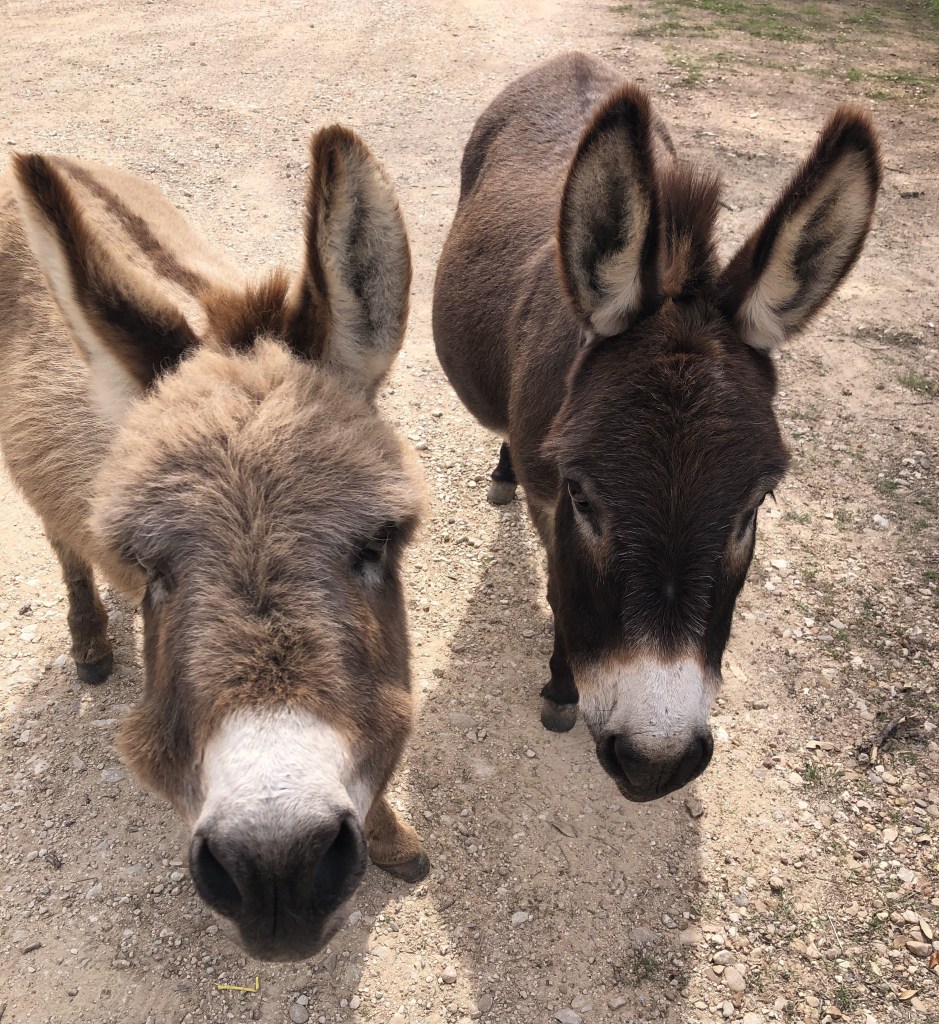
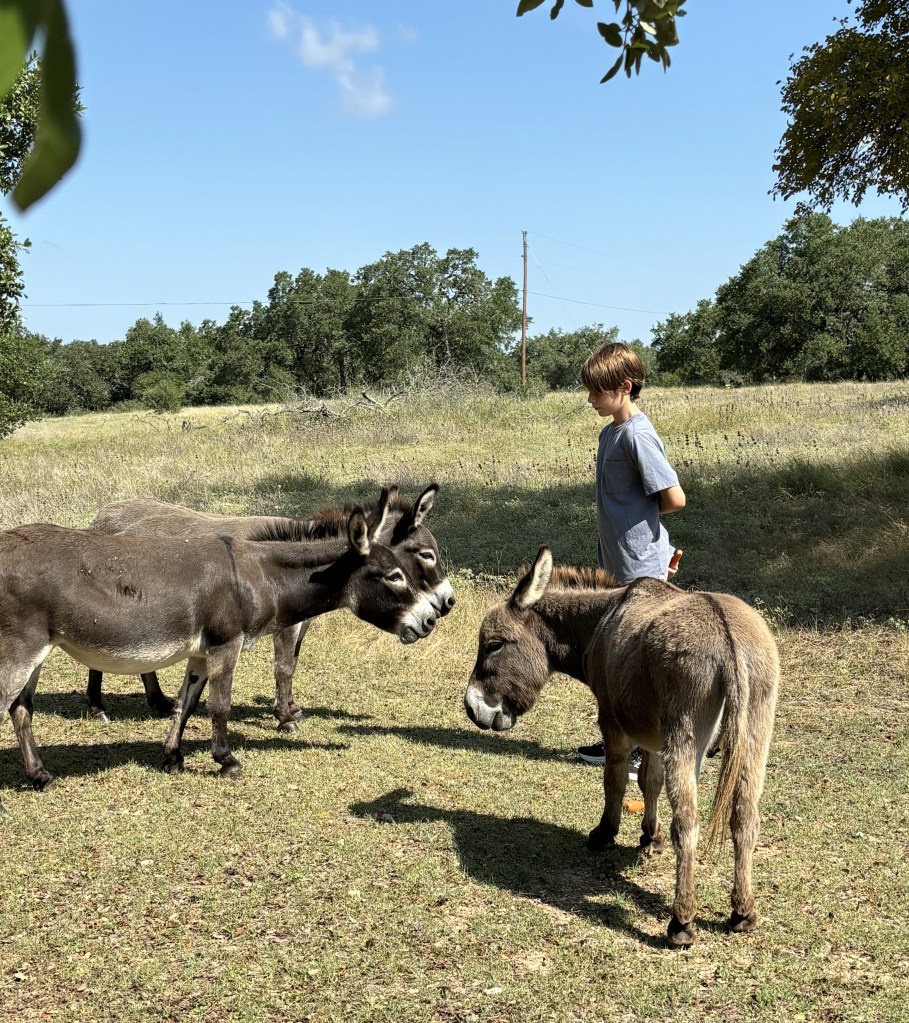
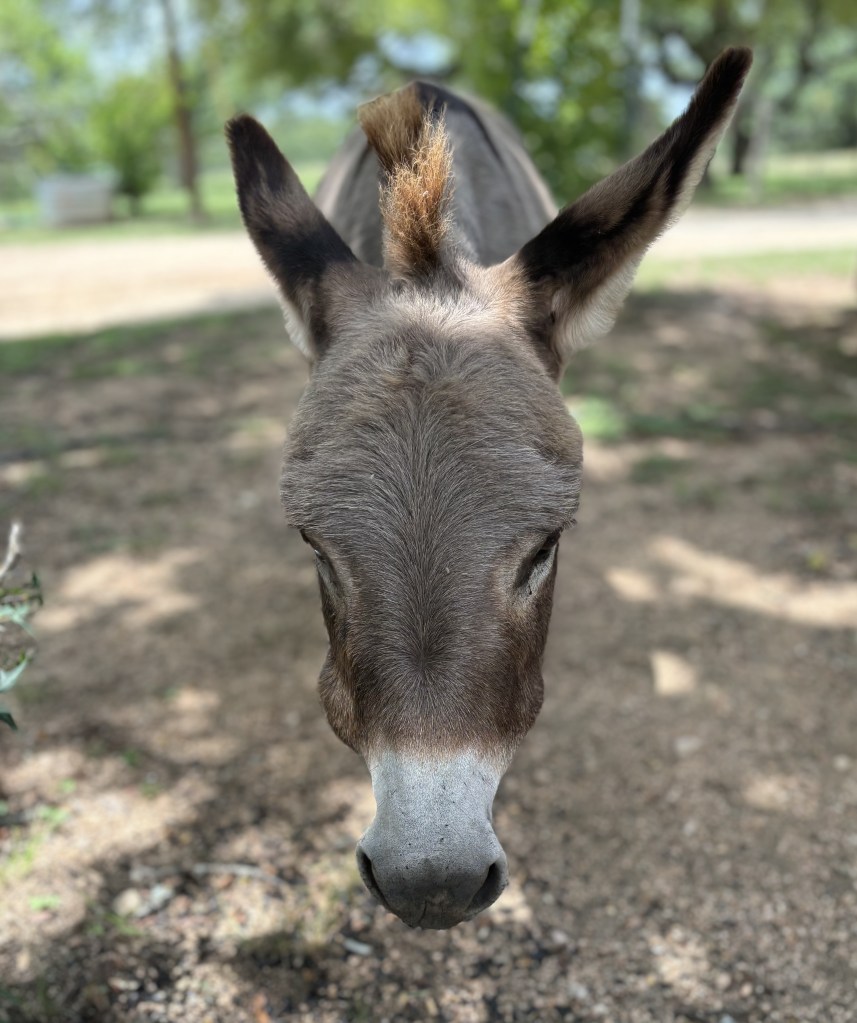
Several of you asked about the three burros, given the recent cold snap. Thank you, they’re well. Their hair’s not waterproof so in cold rain they gather on the south side of the stable, under the roof, safe from rain and the north wind. They were relieved to see green grass again after the drought broke, but they’re also eating—and rolling in––green hay. And mud!

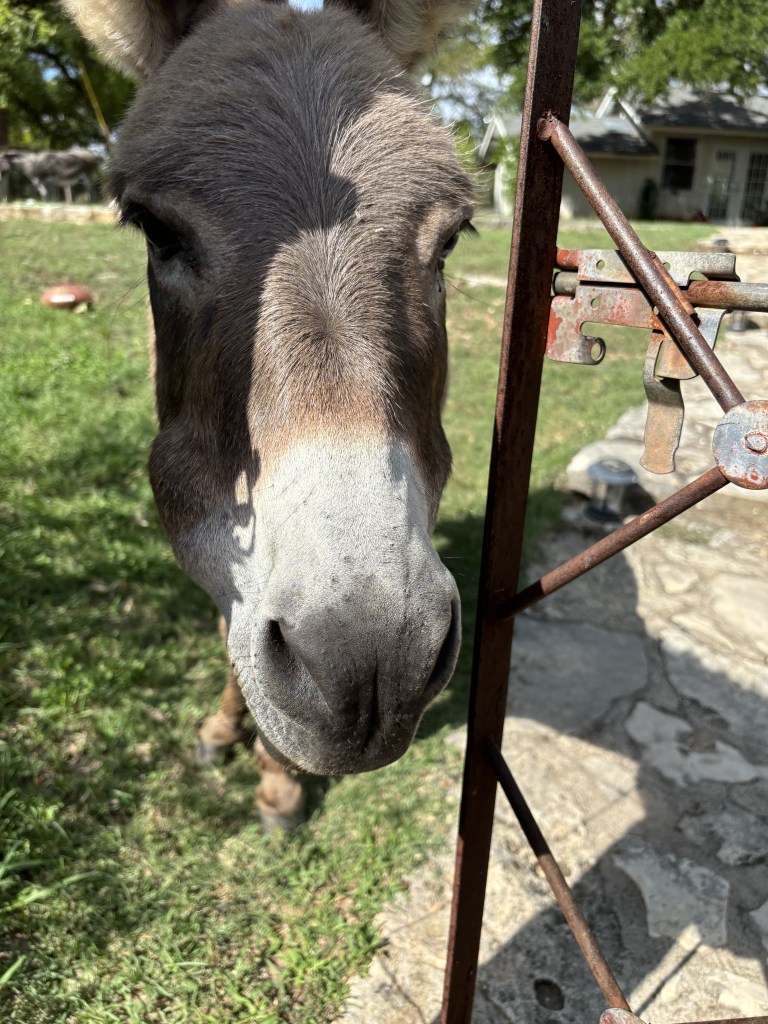
Yet despite hay, they gather outside the gate every morning and afternoon for carrots. They consider this part of their deal.

Burros are curious. They amble over to watch us garden and hang up laundry. They need company. They graze near each other. They may live into their 40’s. Sebastian, the short stubby knock-kneed male who invited himself to live here, may be 35 or more. Amanda (who insists I tell you she’s registered, with papers) may be 20. Her daughter Caroline is 12. Sebastian deems it his duty to bray loudly when any person or car appears at the end of the driveway, and to welcome the sun every morning with a stunningly loud bray. Now both Amanda and Caroline have begun to bray occasionally. 

Only donkeys can bray. Unlike horses or zebras, donkeys begin a bray on the inhale and continue braying on the exhale. They have great hearing—supposedly they can hear another donkey bray 60 miles away. 

They especially detest canids and will attack, dance on and kick dogs, coyotes, bobcats, foxes. A spooked horse will run away: donkeys stand together until they decide what they’re going to do. This morning, leaving for the post office, I saw the three donkeys standing together, knees locked, ears cocked, eyes fixed on two trespassing dogs who’d strayed across the cattleguard and into the donkeys’ domain. 

The dogs immediately acknowledged their gross error of judgment, raced frantically away and never returned.

If donkeys could read (wait—maybe they can, but have trouble turning the pages), I predict they’d prefer mysteries. They enjoy puzzles (like how to lift the chain and invade the fenced garden). 

Humans and donkeys. We are both curious animals.

Helen Currie Foster lives and writes the Alice MacDonald Greer Mystery Series north of Dripping Springs, Texas, loosely supervised by three burros. She’s drawn to the compelling landscape and quirky characters of the Texas Hill Country. She’s also deeply curious about our human history and how, uninvited, the past keeps crashing the party! Currently she’s working on Book 10. Her protagonist, Alice, gets into legal drama, and matters of the heart. Alice does have a treehouse…

Follow Helen at http://www.helencurriefoster.com and on Amazon and Facebook, https://www.facebook.com/helencurriefoster

Curious Animals and Recent Reads

by Helen Currie Foster

New reads! If, like me, you desperately miss John le Carré, consider A Spy Alone, the 2023 debut spy thriller by Charles Beaumont, a field operative veteran of Britain’s MI-6. https://bit.ly/3ZzHjHs His premise is fascinating: we know of the “Cambridge Five” who spied for Russia from the 1930’s to 1950’s—Kim Philby, Guy Burgess, Donald Maclean, Anthony Blunt and John Cairncross. https://en.wikipedia.org/wiki/Cambridge_Five But has there ever been, or could there be, a spy ring linked to Oxford? Beaumont’s protagonist Simon Sharman feels real, right from the first page:

“It is their shoes that give them away. As a lifelong fieldman, Simon Sharman hasn’t forgotten the lesson: walkers might change their jackets, pull on a pair of glasses, even a wig. But nobody changes their shoes on a job. Look at their shoes. 

I was hooked. Warning: Beaumont’s book is contemporary, well-written, tense, and may interfere with sleep. 

Two other recent reads: old adventure and a new “adult fantasy.” I’d never heard of The Long Ships by Frans G. Bengtsson (1954). Set from 980 to 1010 A.D., the book recounts the wide-ranging adventures of Norseman Red Orm Tostesson, and the collision between Christian priests (the “shaven men”) and the Norse culture of Skania at the south tip of Sweden. Now I know what it meant to go “a-viking”—to go sea-raiding! 500 pages, with Red, a very engaging Norseman. Great maps, too.

The Lost Bookshop, by Evie Woods (2024), offers time travel between the 1920’s and 30’s in Britain, and the present; a search for a lost Brontë manuscript; a disappearing attic; and disappearing and reappearing characters.

I confess I flipped through big chunks, relieved when true love finally won out after two women, generations apart, survive appalling treatment. The disappearing attic reminded me of Susan Cooper’s Over Sea, Under Stone,

and of course the wardrobe into Narnia in The Lion, the Witch and the Wardrobe. I’m always up for secret doors. 

I’m rereading a fascinating and fairly demanding study by Graham Robb, who has probably bicycled and walked further in Britain and France than most humans.

In The Search for Middle Earth: Mapping the Lost World of the Celts (2013)he describes how the Keltoi, or Celts, developed a system of surveying based on a midline transected by the lines of the summer and winter solstice to estimate travel distances and times—a feat not replicated for centuries. He maps the Heraklean Way, the path from southwestern Iberia that runs northeast across the Pyrenees to the Alps along the diagonal of the solstice sun, which Hannibal took when he invaded Italia. He describes Druid schooling (20 years to learn) and maps out protohistoric forts which turn out to lie along survey lines. He provides amazing maps. Two ongoing lessons from Robb’s devoted research: the winners write history; and humans tend to underestimate the accomplishments of earlier civilizations. 

Several of you asked about the three burros, given the recent cold snap. Thank you, they’re well. Their hair’s not waterproof so in cold rain they gather on the south side of the stable, under the roof, safe from rain and the north wind. They were relieved to see green grass again after the drought broke, but they’re also eating—and rolling in––green hay. And mud!

Yet despite hay, they gather outside the gate every morning and afternoon for carrots. They consider this part of their deal.

Burros are curious. They amble over to watch us garden and hang up laundry. They need company. They graze near each other. They may live into their 40’s. Sebastian, the short stubby knock-kneed male who invited himself to live here, may be 35 or more. Amanda (who insists I tell you she’s registered, with papers) may be 20. Her daughter Caroline is 12. Sebastian deems it his duty to bray loudly when any person or car appears at the end of the driveway, and to welcome the sun every morning with a stunningly loud bray. Now both Amanda and Caroline have begun to bray occasionally. 

Only donkeys can bray. Unlike horses or zebras, donkeys begin a bray on the inhale and continue braying on the exhale. They have great hearing—supposedly they can hear another donkey bray 60 miles away. 

They especially detest canids and will attack, dance on and kick dogs, coyotes, bobcats, foxes. A spooked horse will run away: donkeys stand together until they decide what they’re going to do. This morning, leaving for the post office, I saw the three donkeys standing together, knees locked, ears cocked, eyes fixed on two trespassing dogs who’d strayed across the cattleguard and into the donkeys’ domain. 

The dogs immediately acknowledged their gross error of judgment, raced frantically away and never returned.

If donkeys could read (wait—maybe they can, but have trouble turning the pages), I predict they’d prefer mysteries. They enjoy puzzles (like how to lift the chain and invade the fenced garden). 

Humans and donkeys. We are both curious animals.

Helen Currie Foster lives and writes the Alice MacDonald Greer Mystery Series north of Dripping Springs, Texas, loosely supervised by three burros. She’s drawn to the compelling landscape and quirky characters of the Texas Hill Country. She’s also deeply curious about our human history and how, uninvited, the past keeps crashing the party! Currently she’s working on Book 10. Her protagonist, Alice, gets into legal drama, and matters of the heart. Alice does have a treehouse…

Follow Helen at http://www.helencurriefoster.com and on Amazon and Facebook, https://www.facebook.com/helencurriefoster

AND IT’S CHRISTMAS ONCE AGAIN –

by

Francine Paino a.k.a. F. Della Notte

     Thanksgiving fell at the end of November this year, making Christmas feel like tomorrow instead of a few weeks away. The urgency to get everything done makes it more challenging to stay in the true spirit of what Christmas is supposed to mean. Add to that the extreme commercialism that, despite our best efforts, most of us fall into at least a little, and spirituality falls to the wayside. Enter the curmudgeons who think it’s all crass, and we have a diverse group to interest.
     My offering? Instead of the commercialized pap on TV with Christmas movie after movie adding to the wreckage of the true spirit of Christmas, I prefer good mysteries with a holiday theme. Here are a few of my favorites – and not so favorite, but judge for yourselves. Of course, the list leads with the gold standard in Christmas stories.
     A CHRISTMAS CAROL, by Charles Dickens. It’s not a mystery in the truest sense of the genre, but the first time one reads it, one must wonder if Scrooge will have that epiphany. And after that, no matter how well we know the story, we cannot help but take the voyage with poor old cranky, miserable Ebenezer as he evolves from a miser and a wretched human being into a man who becomes revered by all. Even if we don’t reread the book, according to the Internet Movie Base, there are over 100 films to choose from. After our re-acquaintance with Scrooge, many other worthy stories with a holiday theme are available.
     My favorite contemporary is THE SPY WHO CAME FOR CHRISTMAS by David Morrell. This five-star mystery is set in Santa Fe, New Mexico. Morrell combines the artsy community and the beauty of Santa Fe with an outstanding spy mystery that will keep you turning the pages and holding your breath. Excellent storytelling and scene setting.
     Another five-star mystery is HERCULE POIROT’S CHRISTMAS by Agatha Christie. Hercule’s holiday turns out to be anything but restful and merry. He’s a guest at Gorston Hall, where family intrigues and secrets are revealed and are deadly.
     DANCING WITH DEATH, by Joan Coggin, written in 1947, is interesting and fun most of the time. The middle is a bit verbose, but still an entertaining read. It takes place during the aftermath of the Second World War. Despite the ongoing rationing and shortages, Duds Lethbridge dreams of celebrating Christmas with an old-fashioned house party, the way it was before the war. She invites several friends and family to stay for the week to relieve the continued dreariness, hoping to recreate the prewar Christmas spirit, but nothing stays the same. Within a short time, Duds regrets having started this. As New Year’s Day approaches, Duds looks forward to being rid of her houseguests, but one of them turns up dead, and it’s believed to be suicide. In a panic, Duds sends for her dear friend and amateur detective Lady Lupin, but things get progressively worse. Everyone has a motive for wanting this guest dead. In the end the mystery is solved, but Duds and her guests will remember this Christmas celebration forever – for all the wrong reasons.
     MURDER ON THE CHRISTMAS EXPRESS, by Alexandra Benedict. A fun book for the season. Not the quality of Murder on the Orient Express, but it examines relationships in the setting of a train derailment and crime.

     Keeping within the confines of mysteries, for curmudgeons and sunshiners alike, If you are not in the mood to read a full-length novel, or just don’t have time, here are a couple of Christmas-themed short stories.
     THE TRINITY CAT, by Ellis Peters. Edith Pargeter, writing as Ellis Peters, first published The Trinity Cat in 1976. Sadly, crimes don’t stop because it’s Christmas, and we do well to remember that victims are not numbers, they are relatives and friends, people we know and love, even in fiction. In the Trinity Cat, beloved old Miss Patience Thompson is found murdered on Christmas morning. There are no clues to help Sgt. Moon solve the crime, until the town’s local black furry, no-name feline and local resident, called Trinity Cat, inserts himself into the mystery. Can he help, or is he just another mouser looking for number one?
     THAT’S THE TICKET. In this Mary Higgins Clark Christmas story, Wilma and Ernie Bean of New Jersey have hit the jackpot. On Christmas Eve, they’re holding the winning lottery numbers. Wilma, who is in Philadelphia visiting her sister, doesn’t know, but hubby Ernie does, and he can’t control himself. Pinning the tickets to his undershirt to keep them safe, he hits the bars in celebration, envisioning how he intends to surprise Wilma when she returns home the next day. He didn’t mean to tell anyone, but liquor loosened his tongue, and a barfly named Loretta loosened the pin holding the tickets. After hearing Ernie’s story, Loretta volunteers to drive the inebriated man home. She relieves him of his tickets after he passes out on the bed.
     The next day, hungover and terrified, Ernie asks a neighbor to pick Wilma up at the train station, and at home, it doesn’t take Wilma long to find out what happened. The only question remaining is whether or not this will be the worst Christmas of their lives or whether or not Wilma can con the con artist and get the tickets back from the thieving Loretta?

     So, whichever side of the Christmas sentiments you fall under, enjoy some good reads to relieve the stress of the holiday.
     I wish you all a Merry Christmas, and a Happy, Healthy New Year, and may all your readings in 2025 be satisfying and fun!